
AI agents are pushing enterprise databases toward vector search, persistent memory, and agent-aware governance. Oracle, Microsoft, and MongoDB shipped agents, and PostgreSQL 19 strengthens the operational base underneath them.
MongoDB launched Atlas Agent Engine, signaling a shift in how database platforms support AI-driven workloads. The platform brings agent execution, memory, retrieval, and governance into its existing database ecosystem. This move reflects a growing infrastructure challenge: AI agents no longer just retrieve information or answer questions. They interact with tools, make decisions, execute actions, and repeat queries across connected systems.
Traditional enterprise databases were built around predictable requests, controlled transactions, and human-triggered activity. Agentic workloads introduce a different pattern, with repeated queries, concurrent operations, and interactions across multiple services. As more businesses move autonomous AI agents into production, database architecture must account for their execution patterns, data access requirements, and operational risks.
This blog explores how AI agents are changing database workloads and how businesses need to rethink their AI agent data infrastructure to support them.
Why AI Agents Pressure Traditional Databases
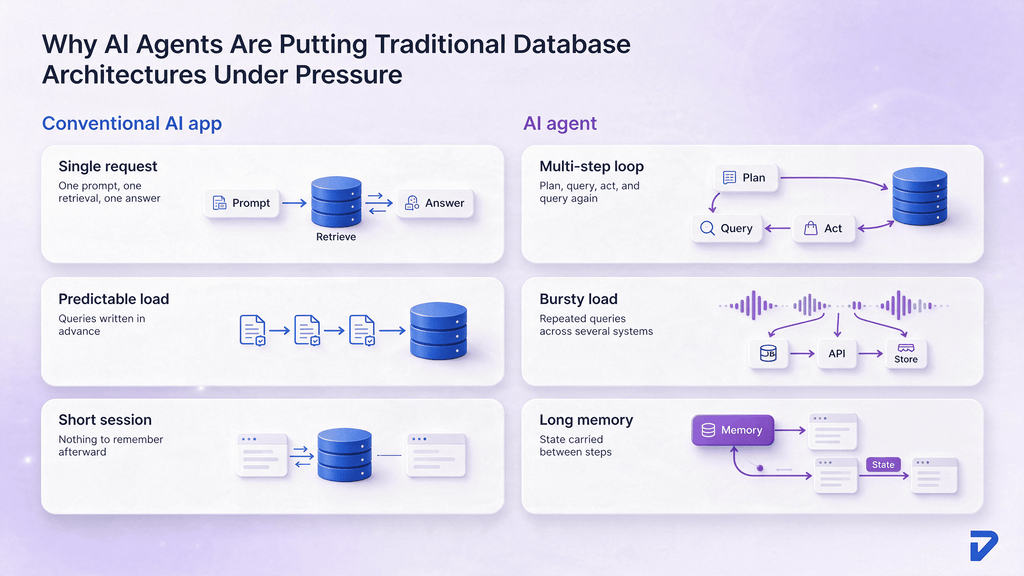
AI agents are changing how enterprise databases handle workloads. Unlike traditional applications that retrieve data and return a response, agents plan tasks, call tools, evaluate results, and repeat actions until they reach a goal. A single request can trigger dozens of database queries across CRMs, ERPs, ticketing platforms, and data warehouses, putting new demands on AI agent data infrastructure.
Another challenge is maintaining context between interactions. For example, an agent preparing a sales quote may need to pause for approval and resume the task the following day. It must retain previous steps, retrieved information, and pending actions. Traditional session-based storage is not always designed to support this type of persistent agent memory.
Key challenges of agent-driven database workloads:
- Repeated queries: One user request can trigger multiple database calls across connected systems.
- Persistent memory: Agents need to retain context, previous actions, and pending tasks between sessions.
- Data fragmentation: Conflicting records across business systems can lead to incorrect agent decisions.
- Higher concurrency: Multiple agents may access the same database resources simultaneously.
- Response latency: Delays in one query can slow down the entire sequence of agent actions.
Data fragmentation creates additional risks. Consider a refund agent that finds an order marked as shipped in a ticketing system but sees it marked as returned in the ERP. If it acts on the wrong record, it could issue an incorrect refund. This makes data consistency essential. Businesses need reliable records and connected data sources before deploying agents at scale. The same foundation is important for successful workflow automation.
These changes also increase infrastructure demands. A single request can trigger multiple queries, while delays in one step can slow the entire workflow. When several agents access the same databases simultaneously, concurrency increases and puts additional pressure on existing resources. This makes scalable AI agent data infrastructure essential for managing growing workloads.
The challenge is no longer limited to agent adoption. Businesses must also determine whether their existing databases can support continuous queries, persistent memory, and concurrent execution without affecting critical applications. This is pushing database providers to rethink how their platforms handle agent-driven workloads.
Database Companies Are Moving Beyond Traditional Data Storage
Database vendors are introducing capabilities such as vector search, persistent memory, semantic retrieval, and controlled data access to support AI agents. These developments show how traditional platforms are evolving to strengthen AI agent data infrastructure for increasingly complex workloads.
| Vendor | Announcement | What it means for agents |
| Oracle | AI Database Agentic Innovations | Combines agent memory, database access, and security controls. |
| Microsoft | Azure HorizonDB and Database Hub | Supports database management and AI-assisted operations. |
| MongoDB | Atlas Agent Engine | Introduces memory and governance capabilities for agent workflows. |
| PostgreSQL | PostgreSQL 19 | Improves query planning, replication, and database monitoring. |
These developments point toward a common shift: keeping operational data, vector representations, and agent context closer together. This can reduce synchronization overhead and simplify data access.
PostgreSQL 19 takes a different approach. Its improvements focus on query planning, replication, and maintenance rather than native agent capabilities. Extensions such as pgvector provide vector search for PostgreSQL-based applications.
However, several agent-focused features remain in preview. Teams should evaluate security, memory portability, and performance before adopting them in production.
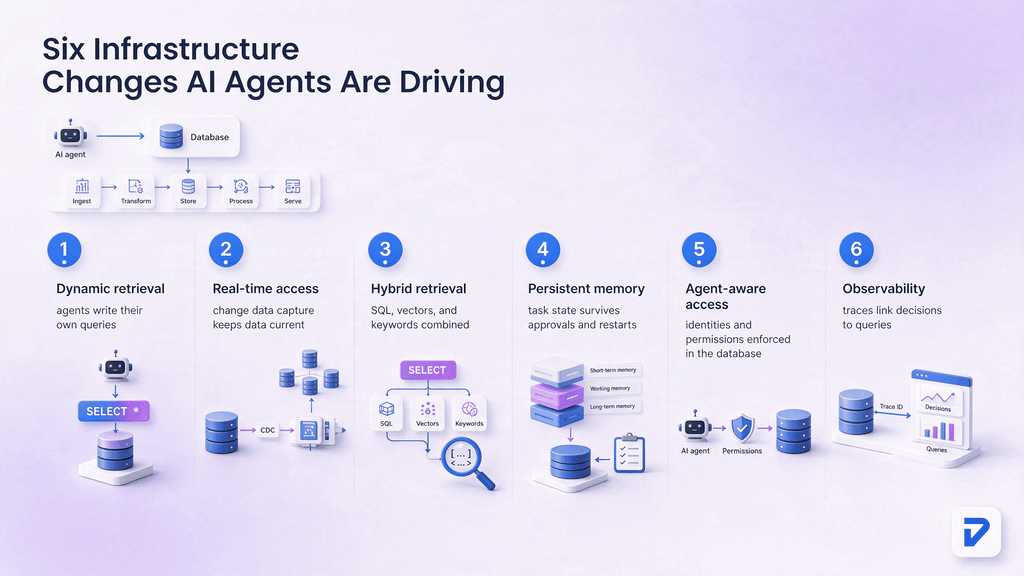
Six Infrastructure Shifts Behind Agent-Driven Systems
Rather than a checklist, each change below follows from a specific agent behavior. Collectively, they describe what enterprise databases must now do: answer unpredictable questions, stay current, mix retrieval styles, remember, enforce identity, and explain themselves.
1. From Static Queries to Dynamic Data Retrieval
A traditional application runs queries its developers wrote in advance. An agent writes its own, shaped by what the last step returned, and may run several before answering one question. A collections agent might check an invoice, then payment history, then contract terms. That pattern favors strong query planning, inexpensive repeated reads, and indexes that cover unpredictable filters.
2. From Periodic Updates to Real-Time Data Access
Nightly batch loads suit reports, not agents that approve credits or reroute shipments. Change data capture (CDC) streams each row-level change from the database log, and Debezium documents very low delay, in the millisecond range for PostgreSQL and MySQL, without constant polling. An agent working from yesterday’s inventory acts confidently on facts that no longer hold.
3. From Structured Records to Hybrid Data Retrieval
AI agents often need both structured records and unstructured information to complete a task. They may use SQL to retrieve transaction details, vector search to find relevant documents, and keyword search to locate exact product codes. Hybrid retrieval combines these methods, giving agents access to more relevant information across different data sources. AI agent data infrastructure must accommodate this mix of retrieval needs.
4. From Temporary Sessions to Persistent Agent Memory
A chat session forgets when the window closes, and a long-running agent cannot. Persistent agent memory keeps task state, past decisions, and learned preferences so a workflow can pause for an approval and resume days later. Oracle and MongoDB now ship memory inside the database platform, which lets memory share the data’s existing permissions and recovery tooling.
5. From Application-Level Security to Agent-Aware Access Controls
IBM’s 2025 breach study found that 97% of organizations reporting an AI-related security incident lacked proper AI access controls. Application-level checks assume a person behind every session. Agents need their own identities, narrowly scoped permissions, and row- or column-level limits enforced inside the database, so a confused or compromised agent still sees only authorized data.
6. From Database Monitoring to Agent-Level Observability
CPU charts and slow-query logs cannot explain why an agent issued a wrong refund. OpenTelemetry’s GenAI conventions, still marked as in development, define spans for retrievals, memory operations, and tool execution, so one trace connects the agent’s reasoning to the exact queries it ran. Teams then debug a decision instead of a server, which also helps auditors.
Why Vector Databases Alone Cannot Solve the Agent Data Problem
Vector databases solve one problem well: they store embeddings, which are numeric representations of meaning, and return the nearest matches quickly. That makes them a natural fit for retrieval-augmented generation (RAG, where relevant documents are fetched before the model answers) over manuals, policies, and support tickets. Meaning-based lookup across unstructured text is a real need, and a vector index meets it.
Similarity is not accuracy, though. Ask for the status of order 48213 and a similarity search returns orders that resemble it, not necessarily that one. A conversational AI assistant that quotes a refund policy from a vector hit but misreads the customer’s actual transaction produces a confident, wrong answer.
Gartner’s December 2025 Innovation Insight on database management systems for enterprise AI agents describes suitable platforms as going well beyond a good vector database.
Open-source tooling reflects the same idea. pgvector adds vector columns and HNSW indexes to PostgreSQL while keeping ACID transactions, joins, and point-in-time recovery. An agent can then filter by customer with SQL and rank by similarity in one query.
| Responsibility | Best-fit system | Risk if used alone |
| Exact transactional facts, such as balances and order status | Relational database | Weak at meaning-based lookup |
| Meaning-based search over text | Vector index | Returns plausible records, not guaranteed correct ones |
| Flexible, nested records and agent state | Document store | Cross-entity joins and strict integrity take more work |
| Actions in other systems | APIs | Live calls only, with no built-in history or ranking |
A hybrid database architecture assigns each job to the engine that does it best while giving agents one governed access path. Some teams achieve that inside one platform, such as PostgreSQL with pgvector, and others coordinate specialized stores behind a retrieval layer. The hybrid route is the more practical direction for enterprise databases because retrieval from enterprise search and RAG pipelines can then draw on trusted records instead of replacing them.
Are your databases prepared for AI-driven workloads?
Pinnasys helps businesses modernize database architectures, integrate AI agents, and build scalable data infrastructure.
What Businesses Must Rethink About Database Infrastructure
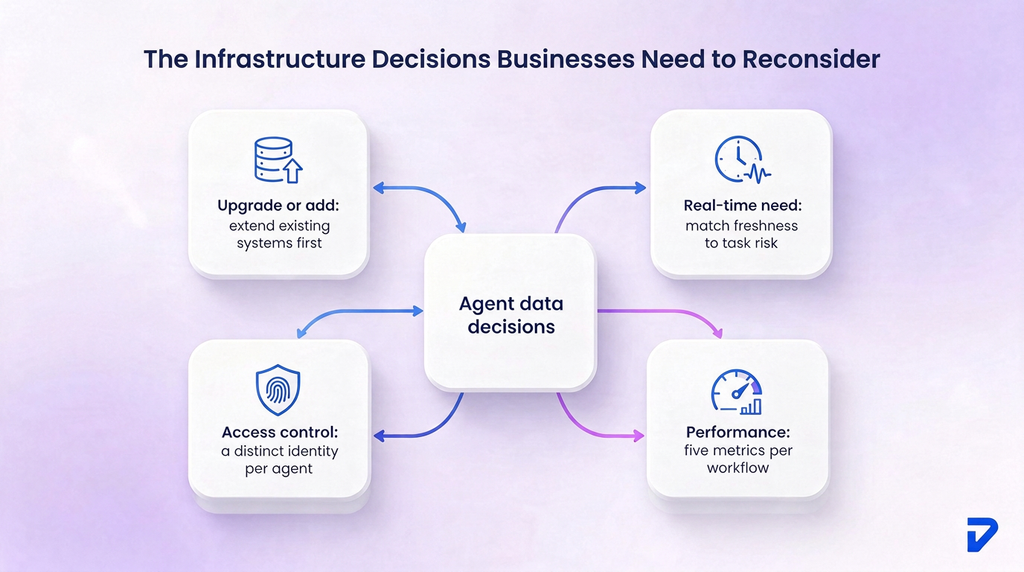
Technical leaders face four decisions, and each depends on how ready the underlying data is. Gartner reports that 63% of organizations lack, or are unsure they have, the data management practices AI requires. It also predicts that through 2026, organizations will abandon 60% of AI projects unsupported by AI-ready data. An honest audit is the first step in reconsidering enterprise databases.
Should Businesses Upgrade Existing Databases or Introduce New Systems?
Extend what you already run first, and add specialized retrieval only where measurements justify it. A team on PostgreSQL can add pgvector and hybrid search long before it needs a separate vector store, which earns its place at very large embedding volumes or demanding ranking needs. An AI consulting roadmap helps rank which workloads truly need new infrastructure.
How Much Real-Time Access Do AI Agents Actually Need?
It depends on the cost of a stale decision. A research agent summarizing contracts can work from data that is hours old, while an agent adjusting delivery routes or approving credit cannot. Match the freshness target to the task: reserve CDC streaming for operational agents, and let reporting-style agents read from nightly or hourly snapshots.
Who Controls What an AI Agent Can Access?
Security and the data owner should decide, and the database should enforce the decision. Three controls cover most of the risk:
- A distinct identity for each agent, never a shared service account
- Least-privilege permissions scoped to one workflow
- A queryable audit log of every read and write
Governance teams can then answer which agent saw which record, and when.
How Should Businesses Measure Agent-Driven Database Performance?
Track five numbers per workflow: 95th-percentile latency for each step, retrieval accuracy against a labeled test set, queries per completed task, peak concurrency, and cost per completed task. Averages hide the slow outliers that agents amplify. A decision intelligence dashboard fed with these metrics lets owners compare agents by outcome rather than raw query counts.
What Comes Next for Enterprise Database Architecture?
Expect convergence rather than replacement in how enterprise databases are built. Transactional engines, vector search, and agent memory are moving toward shared, governed platforms, while specialized systems will persist wherever scale or workload shape demands them. No single technology is positioned to absorb every job, and the vendors’ own products, which pair native retrieval with connectors to outside systems, reflect as much.
Agent-aware data platforms will likely be defined by three capabilities. Persistent memory moves from an application library into the data layer. Gartner’s August 2026 research on agent memory platforms argues that scaling agents to production requires governed memory in place of ad hoc implementations. Real-time retrieval narrows the gap between a business event and the agent’s knowledge of it. Governance, meaning identity, permissions, and audit, becomes a database feature rather than a wrapper.
Open questions remain. Portability of agent memory between vendors is unproven, preview features need production hardening, and telemetry standards are still in development. Leaders can study production AI case studies to see how other organizations handled similar choices while those standards settle.
Conclusion
Reliable agents need more than capable models. Their results depend on whether the data underneath is accurate, reachable, current, and governed. The 2026 announcements from Oracle, Microsoft, MongoDB, and the PostgreSQL project show enterprise databases adapting to that demand. The practical task for technical leaders is sequencing: fix freshness, permissions, and observability on the systems already in use, then add retrieval or memory components where measurements justify them.
Pinnasys builds and runs production AI systems, from agent development to the integrations that connect agents to live business data.
If the agents are ready and the data layer is not, a conversation about AI engineering and agent development is a sensible place to start.
Key Takeaways from the Article
- Agents issue repeated, context-dependent queries, so concurrency and tail latency matter more than before.
- Vendors now build memory, vector search, and governance into databases rather than offering add-ons.
- Vector similarity finds plausible records, while transactional accuracy still belongs to relational systems.
- Freshness needs differ sharply between research agents and agents that take operational actions.
- Distinct agent identities and permissions enforced by the database form the base of safe access.
Frequently Asked Questions
What is the Model Context Protocol, and how does it connect agents to databases?
MCP is an open protocol that gives agents a common interface to tools and data sources. Oracle’s Autonomous AI Database offers an MCP server and Azure Cosmos DB previews a managed one, so agents query data without custom integration code.
What does semantic reranking add to agent retrieval?
A reranker rescores the top candidates from a first-pass search by meaning, so the most relevant passages reach the agent. Azure Cosmos DB made semantic reranking and BM25 relevance scores generally available at Ignite in November 2026.
Should an agent use an HNSW or IVFFlat index for embeddings?
HNSW is the usual default because it needs no training step and can be created on an empty table, while IVFFlat requires tuning list counts. In pgvector, vector columns index up to 2,000 dimensions and halfvec columns up to 4,000.
What is a database agent?
A database agent uses AI to manage and monitor database operations rather than perform general business tasks. Microsoft’s SQL and PostgreSQL database agents, currently in preview within Database Hub in Fabric, help identify database issues, explain their causes, and recommend possible fixes within existing management tools. These capabilities are becoming part of modern AI agent data infrastructure.
Why do vector indexes go stale, and how do teams fix it?
Stale vectors appear when source rows change but their embeddings do not, so agents retrieve outdated context. MongoDB made automated embedding generally available on Atlas, regenerating vectors whenever documents are inserted or updated.