


Cutting through the hype about AI making companies smaller and faster, what becoming an AI business actually means for a company like yours. Written for the people who run real businesses, not the people who write the code.
The story going around about AI right now is that it makes companies smaller. Not trimmed, but transformed: an operation that used to need fifty people run by a handful, an entire firm outcompeted by one person with a laptop and a fleet of AI agents. The claim underneath it is that AI has made coordinating a business so cheap that the reason companies grew large in the first place is starting to fall away.
If you run a real business, with real employees and real customers, this lands two ways at once. Part of it is exciting: the idea that your business could do far more with what you already have. And part of it is unsettling: the suggestion that companies like yours are about to be left behind, or made obsolete.
Both reactions are fair. But most of the noise is aimed at startups and solo founders, and it skips the question that actually matters to you: what does any of this mean for an established business with a hundred or five hundred people, that already works, and that you have no intention of dismantling?
That’s what this guide is for. Strip away the hype, and underneath it is a real, useful shift in AI business transformation, one you can act on deliberately instead of being swept along by. We call it becoming an AI business.
1. What “an AI business” actually means
Start with what it is not, because this is where most companies go wrong. Becoming an AI business does not mean buying AI tools. Most companies that say they “use AI” have a handful of people using a chatbot, something bolted onto the edge of how they work. It helps a little, at the margins, and it changes nothing about how the business actually runs.
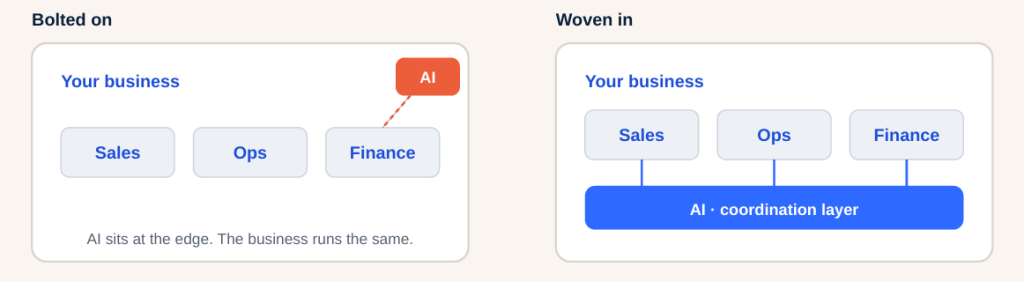
The people studying this have a blunt word for the bolted-on state: stalled. Every serious look at why AI efforts fail keeps landing on the same finding: that companies stall not because the technology is weak, but because the AI never gets woven into the core of how the business operates.
A real AI business is the opposite. The AI isn’t at the edges; it’s in the middle. The coordination that once depended on people chasing updates, waiting for reports, or handling repetitive tasks increasingly flows through AI instead of only human effort.
This is where AI business transformation happens: business operations move out of people’s inboxes and into intelligent systems powered by automation and decision intelligence, enabling faster, smarter, and more data-driven decisions.
2. What this means for you, specifically
Now the translation, because the headlines were written for someone else. The viral version of this story is the solo founder replacing a team, the one-person company running on agents. If you run a 200-person distribution business or a regional insurer, that story isn’t yours, and chasing it would be a mistake. You are not trying to shrink your company to one person.
Here is what you are actually trying to do: make the business you already have operate like one several times its size.
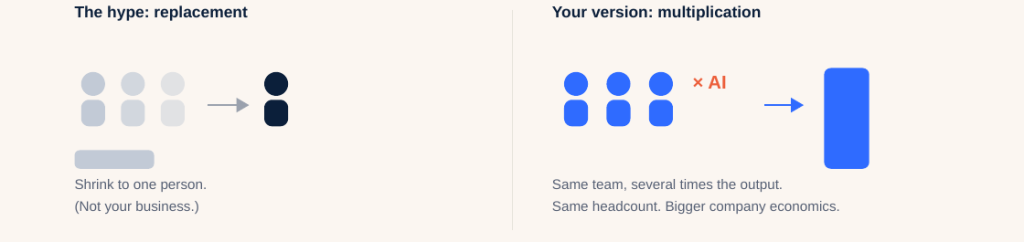
You are not removing your people. You are removing the manual, repetitive, coordinating work that holds them back, so the same team produces the output of a much larger one. Your quoting team handles several times the volume without growing. Your service operation covers more accounts without more dispatchers. Your finance team closes the month faster with fewer late nights. Headcount stays roughly flat; capacity, speed, and margin climb.
For a mid-market business, that is where the real money is. Not in becoming a tech company, and not in cutting your team. In capturing the economics of a much bigger company while staying the size you are. That is the version of AI business transformation that actually fits a business like yours, and it is both more achievable and more valuable than the headline one.
3. The part the hype skips: why most never get there
If the destination is so clear, why doesn’t everyone arrive? Because the hype sells the destination and goes quiet on the journey, and the journey is where almost everyone falls.
95% of enterprise AI projects fail — and almost never on the technology.
They fail because the AI was bought as a tool and never woven into the work. They fail because the team didn’t trust it, wasn’t trained on it, and quietly went back to the old way. They fail because nobody owned it once the vendor left. They fail because the data it needed was a mess, or because the pilot was never designed to leave the demo. Every one of those is an organizational problem, not a technical one.
Main Idea
Becoming an AI business is a business-and-people change that happens to involve technology, not a technology purchase that happens to involve your business.
The companies that make the shift treat it that way. The 95% treat AI as something you install. You do not install a transformation; you lead one. That is the core difference between experimentation and real AI business transformation. It is also the honest reason most businesses need a partner for this, not a product. The hard part was never the model. It is the discovery, the adoption, the change management, and the staying around to make it actually run. Skip those, and you join the 95%.
4. What “woven in” looks like in your business
So what does it look like when AI is woven into a business rather than bolted on? It shows up as a set of shifts in how the work happens. You won’t need all of them, and you shouldn’t chase them at once. Pick the ones where your time and money actually go.
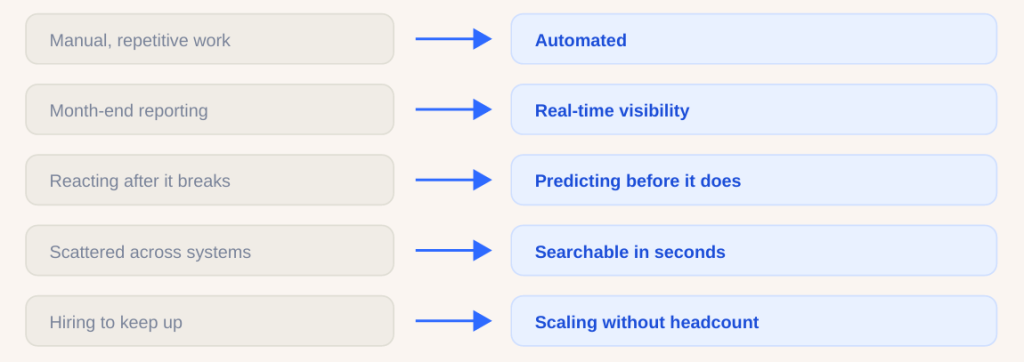
None of these is about the technology, and none requires you to shrink.
Each one is a piece of your business quietly starting to run like a bigger company’s. Add enough of them up, and that is what AI business transformation actually looks like in practice.
5. How you actually get there
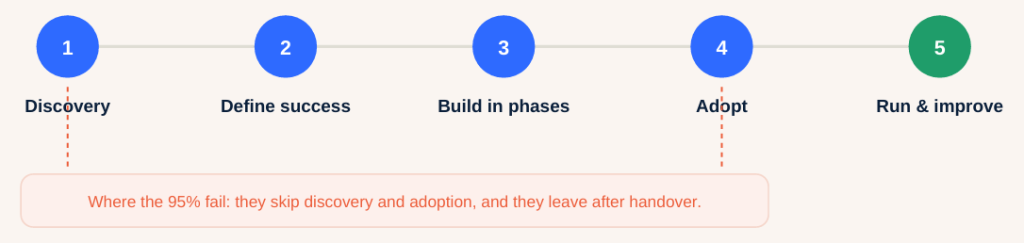
Here is the path a successful AI business transformation should follow. If a partner cannot walk you through something like this, treat it as a warning sign.
Discovery first
Before anyone builds anything, the work starts with understanding your business: interviewing your leadership and the people who will actually use the system, mapping how the work really happens, and surfacing the adoption and cultural challenges early.
Define what success means
Agree on measurable goals tied to the business: hours saved, quote time cut, claims resolved faster, cost-to-serve reduced. If you can’t measure it, you can’t tell whether it worked.
Build in phases
Start with the single highest-impact piece and prove value there before expanding. Each phase earns the next, and protects your budget.
Bring your team with it
Build the system, then introduce it properly: training, ownership, and the change-management work that gets people actually using it. A tool nobody adopts is a failed project.
Run it, don’t abandon it.
After go-live, the work continues: monitoring, maintaining, and improving as the business changes. The transformation isn’t finished at handover. It’s finished when AI is genuinely running your business. That last point is where most vendors disappear, and most projects die. A real transformation partner stays.
6. Is your business ready?
This kind of AI business transformation is not right for every business at every moment. A straightforward way to assess where you stand:
You’re likely ready if…
Your team spends real, countable hours on repetitive work. You’re hiring to keep up with volume rather than to grow into new areas. You can name a slow or error-prone process that’s costing you. And leadership will back the change, not just fund a tool and walk away.
You’re not ready yet if…
Your core processes aren’t defined at all (AI automates a process; it can’t invent one for you). Nobody internally has the time or authority to own the change. Or you’re hoping AI will rescue a business with a deeper strategy problem.
If you recognized your business in the first column, the question was never whether to pursue AI business transformation. It is where to start.
Ready to find where AI can create real business impact?
Start with one workflow, one measurable goal, and a clear path to transformation with Pinnasys.
07. Before you hire anyone, ask these
The fastest way to tell a real transformation partner from a vendor selling a tool is to ask how they work. Take these into any conversation.
Will you start with discovery, or go straight to building?
Discovery first. A build quoted before they understand your business is a tool, not a transformation.
How will we measure success, in numbers tied to our business?
Look for hours saved, quote time cut, claims resolved faster, not vague promises.
Will you roll out in phases, proving value before we commit the full budget?
Phased delivery protects you. One big build is one big risk.
Who gets our team to actually use it?
Adoption and training should be in the plan, not left to you.
After launch, do you stay and run it, or hand it over and leave?
The work isn’t done at handover. The right partner stays.
Is this going to production, or is it a pilot?
You want something that ships and runs, not another demo that stalls.
How do you keep our data and our ideas private?
Expect a clear answer, and a willingness to sign an NDA.
If a partner answers these the way this guide describes, you’re talking to the right kind of partner.
8. Your First Step
You do not have to decide your whole AI business transformation today. The market will keep shouting about AI making companies smaller, faster, and many times more productive. You do not have to answer the hype. You just have to take the first honest step toward the grounded version of it: a business that runs on AI underneath and operates like one several times its size.
Start by getting a clear read on where your business actually stands, and where AI workflow automation services would create the most value fastest. That is a short conversation, not a commitment: thirty minutes to understand your business, your goals, and whether AI fits, with a straight answer either way. If it’s a fit, you’ll leave knowing where to start. If it isn’t, you’ll know that too.
Key Takeaways
- An AI business weaves AI underneath its operations. It doesn’t bolt tools onto the edge.
- The goal isn’t to shrink; it’s to multiply: your existing team operating like one several times its size.
- Most attempts fail for organizational reasons, not technical ones. It’s a business, and people change, not a purchase.
- The shifts that matter are business outcomes like real-time visibility, automation, and prediction, not technology for its own sake.
- Start small, prove value in phases, and choose a partner who stays to run it.
Frequently Asked Questions
What is AI business transformation?
AI business transformation is the redesign of how work moves through a business so AI supports coordination, execution, and routine decision-making within core operations. It is a structural operating change, not simply the adoption of standalone tools.
Is AI business transformation only relevant for large enterprises?
No. Mid-market businesses often benefit most because they face operational complexity without the scale to absorb inefficiency. The opportunity is to increase speed, capacity, and consistency without having to expand headcount at the same pace.
Does becoming an AI business mean replacing employees?
Not in most cases. The value usually comes from removing repetitive, administrative, and coordination-heavy work that limits team output, allowing the same team to handle more volume, respond faster, and operate with greater consistency.
How do I know if my business is ready for AI transformation?
A business is usually ready when its processes are defined, repetitive work is consuming measurable time, and leadership is prepared to support change. If hiring is being used to absorb avoidable manual work, the case is already forming.
Which business processes are the best place to start with?
Start with high-volume, repetitive workflows that carry a clear operational cost. Quoting, claims handling, customer service, reporting, document processing, scheduling, and internal approvals are common starting points, especially where delays and errors already exist.
Do we need perfect data before starting AI business transformation?
No, but the business does need usable data and reasonably stable processes. AI can strengthen a workflow, but it cannot compensate for unclear ownership, inconsistent operational logic, or fundamentally unreliable information.
How long does AI business transformation take to show results?
It should begin with a focused use case rather than a broad transformation programme. A well-scoped first phase should produce measurable value early, then expand in stages so the business can build momentum without unnecessary risk.





Prakash C. Saini
Prakash Saini is the Founder & CEO of Pinnasys. With over a decade in digital transformation and building production systems, he grew an engineering team from 2 to 50 people and has led the delivery of 100+ production digital systems. Products built under his leadership have raised millions in funding and generated over $50 million in revenue. He holds an Executive MBA from IIM Kozhikode and today leads the AI engineering team at Pinnasys.