An AI SLA framework replaces uptime-only promises with measurable commitments on accuracy, P95 latency, containment rate, and cost per task. Each one needs a baseline, an error budget, and a named owner.
88% of organizations report regular AI use in at least one business function, and nearly one-third of respondents say AI inaccuracy has already caused them real problems, yet an uptime dashboard shows none of it. An AI SLA framework closes that gap by tying every commitment to what the system actually produces: correct answers, finished tasks, and predictable spend.
For mid-market AI teams without a dedicated reliability group, the gap hurts more, because the support and operations workflows now running on models shift behavior from one request to the next. The blog covers what to measure, how to set targets from real baselines, and how to keep them honest in production.
Why Traditional SLAs Fall Short for AI Systems
Traditional SLAs promise that a service is reachable, while an AI system can be reachable and still wrong. Gartner expects at least 30% of generative AI projects to be abandoned after proof of concept because of poor data quality, weak risk controls, rising costs, or unclear business value, and none of those causes appears as downtime.
Server Uptime Does Not Measure AI Quality
A model endpoint can return a fluent, wrong answer at 99.99% availability and still pass an uptime SLA. That is a software-delivery finding, not an SLA benchmark, but it shows speed and stability moving separately. Quality needs its own measurements.
How AI Outputs Change Across Requests
The same prompt can produce different answers across runs, and a model update, prompt edit, or retrieval change can shift behavior overnight. A support bot might explain refunds correctly on Monday and cite a retired policy on Friday. One test run proves little, so a service level has to score sampled production traffic against fixed acceptance criteria.
The Business Risks of Undefined AI Performance Targets
Without AI performance targets, nobody can say whether the system is failing, so problems surface through customer complaints instead of dashboards. Costs drift, escalations pile up, and finance cannot tell whether spend produces value. Vague promises such as “high accuracy” also leave providers and buyers arguing over remedies after an incident instead of agreeing on them beforehand.
Key Metrics an AI SLA Framework Should Measure
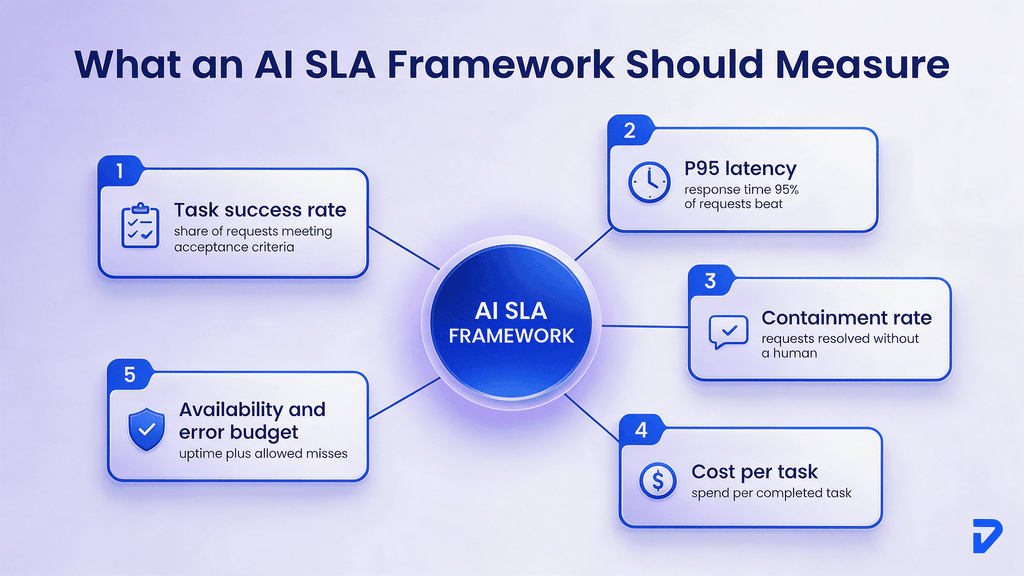
A sound framework measures five independent things: whether the answer was right, how fast it arrived, how often a person had to step in, what it cost, and whether the service stayed up. No single number can stand in for the rest, because a system can improve on one while quietly degrading another.
| Metric area | What it tells you | How to set the target |
| Task success rate | Share of requests that meet task-specific acceptance criteria | Score a sample of production traffic |
| P95 latency | Response time that 95% of requests beat | Time the full request, not just the model call |
| Containment rate | Share of requests resolved without a human | Set per intent, paired with a resolution check |
| Cost per task | Spend per successfully completed task | Include tokens, retrieval, retries, and review |
| Availability and error budget | Uptime and the allowed rate of misses | Set separately from quality thresholds |
Accuracy and Task Success Rate
Accuracy means little until a team defines what a correct outcome looks like for each task. Score sampled outputs against written criteria, including groundedness, meaning the answer matches the source documents the system retrieved.
P95 Latency and Response Time
P95 latency is the response time that 95% of requests beat, which exposes the slow tail that averages hide. Measure it from user request to usable answer, because retrieval, tool calls, and long prompts all add delay. Track time to first token separately for streaming chat, where perceived speed differs from total duration.
Containment Rate and Escalation Rate
Containment rate is the share of requests an AI system resolves without a human, and escalation rate is its counterpart. High containment can hide bad outcomes when the system deflects instead of solving, so pair it with a resolution check or repeat-contact rate. Set separate targets for each intent, since billing disputes and password resets carry different risk.
Cost Per Task and Token Usage
Cost per task divides total spend by successfully completed tasks, which penalizes cheap runs that fail. Count tokens, retrieval, retries, and human review, since a model that looks inexpensive per call can cost more per finished task. Gartner lists escalating costs among the reasons over 40% of agentic AI projects will be canceled by the end of 2027.
Availability, Error Budgets, and Recovery Targets
Availability still matters, but it becomes one line item instead of the whole promise. An error budget is the amount of failure a service may accrue before releases pause, and Google’s SRE book ties it to a quarterly objective. Add recovery targets, such as time to detect and time to roll back a bad prompt or model version.
AI SLA vs. AI SLO vs. AI Quality Metrics
An SLA is the promise, an SLO is the internal target that protects it, and AI quality metrics are the measurements that feed both. Google’s SRE guidance separates indicators, objectives, and agreements the same way, and the split applies cleanly to AI.
| Term | Who owns it | Purpose |
| SLA | Customer and provider | Formal commitment with remedies when missed |
| SLO | Engineering and product | Stricter internal target that warns early |
| AI quality metrics | Evaluation team | Factual accuracy, task success, groundedness, policy compliance |
Understanding the Differences
An SLA is the formal commitment, usually with remedies when it is missed. An AI SLO is the stricter internal target that warns the team before the SLA is at risk. AI quality metrics, such as factual accuracy, groundedness, and policy compliance, are the indicators both depend on. Keep the SLA simple and keep the detail in the SLOs.
How to Connect SLAs, SLOs, and Internal Performance Targets
Work backward from the customer promise. An AI SLA framework sets the SLA first, then an SLO with headroom, then daily quality metrics that feed both. If the SLA covers resolved requests, for instance, the SLO might sit a few points tighter, with alerts firing when the trailing average nears it. Review each layer monthly.
How to Create a Practical AI SLA Framework
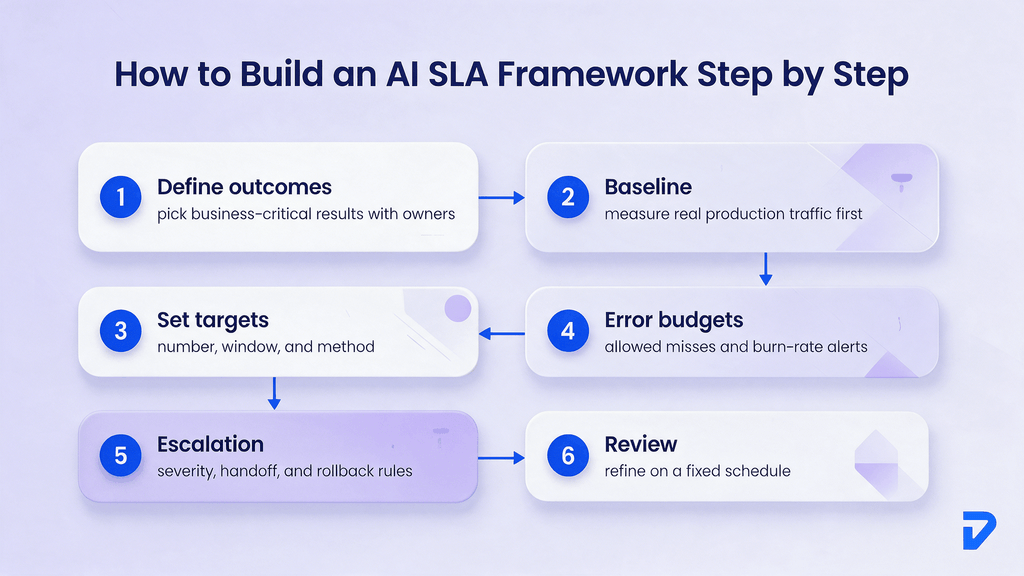
Build an AI SLA framework in six steps: define outcomes, set baselines, establish targets, monitor performance, agree on escalation, and review regularly. Start with reliable data, which Gartner identifies as a key challenge for AI adoption.
Step 1: Define Business-Critical AI Outcomes
List the two or three outcomes the business cannot afford to miss, such as correct quotes, resolved tickets, or accurate claims triage. Describe each in terms a reviewer can score and give it a named owner. For a distributor, that might be quote accuracy against the price book, not a vague goal of faster replies.
Step 2: Establish Baseline AI Performance
Measure before you promise. Run the system on real traffic for two to four weeks, score a stratified sample, and record accuracy, P95 latency, containment rate, and cost per task. An AI readiness assessment exposes data gaps first. Baselines turn targets from guesses into commitments the system has already shown it can meet.
Step 3: Set Measurable Service Level Targets
Set targets just inside proven performance, then tighten them as the system matures. Use different levels by use case, since a refund bot and a claims summarizer tolerate different miss rates. Write each target as a number, a window, and a method, such as the share of sampled tasks scored correct over 30 days.
Step 4: Define Monitoring and Error Budgets
Convert each SLO into an error budget, the allowed share of misses in a window. At a 99.9% objective over 30 days, a constant 0.1% error rate consumes the entire budget, which Google calls a burn rate of 1. Alert on burn rate instead of single failures, and pause prompt or model changes when the budget runs out.
Step 5: Establish Incident Response and Escalation Rules
Write down who acts, how fast, and in what order. Define severity levels for wrong answers, not only outages, plus triggers for human handoff, rollback of a prompt or model version, and customer notice. Name an owner for each metric. A rule such as halting releases once the budget is spent prevents arguments mid-incident.
Step 6: Review Performance and Refine Targets
Review on a fixed schedule, monthly at first and quarterly once stable. Compare trends in drift, incidents, cost per task, and business outcomes, then retire targets that no longer matter. A living AI SLA framework changes whenever the model, data, or workflow does, so treat every model upgrade as a trigger to re-baseline.
How to Monitor AI SLAs in Production
Monitor by sampling live outputs, scoring them continuously, and alerting on trends before customers notice. Any AI SLA framework depends on telemetry, and OpenTelemetry now defines standard GenAI metrics such as token usage and operation duration, so teams can compare data across vendors.
AI Observability and LLMOps
AI observability means logging prompts, retrieved context, tool calls, outputs, and scores so any bad answer can be traced to its cause, which shortens every investigation. LLMOps, the operating practice for large language models, adds versioned prompts, evaluation suites, and release gates.
Tracking Model Drift and Output Quality
Drift is gradual decay in quality as data, user behavior, or model versions change. Replay a fixed test set on a schedule, compare scores with the launch baseline, and watch retrieval health in enterprise AI search pipelines, where stale indexes quietly degrade answers. Alert when scores fall beyond tolerance across several consecutive runs.
Connecting AIOps With AI Service Monitoring
AIOps applies machine learning to operations data, grouping alerts, spotting anomalies, and suggesting likely causes. Feed it the AI service’s latency, error, cost, and quality signals alongside infrastructure metrics so one incident view exists. A quality drop that coincides with a deployment or an upstream model change then points straight to the suspect.
Reporting SLA Breaches and Performance Trends
Report against the SLA monthly and the SLO weekly, showing budget remaining, trend direction, and top failure categories. Include each breach with its cause and fix, not just a count. A one-page summary for executives and a detailed view for engineers keeps both groups working from the same numbers and prevents conflicting stories.
Ready to make AI performance measurable?
Pinnasys can help define meaningful SLAs, set quality targets, and build reliable monitoring.
Common AI SLA Mistakes to Avoid
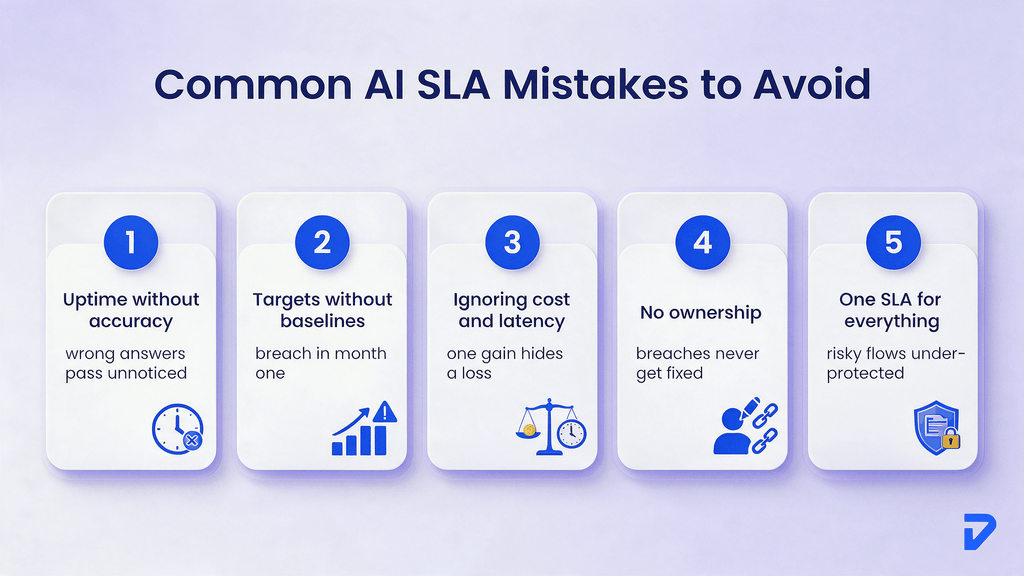
Most breakdowns in an AI SLA framework trace to five avoidable habits: measuring only uptime, guessing targets, ignoring unit cost, leaving ownership vague, and copying one agreement across every workflow. Each one is cheap to prevent during design and expensive to repair after a dispute.
| Mistake | What goes wrong | Better practice |
| Uptime without accuracy | Wrong answers pass unnoticed | Add scored task success |
| Targets without baselines | Breach in month one | Measure production first |
| Ignoring cost and latency | One gain hides another loss | Set all three together |
| No ownership | Breaches never get fixed | Name owners and deadlines |
| One SLA for everything | Risky flows under-protected | Tie targets to error tolerance |
Measuring Uptime Without Measuring Accuracy
A service that answers every request is available, not necessarily correct. Add task success and groundedness to the agreement, scored on sampled production traffic, and report them beside availability. For a claims assistant, a 99.9% uptime figure means little if its summaries omit policy exclusions. Buyers should ask to see both figures together.
Setting Targets Without Production Baselines
Targets copied from vendor demos rarely survive real data. Measure production behavior first, segment it by intent and customer type, then commit to a level the system already meets with headroom. Otherwise, the provider breaches in month one, the buyer loses trust, and the error budget turns into a meaningless number.
Ignoring Cost Per Task and Latency Trade-Offs
Quality, speed, and cost pull against each other. A larger model may lift accuracy yet double P95 latency and cost per task, while aggressive caching cuts spend but risks stale answers. Set thresholds for all three together and review them jointly, so a gain in one never hides a loss in another.
Failing to Define Ownership and Remediation
Every metric needs an owner and a response, and that assignment should survive staff turnover. Google’s sample policy requires a postmortem when one incident burns more than 20% of the error budget and names who settles disputes. Copy that discipline: assign accountable people, set remediation deadlines, and record fixes so breaches lead to change.
Applying the Same SLA to Every AI Use Case
A drafting assistant and an agent that issues refunds need different levels, because one blended target over-polices easy cases. Tie targets to tolerance for error, reversibility, and regulatory exposure, with stricter limits and human approval for agentic workflows that take actions. Low-risk summarization can run looser targets, which saves review cost where mistakes are cheap.
AI SLA Implementation Timeline and Best Practices
Expect an AI SLA framework to take roughly five to ten weeks for a first workflow, an illustrative planning range rather than an industry average. Scale shapes the approach: McKinsey found that 54% of organizations above $1 billion in revenue report scaling AI enterprise-wide, versus one-third of smaller ones, so mid-market teams should start narrow.
| Phase | Suggested planning estimate | Key deliverable |
| Baseline and scope | 1 to 2 weeks | Use cases, existing metrics, and risk profile |
| Define targets and responsibilities | 1 to 2 weeks | SLA and SLO matrix with escalation owners |
| Instrumentation and testing | 2 to 4 weeks | Dashboards, evaluation tests, and alerts |
| Validation and rollout | 1 to 2 weeks | Tested thresholds and a reporting process |
What Determines the Implementation Timeline
Four factors move the schedule most: data readiness, the number of workflows, existing observability tooling, and how quickly owners agree on acceptance criteria. A single support workflow with logging in place moves fast, while several agents across disconnected systems take longer. Treat the ranges above as planning estimates, not benchmarks.
A Phased Approach to AI SLA Implementation
Start with one workflow, prove the measurement loop, then expand. Run baseline and target work first, instrument and test next, and roll out in observation mode, where breaches are logged but carry no penalty, before remedies apply. After two or three clean review cycles, convert the tested SLOs into formal commitments.
When to Involve a Managed AI Service Provider
Bring in a managed AI service provider when no internal team can own monitoring, evaluation, and incident response after launch. Managed AI services can stand up an AI SLA framework faster, while AI managed services keep dashboards, drift checks, and monthly reviews running. Ask any provider how quality sampling is audited.
Conclusion
An AI SLA framework works when it defines what success means, how it is measured, and what happens when the system falls short. Uptime stays on the list, but accuracy, P95 latency, containment rate, cost per task, and error budgets now share it, each set from real baselines and owned by a named person. Pinnasys builds and runs that measurement layer for mid-market operators, so commitments rest on evidence instead of optimism.
Start with one workflow this quarter, baseline it, and review the numbers monthly with executives and engineers in the same room. Keep the first scope small enough to finish. When you are ready to extend the approach, explore production AI services that fit your existing stack.
Key Takeaways from the Article
- Uptime proves a service responds; only sampled, scored outputs prove it answers correctly.
- Baselines from real production traffic should come before any numeric commitment is signed.
- Error budgets turn quality targets into a trigger for pausing risky releases.
- Quality, latency, and cost per task must be reviewed together, never one at a time.
- Risk tolerance, not habit, should decide how strict each use case’s service level becomes.
Frequently Asked Questions About AI SLA Frameworks
How do I write AI SLAs that actually mean something?
Name the task, acceptance criteria, sample size, measurement window, and remedy. A clause such as “95% of 400 sampled tasks scored correct over 30 days” can be audited, while “high accuracy” cannot. Keep each SLO stricter than its SLA.
What is the best way to implement AI service levels at a mid-size company?
Begin with one workflow in observation mode for one or two review cycles before adding remedies. A weekly scored sample of 100 to 200 outputs plus existing logging is enough to start; custom tooling is rarely needed.
How should AI SLOs change for agents that call tools?
Add tool-call success rate, unauthorized-action count, and human-approval rate to the targets. Agents act instead of answer, so one wrong tool call can cost more than one wrong sentence. Set a zero-tolerance objective for policy violations.
Who should own AI service levels inside a company?
Name one business owner for outcomes and one technical owner for measurement and incidents. Shared responsibility without names is the usual reason breaches go unfixed. Revisit ownership whenever a model, vendor, or workflow changes, and record it in the agreement.
How often should AI quality metrics be reviewed?
Check SLO dashboards weekly and formal SLA performance monthly. Rerun the fixed evaluation set after every model, prompt, or retrieval change, since any of the three can shift behavior overnight. Quarterly reviews then reset targets from accumulated baselines.
What metrics should an AI SLA include?
Include metrics that reflect the actual business task, such as accuracy, groundedness, response time, availability, escalation rate, or error rate. The right metrics depend on the workflow, so avoid tracking technical metrics that do not reflect user or business outcomes.
What happens when an AI SLA is breached?
Define the response before deployment. Depending on the severity, this could include investigation, increased human review, model rollback, remediation within a defined timeframe, or service credits for vendor agreements. Every breach should be logged with its cause, impact, and corrective action.