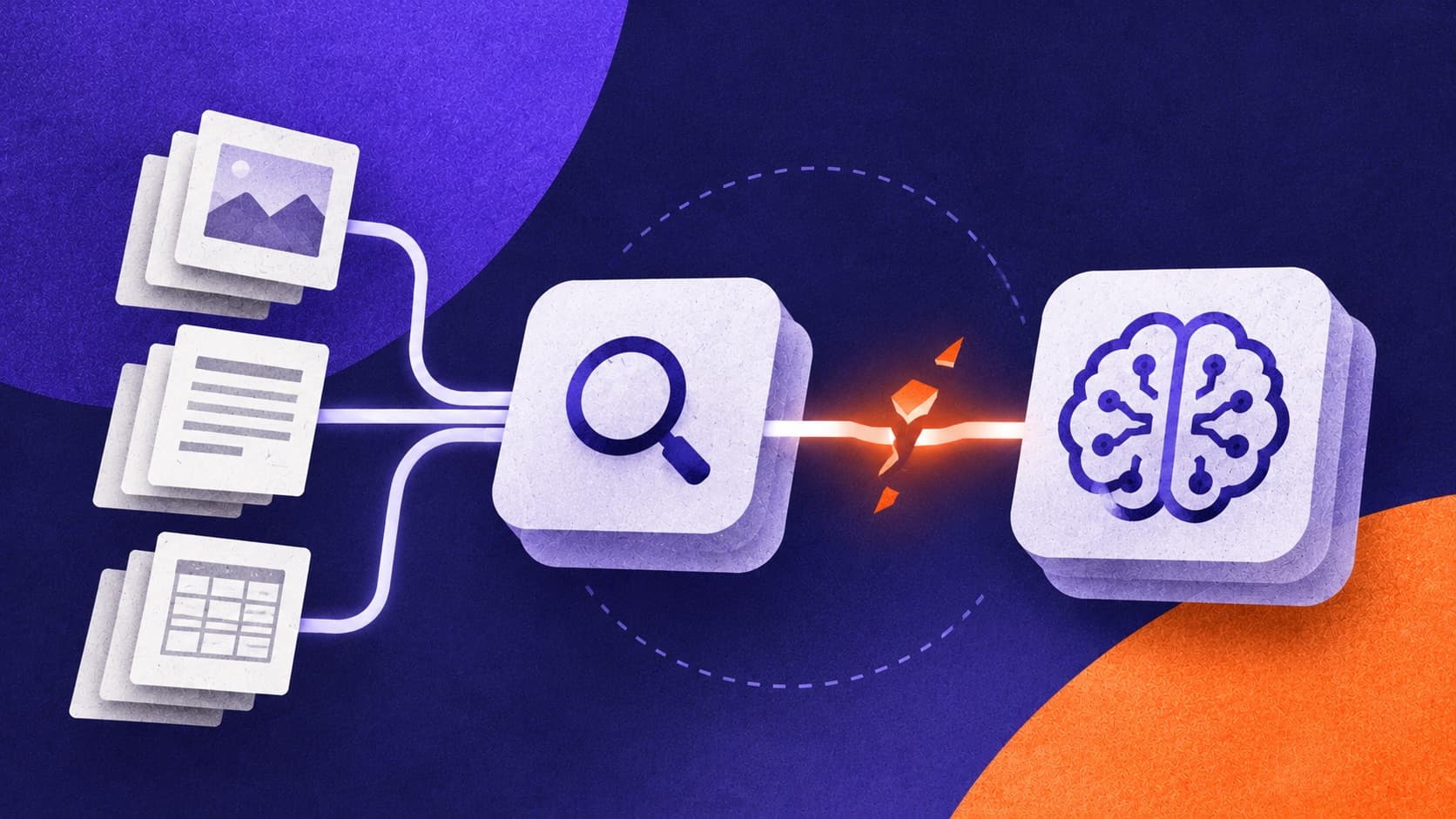
RAG production failures usually trace back to data, chunking, retrieval, grounding, or missing evaluation, not the language model. A five-step root-cause framework isolates the failing layer so teams fix one thing at a time.
In one public benchmark, industry RAG solutions answered only 63% of questions without a hallucination. Real users push that gap wider. RAG production failures rarely trigger an error message, because the system keeps answering while accuracy erodes week by week. Nobody notices until a customer, a claims reviewer, or an auditor catches a wrong answer.
A prototype built on retrieval-augmented generation (a pattern that fetches relevant documents before the model answers) shines on clean test data. Production adds messy files, vague questions, and tight latency limits.
The framework below traces each failure to its root layer, so mid-market teams weighing RAG application development can fix causes instead of rewriting prompts.
Why RAG Systems Fail in Production: The Core Root Causes
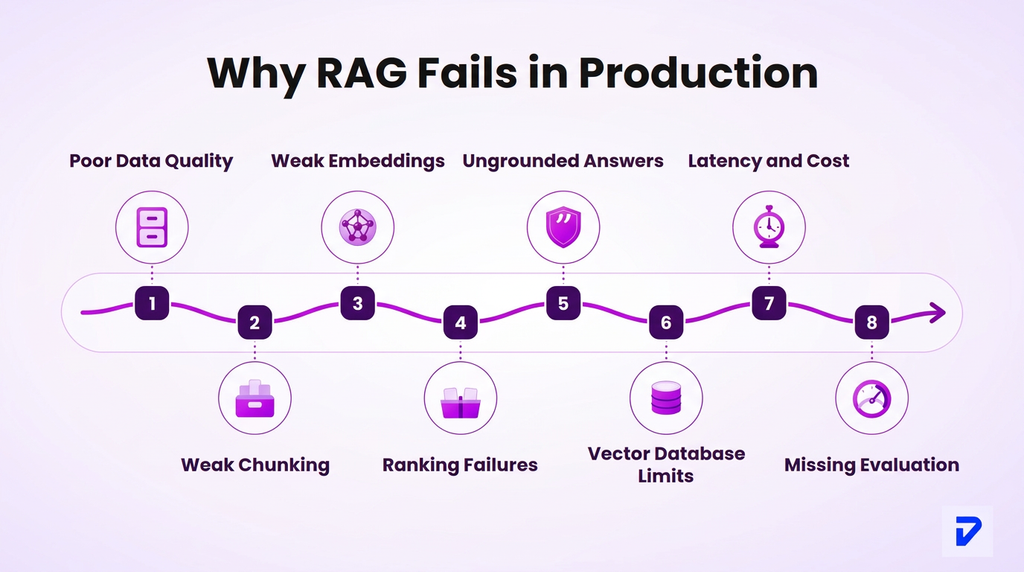
Why RAG fails in production often starts upstream of the language model. Data, chunking, retrieval, grounding, infrastructure, and measurement can each fail differently. Each cause below shows how it appears to users and what the evidence says.
1. Poor Data Quality and Document Ingestion
Stale policies, duplicate drafts, and scanned PDFs with broken text all enter the index unchecked. The model then retrieves contradictions or nothing at all. Deloitte notes that RAG can add data integration, retrieval relevancy, and maintenance challenges. Picture a distributor whose price sheet changes weekly while the index refreshes monthly.
2. Ineffective Chunking and Context Fragmentation
Chunking splits documents into passages before indexing. Fixed windows cut tables in half and separate a rule from its exception. Deloitte lists context loss, redundant or irrelevant passages, slower performance, and higher resource use as consequences of inadequate chunking. A warranty clause split across two chunks, for instance, returns half an answer with full confidence.
3. Weak Embeddings and Semantic Search
Embeddings turn text into numbers so semantic search can match meaning. A general model may not grasp product codes, legal terms, or internal shorthand, so it returns passages that sound similar but answer nothing. Pure vector matching also misses exact identifiers. Keyword search plus a domain-tuned embedding model usually closes that gap.
4. Retrieval Failures and Incorrect Ranking
Retrieval fails in two quiet ways: the right passage is never fetched, or it lands too low to reach the model. Microsoft’s document retrieval evaluator scores this with Fidelity, NDCG, XDCG, Max Relevance, and Holes against labeled ground truth. NDCG (a ranking-quality score) shows whether the best passages sit at the top.
5. Hallucinations and Poor Context Grounding
Even with good retrieval, the model may ignore context, blend unrelated passages, or answer when it should decline. The RGB benchmark found that tested models handle noisy documents reasonably but struggle to reject unanswerable questions, combine several documents, and resist false information. Confident wording makes these errors hard for users to spot.
6. Vector Database Performance and Scalability Issues
A vector database stores embeddings and finds nearest neighbors quickly, until scale, filters, and freshness collide. Index rebuilds stall, metadata filters slow queries, and replicas drift out of sync. Teams often notice only when latency passes what a live chat can tolerate. Load test at production volume before launch, not after the first complaint.
7. Latency, Cost, and Infrastructure Bottlenecks
A RAG system can answer correctly and still fail if it is slow or expensive. IBM’s evaluation guidance ties CPU use mostly to retrieval, and GPU use mostly to generation, alongside storage, networking, and compute costs. Track cost per query next to accuracy. A support assistant that stalls for several seconds loses users regardless of quality.
8. Missing Evaluation, Monitoring, and Feedback Loops
Without a golden dataset (a set of questions with known good answers), nobody can tell whether last week’s change helped. There is no baseline, no regression test, and no alert when retrieval degrades. RAG production failures stay invisible until users complain. Without measurement, every other cause on this list stays hidden.
A Root-Cause Framework for Diagnosing RAG Failures
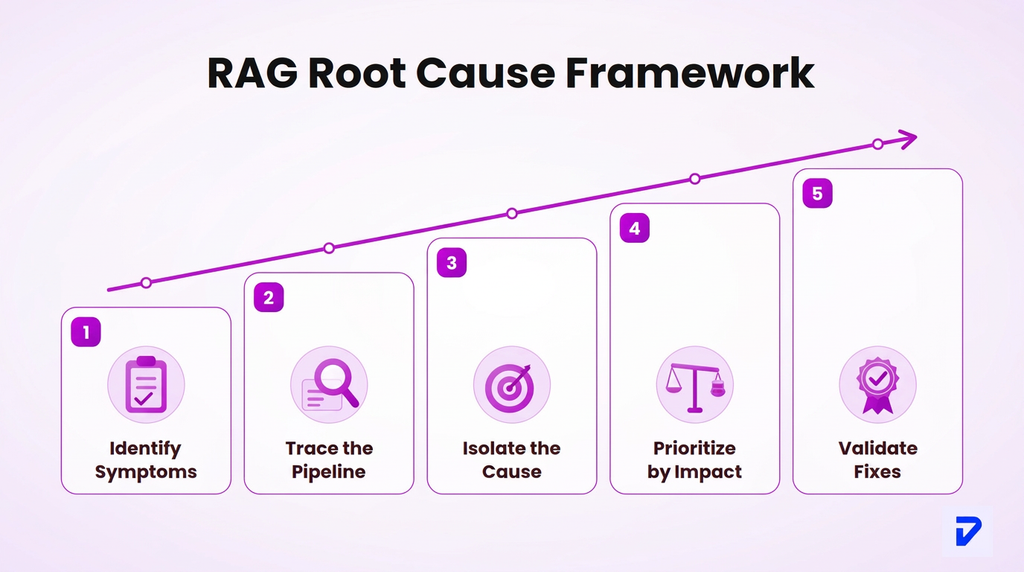
RAG root cause analysis works best as five ordered steps: name the symptom, trace the pipeline, measure the suspect layer, rank the fixes, and validate before release. Applied to RAG production failures, the discipline of changing one variable at a time keeps the process honest.
Step 1. Identify the Failure Symptoms
Start with what users actually see: wrong, missing, outdated, slow, or refused answers. Collect ten to twenty real examples of each. Symptoms narrow the search quickly, as the table shows. Outdated answers point toward ingestion, while partial answers point toward chunking. Label every example with its symptom before anyone proposes a fix.
| Symptom | Likely root layer | First check |
| Outdated answer | Ingestion and freshness | Compare document dates with index timestamps |
| Partial answer | Chunking | Read the chunks around the answer |
| Right document, wrong answer | Grounding | Score groundedness against retrieved text |
| Correct but slow | Infrastructure | Time each pipeline stage |
| Confident answer to an unanswerable question | Refusal logic | Run negative test queries |
Step 2. Trace the Failure Across the RAG Pipeline
Replay each bad answer through the pipeline stage by stage: query, retrieval, ranking, context assembly, and generation. The first stage where the evidence disappears is your suspect. If the right passage never reaches the top results, retrieval owns the failure. If it appears and the model ignores it, generation does.
Step 3. Isolate the Root Cause Using Evaluation Metrics
Attach a metric to the suspect stage. Microsoft’s debugging guidance pairs reference-free groundedness and relevance checks with XDCG and Max Relevance when ground truth exists. Reference-free means no labeled answers are needed. Weak retrieval scores alongside strong generation scores point back to chunking and search settings, not the language model.
Step 4. Prioritize Fixes by Business Impact
Rank causes by how many queries they touch and what each wrong answer costs. Pinnasys frames that ranking around hours saved, errors reduced, and revenue unlocked. A pricing error that reaches customers outranks a slow FAQ lookup. Fix cheap, high-frequency causes first, and schedule structural rebuilds separately. Document the reasoning so stakeholders can challenge it.
Step 5. Validate Improvements Before Deployment
Rerun the full evaluation set after each change and compare it against the saved baseline. Include unanswerable and adversarial questions, not only easy ones. Ship only when target metrics improve without regressions elsewhere. Then release to a small traffic slice for a week, so real usage confirms what the offline numbers promised.
How to Fix Common RAG Production Failures
Fix RAG issues in order: data, retrieval, then generation. Most failures can be resolved before changing the model.
- Improve Data Preparation: Preserve document structure, remove duplicates, maintain canonical versions, and add metadata such as source, date, owner, and version. Keep content refreshed.
- Optimize Retrieval: Test chunk sizes and overlap with real questions. Combine semantic and keyword search, use domain-tuned embeddings, and track performance changes.
- Strengthen Reranking: Use reranking to prioritize relevant passages. Remove duplicates, organize context clearly, and limit unnecessary content to improve accuracy and reduce costs.
- Reduce Hallucinations: Ground answers in retrieved passages, require citations, validate claims, and route low-confidence responses for human review.
- Improve Query Performance: Use efficient indexes, metadata filters, caching, and optimized embedding sizes where appropriate. Monitor p95 latency, especially for conversational AI.
- Monitor Continuously: Evaluate every pipeline change and track retrieval quality, groundedness, latency, and cost. Feed user feedback into the evaluation dataset to keep improving the system.
Why is your RAG system still failing in production?
Pinnasys helps identify retrieval, data, grounding, and architecture issues to build more reliable AI systems.
How to Implement a Reliable RAG System Step-by-Step
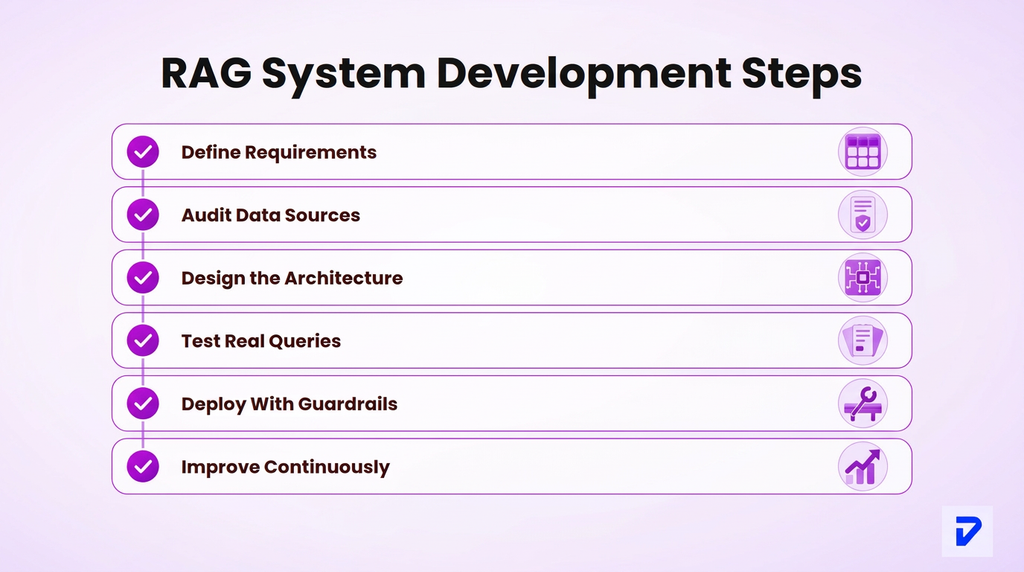
A reliable build starts with requirements and measurement, not a model choice. Six stages carry RAG software development from business goal to monitored release, and each stage produces something a reviewer can inspect.
1. Define Business Requirements and Success Metrics
List the questions the system must answer, who asks them, and what a wrong answer costs. Convert that into targets: retrieval hit rate, groundedness, response time, and cost per query. Write refusal rules too, so the system knows what to decline. A claims assistant, for example, may tolerate slower replies but never an invented coverage term.
2. Audit Data Sources and Access Permissions
Inventory every source, its owner, its refresh rate, and who may read it. Retrieval must respect those permissions at query time, not after generation. Flag outdated and conflicting files before indexing. This audit often shows that the biggest accuracy gain comes from fixing or deleting a handful of bad documents.
3. Design the Retrieval and Generation Architecture
Choose components against the requirements. Typical pieces include hybrid search, a vector database, a reranker, and, when relationships matter, a knowledge graph (a map of entities and their connections). Where questions need planning, agentic AI can split them into sub-queries. A sound RAG system keeps retrieval and generation separately testable.
4. Test With Representative Queries and Failure Cases
Build the evaluation set from real questions, plus unanswerable, ambiguous, and adversarial ones that expose RAG production failures early. Google’s evaluation lab suggests about 100 examples for reliable results and growing the set from anonymized live queries. Score retrieval and generation separately, then version the dataset like code so results stay comparable over time.
5. Deploy With Monitoring, Guardrails, and Fallbacks
Release behind a feature flag to a small audience. Add guardrails such as refusal on low retrieval scores, citation checks, and permission filters. Define fallbacks like keyword-only search or an automated human handoff when the vector store slows down. Send traces to a dashboard so the first regression shows up in minutes.
6. Establish a Continuous Improvement Cycle
Treat launch as the starting line. Review failed queries weekly, add them to the evaluation set, and rerun regression tests before every change. Re-embed content when the domain shifts or the embedding model changes. Budget for this upkeep from day one, because retrieval quality drifts as documents and questions evolve.
How Long Does It Take to Diagnose and Fix RAG Production Failures?
No universal benchmark exists for this timeline, so treat every duration below as a planning estimate, not a published statistic. A Deakin University study of three RAG projects found that validation is only feasible during operation and that reliability evolves over time. The work never fully ends.
Factors That Affect Diagnosis and Resolution Time
Scope drives duration more than any tool choice. Check these variables before promising a date:
- Number of data sources and file formats
- Whether a labeled evaluation set already exists
- Integration effort and permission rules across systems
- Live traffic volume and latency limits
- Security review and compliance requirements
Each factor adds days or weeks independently.
Typical Timelines for RAG Audits, Optimization, and Rebuilding
Small, well-scoped systems with a labeled test set sit at the short end of each range. RAG production failures tied to messy ingestion or permissions take longer, because the fix means rebuilding pipelines. Use the ranges as a plan, then replace them with measured progress after the first audit.
| Stage | Planning estimate | What it delivers |
| Audit and failure diagnosis | 1 to 2 weeks | Ranked root causes and a baseline evaluation set |
| Retrieval and chunking optimization | 2 to 6 weeks | Measured gains in hit rate and groundedness |
| Ingestion or architecture rebuild | 2 to 4 months | New pipeline with permission and freshness rules |
| Monitoring and tuning | Ongoing | Alerts, regression tests, weekly query reviews |
Planning estimates only, not industry benchmarks.
How to Prioritize Quick Fixes and Long-Term Improvements
Ship low-risk fixes in the first weeks: metadata filters, hybrid search, reranking, refusal rules, and alerts. Schedule structural work, such as re-parsing documents or changing the data layer, behind measured evidence. Rank both lists by queries affected and cost per wrong answer. Quick wins buy credibility while bigger changes take shape.
When to Consider Custom RAG Development Services
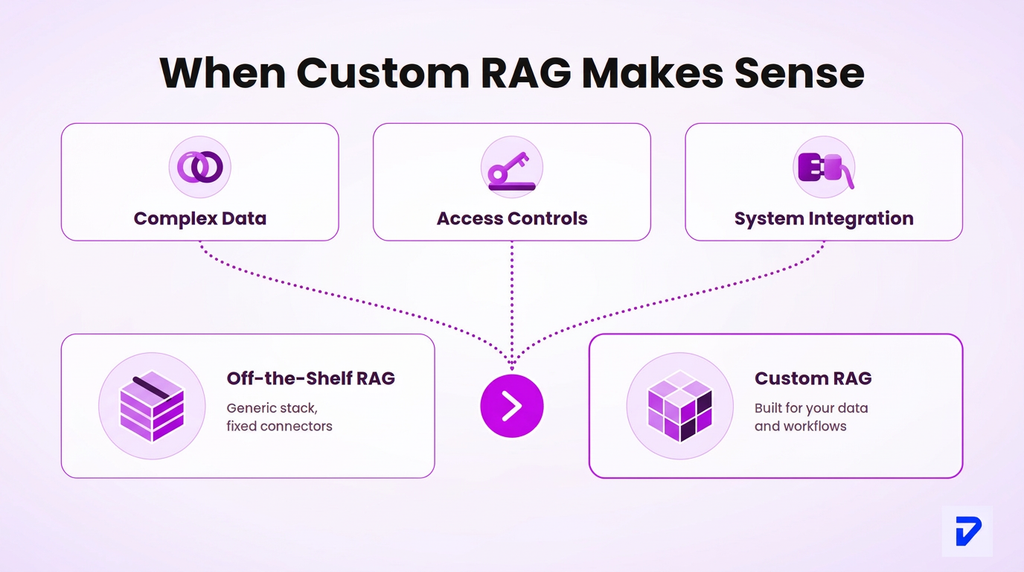
Off-the-shelf tools handle simple document question answering well. Custom RAG development services become worthwhile when data, permissions, or workflows outgrow a generic stack. If you have tuned the basics and quality still stalls, the constraint is probably architectural.
When Existing RAG Solutions Cannot Meet Business Requirements
Generic products struggle with mixed file types, row-level permissions, strict citation rules, and tight latency budgets. Common signs include plateaued evaluation scores, connectors that cannot reach a key system, and retrieval traces you cannot inspect. When RAG production failures survive tuning, RAG development services that own the architecture beat another round of configuration.
Custom RAG Development for Complex Data and Workflows
Contracts, product catalogs, and support tickets need tailored parsing, entity links, and sometimes a knowledge graph. Multi-step questions benefit from agentic retrieval, where an AI agent plans sub-queries. Microsoft reports up to 40% better relevance on complex queries with that approach in Azure AI Search, compared with its own baselines.
Integrating RAG With Existing Business Systems
Answers become useful when RAG connects to the systems people already use: CRM, ERP, ticketing, and document storage. That means identity-aware connectors, event-driven refresh, and write-back where appropriate. Strong AI integration work also covers monitoring and governance, so retrieval follows the same security and audit rules as every other system.
Evaluating RAG Development Services and Solutions
Ask candidates to show retrieval metrics, not demos. Request their evaluation method, their permission model, and the monitoring that ships with the system. Look for RAG AI development experience in your document types. A mid-market AI team should also ask who runs the system after launch.
The Bottom Line
RAG production failures become diagnosable once teams stop blaming the model and start tracing the pipeline. Separate retrieval from generation, measure each layer, change one variable at a time, and keep the evaluation set growing with real questions. That habit turns scattered patches into steady, measurable gains and a reliable, production-ready foundation.
Pinnasys builds and runs retrieval systems on this discipline, and success is measured in hours saved and errors reduced. Mid-market teams that want an outside read on their pipeline can start with an AI consulting engagement that ends in a ranked fix list. Pick the one failing layer, measure it this week, and fix it before adding anything new.
Key Takeaways from the Article
- Most failures start in data, chunking, or retrieval, so inspect those before touching the model.
- Root-cause analysis works when symptoms are traced stage by stage and only one variable changes.
- Retrieval and generation need separate metrics, or a single score hides the broken layer.
- Public benchmarks can overstate quality, so test with your own documents and live questions.
- Timelines are estimates, and monitoring never ends because documents and questions keep changing.
Frequently Asked Questions
What are the best RAG solutions for conversational AI?
The best RAG solutions for conversational AI typically combine hybrid retrieval, reranking, session context, and citation checks. Evaluate them using metrics such as faithfulness, context relevance, and answer relevancy, then compare latency, scalability, and cost under realistic workloads.
Does a larger context window replace RAG?
No. A larger context window can hold more information, but it does not guarantee that the right information will be provided to the model. RAG adds targeted retrieval, document freshness, access controls, and source attribution.
Do I always need a dedicated vector database?
Not always. A relational database with a vector extension such as pgvector can work well for moderate workloads. Dedicated vector databases become more relevant when retrieval volume, corpus size, filtering requirements, or latency targets demand specialized infrastructure.
Should I fine-tune the model or improve retrieval first?
In most RAG failures, retrieval should be investigated first. Fine-tuning can improve behavior, formatting, or domain-specific responses, but it cannot reliably compensate for missing, outdated, or incorrectly retrieved information.
How do I identify the root cause of a RAG failure?
Start by separating retrieval failures from generation failures. Check whether the correct documents were retrieved, whether relevant content was ranked highly, whether the model used the retrieved evidence, and whether the final response remained grounded in that evidence.
What metrics should I use to evaluate a RAG system?
Use a combination of retrieval and generation metrics. Retrieval can be evaluated with measures such as recall, precision, Hit@K, MRR, and NDCG, while generation can be assessed using faithfulness, answer relevance, context relevance, and citation accuracy.
How long does it take to fix a RAG system that fails in production?
The timeline depends on the source of the failure, data complexity, retrieval architecture, evaluation coverage, and integration requirements. A focused retrieval issue can be resolved relatively quickly, while problems involving data pipelines, architecture, security, and monitoring may require a broader RAG optimization project.