



Most automation projects fail not because of bad technology but because teams pick the wrong processes. A process mining framework closes that gap by showing exactly where work breaks down, where manual effort accumulates, and which workflows are genuinely ready to automate.
Most organizations that invest in automation make the same early mistake. They decide what to automate based on gut feel, stakeholder pressure, or the loudest complaint in the building. The result is automating something broken, or something too variable to run reliably. Deloitte’s Global Intelligent Automation Survey found that 82% of respondents believe process mining drives better outcomes than skipping it, yet only 23% are actually using it. That gap explains a lot of failed automation programs. This guide lays out a practical process mining framework, step by step, so your team selects automation candidates from data rather than assumptions.
Why Process Mining Matters Before You Automate
Most businesses don’t have a technology problem. They have a visibility problem. Teams document how a process should work, then automate that version, only to discover the real process is messier, faster, slower, or different entirely.
Process mining solves this by reading event logs (the timestamped records your ERP, CRM, WMS, and other systems generate automatically) and reconstructing the actual execution path of every process instance. It’s objective. No interviews, no whiteboard sessions, no assumptions. You see exactly what happened, in what order, and how long each step took across thousands of cases at once.
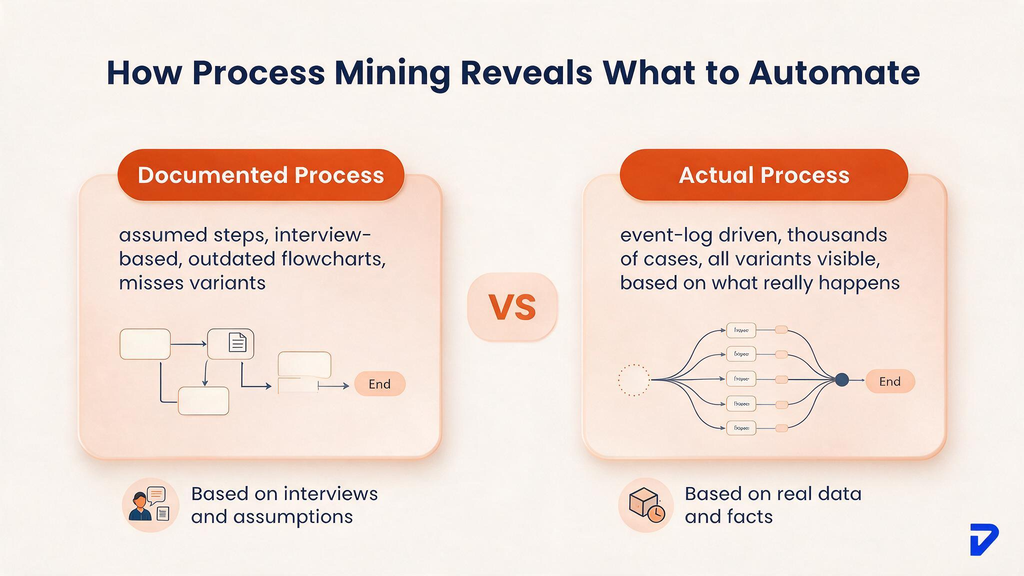
Traditional process analysis relies on workshops, flowcharts drawn from memory, and documentation that often hasn’t been updated in years. A process mining framework replaces that with a data-driven picture of reality. When you can see the 47 variants of your purchase order process, the rework loops inside your claims workflow, and the handoffs that add three days of waiting, you know where automation will actually help.
The 2025 Deloitte Global Process Mining Survey, based on interviews with over 120 respondents, shows growing confidence in process mining’s value, with 80% agreeing it helps identify and qualify high-value processes. That confidence is earned through what process mining reveals, not just what it promises.
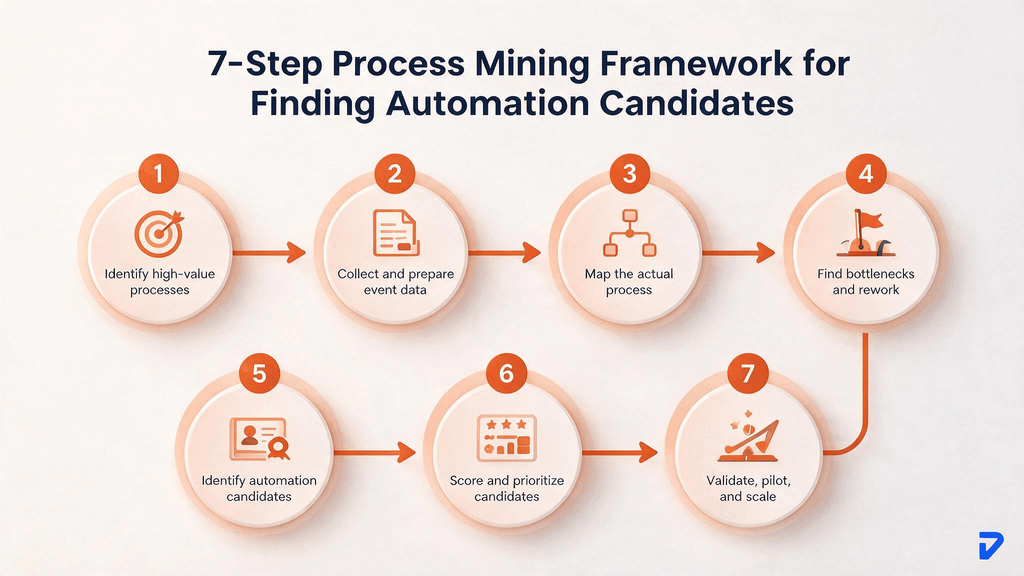
A 7-Step Process Mining Framework: From Data to Automation
A strong process mining framework connects data, analysis, and action. Each stage helps uncover how work actually happens, where problems occur, and where automation can deliver value.
Step 1: Identify High-Value Processes for Analysis
Start by narrowing scope. Process mining applied across an entire organization at once produces noise, not clarity. Pick one business domain with high transaction volumes, measurable costs, and clear pain.
Good candidates include invoice processing, order management, service desk workflows, and procurement cycles. Look for processes where people regularly complain about delays, where error rates are high, or where manual workarounds have piled up over years. Define the business problem specifically: “reduce purchase order cycle time by 30%” beats “improve procurement.” Specific goals produce specific findings.
McKinsey’s research has analyzed automation potential across more than 190 business processes spanning 16 functions, consistently finding that systematic process identification outperforms ad hoc automation targeting.
Step 2: Collect and Prepare Process Data
A process mining framework lives or dies on event log quality. Every event log needs three things: a case ID (the unique identifier tying each activity to a specific process instance), a timestamp, and an activity name. Without clean versions of all three, the process map will be unreliable.
Pull event data from your source systems, typically ERP platforms like SAP or Oracle, your CRM, WMS, or service management tools. Expect to spend real time on data preparation. Missing events, duplicate records, inconsistent timestamps, and different naming conventions across systems are common. Fixing these issues before analysis helps prevent inaccurate conclusions from corrupted data.
Step 3: Map How the Process Actually Works
Once the data is clean, let the process mining tool build the actual process map. This is where most teams experience their first genuine surprise. The documented flowchart shows five neat steps. The event log shows 22 variants, three unexpected loops, and activities that happen in a completely different order than anyone assumed.
Compare the documented process with what the data reveals. Identify which variants are common versus rare. Find the paths that generate the most delays or the most exceptions. Understand the handoffs between systems and people, because the dead time between steps is often where the most waste lives. The process mining framework here is diagnostic: you’re not judging, you’re observing.
Step 4: Identify Bottlenecks, Rework, and Manual Tasks
With the process map visible, shift to analysis. Bottlenecks show up as activities where cases pile up and wait. Rework loops appear where the same activity runs multiple times in a single case. Manual tasks often reveal themselves through long, inconsistent activity durations, because automated steps have predictable, fast execution times while manual steps vary widely.
Use task mining alongside process mining when you need to go deeper. Task mining (capturing the specific desktop actions employees take to complete each process step) shows what someone actually does inside an activity that process mining treats as a single node. Together, the two tools reveal both the process-level picture and the employee-level detail. McKinsey estimates that roughly 60% of potential productivity gains from AI concentrate in sector-specific workflows, which makes bottleneck-level analysis a serious financial exercise, not just an operational one.
Step 5: Find the Best Automation Candidates
This is where the process mining framework becomes an automation discovery engine. Separate activities by type: rule-based, structured, and high-volume work suits robotic process automation (RPA, software bots that mimic human actions on digital interfaces). Decision-heavy work involving judgment and unstructured inputs is better suited to AI.
Look for activities where the process is stable (low variation), the data is digital and accessible, the task executes repeatedly, and the output is predictable. Avoid pushing automation onto activities where human judgment, relationship management, or ethical reasoning are core to the outcome. UiPath’s 2025 Agentic AI Report, drawn from a survey of over 250 U.S. IT executives, found that 90% said they have processes that would benefit from agentic AI, and 52% cited the automation of complex business workflows as a particularly appealing use case.
Step 6: Prioritize Candidates With an Automation Scoring Model
Not every automation candidate deserves equal investment. Score each one across multiple dimensions so you can rank them objectively. The table below shows a practical scoring model:
| Dimension | What to Measure | Why It Matters |
| Volume and frequency | Transactions per month | Higher volume = greater time savings |
| Manual effort | Hours spent per week | More hours recovered = stronger ROI case |
| Error rate | Rework or exception frequency | High errors = quality and cost problem |
| Process stability | Number of variants | Fewer variants = simpler automation |
| Data readiness | Digital, accessible, clean? | Poor data quality blocks reliable automation |
| Business impact | Revenue, cost, or compliance effect | Ties automation to measurable outcomes |
| Technical feasibility | Integration complexity | Determines time and cost to build |
Rank your candidates using this model. Separate the quick wins (high volume, stable, low complexity) from the strategic initiatives that take longer but deliver larger gains. A process mining framework should produce a ranked backlog, not just a list of ideas.
Deloitte’s research confirms that process intelligence enables identification of more high-value processes when applied systematically, with 80% of respondents agreeing this was a key benefit.
Step 7: Validate, Pilot, and Scale
Before building anything, establish a performance baseline: cycle time, error rate, cost per transaction, and manual hours. Without this, you can’t prove the automation worked. Select a single, clearly scoped pilot process. Run it under real operating conditions, not a controlled demo environment. Measure results against the baseline after a meaningful run period.
Fix what doesn’t work before scaling. The IBM Institute for Business Value found in a global survey of 2,900 executives that AI-enabled workflows are expected to grow from 3% to 25% of total workflows by year-end 2025. That growth only holds if pilots prove their value before scale decisions are made.
How to Evaluate Automation Candidates With Process Mining
Beyond the scoring model in Step 6, there are five specific evaluation criteria that separate good automation candidates from poor ones.
- Stability: A process with 40 variants is a different engineering problem than one with four. Count the variants your process mining tool surfaces. More than ten to fifteen major variants usually signals a process that needs redesign first.
- Structured inputs: Can every required input field be pulled from a digital system? Automation breaks when it encounters handwritten notes, unstructured PDFs, or decision logic locked in someone’s head.
- Clear output definition: The automation must produce a defined, verifiable output. Open-ended outcomes require judgment; automation requires determinism.
- Compliance visibility: Some processes carry audit or regulatory requirements that affect how automation can be deployed. Flag these early and involve compliance teams before building.
- Measurable baseline: If you can’t measure the current state, you can’t prove improvement later. This alone disqualifies many candidates until proper measurement is in place.
Build a simple opportunity scorecard that combines these criteria with the dimensions in Step 6. Score each candidate on a 1–5 scale across all criteria, add the scores, and rank. The top candidates are where your first automation investments go.
RPA, AI, and Intelligent Process Automation: Choosing the Right Approach
One of the most common mistakes in automation planning is reaching for a single tool when the right answer is a combination. Here’s how to match the approach to the problem.
Where RPA Works Best
Robotic process automation handles structured, rule-based work reliably and cost-effectively. Data entry between systems, invoice matching, report generation, and fixed-rule approval routing are strong RPA use cases. The process needs to remain stable because significant changes can require bot updates.
Where AI Fits Better
AI works better when workflows involve ambiguity or interpretation. Classifying support tickets, extracting data from varied invoice formats, and predicting delayed orders require the system to understand changing inputs rather than follow fixed rules. AI automation matches these tasks to the complexity of the process.
Intelligent Process Automation for End-to-End Workflows
Intelligent process automation (IPA) combines RPA and AI across workflows that span multiple systems and require both automation and decision-making. Agentic AI can manage orchestration, decisions, and human handoffs, making IPA useful for more complex end-to-end processes. IBM found that 69% of executives cited improved decision-making as the top benefit of agentic AI.
The rule is straightforward: use the simplest technology that solves the problem reliably in production. A process that RPA handles well doesn’t need an AI layer. A process requiring contextual judgment doesn’t belong inside a rigid bot.
| Automation Type | Best For | Watch Out For |
| RPA | Structured, stable, rule-based tasks | Brittle when processes change |
| AI / ML | Judgment, classification, prediction | Needs quality training data |
| Intelligent Process Automation | End-to-end workflows with both types | Higher implementation complexity |
| Human-in-the-loop | Exception handling, compliance decisions | Must define escalation triggers clearly |
How AI Enhances the Process Mining Framework
AI doesn’t replace process mining. It makes process mining faster, more accurate, and capable of finding patterns that humans would miss across large, complex datasets.
Traditional process mining tools surface the process map and the variant list. AI layers on top of that to identify which variants are most likely to generate exceptions before they happen, cluster similar cases to find patterns across thousands of instances, and flag emerging bottlenecks based on early warning signals rather than after delays accumulate.
McKinsey’s 2025 State of AI report found that 88% of organizations now use AI in at least one business function, up from 78% the prior year. The organizations getting the most value are those pairing AI with process intelligence, not running AI in isolation. Only about one-third have begun to scale those programs, which is where process mining becomes the navigation layer.
In practice, AI enhances the process mining framework in three concrete ways:
- Pattern detection at scale: AI identifies correlations across millions of events that no analyst could review manually, surfacing which process combinations predict poor outcomes.
- Predictive conformance: Rather than flagging deviations after they occur, AI-enhanced process mining predicts when a case is about to deviate and can trigger an intervention.
- Automation opportunity scoring: AI models trained on past automation outcomes can score new process candidates with more precision than manual heuristics alone.
For AI process automation to run well in production, process intelligence has to come before model selection. You need to know the process before you can build the AI that improves it.
Common Process Mining and Automation Mistakes to Avoid
The biggest automation mistakes usually happen before implementation. Process mining helps identify where teams go wrong before they invest time and resources.
- Automating a broken process: Fix unnecessary steps, outdated approvals, and flawed workflows before automating them. Otherwise, automation simply makes a bad process faster.
- Choosing candidates by volume alone: High volume doesn’t always mean high value. Prioritize processes based on time saved, error rates, complexity, and business impact.
- Ignoring process variants: Multiple process variations increase testing, exception handling, and maintenance requirements. Account for these differences before estimating automation effort and ROI.
- Working with incomplete event data: Missing events create inaccurate process maps and force analysts to make assumptions. Reliable event data is essential for meaningful process analysis.
- Scaling before proving value: Start with a focused pilot, measure its results, and refine the process before expanding automation across the organization.
McKinsey found that nearly 90% of companies have invested in AI, but fewer than 40% report measurable gains. The lesson is clear: successful automation depends on choosing the right processes and proving value before scaling.
Measuring Automation ROI After Process Mining
A process mining framework without a measurement plan is incomplete. Every automation project should be evaluated against the baseline established before go-live.
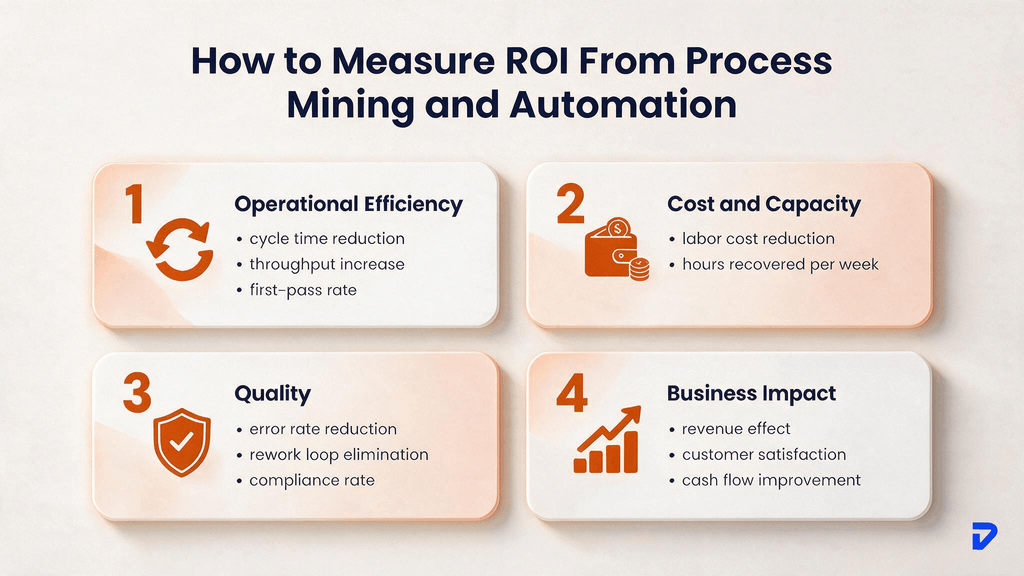
The most useful metrics fall into four categories:
- Operational efficiency: Cycle time reduction (the difference between average process duration before and after automation), throughput increase (more cases processed per hour or day), and first-pass rate improvement (the percentage of cases that complete without rework or exception handling).
- Cost and capacity: Direct labor cost reduction tied to hours recovered from manual tasks. Where employees have been redeployed rather than reduced, track the capacity recovered as an equivalent value.
- Quality: Error rate reduction, rework loop elimination, and compliance rate improvement (particularly relevant for regulated processes in insurance, financial services, or distribution).
- Business impact: Revenue effects where automation touches customer-facing processes, customer satisfaction scores for service workflows, and cash flow improvements where payment or fulfillment cycles shorten.
Compare projected ROI (from the scoring model) against actual ROI (from post-implementation measurement) and publish the comparison internally. This builds the credibility needed to fund the next phase of automation investment. It also feeds back into the scoring model, improving the precision of future candidate evaluations.
The Bottom Line
A process mining framework changes the question from “what should we automate?” to “what does the data show us?” That’s not a small shift. It’s the difference between an automation program that delivers consistent, measurable results and one that burns budget, proving that a process nobody fully understood is harder to automate than anyone expected.
Pinnasys works with mid-market operators to run exactly this kind of structured analysis: mapping the real process, scoring the candidates, and building AI integration that connects automation to the systems already running the business. The result is automation that holds up in production, not one that works in a demo and breaks under real operating conditions. If your organization is ready to move from automation experiments to a repeatable pipeline, the process mining framework in this guide is where that starts.
Key Takeaways
- Process mining reveals actual process execution, not the version documented in a flowchart.
- Automation candidates should be scored across seven dimensions, not selected by volume alone.
- RPA, AI, and intelligent process automation serve different process shapes and complexity levels.
- Scaling automation before a pilot proves value in production is the most common cause of wasted investment.
- Measuring ROI against a pre-automation baseline is not optional; it’s what funds the next project.
Frequently Asked Questions About Process Mining Frameworks
How do I approach a process mining framework for the first time?
Start with a single, clearly scoped process where event data already exists in your systems. Define the business problem and measurable success criteria before running any analysis. Focus on a high-volume, well-documented workflow such as invoice processing or service desk ticket routing.
What is the difference between process mining and task mining?
Process mining reconstructs the end-to-end flow of a business process from system event logs, showing sequence, duration, and process variants across cases. Task mining captures desktop-level actions employees perform within a specific activity. Process mining provides the broader view, while task mining adds detailed insight for identifying automation opportunities.
How does AI improve business process automation outcomes?
AI adds pattern recognition, prediction, and adaptability that rule-based automation cannot provide. It is especially useful for classification, exception handling, forecasting, and decision support. When combined with process intelligence, AI can help identify inefficiencies and make automated workflows more responsive to changing conditions.
What mistakes should you avoid with process mining and automation?
Avoid automating without a performance baseline, selecting candidates based only on task volume, and scaling before a controlled pilot proves reliability. Other common issues include poor event data, overlooked process variations, unclear success criteria, and automating a process that should be redesigned first.
How long does a process mining framework take to implement?
A single-process proof of concept can often be completed within several weeks, depending on data availability and system access. Scaling across departments takes longer because it may require system integration, data standardization, process alignment, and change management.
What is automation ROI and how do you calculate it?
Automation ROI compares the cost of building and maintaining an automation against measurable benefits. These can include labor hours saved, fewer errors, shorter cycle times, lower operating costs, and improvements in customer or business outcomes.





Prakash C. Saini
Prakash Saini is the Founder & CEO of Pinnasys. With over a decade in digital transformation and building production systems, he grew an engineering team from 2 to 50 people and has led the delivery of 100+ production digital systems. Products built under his leadership have raised millions in funding and generated over $50 million in revenue. He holds an Executive MBA from IIM Kozhikode and today leads the AI engineering team at Pinnasys.