LangChain vs LlamaIndex comes down to where your complexity sits. Pick LangChain when orchestration and integrations dominate, LlamaIndex when document parsing and retrieval do, and combine them when a RAG project needs both.
Introduction
Gartner predicts that 80% of generative AI business applications will be developed on existing data management platforms by 2028. That forecast points to a simple truth about RAG (retrieval-augmented generation, where a model answers from your own documents). The model is rarely the hard part; the data feeding it usually is.
Picture a team building a document-based assistant for internal policies and technical manuals. It must ingest PDFs, retrieve the right passages, generate grounded answers, and connect to existing services. The LangChain vs LlamaIndex question arrives almost immediately.
Both frameworks can run RAG, but they start from different places. Teams planning custom AI development hit this choice early, and this guide shows where each fits so the decision rests on architecture, not habit.
What Are LangChain and LlamaIndex?
LangChain and LlamaIndex are open-source frameworks for building LLM applications, but their original goals differ. LangChain began as a toolkit for wiring models to prompts, tools, and services. LlamaIndex began as a way to connect models to private data.
Adoption data offers some context for the LangChain vs LlamaIndex discussion, with one caveat. In the 2026 Stack Overflow Developer Survey, 30.2% of respondents (1,329 developers) had used LangChain for agent orchestration in the past year. That measures agent frameworks, not RAG adoption, and it offers no directly comparable LlamaIndex figure.
What Is LangChain?
LangChain connects LLMs with prompts, tools, retrievers, and external services, then chains those pieces into multi-step workflows. It integrates with many model providers and vector databases. When an application needs durable state, retries, branching, or human approval, LangGraph adds a stateful orchestration layer. Think of LangChain as the wiring behind the application.
What Is LlamaIndex?
LlamaIndex connects LLMs with private and external data. It focuses on ingestion, parsing, indexing, and retrieval, and it ships query engines that turn retrieved context into answers. Advanced retrieval strategies come built in rather than bolted on. Its developer documentation frames the framework as the data layer between your sources and the model.
How LangChain and LlamaIndex Differ in Architecture
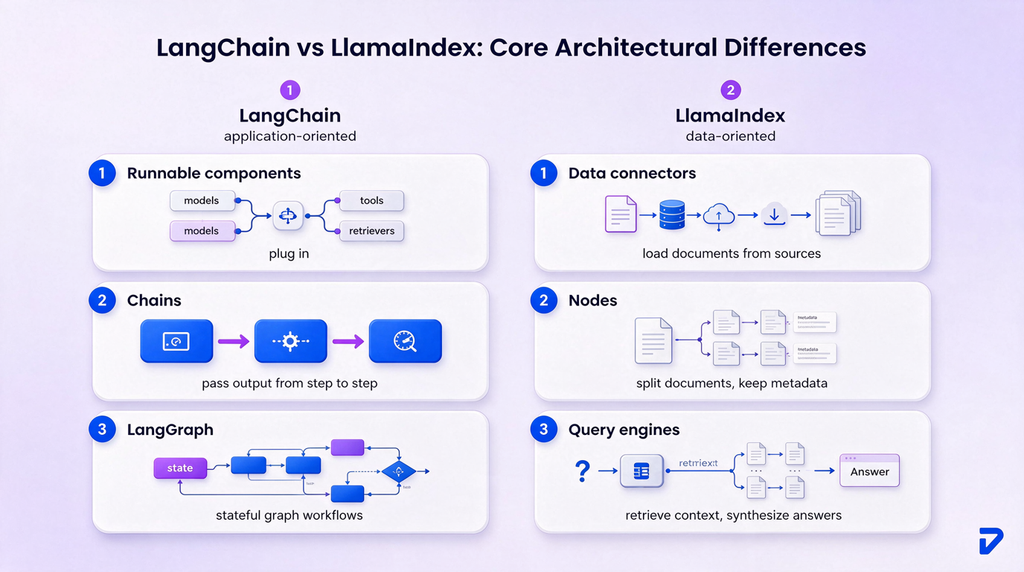
Among RAG frameworks, the core split is simple. LangChain is organized around the application, while LlamaIndex is organized around the data. That difference shapes nearly every API and default you will touch.
That difference is the heart of the LangChain vs LlamaIndex choice. LangChain asks what the application should do next; LlamaIndex asks which data the model needs right now. Neither question matters more in general, but one usually dominates a given project.
LangChain’s Application-Oriented Architecture
LangChain treats a RAG system as one component inside a larger application. Models, tools, and retrievers plug in as interchangeable runnable components, and chains pass the output of one step to the next. Vector-store connections are standard integrations. For branching or long-running flows, LangGraph models the workflow as a graph of nodes with shared state.
LlamaIndex’s Data-Oriented Architecture
LlamaIndex starts with documents. Data connectors load them, transformations split them into nodes, and indexes organize those nodes for retrieval. A query engine then retrieves context and synthesizes a response. Because nodes carry metadata and relationships, retrieval can respect document structure, such as a table sitting inside one section of a report.
Feature-by-Feature Comparison
This LangChain vs LlamaIndex comparison table works as a quick reference. Each row compresses a larger tradeoff, so read the notes beneath it before concluding.
| Comparison area | LangChain | LlamaIndex |
| Primary focus | LLM application development and orchestration | Data ingestion, indexing, and retrieval |
| Document ingestion | Document loaders and integrations | Data connectors and parsing tools |
| Indexing | Works with external vector stores and retrievers | Provides indexing abstractions |
| Retrieval | Multiple retriever patterns | Advanced data-centric retrieval patterns |
| Workflow orchestration | LangChain and LangGraph | Workflows and AgentWorkflow |
| Integrations | Broad model, tool, and data integrations | Data-source, reader, and retrieval integrations |
| Best suited to | Applications with varied LLM workflows | Applications with complex data and retrieval needs |
Ingestion and indexing show the clearest gap. LangChain relies on document loaders and external vector stores, so you assemble more of the pipeline yourself. LlamaIndex supplies connectors, parsers, and several index types in one data layer. If your sources are messy, that built-in structure saves real engineering time.
Retrieval differs in emphasis. LangChain offers several retriever patterns, including ensemble and parent-document retrievers. LlamaIndex goes deeper on data-centric options such as hybrid search, recursive retrieval, and sub-question decomposition. Both can reach strong results, but LlamaIndex exposes more retrieval controls by default.
Integration counts deserve careful reading. LangChain’s June 2026 comparison reports more than 1,000 integrations across its ecosystem and 300+ LlamaIndex integration packages, including 158 reader packages verified in May 2026. These are vendor-published figures, not an independent benchmark. Treat them as a signal of breadth, not quality.
Building a RAG application?
Partner with Pinnasys to build the right solution with the right framework.
How LangChain and LlamaIndex Manage RAG Workflows
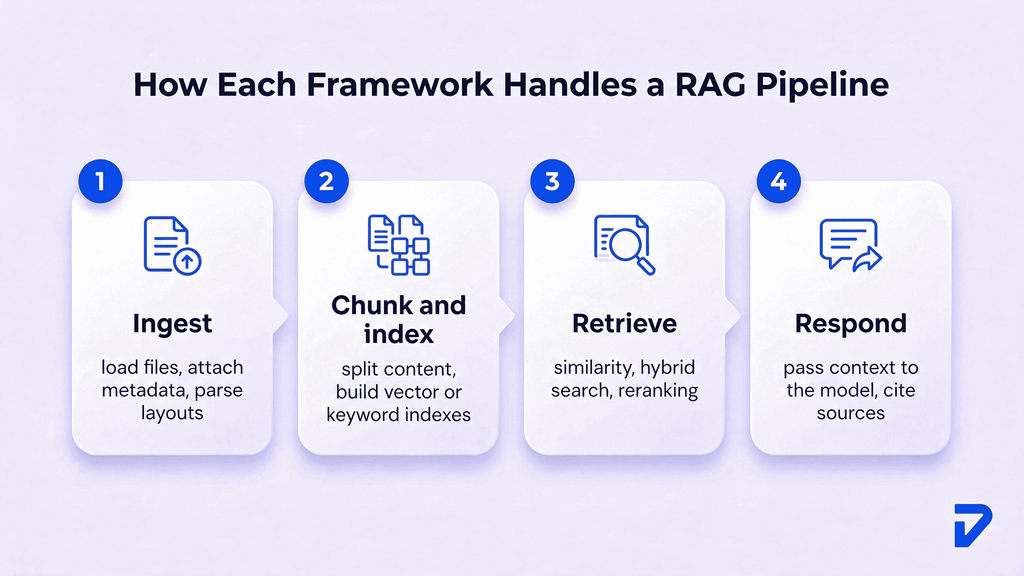
A RAG pipeline has four stages: ingest, index, retrieve, and respond. The LangChain vs LlamaIndex differences show up at every one of them.
Demand for this infrastructure keeps climbing. Databricks reported 377% year-over-year growth in vector databases supporting RAG applications, drawing on usage data from more than 10,000 organizations. That is Databricks customer data, not a market-wide measurement. Still, it shows why retrieval quality now sits at the center of AI projects.
Data Ingestion and Document Processing
LangChain loads files through document loaders, attaches metadata, and hands the results to a splitter. Coverage is broad, though parsing complex layouts often requires an extra tool. LlamaIndex pairs its readers with LlamaParse, which extracts charts, tables, and mixed layouts. For a folder of clean text files, either works. For scanned contracts, the gap widens.
Chunking and Indexing
Chunk boundaries decide what your retriever can find. LangChain’s text splitters cover fixed-size and recursive strategies, and semantic chunking is available too. LlamaIndex parses documents into nodes, keeps parent-child relationships, and builds vector, keyword, or property-graph indexes on top. Metadata extraction matters in both, because filters and citations depend on it.
Retrieval and Query Processing
Basic similarity search works in both. Beyond that, LlamaIndex ships hybrid retrieval, recursive retrieval, and sub-question decomposition as first-class patterns, while LangChain offers multi-query, self-query, and contextual-compression retrievers. A second-stage reranking model plugs into either one. Query transformation, such as rewriting or splitting a question, helps most when users ask vague or multi-part questions.
Response Generation
Both frameworks pass retrieved context to the model inside a prompt. LlamaIndex wraps this step in response synthesizers that can refine or summarize across many chunks and return source nodes for citations. LangChain gives you explicit control over the prompt and output format. Either way, fewer hallucinations come from better retrieval more than from the synthesis step.
Performance, Scalability, and Production Considerations
In any LangChain vs LlamaIndex performance debate, remember that neither framework is inherently faster. Latency and cost depend on your model, embedding service, vector database, document volume, retrieval strategy, and infrastructure. Test with your own data.
Measure the pieces separately. Index build time grows with corpus size and parsing depth, while query latency depends on retrieval, reranking, and the model call. Memory use climbs with in-process indexes. Cached embeddings, batched ingestion, and asynchronous retrieval usually deliver bigger gains than swapping frameworks.
Observability and evaluation decide whether a prototype survives launch. You need traces that show what was retrieved, which prompt ran, and where an answer drifted. LangSmith works with LangChain, LlamaIndex, and custom code. Build a small evaluation set early, then rerun it after every change.
Maintenance is the quieter cost. Both libraries release often, so pin versions, wrap framework calls behind your own interfaces, and budget time for upgrades. Deployment complexity rises sharply once an application needs queues, state stores, and human review steps.
The pressure to get this right is growing. McKinsey’s 2025 State of AI survey found that 62% of respondents were at least experimenting with AI agents, while 23% were scaling them somewhere. Those figures measure agent adoption, not RAG performance. They do show why prototypes must become systems that teams can evaluate and maintain.
When Should You Choose LangChain?
LangChain for RAG makes the most sense when the application around retrieval is the harder problem. That usually means connecting several models and external tools, running multi-step assistant workflows, or applying conditional logic and state management. The LangChain reference documentation lists the components you would compose.
LangGraph earns its place when a workflow needs durable state, retries, branching, or human approval. It resumes from saved checkpoints, so an agent can pause for an approval and continue without repeating earlier steps. LlamaIndex Workflows offer checkpointing as an opt-in instead.
A support assistant that checks policy documents, opens a ticket, and waits for a manager’s sign-off is a typical fit. Teams that need AI agent engineering for flows like this rely on that orchestration layer. No benchmark here supports a speed claim, so none is made.
When Should You Choose LlamaIndex?
LlamaIndex for RAG fits best when document processing, indexing, and retrieval quality are the hard parts. Typical cases include document-heavy applications, knowledge assistants spanning several data sources, and projects full of complex PDFs, tables, charts, and structured files. Its query engines and index types give you more retrieval controls out of the box.
Document parsing is the standout. LlamaIndex lists support for 130+ file formats through LlamaParse. That figure describes the parsing product, not a guarantee for every integration, so test your worst documents first. Policy manuals with nested tables make a good stress test.
Orchestration is not absent. Workflows and AgentWorkflow handle event-driven, multi-step logic, and many document assistants never need more. Teams usually outgrow them only when approvals, long waits, or many external tools enter the picture.
Can You Use LangChain and LlamaIndex Together?
Yes, and many production teams do. The LangChain vs LlamaIndex choice is not always either-or. A hybrid architecture gives each framework the job it handles best:
- LlamaIndex handles document ingestion, indexing, and specialized retrieval.
- LangChain or LangGraph manages application logic and multi-step workflows.
- A shared vector database stores the embeddings.
- The LLM generates responses from the retrieved context.
- Evaluation and observability monitor the complete pipeline.
Picture an internal knowledge assistant. LlamaIndex parses policy documents and technical manuals, then retrieves the relevant sections. LangGraph takes over from there, deciding whether to answer directly, open a ticket, or pause for approval. That last step is the kind of process covered by AI automation services.
LangChain’s community packages include a LlamaIndex retriever integration for the basic case. For production, its comparison article recommends wrapping a LlamaIndex query engine as a tool inside the agent loop. That keeps invocation, retries, and error handling under your control.
Choosing the Right Framework for Your RAG Architecture
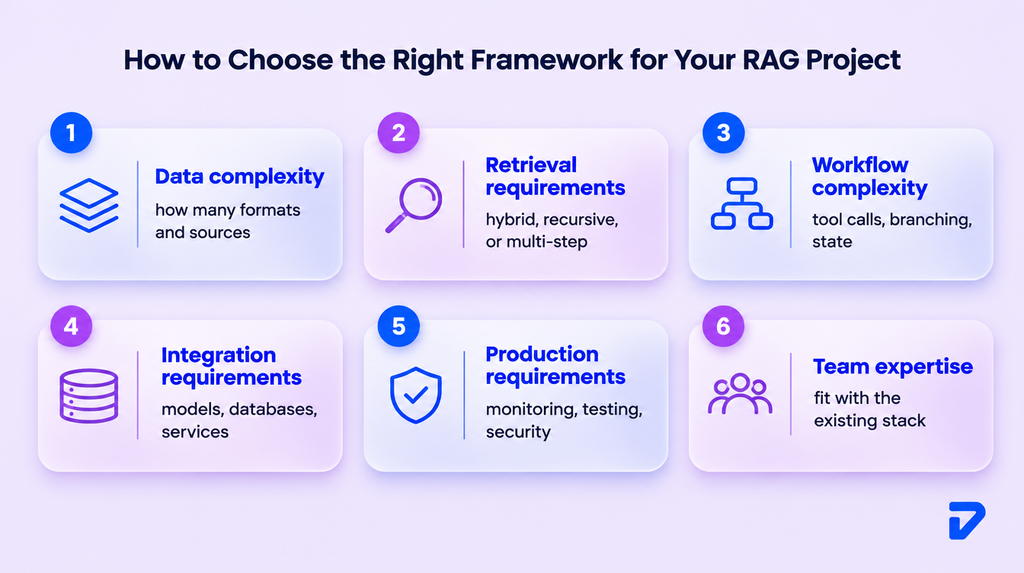
Start with where the complexity lives, then test one real workload before committing. Six criteria cover most decisions:
- Data complexity: How many formats and sources must the system process?
- Retrieval requirements: Does it need hybrid, recursive, or multi-step retrieval?
- Workflow complexity: Will the application need tool calls, branching, or state management?
- Integration requirements: Which models, databases, and application services must connect?
- Production requirements: What do monitoring, testing, security, and maintenance demand?
- Team expertise: Which framework fits the team’s existing development stack?
A short decision guide follows from those answers:
- Choose LangChain when application orchestration and integration are the primary challenges.
- Choose LlamaIndex when document processing, indexing, and retrieval are the primary challenges.
- Consider both when the application has substantial requirements in both areas.
No LangChain vs LlamaIndex scorecard replaces a pilot. Score each criterion from one to five, then run a real workload through your top choice. When the results are mixed, an outside view helps, and a short AI consulting engagement can map requirements before any code is written.
Conclusion
The LangChain vs LlamaIndex question has no universal answer. LangChain fits projects where orchestration, tool use, and state management carry the load. LlamaIndex fits projects where parsing, indexing, and retrieval quality decide success. Many production systems combine them. The right choice depends on where your RAG application’s complexity actually sits.
Once the framework is chosen, the harder work begins. Models, vector databases, and existing systems must connect so the assistant holds up under real traffic, and strong AI integration services shorten that path.
Pinnasys designs, integrates, and builds RAG applications from actual technical requirements, so the framework follows the problem. Bring your data and workflows, and the team will help you choose.
Key Takeaways from the Blog
- Neither framework is universally better; the right pick follows where project complexity sits.
- LangChain suits orchestration-heavy applications with several tools, models, and stateful workflows.
- LlamaIndex suits document-heavy projects that depend on parsing, indexing, and advanced retrieval.
- A hybrid stack pairs LlamaIndex retrieval with LangGraph orchestration and shared observability.
- Speed claims need testing against your own data, since performance depends on the whole pipeline.
Frequently Asked Questions
Is LangChain better than LlamaIndex for RAG?
Not universally. LangChain suits RAG that sits inside a larger agent or tool workflow, while LlamaIndex suits document-heavy retrieval. Test both against a representative set of real user questions, then compare retrieval accuracy and engineering effort before you commit.
What is the main difference between LangChain and LlamaIndex?
LangChain is an orchestration framework for connecting models, tools, and services. LlamaIndex is a data framework for ingesting, indexing, and retrieving documents. LangGraph, the stateful layer in the LangChain ecosystem, was used by 18.8% of 2026 Stack Overflow survey respondents.
Can LangChain and LlamaIndex be used together?
Yes. A common pattern wraps a LlamaIndex query engine as a tool that a LangGraph node calls. LlamaIndex handles parsing and retrieval, while LangGraph runs the agent loop and approval steps. Both can share one vector database.
Which framework is better for document-heavy RAG applications?
LlamaIndex usually fits better, because LlamaParse reads charts, tables, and mixed layouts, and its node model preserves document structure. Scanned reports, nested tables, and multi-source knowledge bases benefit most. Clean text files rarely justify the extra tooling.
Does LlamaIndex support vector databases?
Yes. LlamaIndex connects to many vector databases through integration packages, and its VectorStoreIndex works with them directly. It also offers summary, tree, keyword, and property-graph indexes, so vector search is one retrieval option among several.
Can LangChain work with existing vector databases?
Yes. LangChain’s vector-store integrations let retrievers point at an existing index, so you keep your current database and metadata filters. Confirm that your embedding model matches the one used when the vectors were first created.