


No, agentic AI is not the same as an AI agent. An AI agent completes one defined task when prompted. Agentic AI is the wider system that holds a goal, plans the steps, and directs several agents until the outcome is reached. Most deployments today are agents, not agentic systems.
Stanford’s 2026 AI Index economy chapter reports that 70% of organizations now use generative AI in at least one function. Yet AI agent deployment sits in the single digits across nearly every business function. That gap between broad interest and narrow execution is where confused vocabulary starts costing real money.
When a mid-market operator approves an autonomous system and receives a scripted assistant, the difference surfaces on the invoice. So asking whether agentic AI is the same as an AI agent is a procurement question, not a semantic one. This piece settles the definitions, the architecture, the security exposure, and the choice in front of you.
What Is Agentic AI Terminology?
Agentic AI terminology is the shared language that vendors, analysts, and engineers use to describe software that reasons, decides, and acts. At the moment, that language is inconsistent, and buyers absorb the cost of the confusion. Because the top of this stack commands the highest contract value, definitions tend to slide toward whatever closes a deal. A short working glossary is therefore the cheapest form of due diligence available to any team weighing an AI consulting and roadmap engagement this year.
Why the Terms Get Used Interchangeably
Both terms describe software that acts without a person clicking through every screen, so the surface behavior looks identical from a demo seat. The real separation sits in the architecture, which no demo reveals. Consider a support bot that resolves a refund and an orchestrated system that reworks an entire claim; for ninety seconds, both appear equally autonomous to the person watching.
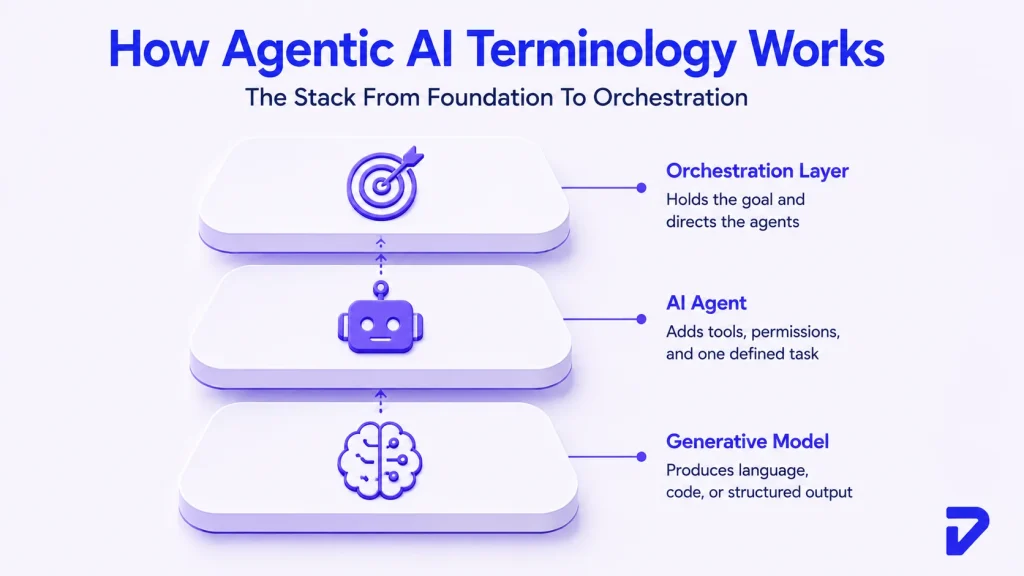
Three labels dominate the conversation, and each sits one layer above the last. Generative AI produces text, code, or images. An AI agent wraps that model in tools and a defined task. Agentic AI coordinates several agents against a broader goal. Vendors collapse the three precisely because the highest layer carries the richest price tag.
What Is an AI Agent?
An AI agent is a single software program that pairs a language model with a fixed set of tools to finish one task for a user or another system. Its boundaries are drawn in advance by engineers rather than chosen at runtime. Order-status lookups, invoice extraction, and password resets all fit this shape cleanly. Most production deployments in conversational AI and support automation are agents in this precise sense, whatever the marketing page happens to claim.
An agent perceives an input, reasons over it, calls a tool, and returns a result inside a path someone defined ahead of time. Nothing about that path shifts based on what the agent learns partway through. As an illustration, a returns agent checks eligibility, updates the ticket, and stops, regardless of what the customer types next.
How AI Agents Work in Practice
Practical agents rest on three parts: a model for language, an allowlist of tools such as a CRM lookup, and guardrails that cap what those tools may reach. To make that concrete, a distributor’s quote agent might pull pricing tiers, apply one discount rule, and draft a response for a human rep to approve before anything is sent.
What Is Agentic AI?
Agentic AI is the system layer that accepts a goal, breaks it into steps, chooses which agents and tools handle each step, and revises the plan when conditions change. Autonomy lives at this layer, not inside any individual agent. Because the plan is generated as the work unfolds rather than written in advance, the oversight burden climbs sharply. The distinction matters most in messy, cross-system work, which is exactly where custom AI and agent engineering earn their keep.
The line between the two is not academic. IBM states it directly in its definition of agentic AI:
“Agentic AI is an artificial intelligence system that can accomplish a specific goal with limited supervision.”
That framing captures the ambition. What follows is the architecture that has to hold it up.
The Four Capabilities That Define It
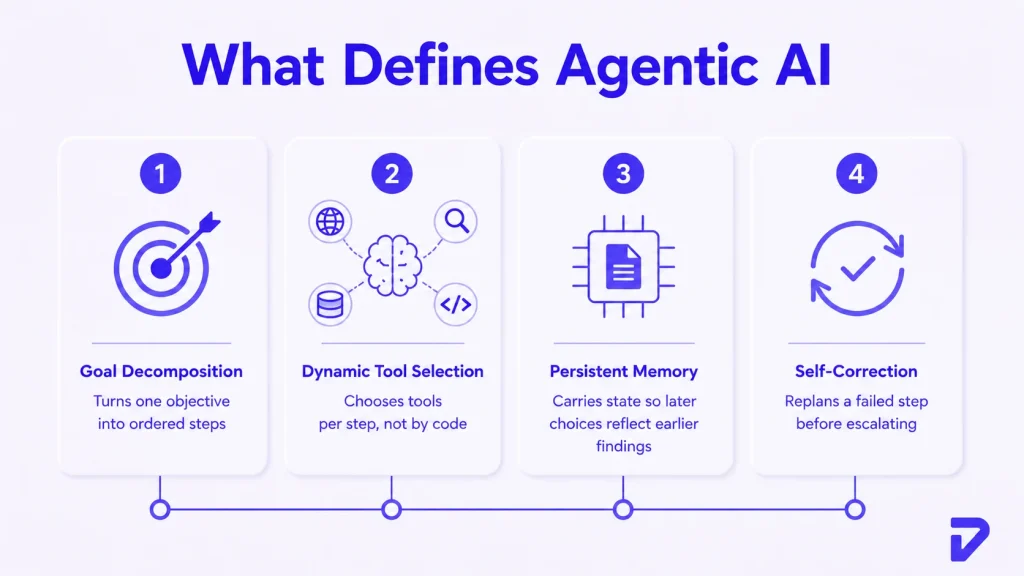
Four capabilities separate a real agentic system from a bundle of agents:
- Goal decomposition: It turns one objective into an ordered sequence of executable steps.
- Dynamic tool selection: It picks tools per step instead of following a hardcoded order.
- Persistent memory: It carries state across steps, so later choices reflect earlier findings.
- Self-correction: It spots a failed step, replans, and tries another route before escalating.
Where Does Generative AI Fit Into Agentic AI Terminology?
Generative AI supplies the reasoning, while agents and agentic systems supply the structure around it. On its own, a language model predicts output; it cannot query your ERP, write to a ticket, or verify whether its own answer held up. Attach retrieval, tools, and permissions, and that same model becomes the engine inside an agent. Retrieval that grounds those answers in your own documents is usually the bridge, and it anchors most AI search and knowledge work.
Generative AI Is the Model, Not the System
A model mistaken for a system is the root of many stalled pilots. IBM draws the boundary cleanly in its comparison of the two ideas. It describes agentic AI as the broader concept of solving problems with limited supervision, and an AI agent as a specific component inside that system.
In other words, the model is closer to a database engine than to a finished application. For example, a finance team that wires a chatbot to invoices without retrieval, audit logs, or approval gates has bought a component while expecting a product. The gap then shows up the first time the numbers matter.
Is Agentic AI the Same Thing as an AI Agent?
Agentic AI is not the same thing as an AI agent, and the gap shows up across seven design dimensions rather than one. A side-by-side read settles the question faster than two vendor decks in sequence.
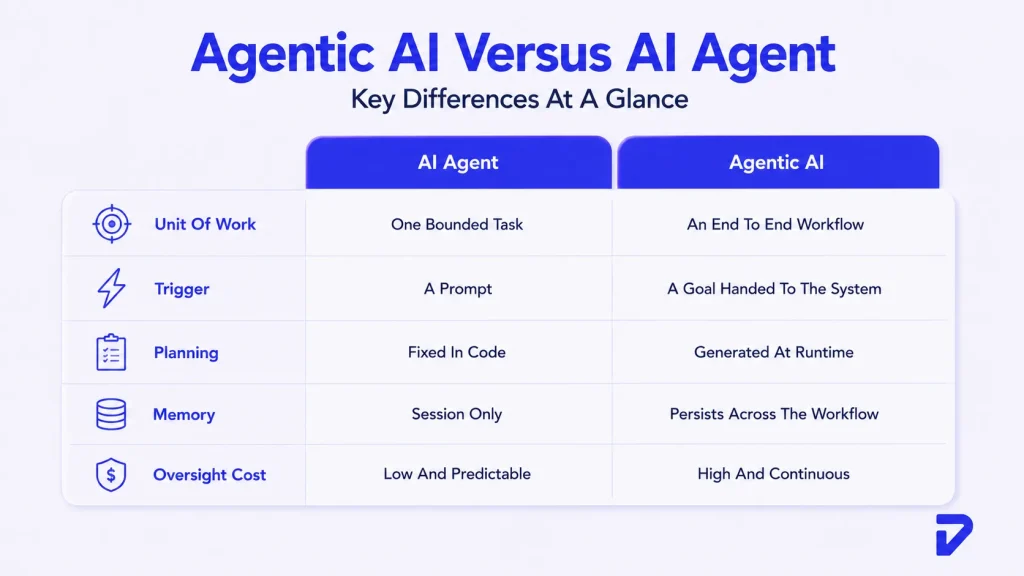
| Dimension | AI agent | Agentic AI |
| Unit of work | One bounded task | An end-to-end workflow |
| Trigger | A prompt or a system event | A goal handed to the system |
| Planning | Fixed, written in code | Generated at runtime |
| Tool use | A short allowlist | Selected step by step |
| Memory | Usually session only | Persists across the workflow |
| Failure handling | Escalates to a human | Replans, then escalates |
| Oversight cost | Low and predictable | High and continuous |
Scope: Task vs. Workflow
Scope is the cleanest test to apply. An agent answers whether one task finished correctly, whereas an agentic system answers whether the outcome actually happened. In field services, a parts-lookup agent confirms stock availability, while an agentic layer would confirm the technician arrived on site with the correct part in hand.
Decision-Making: Bounded Rules vs. Strategic Reasoning
Agents decide within limits an engineer wrote down in advance. Agentic systems, by contrast, weigh tradeoffs nobody enumerated ahead of time, such as whether to expedite a shipment or hold it for consolidation. That freedom pays off in unpredictable processes, yet it removes the predictability that tightly regulated workflows depend on.
Does Deploying Multiple AI Agents Automatically Create Agentic AI?
No, running several agents at once does not make a system agentic, and it does not settle whether agentic AI is the same as an AI agent either. Ten agents wired into a fixed sequence remain a workflow, however elaborate the architecture diagram looks on a slide.
What converts a set of agents into agentic AI is an orchestration layer with the authority to choose the sequence, reassign work, and rewrite the plan mid-run. Absent that authority, you own parallel automation plus the operating cost of ten separate integrations.
Why More Agents Doesn’t Mean More Autonomy
Autonomy is a property of the decision layer, never a function of headcount. Each additional agent multiplies the surface you have to monitor while the decision logic stays exactly where it began. To put it plainly, a procurement team running six agents behind one fixed rulebook still routes every exception to the same buyer it relied on before.
How Does Agentic AI Terminology Work?
Agentic AI terminology works as a layered stack, so the useful question is which layer a system actually reaches rather than which label it wears. The model sits underneath, the agent with its tools sits above it, and the orchestration layer that holds the goal sits above that. Every layer adds capability along with cost, latency, and oversight. Two worked examples make the stack concrete.
A Simple Booking Example
A booking agent checks availability, holds a slot, sends confirmation, and then stops. An agentic booking system, given “get this team to Chicago under budget,” compares fares against policy, rebooks when a price moves, and notifies travelers along the way. Same domain, different authority, and a materially different failure mode when something breaks.
An IT Ticketing Example
A ticketing agent classifies an incoming request and routes it to the correct queue. An agentic service desk instead reads the ticket, pulls device history, checks for a matching prior incident, applies the fix, and escalates only the outliers. Naturally, the second version needs write access to systems the first one never touched.
Not sure whether your workflow needs one agent or an agentic layer?
Pinnasys audits the process first, then builds only the architecture the outcome justifies. Map your workflow with our agent engineering team.
Are There Security Risks That Differ Between the Two?
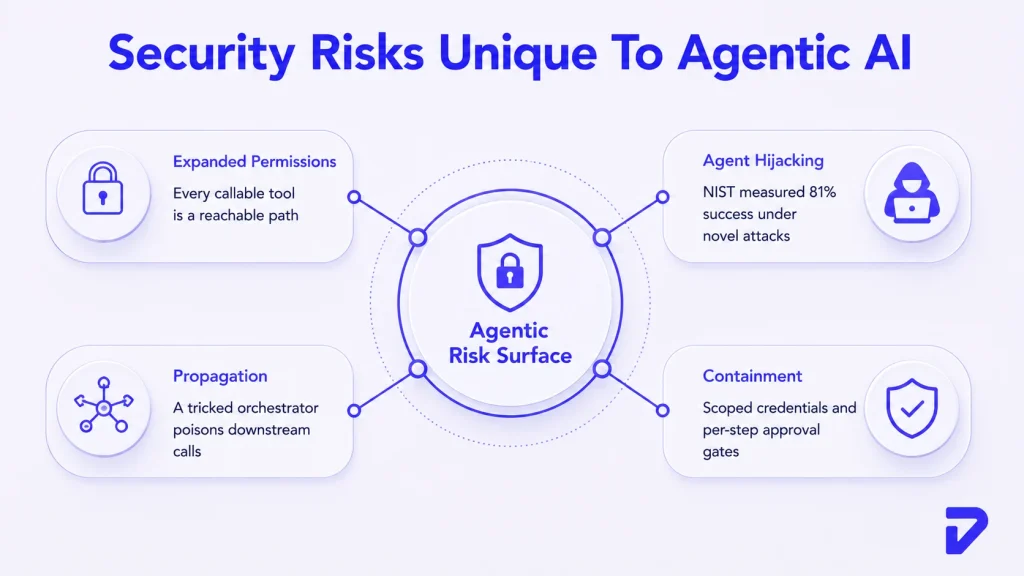
Yes, and here the fact that agentic AI is not the same as an AI agent has real security weight, since risk scales with authority rather than model quality. In red-team testing by the National Institute of Standards and Technology, novel attacks pushed the agent hijacking success rate from 11% to 81% against a leading model.
An agent with read access to a knowledge base carries a contained blast radius. An agentic system with write access across finance, ticketing, and email carries a far larger one, which is why governance belongs in the build rather than the retrofit.
Expanded Permissions Mean an Expanded Attack Surface
Every tool an agentic system may call becomes a path an attacker can try to reach. The federal government has flagged the pattern directly: its request for information on AI agent security warns that agents taking autonomous actions may be susceptible to hijacking, backdoor attacks, and other exploits. Scoped credentials and per-step approval gates contain that exposure far better than one broad service account.
Prompt Injection Is a Bigger Concern at the Agentic Layer
Prompt injection grows more dangerous the moment an agent can act on retrieved data. When a single agent is tricked, one task goes wrong. When an orchestrator is tricked, the poisoned instruction propagates into every downstream tool call it authorizes. IBM frames the stakes plainly in its guidance on agentic accountability. Autonomous agents operate at machine speed and act continuously across APIs and tools, so a single hijacked instruction can ripple outward before anyone notices.
Does Agentic AI Replace AI Agents, or Work Alongside Them?
Agentic AI does not replace AI agents; it employs them. The orchestration layer depends on reliable workers underneath it, and those workers are agents with narrow scopes and predictable behavior.
Strip them out, and the orchestrator has to handle both strategy and execution, which is how latency and cost run away. So the honest answer to whether agentic AI is the same as an AI agent is no; the two are layers of one stack, not rivals for the same job.
Why the Future Is Both, Not Either/Or
Mature stacks pair narrow agents for repeatable work with an agentic layer reserved for exceptions. Picture a distributor: agents handle order entry and stock checks every single day. An agentic layer steps in only when a supplier misses a delivery, and the entire promise date has to be rebuilt from scratch.
How Do I Know Which One My Business Actually Needs?
Because agentic AI is not the same as an AI agent, start from the process rather than the technology; the answer follows from how much variation the work contains. Repeatable, high-volume steps with a documented rulebook suit an agent. Work that branches unpredictably and currently eats senior judgment suits an agentic system, provided you can fund the oversight it demands.
As Prakash Saini, Head of AI Engineering at Pinnasys, puts it:
“The word agentic should describe your architecture, not your ambition. If a human still approves every step, you have bought an agent with a longer sales deck attached.”
When an AI Agent Is the Right Fit
An agent is the right call when these conditions hold:
- The task runs on a documented, stable set of rules.
- Volume is high, and each instance looks broadly alike.
- A wrong output is cheap to catch and cheap to reverse.
- Auditors expect a traceable, repeatable path every time.
When Agentic AI Is the Right Fit
An agentic system earns its cost when the opposite is true:
- The workflow crosses three or more systems with real dependencies.
- Exceptions, not the happy path, consume most of the effort.
- Outcomes matter more than task completion, and both are measurable.
- Your team can fund continuous monitoring rather than a one-time launch.
What’s the Most Common Mistake Businesses Make With This Terminology?
The most common mistake is buying the label instead of the architecture. Teams approve an agentic budget, receive a scripted assistant, and then measure it against autonomous expectations it was never built to meet. Since terminology drives the purchase order, a mislabeled system is set up to disappoint before a single line of code runs.
Put three questions to any vendor: who writes the plan, who selects the tools, and what happens when a step fails. Answers that name a human or a config file describe an agent. Answers that name the system itself describe agentic AI, and the price you agree to should reflect which one you are genuinely buying.
The Bottom Line
Agentic AI is not the same as an AI agent, and treating the two as synonyms is what turns a promising pilot into a written-off cost. An agent finishes a task inside boundaries you set. An agentic system owns an outcome and writes its own path to reach it, buying flexibility at the price of continuous oversight.
Match the architecture to the variation in your process, then govern it as if it can act, because it can. When you are ready to draw that line for a specific workflow, Pinnasys builds and runs both.
Key Takeaways from the Article
- An AI agent completes one bounded task; agentic AI owns an entire outcome.
- Autonomy lives in the orchestration layer, never inside a single agent.
- More agents running in parallel do not make a system agentic.
- Generative models are components, while agents and agentic systems are architectures.
- Broader permissions expand the attack surface faster than they expand value.
Frequently Asked Questions on Agentic AI Terminology
Is ChatGPT an AI agent or agentic AI?
Neither by default. A chat interface over a language model is generative AI. It becomes an AI agent once tools, permissions, and a defined task are attached, and agentic only with an orchestration layer directing it above.
What is the difference between agentic AI and robotic process automation?
Robotic process automation follows recorded, deterministic steps and breaks when a screen changes. Agentic AI interprets intent and replans around change, which is why the two suit very different processes despite frequent conflation in vendor decks.
Do AI agents need human oversight in production?
Given that NIST recorded agent hijacking success rates as high as 81% under novel attacks, approval gates on write actions remain the standard control for both single agents and full agentic systems.
What does multi-agent orchestration mean in practice?
It means a coordinating layer assigns work across specialized agents, tracks shared state, and resolves conflicts between their outputs. Without that coordinating authority, multiple agents amount to parallel automation rather than a genuinely agentic system.





Prakash C. Saini
Prakash Saini is the Founder & CEO of Pinnasys. With over a decade in digital transformation and building production systems, he grew an engineering team from 2 to 50 people and has led the delivery of 100+ production digital systems. Products built under his leadership have raised millions in funding and generated over $50 million in revenue. He holds an Executive MBA from IIM Kozhikode and today leads the AI engineering team at Pinnasys.