
The right conversational AI development company can show you a live assistant, name its resolution and escalation numbers, and stay accountable after launch. Credentials and demos predict far less than production evidence does.
Deloitte’s 2026 survey of more than 3,000 enterprise leaders found AI moving out of the pilot phase, while only a minority of organizations have operationalized it at real enterprise scale. Support and operations teams feel that gap first, which is why the search for a conversational AI development company usually starts with a scar. Behind it sits a chatbot pilot that deflected tickets and got quietly switched off.
Vendors are easy to find. Dozens will answer an RFP, and their homepages read identically. The difference shows up months after signature, in resolution rates, escalation quality, and who fixes the assistant when a model update changes its behavior. That work sits much closer to custom AI development than buying software, and the evaluation below reflects that.
What Is a Conversational AI Development Company?
A conversational AI development company designs, builds, integrates, and operates AI assistants that understand natural language, hold multi-turn conversations, and take actions inside your business systems. You receive a working system on your own infrastructure, with its code, prompts, and data under your control, rather than a license to a product someone else runs.
Conversational AI vs AI Chatbots
A traditional AI chatbot matches messages to predefined intents and returns scripted replies, which suits simple FAQs. Conversational AI uses natural language understanding to hold multi-turn dialogue, retrieve company knowledge, and take actions in live systems.
| Dimension | AI chatbot | Conversational AI |
| How it understands users | Keyword or intent matching | Natural language understanding with context |
| Conversation depth | Single question and answer | Multi-turn dialogue with memory |
| Knowledge source | Hand-written responses | Retrieval over approved company content |
| System access | Read-only, if any | Scoped read and write into core systems |
| Typical failure | Dead end and a fallback message | A wrong action, so guardrails matter |
| Best fit | FAQ traffic and simple routing | Support, sales, and operations workflows |
| Success metric | Deflection rate | Resolution rate and cost per contact |
When Should You Hire a Conversational AI Development Company?
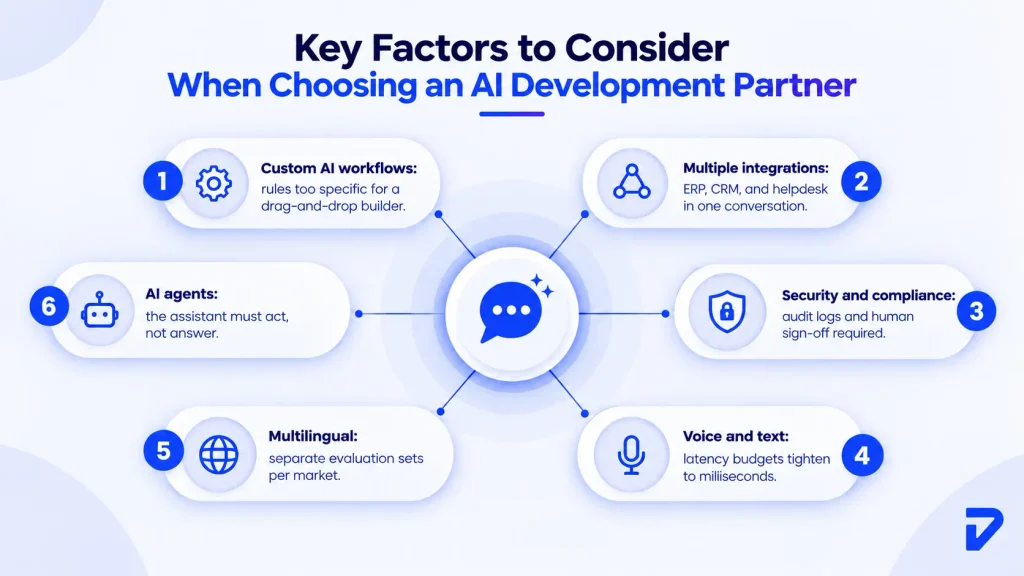
McKinsey’s global survey found 88% of organizations now use AI in at least one business function, while only about a third have scaled it across the enterprise. That gap is usually a delivery problem rather than a model problem, and a specialist partner makes sense once your requirements outgrow what a standard platform can handle. Consider hiring one if you need:
- Custom workflows: Business rules that vary by customer tier, region, or contract year, which drag-and-drop builders cannot express without fragile workarounds.
- Multiple system integrations: An assistant that reads and writes across your CRM, ERP, and help desk, where authentication models and undocumented API quirks stall most builds.
- Enterprise security and compliance: Decision logs, retention rules, and human sign-off on consequential actions such as payouts, which cost far more to retrofit than to build in.
- Voice and text AI: Voice turns with latency budgets of a few hundred milliseconds and reliable barge-in handling, the point where lightweight vendors quietly fall away.
- Multilingual conversational AI: Separate evaluation sets per language, reviewed by native speakers, since intent phrasing and escalation etiquette differ by market.
- AI agents instead of a basic FAQ bot: Sierra’s tau-bench study found leading tool-calling agents solved fewer than half of realistic customer tasks, which is why agentic AI services demand tighter guardrails.
How to Hire the Right Conversational AI Development Company?
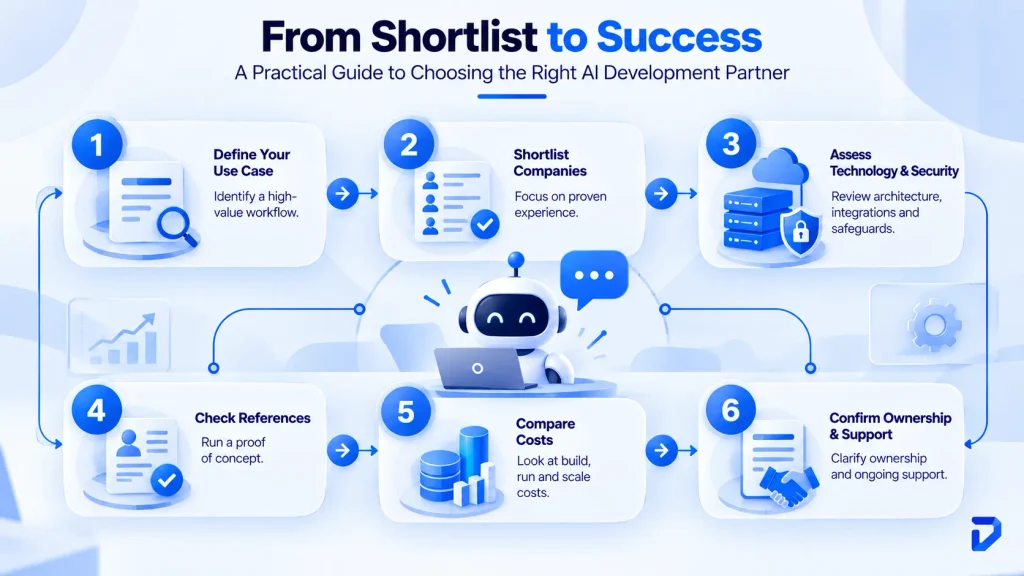
1. Define Your Use Case and Technical Requirements
Start with one high-volume workflow, such as order tracking or appointment changes. Define the expected outcome, channels, integrations, data requirements, peak usage, and whether the AI needs to answer questions, retrieve information, or take actions.
2. Shortlist Companies With Production Experience
Shortlist 5–7 companies, then narrow them to 3 based on relevant production deployments, case studies, and technical expertise. Ask for measurable results such as containment rate, escalation rate, response accuracy, and examples of conversations intentionally handed to human agents.
3. Evaluate Architecture, Integrations, and Security
Ask how the company handles RAG, tool calling, vector databases, integrations, guardrails, and human escalation. Anthropic recommends starting with the simplest architecture that meets the use case rather than adding unnecessary agentic complexity.
4. Check References and Run a Proof of Concept
Ask for 2 relevant production references and specifically discuss what went wrong, how it was detected, and how quickly it was fixed. Before committing to a full build, run a paid proof of concept using your own historical conversations and agree on measurable success criteria.
5. Compare Build, Run, and Scale Costs
Separate the proposal into development costs, monthly operating costs, and scaling costs. Include LLM/API usage, infrastructure, monitoring, human review, maintenance, and future model changes so the cheapest initial quote doesn’t hide higher operating costs.
6. Confirm Ownership and Post-Launch Support
Put ownership of source code, prompts, evaluation datasets, integrations, and configurations in the contract. Also define SLA response times, maintenance responsibilities, regression testing after model updates, and the handover process.
Questions to Ask a Conversational AI Development Company
These questions separate firms with production experience from firms still learning on your budget:
- Which conversational AI assistants do you have in production today, and how long have they been live?
- Can you share client references for projects similar to ours?
- How do you ground responses in our business data, and what does the assistant do when it is uncertain?
- What happens when a downstream API fails or times out during an active conversation?
- Where is conversation data stored, how long is it retained, and is any of it used for model training?
- How do you monitor the assistant after launch and catch regressions from prompt, model, or content changes?
- How do you price initial development, ongoing AI and infrastructure costs, and usage growth separately?
- Who owns the code, prompts, workflows, and integrations, and what would it cost to move to another provider?
Conversational AI Development Process
A vendor who can describe each stage, its exit criteria, and who signs off is describing something they have run before. A sound process usually covers six stages:
- Discovery and strategy: Stakeholder interviews, a review of historical conversations, and a systems inventory, ending with a written problem statement, a baseline number, and a clear line on which intents stay with humans. A short AI readiness assessment tests whether your data can support the plan.
- Architecture and data preparation: Model choice, retrieval design, and the permission model, plus deduplicating content and retiring outdated documents. Our comparison of agentic AI versus traditional AI shows where an acting system earns its extra complexity. Data cleanup is the most common reason timelines slip.
- Prototype and proof of concept: A two-week prototype tests the riskiest assumption, usually retrieval accuracy, and a proof of concept then runs your hardest historical conversations against an agreed pass mark.
- Development and integration: Prompts, retrieval tuning, tool definitions, and escalation logic, reviewed in weekly demos. Permissions are scoped per action, and grounding often relies on enterprise search and retrieval infrastructure that outlives the project.
- Testing and compliance: Per-intent pass rates, adversarial cases such as prompt injection, and checks on logging, retention, and disclosure. The Cloud Security Alliance confirms EU AI Act Article 50 transparency duties became enforceable on schedule.
- Deployment and optimization: A canary release to 5% of traffic with a tested rollback path, followed by daily transcript reviews that feed every failure back into the evaluation set.
Still comparing vendors who only show demos?
Pinnasys builds conversational AI that resolves real customer issues inside your CRM, ERP, and help desk, then keeps improving it with you after launch.
How Much Does Conversational AI Development Cost?
Scope drives price far more than model choice does. Most mid-market builds land between roughly $40,000 and $150,000 for the initial workflow, with operating costs that run monthly and grow with volume. Epoch AI’s tracking of inference price trends shows the cost of a fixed capability level falling sharply each year, so the running side of that equation is the one worth modeling carefully.
| Build tier | Typical range | Timeline | What it covers |
| Scripted FAQ assistant | $5,000 to $15,000 | 3 to 5 weeks | One channel, fixed answers, no system writes |
| Grounded LLM assistant | $30,000 to $80,000 | 8 to 14 weeks | Retrieval over your content, one or two integrations |
| Multi-system agentic assistant | $80,000 to $250,000 | 16 to 28 weeks | Actions across core systems, approval gates, audit logs |
| Voice and omnichannel platform | $150,000 upward | 5 to 9 months | Voice, messaging, and web parity with compliance controls |
Factors That Affect Conversational AI Development Cost
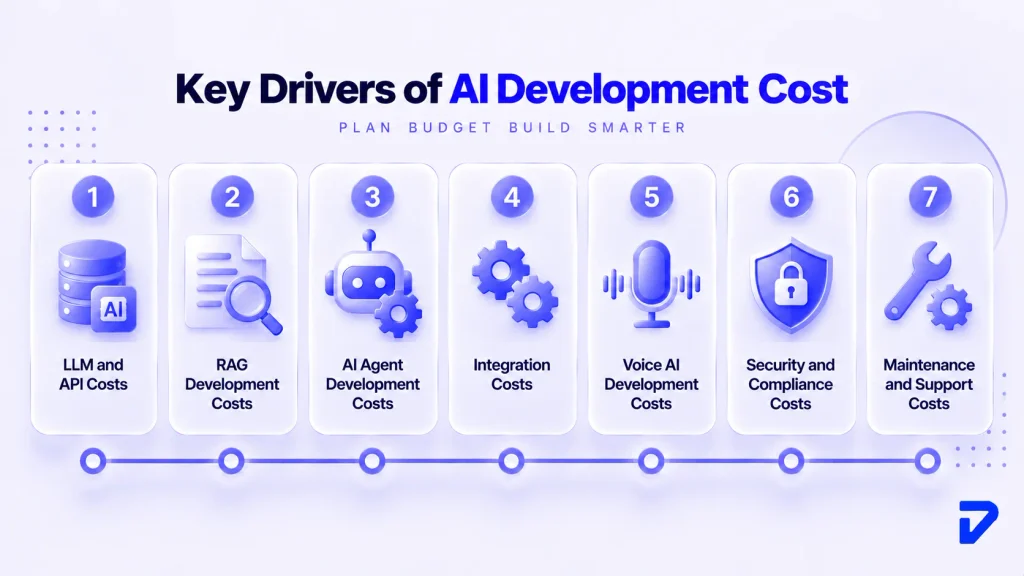
- LLM and API Costs: Estimate tokens per conversation and monthly usage, including retrieval context, retries, and tool calls. Review model and API pricing regularly and account for ongoing usage costs.
- RAG Development Costs: Consider expenses for document chunking, embeddings, indexing, retrieval tuning, citations, and source-document preparation. Poor-quality content can also increase costs and reduce retrieval accuracy.
- AI Agent Development Costs: Budget for tool definitions, permission controls, approval workflows, action validation, error handling, recovery logic, and multi-step workflow testing.
- Integration Costs: Legacy systems, undocumented APIs, strict rate limits, and complex authentication can increase costs. Ask vendors to price major integrations separately with clear assumptions.
- Voice AI Development Costs: Account for speech recognition, text-to-speech, telephony integration, per-minute usage, latency optimization, and voice-specific testing.
- Security and Compliance Costs: Factor in encryption, access controls, audit logging, data retention, penetration testing, compliance documentation, and other governance requirements.
- Maintenance and Support Costs: Include prompt updates, knowledge-base updates, model changes, regression testing, monitoring, bug fixes, security updates, and incident response.
How to Measure the Success of Your Conversational AI Project
Choose the metrics that match your use case, baseline them before launch, and review them weekly. Accuracy alone tells you little, which is why OWASP lists misinformation among the top LLM application risks: a confident wrong answer scores well on fluency and badly on everything that matters.
- Resolution rate: Count a conversation as resolved only if the same customer does not return about the same issue within seven days.
- Task completion rate: Track the share of initiated tasks finished without human help, broken out by task type so one weak workflow cannot hide in the average.
- Escalation rate: A healthy rate is neither zero nor climbing. Segment escalations by reason, since reason codes drive next month’s improvement work.
- Customer satisfaction: Collect CSAT separately for assistant-handled and escalated conversations to learn whether handoffs feel like rescue or abandonment.
- Cost per resolution: Divide total monthly cost, including inference, platform, review time, and amortized build, by resolved contacts. Decision intelligence and analytics pipelines can track this ratio automatically.
- Accuracy and hallucination rate: Score a weekly sample against source documents. A rate above a couple of percent on grounded content usually signals a retrieval problem.
- Response latency: Report p95 rather than the average. Text assistants should reply within two to three seconds, and voice needs to be much faster.
The Bottom Line
Choosing a conversational AI development company comes down to evidence, not credentials. The firms worth shortlisting can name a live assistant, its resolution rate, and the person who fixes it on a bad Monday. Everything else, from framework preferences to award logos, is noise around that one question.
Follow the six steps, score the proposals against weighted criteria, and pay for a proof of concept on your own messy data before committing to a full build. At Pinnasys, we start with one high-volume conversation and a number we agree to move. A short AI consulting and roadmap engagement is usually the cheapest way to test whether the fit is real.
Key Takeaways from the Article
- Production evidence predicts delivery success far better than credentials or vendor rankings
- Integration effort, not model choice, drives most conversational AI cost overruns
- Resolution rate beats deflection rate as the metric worth holding vendors to
- Scoped permissions per action prevent an assistant from taking costly wrong steps
- Ownership of code, prompts, and evaluation data decides your future exit options
Frequently Asked Questions on Conversational AI Development Company
How Do I Choose a Conversational AI Development Company?
Shortlist five to seven firms, cut to three, and score them on production evidence, integration depth, and security documentation. Run a paid proof of concept on real historical conversations.
What Does a Conversational AI Development Company Do?
It handles conversation design, natural language understanding, retrieval over your content, system integrations, guardrails, and live operations. Unlike a chatbot platform vendor, it delivers a system you own outright, including source code, prompts, and the evaluation set used to test every release.
How Long Does It Take to Build Conversational AI?
A focused first assistant reaches production in eight to fourteen weeks with early system access. Enterprise rollouts across several systems run four to nine months. Credential approvals and content cleanup delay projects more often than model complexity or integration engineering.
What Skills Should a Conversational AI Development Company Have?
Look for conversation design, natural language understanding, retrieval engineering, prompt evaluation, and integration work across CRM and ERP systems. Security and MLOps skills matter equally, since roughly 40% of agentic projects are forecast to fail on cost, value, or risk controls.
What Technologies Are Used to Build Conversational AI?
Typical stacks combine a large language model, a vector database for retrieval, an orchestration layer, and tool-calling interfaces such as the Model Context Protocol. Older platforms like Dialogflow, Rasa, and Amazon Lex still handle intent-driven flows where multi-turn reasoning is unnecessary.
Should I Hire a Conversational AI Company or Use an Off-the-Shelf Platform?
Platforms suit single-channel FAQ traffic under modest volume. Custom builds win once you need more than two internal data sources, cross-session memory, or write access to core systems, where SaaS total cost of ownership typically overtakes a custom build within 18 to 24 months.