


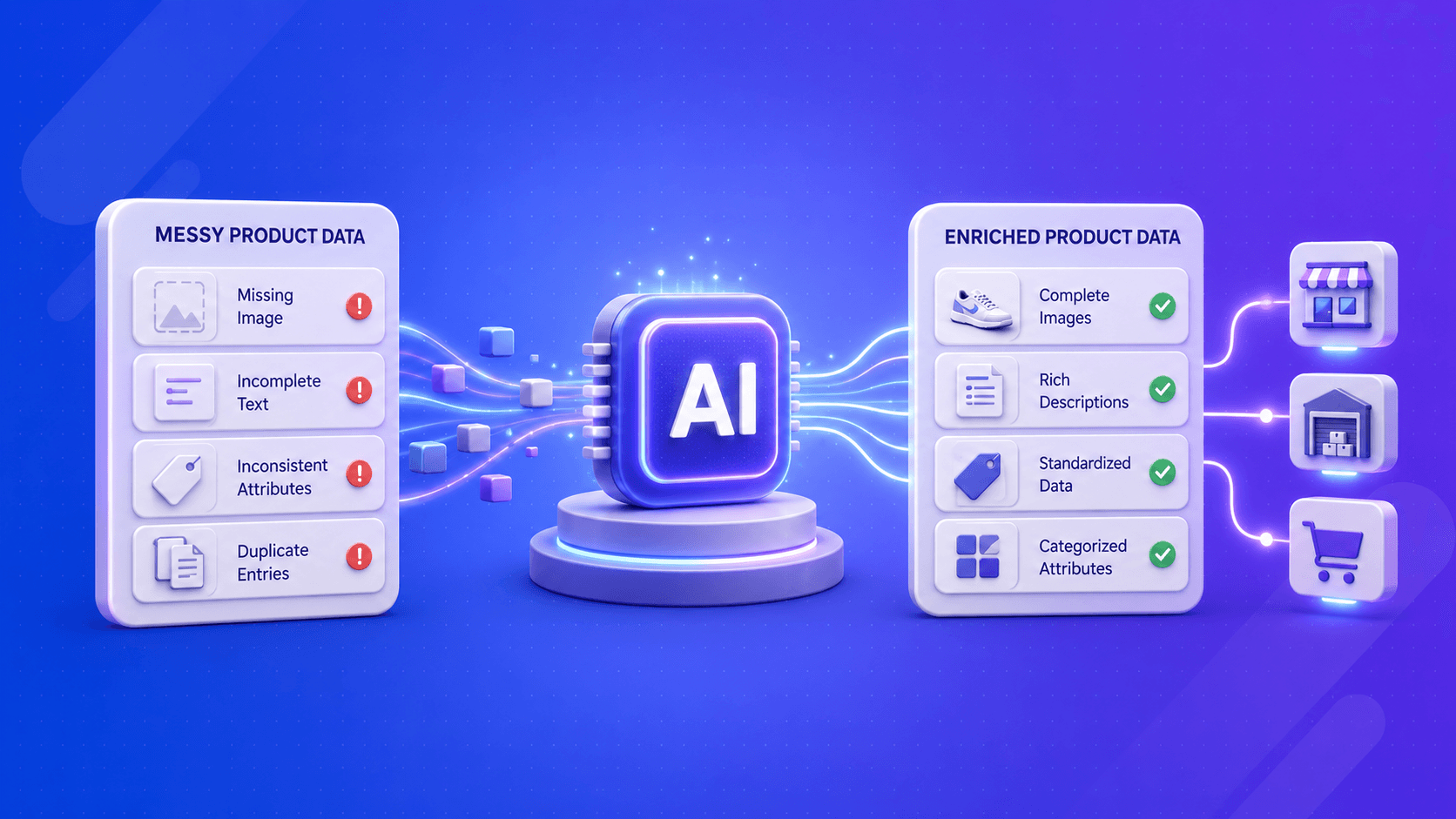
AI product data for distributors extracts attributes, fixes errors, and standardizes catalogs across thousands of SKUs. It clears the messy multi-supplier feeds that manual cleanup can never keep up with at scale.
Poor data quality costs the average organization $12.9 million a year, Gartner estimates; for distributors, that cost lands hardest on the product catalog. A single wholesaler may carry 50,000 SKUs from hundreds of suppliers. Each one sends data in a different format, with different units and naming.
AI product data enrichment for distributors fixes this at a scale no team can match by hand. It reads spec sheets, extracts attributes, removes duplicates, and automatically standardizes units. Buyers who cannot find or trust a listing leave, return the wrong item, or call a rep instead. Clean, structured catalog data now drives sales directly, not back-office housekeeping. Here is how the technology actually works.
What Is AI Product Data Enrichment for Distributors?
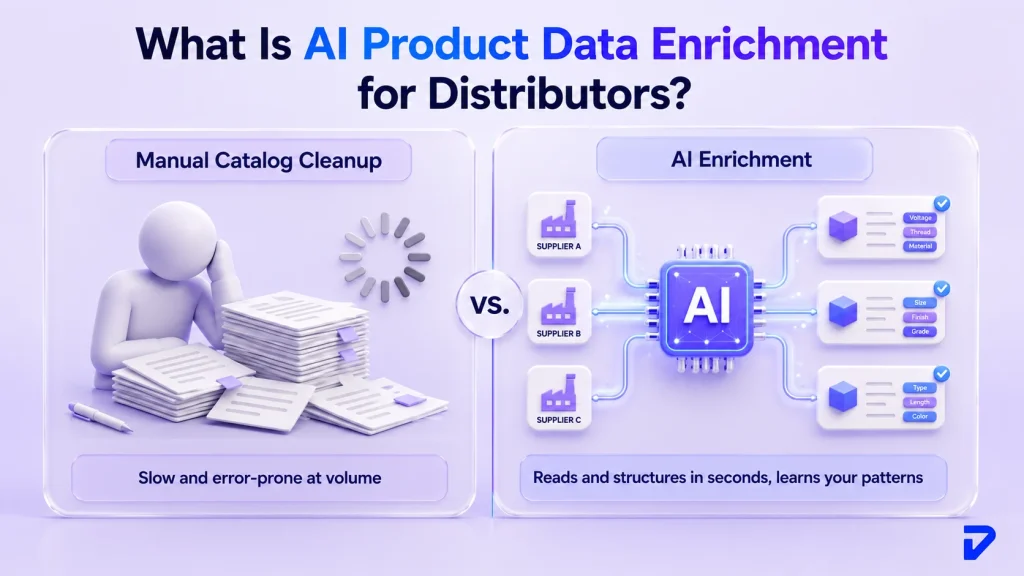
AI product data enrichment uses machine learning to complete, correct, and structure product records automatically. It pulls specifications from PDFs, supplier feeds, and images, then maps them to your catalog schema. The goal is simple: turn raw, inconsistent supplier data into a clean, searchable catalog without armies of data entry staff. This matters most for distributors, who resell products they did not manufacture and rarely control the source data.
How It Differs from Manual Catalog Cleanup
Manual cleanup means someone opens a spec sheet, copies fields, and pastes them into a system. It is slow and error-prone at volume. The work slows to a crawl once a catalog passes a few thousand products. AI does the same reading in seconds and never gets tired. It also learns your patterns, so accuracy improves as your catalog grows. Manual work cannot scale to millions of attributes; AI can.
Why Distributors Face Bigger Data Challenges Than Retailers
Retailers usually sell a curated range from a few brands. However, distributors have a much larger selection from many manufacturers. Buyers look for items by the pitch of threads, voltage, level of material quality, or competitor part numbers. If those attributes are missing, then the item will be simply invisible to the buyer. According to a survey among 750 professional buyers, 36% were unable to find their item online. For distributors, that gap directly costs orders.
The State of Product Catalog Data in Distribution Today
Most distributor catalogs carry years of accumulated mess. Records come from ERP exports, supplier spreadsheets, scanned PDFs, and legacy systems that no longer match the business. Akeneo research found 99% of B2B leaders faced a major product information challenge last year. Product catalog data rarely fails all at once. It decays quietly, one missing field and one duplicate at a time.
Common Distributor Product Data Problems
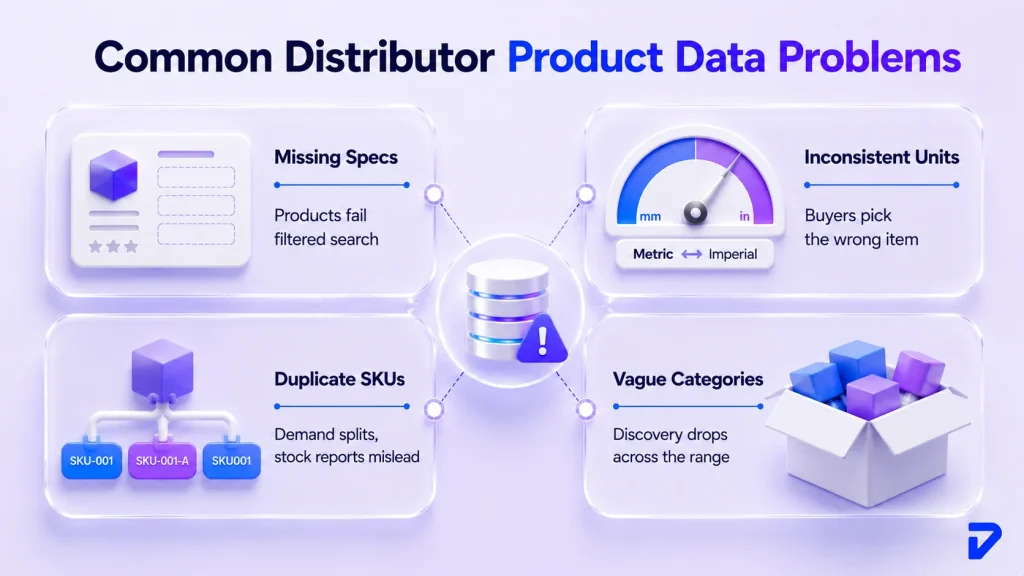
The same distributor product data problems show up across almost every catalog. Blank specification fields block filtered search, inconsistent units confuse buyers and break comparisons, and duplicate SKUs split demand and erode trust. Each problem seems minor on its own, but together they choke discovery and conversion.
| Problem | What it looks like | Business impact |
| Missing specs | Blank attribute fields on key products | Products fail filtered search |
| Inconsistent units | Metric and imperial mixed in one catalog | Buyers pick the wrong item |
| Duplicate SKUs | Same product under several codes | Demand splits, stock reports mislead |
| Vague categories | Items filed under generic buckets | Discovery drops across the range |
Why Multi-Supplier Feeds Break Down Fast
Every supplier structures data its own way. One uses “color,” another “color,” a third leaves it blank. Feeds arrive as CSVs, Excel files, and PDFs with no shared standard. Cross-channel consistency ranks among the hardest problems B2B teams report. As supplier count grows, manual reconciliation collapses, and that is where multi-supplier feeds break down fast and errors compound.
How Does AI Fix Product Data for Distributors?
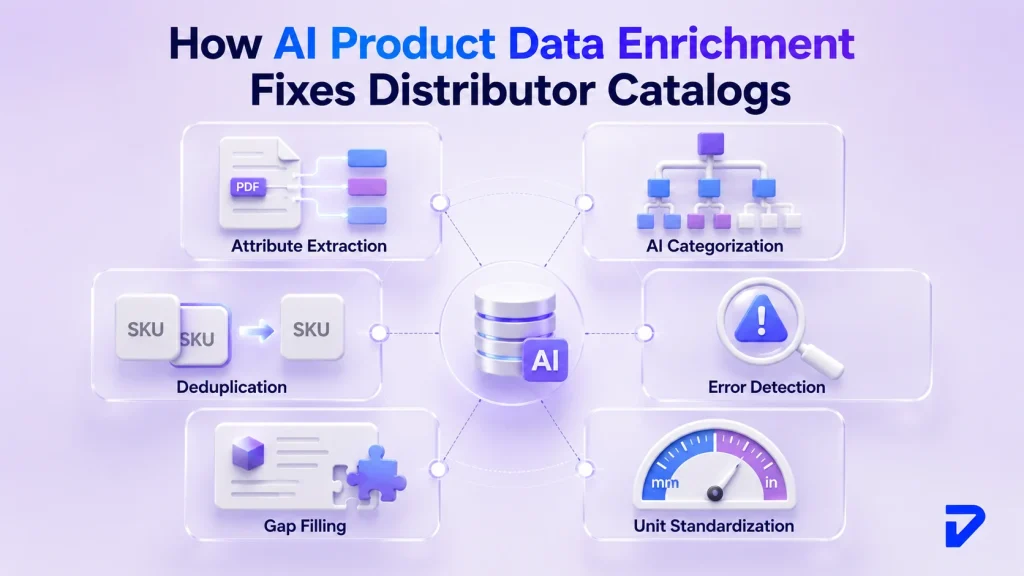
So how does AI fix product data for distributors in practice? It applies three capabilities that manual teams cannot match at scale: extraction, categorization, and error detection. Each runs continuously across the whole catalog, not just the records a person happens to open. The result is data that stays clean as new products arrive.
Automated Attribute Extraction from Supplier Feeds and Spec Sheets
AI reads a supplier feed or a spec-sheet PDF and pulls out structured attributes. Voltage, dimensions, material, and compatibility all become tagged fields. The model handles messy layouts, tables, and even scanned documents. What took a person minutes per product now takes a fraction of a second. Extraction is the foundation that makes everything downstream possible.
AI-Driven Categorization Across Thousands of SKUs
Once attributes exist, products still need the right categories. AI classifies each SKU against your taxonomy using its description and attributes. It sorts thousands of items in the time a person sorts a handful. Consistent categorization means buyers narrow results and find products fast. It also keeps your filters and navigation reliable across the range.
Real-Time Error Detection and Standardization
AI flags anomalies as data enters, not months later. A price with an extra zero, a unit mismatch, or a broken value gets caught early. Gartner found 69% of B2B buyers hit inconsistent information between a seller’s site and its reps. Real-time checks standardize units and formats so records stay consistent. Early detection is far cheaper than fixing errors after a buyer finds them.
Clean Product Data AI: What “Clean” Actually Means for Distribution Catalogs
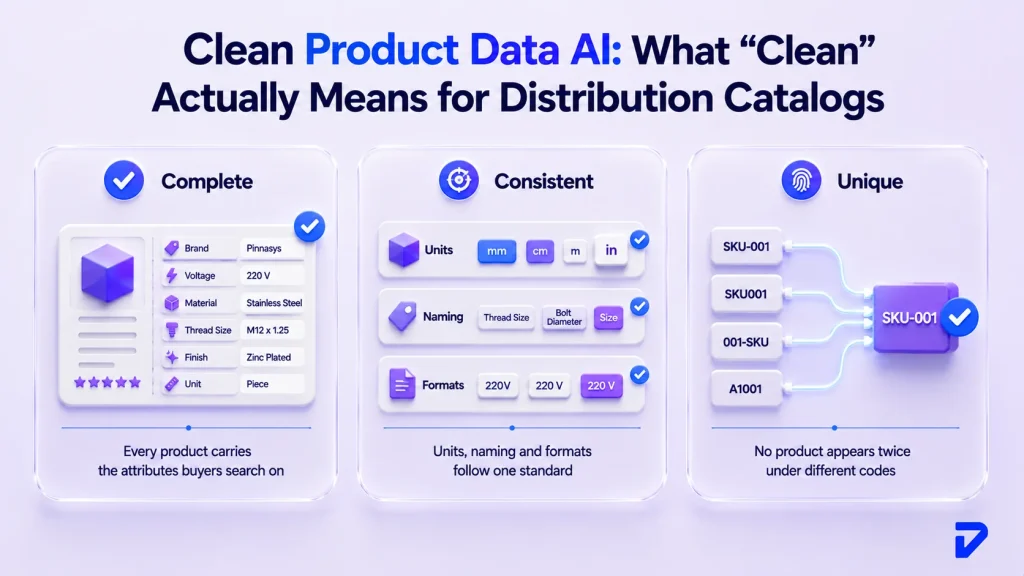
Clean does not mean pretty, and for a distribution catalog, clean means complete, consistent, and unique. Every product carries the attributes buyers search on. Units, naming, and formats follow one standard. No product appears twice under different codes. Clean product data AI is the set of models that reach and hold that state automatically.
Deduplication and Format Standardization
Duplicates are the quiet killer in distributor catalogs. The same bolt might exist under four SKUs with slightly different descriptions. AI matches records by attributes, not just text, and merges the true duplicates. It then forces one format for units, dates, and naming. The catalog shrinks to its real size, and stock data finally makes sense.
Filling Attribute Gaps Without Manual Rework
Gaps appear when suppliers omit fields or send partial data. AI infers missing attributes from similar products, spec sheets, and reference sources. A missing weight or material often resides in a linked PDF that the model can read. This fills gaps without requiring a person to touch each record. Coverage rises across the catalog while the team focuses on exceptions.
AI Data Enrichment Distribution: Where It Delivers the Most ROI
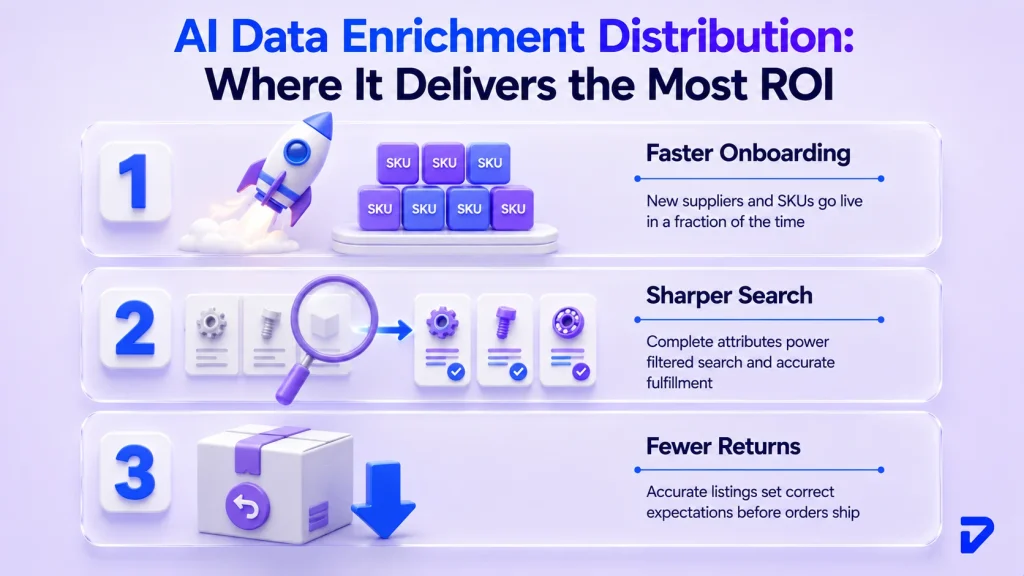
AI data enrichment distribution pays back fastest in three places: onboarding speed, search accuracy, and returns. Each ties directly to revenue or cost, and the pattern is consistent. Better data means faster listings, easier discovery, and fewer wrong orders. Below are the areas distributors should measure first.
Faster Onboarding When Adding New Suppliers or SKUs
New suppliers arrive with thousands of products and no standard format. Manual onboarding can stall a launch for weeks. Since a single SKU can take 20 to 46 minutes by hand, large batches become impossible to staff. AI ingests, extracts, and standardizes the batch in a fraction of that time. Products reach the storefront while the demand is still fresh.
Improved Search Accuracy and Order Fulfillment
Buyers cannot buy what they cannot find. Complete attributes power filtered search, so a query returns the right three products, not three hundred. Accurate specs also mean the picked item matches the order. Enrichment paired with AI-powered product search lifts both discovery and fulfillment accuracy. Fewer mispicks mean fewer costly corrections downstream.
Fewer Returns Caused by Inaccurate Listings
Returns are expensive, and many are preventable. Akeneo’s 2025 research found that 43% of consumers returned a product after pre-purchase information proved to be wrong. The same failure hits B2B when a spec sheet lists the wrong dimension or rating. Accurate, enriched listings set correct expectations before the order ships. That single change cuts return volume and protects margin.
Product Data Management Distribution: Building the Right Foundation
Enrichment fails without a foundation to hold the results. Product data management distribution means one governed source of truth, fed by clean pipelines. McKinsey notes that fragmented, siloed data becomes impossible to manage at scale. AI keeps the catalog clean; the foundation keeps it that way. Both parts matter.
Centralizing Data Across ERPs, PIMs, and Supplier Systems
Product information is scattered across multiple channels simultaneously. Pricing resides in the ERP system, content within the PIM system, and specifications in the supplier feed system. This results in contradictory information that creates confusion for the consumer. The solution lies in the AI integration into all the systems used to create one accurate record across all channels.
Setting Governance Rules That Keep AI Output Accurate
AI needs some boundaries set up for its operation. The governance policies help in setting requirements, validity of the values of different attributes, and the approval process. This ensures that any badly extracted information does not find its way into an active listing. It provides an audit trail for the extracted information.
PIM + AI: Why the Two Work Better Together
A PIM stores and distributes product data; AI creates and cleans it. Neither replaces the other. These systems have become central to how distributors manage product catalog data. PIM AI capabilities paired with a solid platform give distributors both structure and speed.
What a PIM Alone Can’t Solve
A PIM is a container that holds whatever data you put in, clean or not. It will not read a supplier PDF, infer a missing spec, or spot a duplicate on its own. Feed a PIM messy data, and it distributes messy data faster. The platform organizes; it does not enrich, and that gap is exactly where AI earns its place.
How AI Strengthens Existing PIM Workflows
AI sits in front of the PIM and prepares data for it. It extracts, categorizes, and validates before records ever land in the system. Inside the PIM, AI can score data quality and flag weak records for review.
| Task | PIM alone | PIM + AI |
| Read supplier PDFs | Manual entry | Automatic extraction |
| Categorize new SKUs | Human sorting | Model classification |
| Catch bad data | After it ships | As it enters |
| Fill missing attributes | Staff research | Inferred automatically |
AI for Distributor Product Data: A Step-by-Step Implementation Approach
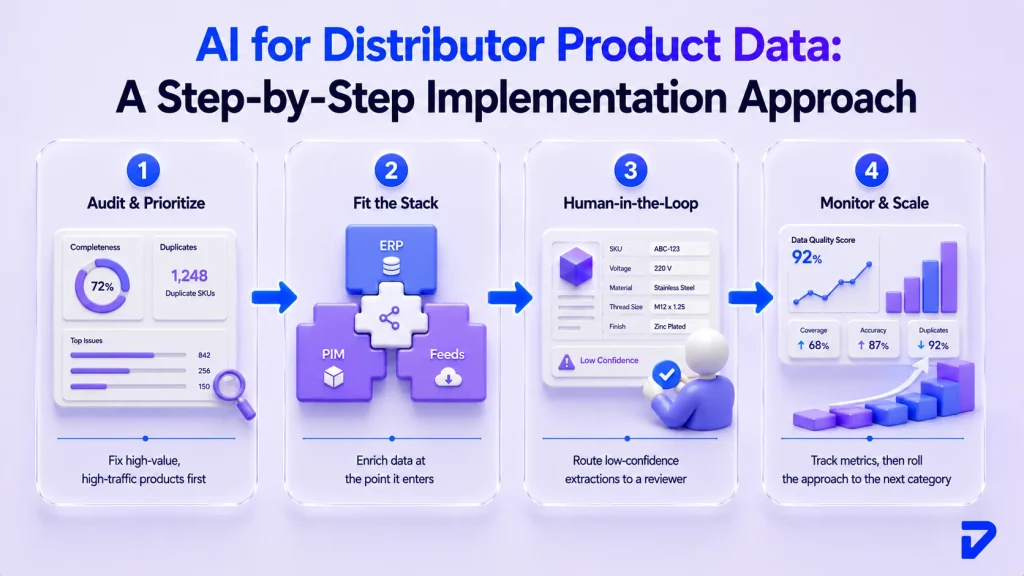
A phased rollout of AI for distributor product data works best. A phased plan lowers risk and proves value early. The four steps below move a distributor from a messy catalog to a self-maintaining one.
Step 1: Audit and Prioritize Your Catalog
Begin with a clear picture of the damage. Measure completeness, duplicate rates, and which categories drive revenue. Fix the high-value, high-traffic products first. A focused audit shows where enrichment returns the most, fast, and sets the baseline you will measure against later.
Step 2: Decide Where AI Fits Your Existing Stack
Map your current systems before adding anything new. Decide whether AI runs ahead of the PIM, inside it, or across the ERP. The goal is to enrich data at the point it enters. Fit the tools to your workflow, not the other way around. A clean handoff between systems prevents new silos.
Step 3: Build in Human-in-the-Loop Review
AI handles volume; people handle judgment. Route low-confidence extractions to a reviewer instead of publishing them blind. This catches edge cases and trains the model over time. As accuracy climbs, the share needing review shrinks, and the loop keeps quality high while automation does the heavy lifting.
Step 4: Monitor, Measure, and Scale
Track completeness, duplicate rate, search success, and return rate. Watch these numbers move as enrichment expands. When a category proves the gains, roll the same approach to the next. Continuous monitoring turns a one-time cleanup into a lasting system, so scale only what the metrics justify.
How to Solve Product Data Problems Before They Cost You Sales
The best time to solve product data problems is before a buyer notices them. Bad data does not announce itself; it shows up as a lost sale you never see and a rep call you should not need. Spot the warning signs early, and small issues never grow into revenue leaks. A few signals mean your catalog needs help. Watch for these patterns across your data and your sales floor:
- Buyers call reps for specs that should be on the page.
- Search returns too many results or none at all.
- The same product appears under several SKUs.
- Return rates climb on specific categories or suppliers.
- New supplier onboarding takes weeks, not days.
The Real Cost of Waiting
Delay is not free, and every week of messy data means lost orders, extra rep hours, and preventable returns. The costs hide inside normal operations, so leaders rarely add them up. Meanwhile, competitors with clean catalogs win the buyers you lose. The longer the catalog stays messy, the larger and quieter the leak grows.
AI Product Catalog Cleanup: What the Process Actually Looks Like
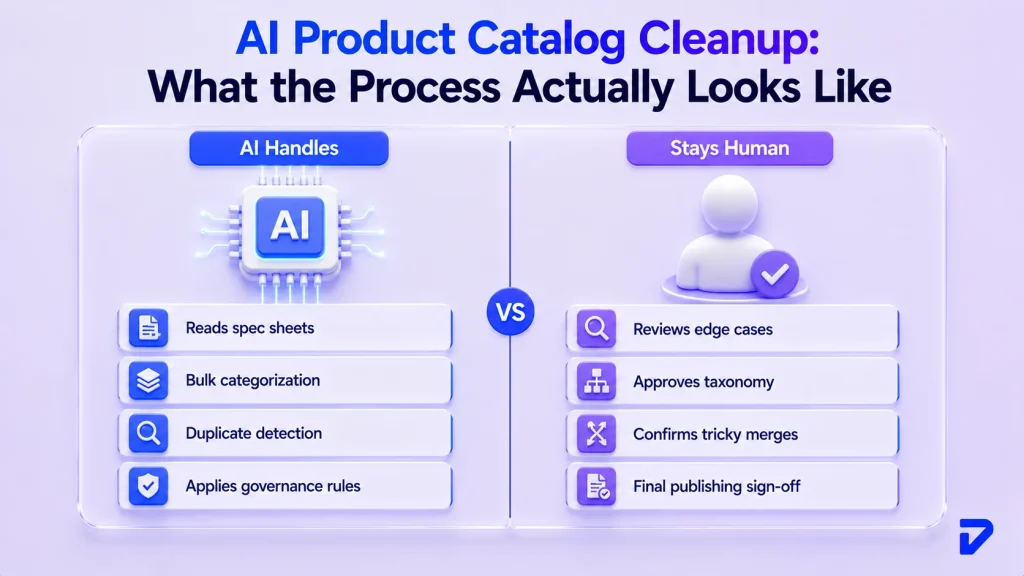
AI product catalog cleanup is not a magic button. It is a structured project with clear phases and real human oversight. Distributors who expect a one-click fix get disappointed. Those who plan for a staged rollout get a catalog that stays clean. Here is what a realistic effort involves.
Realistic Timeline and Rollout Expectations
A focused first phase often runs a few weeks, not months. Early wins come from the highest-value categories, where clean data pays back fastest. Full catalog coverage takes longer and grows in waves. A big-bang attempt at the whole catalog tends to bury the team in review. Steady, measured rollout beats a big-bang attempt.
What Stays Human vs. What AI Handles
AI and people each do what they are best at. The split below keeps quality high without slowing down the work.
| Task | AI handles | Stays human |
| Reading spec sheets | Yes | Review edge cases |
| Bulk categorization | Yes | Approve taxonomy |
| Duplicate detection | Yes | Confirm tricky merges |
| Governance rules | Applies them | Defines them |
| Final publishing sign-off | Flags risk | Approves release |
Choosing the Right AI Partner for Distributor Product Data
Tools alone rarely fix distributor product data. The catalog, the systems, and the edge cases are too specific. The right partner brings production experience, not a demo that stalls after launch. Look for a track record of systems that run in the real world and keep running. Most AI pilots never reach production. Pinnasys builds ones that do.
The focus stays on outcomes distributors can measure: hours saved, errors reduced, and orders recovered. Distribution is a flagship focus, so the approach fits how wholesalers and merchants actually operate. Rather than sell a license and leave, Pinnasys ships and runs the system. That difference is what turns clean data from a project into a standard.
The Bottom Line
Messy product data quietly costs distributors sales, staff hours, and buyer trust. AI product data enrichment fixes the root problem at a scale manual teams cannot reach. It reads supplier feeds, extracts attributes, removes duplicates, and holds the catalog clean as new products arrive. The payoff shows up in faster onboarding, sharper search, and fewer returns.
Pinnasys builds these systems for production, not for a demo, with distribution as a core focus. Clean catalog data has become a competitive edge, and the gap between leaders and laggards keeps widening. If your catalog is holding back revenue, AI automation for product data is the place to start. Map out your enrichment roadmap and turn a recurring headache into a lasting advantage.
Key Takeaways from the Article
- AI enrichment cleans distributor catalogs at a scale manual data entry cannot reach.
- Absent specs, mixed units, and duplicate SKUs quietly block search and conversion.
- Extraction, categorization, and real-time error checks are AI’s three core catalog fixes.
- A PIM stores product data, but AI is what creates and cleans it.
- Human-in-the-loop review keeps automated enrichment accurate as the catalog scales.
Frequently Asked Questions
How long does AI product data enrichment take for a large catalog?
A focused first phase often runs a few weeks, targeting high-value categories. Full catalog coverage grows in waves over months. Timelines depend on catalog size, data quality, and how many systems the enrichment must connect.
Can AI enrichment integrate with our existing PIM or ERP?
Yes, AI enrichment is designed to sit alongside a PIM, ERP, or supplier feeds. It cleans and structures data before it enters those systems, then it feeds one accurate record to every channel.
Does AI enrichment replace our catalog management team?
No, AI handles volume tasks like extraction and deduplication. People define governance, approve taxonomies, and review edge cases. The team shifts from manual data entry to oversight, handling exceptions while automation does the repetitive work.
Is AI product data enrichment accurate enough for technical specifications?
Yes, with human review built in. Models extract technical attributes reliably and flag low-confidence values for a person to check. Accuracy improves as the system learns your catalog, keeping specifications trustworthy for buyers who search by them.





Prakash C. Saini
Prakash Saini is the Founder & CEO of Pinnasys. With over a decade in digital transformation and building production systems, he grew an engineering team from 2 to 50 people and has led the delivery of 100+ production digital systems. Products built under his leadership have raised millions in funding and generated over $50 million in revenue. He holds an Executive MBA from IIM Kozhikode and today leads the AI engineering team at Pinnasys.