


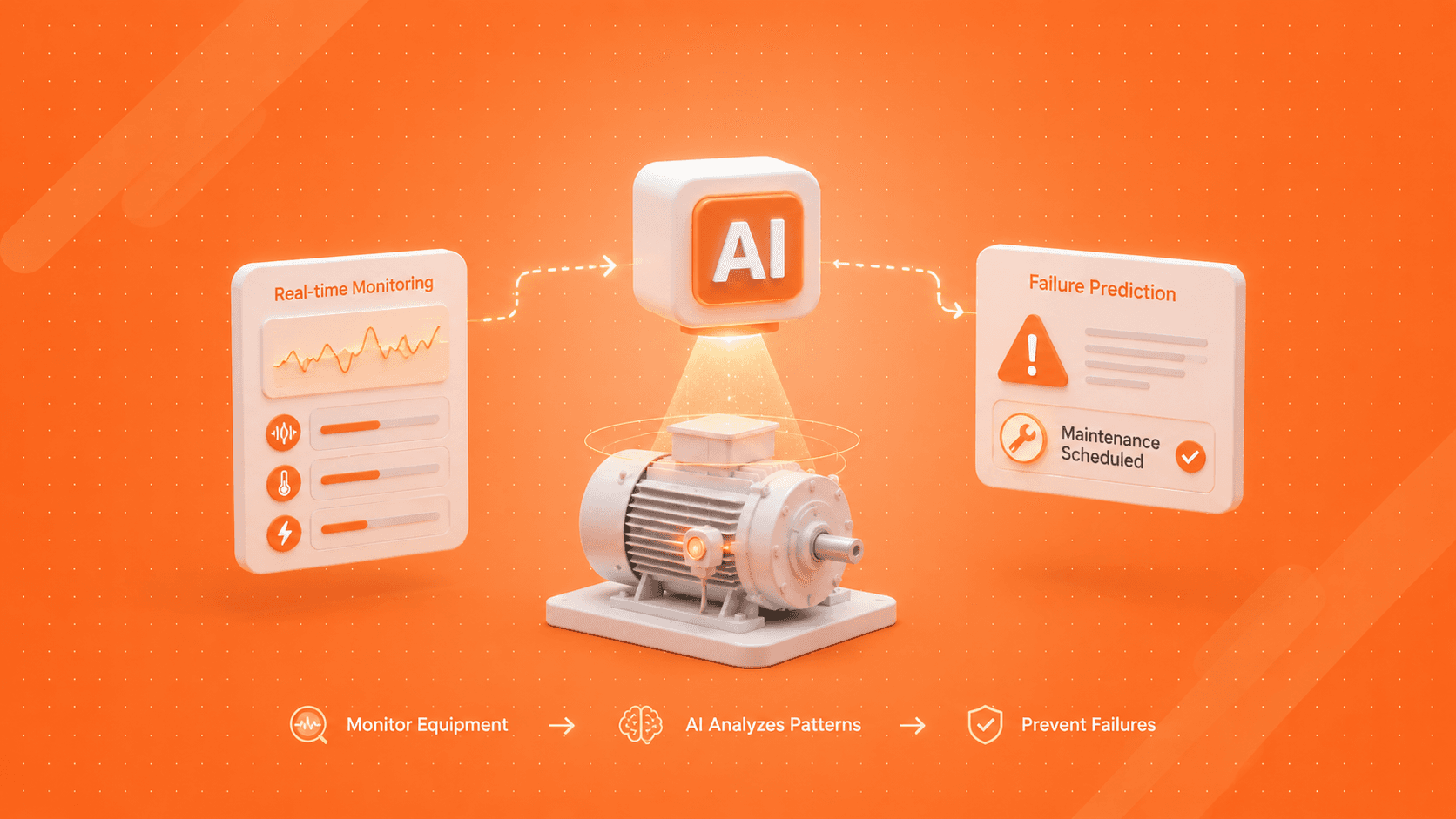
AI Predictive Maintenance is a technique that uses sensor data to predict equipment failures and help prevent downtime. Factories use it to minimize downtime, save on repair costs, and prolong equipment lifetime.
Unforeseen equipment failure costs industrial manufacturers more than $50 billion per year. It is calculated as the losses due to failures that occur unexpectedly. Repair, idling, and overtime work are inevitable consequences that accumulate quickly. However, AI predictive maintenance can help. Its key idea is to continuously monitor equipment performance and identify problems before they fail.
Unlike other solutions, this approach turns maintenance from costly to a competitive advantage. Traditional techniques are ineffective, either replacing parts too soon or leaving them for too long. As a result, fewer surprises, reduced costs, and constant production are achieved. Below is described what equipment failure prediction is and how to implement it.
What Is AI Predictive Maintenance?
AI predictive maintenance uses data and machine learning to predict equipment failure before it happens. Sensors on machines track vibration, temperature, pressure, and sound. Software studies that data and learns what healthy operation looks like. When readings drift, the system spots the change and warns your team.
This differs sharply from older habits. Reactive maintenance fixes a machine only after it breaks. Preventive maintenance swaps parts on a fixed calendar, whether they need it or not. Predictive maintenance sits between the two. It repairs based on real condition, not guesswork or the clock.
The approach fits AI in manufacturing especially well. Factory machines run hard and produce rich streams of data, which feed models that catch small faults early. So many operators ask a fair question: Can AI prevent equipment breakdowns? In practice, it prevents many of them and softens the rest. Early warning gives crews time to plan the fix on their own terms.
Why Is Predictive Maintenance Important?
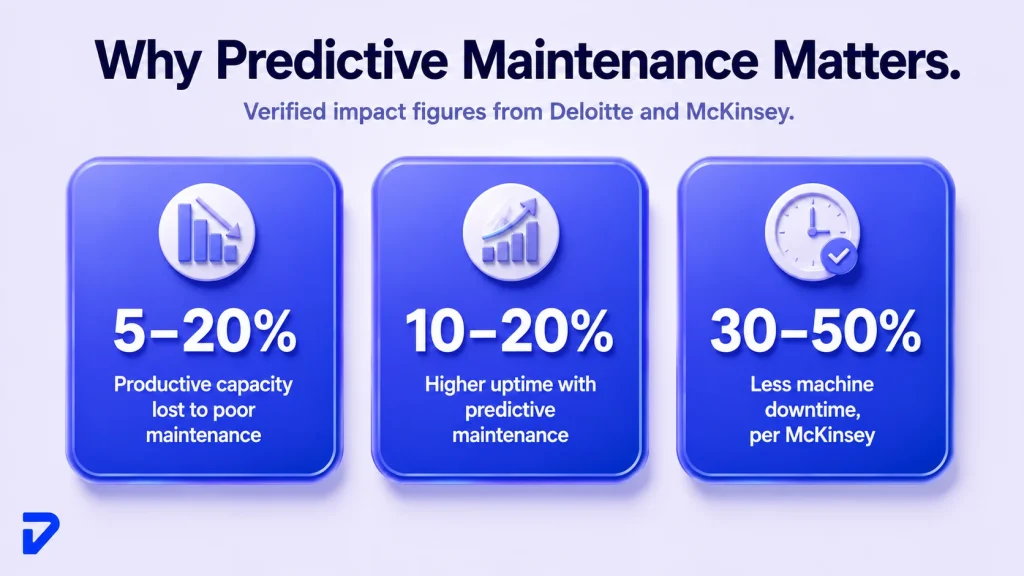
Downtime is one of the main losses affecting manufacturing plants. Improper maintenance can reduce a plant’s productive capacity by 5 to 20%, causing order losses and idle workers. Predictive maintenance solves this problem directly.
Research supports this approach. According to Deloitte, such maintenance increases factory uptime by 10-20% and reduces repair costs. For predictive-maintenance companies, this difference often means on-time delivery of goods. As for downtime, McKinsey suggests it reduces machine downtime by 30-50% and provides more billable production hours each week.
There is a safety angle too, as a machine that fails hard can injure nearby people. Early warnings reduce that danger, and AI-driven tools that reduce equipment downtime also protect margins, since emergency repairs cost far more than planned repairs. In short, the case is both financial and human.
How Does AI Predict Machine Failure?
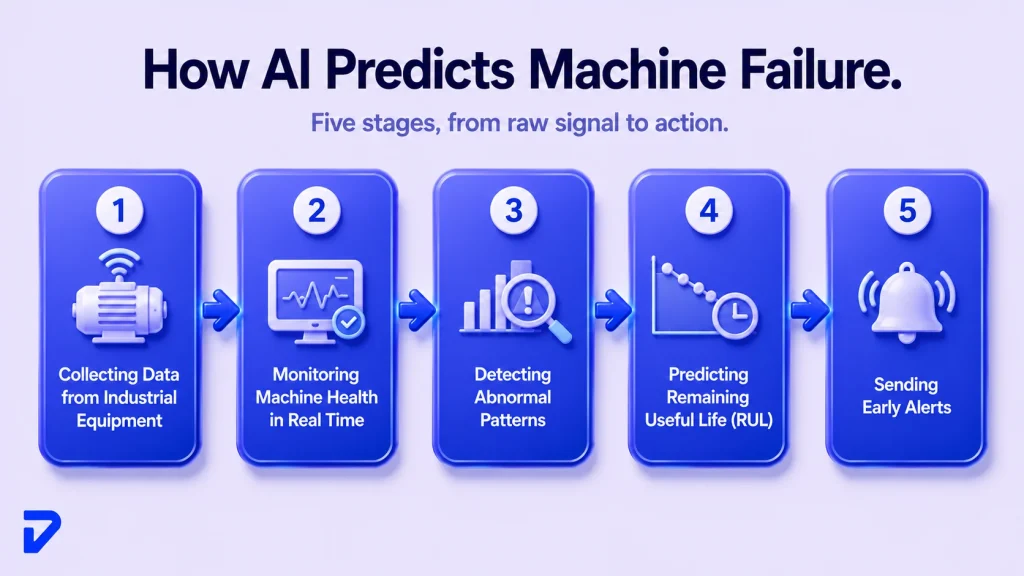
Collecting Data from Industrial Equipment
Prediction starts with good data. Sensors on motors, pumps, and bearings record vibration, heat, and pressure. Many plants add sound and current readings for more detail, and this data streams into a central system around the clock. The richer and cleaner the feed, the sharper the prediction.
Monitoring Machine Health in Real Time
Next comes AI for machine monitoring at scale. The system monitors every asset at once, without interruption, and tracks each machine against its own healthy baseline. Small shifts that a human might miss show up fast. Real-time visibility lets teams act in hours, not weeks.
Detecting Abnormal Patterns
Here, the model earns its keep by comparing live readings to thousands of past patterns. When behavior deviates from the norm, it flags the change. A rising vibration signature, for example, can point to a failing bearing. The system separates a real fault from routine noise.
Predicting Remaining Useful Life
Detection tells you something is wrong. RUL (Remaining Useful Life) tells you how long you have. The model estimates the time left before a part fails, and that lead time is the whole point of predictive machine failure AI. In one McKinsey case, an algorithm forecast a compressor failure weeks in advance, cutting downtime from 14 days to 6.
Sending Early Alerts
Finally, the system turns insight into action by sending an alert to the right technician with clear context. Good platforms link that alert to a work order automatically, and crews then schedule the repair during planned downtime. The failure never gets the chance to stop the line.
Preventative Maintenance vs. Predictive Maintenance
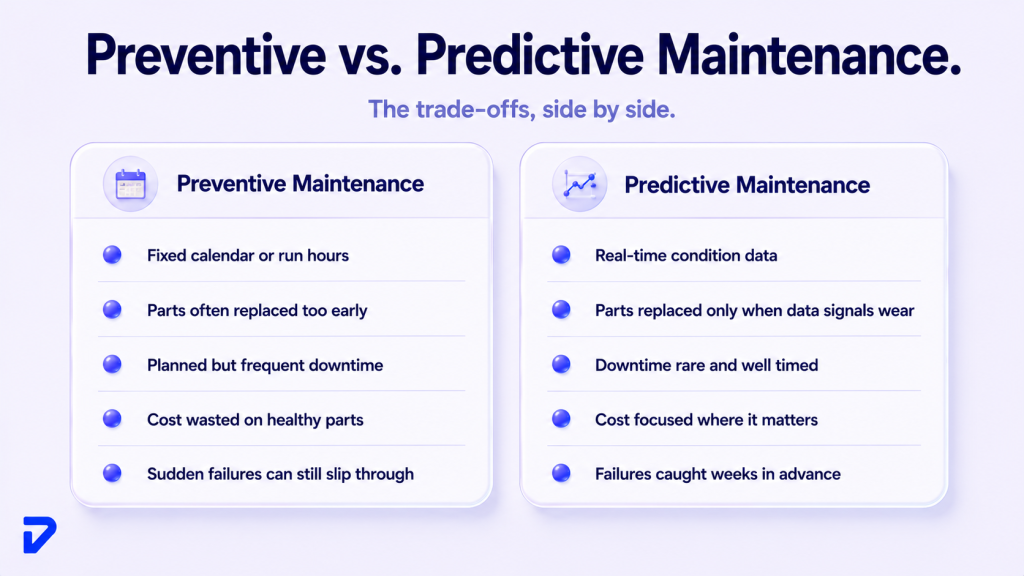
Both strategies beat waiting for a breakdown as they differ in how they decide when to act. The table below shows the trade-offs at a glance.
| Aspect | Preventive Maintenance | Predictive Maintenance |
| Trigger | Fixed calendar or run hours | Real-time condition data |
| Part replacement | Often too early | Only when data signals wear |
| Downtime | Planned but frequent | Rare and well timed |
| Cost pattern | Wasted on healthy parts | Focused where it matters |
| Sudden failures | Can still slip through | Caught weeks in advance |
Preventive maintenance still beats a purely reactive approach, yet it wastes effort on parts that are fine. Predictive maintenance trims that waste while catching real risk. Most factories use a blend of predictive maintenance for their critical assets. That mix gives strong coverage without over-servicing every machine.
Common AI Models Used to Predict Equipment Failure
No single model fits every machine. Teams match the method to the failure type and the data on hand. Most equipment failure prediction systems combine a few of the models below.
| Model type | What it does | Best for |
| Anomaly detection | Learns what normal operation looks like and flags any reading that drifts away from that baseline, without needing labeled examples of past failures. | Catching early, unlabeled fault signals before they turn into obvious problems |
| Regression models | Predicts a continuous value, such as the number of hours or cycles a component has left, by mapping sensor inputs to an expected outcome. | Estimating remaining useful life so you can plan repairs with lead time |
| Time-series models (LSTM, ARIMA) | Learns patterns and dependencies across a machine’s sensor history, picking up gradual shifts and seasonal rhythms that single snapshots would miss. | Tracking trends in vibration, temperature, or other signals that evolve over time |
| Classification models | Sorts the current state of a machine into defined categories, such as healthy or at-risk, based on patterns it has learned from labeled data. | Recognizing known, well-documented failure modes you can clearly label |
| Survival models | Estimates the probability that a component will fail within a given window, drawing on the full history of when similar assets lasted or gave out. | Fleets with rich maintenance logs where timing and failure history are well recorded |
Anomaly detection often comes first, since it needs no labeled failures. Regression and survival models then estimate how long a part will last. Time-series models like LSTM read the shape of a signal over time. Classification models work well once you have clear failure labels. In practice, a strong system layers several models together, and that mix raises accuracy and cuts false alarms across the plant.
How to Implement AI for Machine Failure Prediction?
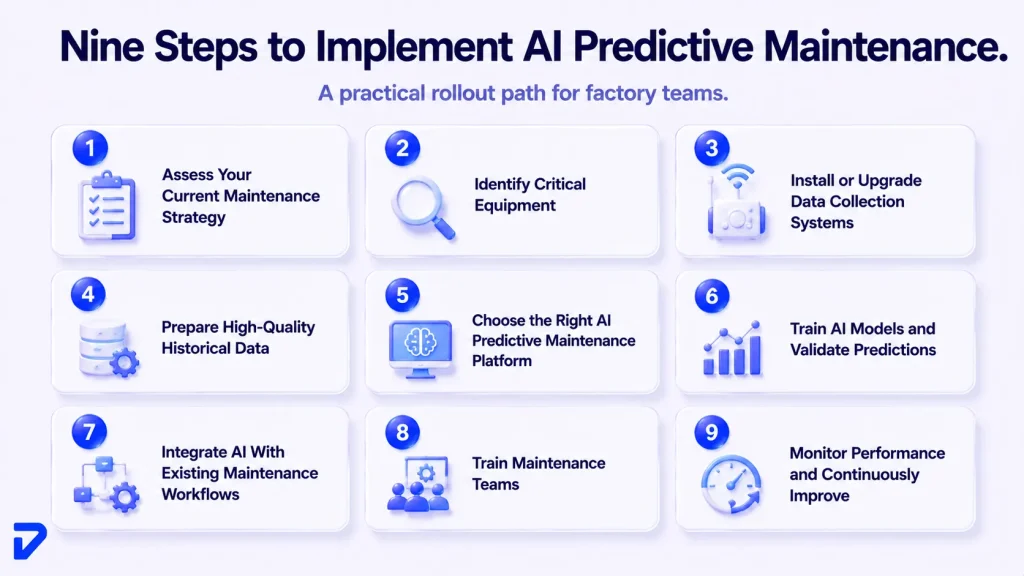
Assess Your Current Maintenance Strategy
Start by mapping how you maintain equipment today. Note where you run to failure and where you over-service. This baseline shows the gaps that prediction can close. A short AI consulting and roadmap review shows where prediction adds the most value first.
Identify Critical Equipment
Target the machines where a failure hurts output most and rank assets by downtime cost and repair lead time. These high-stakes machines earn the strongest early return. Proving value here builds momentum for a wider rollout.
Install or Upgrade Data Collection Systems
Prediction is only as good as the data feeding it. Add sensors for vibration, heat, and current, or connect the ones you have and check that readings stream reliably to a central system. Clean, steady signals matter more than raw sensor count.
Prepare High-Quality Historical Data
Models learn failure signs from your past records. Gather clean logs of breakdowns, repairs, and part replacements; label known failures so the model can recognize them; and fix any gaps or errors before training begins.
Find the Right AI Predictive Maintenance Platform
Pick tools that fit your machines and your stack. Favor systems that integrate with your existing software with minimal friction. Weigh accuracy, ease of use, and vendor support. The best platform is the one your team will actually run.
Train AI Models and Validate Predictions
Train models on your historical data, then test them on fresh readings. Confirm the model catches real faults without crying wolf and tune it to balance early warnings against false alarms. Trust grows when predictions prove right on the floor.
Integrate AI with Existing Maintenance Workflows
Predictions only help when they reach the right people fast. Link alerts to your CMMS and work order system. Smooth AI integration with your systems keeps crews inside familiar tools. Automatic work orders turn each warning into a scheduled fix.
Train Maintenance Teams
Adoption fails when people do not trust the alerts. Show technicians how to read and act on predictions, and explain what each warning means and why it fired. Buy-in from the floor turns a good model into real savings.
Monitor Performance and Continuously Improve
Track prediction accuracy and downtime after go-live. Refine models as new data and failure modes arrive, retire alerts that miss, and reinforce the ones that land. Prediction gets sharper the longer the system runs.
Still finding out about failures after the line stops? Pinnasys builds predictive systems that read your machine data and warn crews before equipment fails, so you fix problems early and keep production moving.
What are the Benefits of AI Predictive Maintenance?
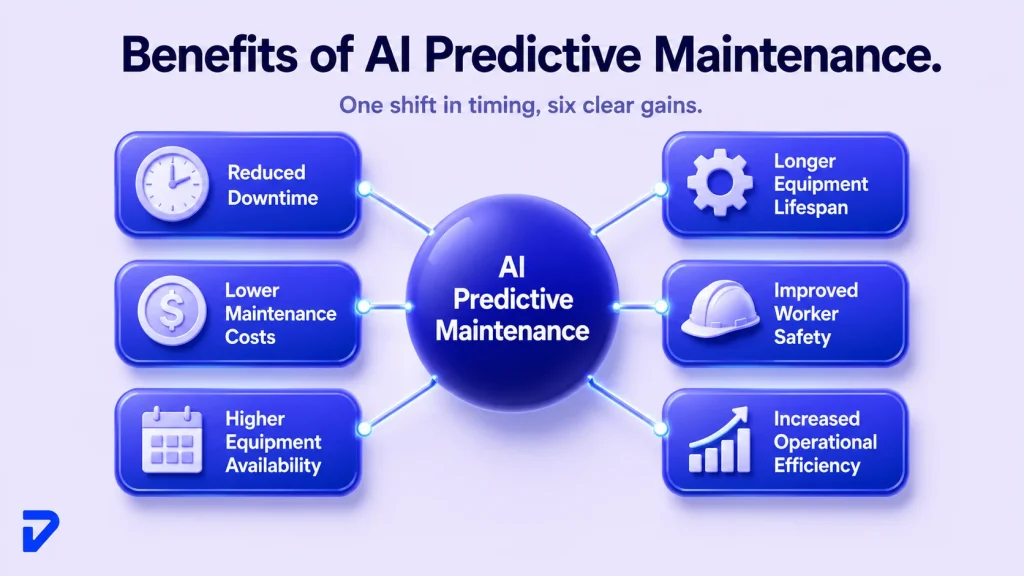
Reduced Downtime
The biggest shift is that machines stop on your terms rather than theirs. You catch a developing fault before it forces the line down mid-shift, then schedule the repair for a quiet window. When it matters most, the line keeps moving instead of grinding to an unexpected halt.
Lower Maintenance Costs
Emergency repairs are where budgets quietly bleed out, between expedited parts, overtime call-outs, and the scramble that follows a surprise failure. Early warnings let you plan the fix instead, at a fraction of the cost. Over time, spending shifts away from constant firefighting toward steady, predictable upkeep you can actually budget for.
Longer Equipment Lifespan
A small fault left unnoticed rarely stays small; it spreads and takes healthy components down with it. Catching those issues early stops that damage from cascading through the machine. Your assets end up running closer to the life they were designed for, pushing expensive capital replacements back by years.
Improved Worker Safety
Abrupt and sudden machine failure poses danger because it comes without warning. Fewer such breakdowns mean there will be fewer dangerous situations on the shop floor; maintenance teams can attend to machines at their leisure instead of having to deal with emergencies. This will create a safer environment for all the employees working in the facility.
Higher Equipment Availability
Every breakdown avoided helps to add productive hours to the day as machines will be spending less time idle waiting for repairs and more time running. Such availability increases output without any additional equipment being introduced into the process.
Increased Operational Efficiency
With all operations being planned according to the condition of the machinery, all the activities will fall into place in an organized manner. Maintenance slots align with production schedules and demand, while spare parts and labor go exactly where the data says they are needed.
These gains are measurable, not theoretical. In one Deloitte pilot, predictive analytics cut unplanned downtime by 80 percent on a chemical extruder. That single asset saved roughly $300,000. When you prevent breakdowns, AI can turn a fragile line into a reliable one. The savings then compound across every critical machine you cover.
Still finding out about failures after the line stops?
Pinnasys builds predictive systems that read your machine data and warn crews before equipment fails, so you fix problems early and keep production moving.
Challenges of Implementing AI in Factory Maintenance
The technology works, but the rollout has real friction. Most projects stall for the same handful of reasons, so naming them early keeps your program on track.
- Data quality is the first hurdle. Sensors fail, logs go missing, and old records stay messy. Poor data leads to poor predictions, full stop.
- Legacy integration is the second. Many plants run machines older than the software meant to watch them.
- Cost and skills round out the list. Upfront hardware and setup take a real budget, so interpreting model output needs people who trust the data.
- Change management matters just as much. If technicians ignore alerts, even a perfect model fails, and this is where many programs quietly stall. The tool works, but nobody acts on what it says.
- Cybersecurity adds another layer, since connected machines expand the attack surface. The fix is to phase the rollout and win trust on a few assets first. None of these blocks progress, but each needs a plan.
Some of the Best Practices for Successful AI Predictive Maintenance
Start With Critical Assets
Resist the urge to monitor everything on day one. Choose a handful of machines whose failure would cost you the most in lost output, and prove the value there first. A clear win on those assets gives you the credibility and momentum you need to expand across the plant later.
Prioritize Data Quality First
Every reliable prediction rests on clean, well-connected data. Before you invest in sophisticated models, replace faulty sensors, close the gaps in your maintenance logs, and agree on a consistent way to record failures and repairs. Better inputs will always outperform a clever algorithm that has been fed messy, inconsistent information.
Build a Cross-Functional Team
Predictive maintenance falls apart when maintenance, operations, and IT stay in their own corners. Each team holds a piece of the picture, so bring them together under shared goals and clearly defined responsibilities. That alignment is what carries a project past the pilot stage and turns it into a lasting program.
Integrate With Your CMMS
The real value shows up when an alert becomes an action without anyone copying details by hand. Connect your predictions directly to the CMMS so a warning automatically raises a scheduled work order. Your crews stay in the tools they already know, and leadership can finally see the impact clearly.
Measure the Right Metrics
Decide upfront what success actually looks like. Keep an eye on availability, unplanned downtime, and cost per production hour, while also watching prediction accuracy and how often false alarms creep in. These numbers tell you honestly whether the program is delivering and point you toward what needs adjusting next.
Iterate Continuously
Treat the system as something you refine, not something you finish. Sit down with the floor team to review both the misses and the near-misses, and retrain your models as new failure patterns emerge. Those small, steady corrections add up over time into genuine, measurable gains in reliability.
The Future of AI in Manufacturing Maintenance
Adoption is climbing fast, and the market shows it. The global predictive maintenance market continues to grow rapidly. It is projected to reach $60.13 billion by 2030, at a 29.5 percent rate. That growth reflects cheaper sensors, stronger models, and a simple truth: reactive maintenance no longer keeps up.
Three shifts stand out for the years ahead. Edge computing moves prediction onto the machine itself, cutting lag. Generative AI helps technicians query equipment history in simple language, and self-optimizing systems will start scheduling their own repairs.
The direction is clear enough, as maintenance is moving from a reactive chore to a strategic advantage. Predictive-maintenance factories that build this muscle now will run leaner than their rivals. The tools keep improving, but the core idea holds steady. Predict the failure, plan the fix, and keep the line running.
The Bottom Line
AI predictive maintenance changes the basic economics of the factory floor. It replaces guesswork and fixed schedules with data-driven timing. The payoff is less downtime, lower costs, longer asset life, and safer work, which is a rare combination of gains from one shift in approach.
Getting there takes clean data, the right models, and a team that trusts the alerts. Pinnasys builds and runs these systems end-to-end, so the value lands in production, not in a demo. If you want to predict machine failures with AI before they stop your line, explore our predictive analytics and decision intelligence services. Book a discovery call and map your first high-impact use case.
Key Takeaways from the Article
- AI-based predictive maintenance detects equipment failures early by continuously analyzing live sensor data.
- McKinsey research links predictive maintenance to 30 to 50 percent less machine downtime.
- Remaining useful life estimates give crews the lead time to plan repairs calmly.
- Data quality, not the model, is the most common reason projects stall.
- Start on critical assets, prove value, then scale prediction across the plant.
Frequently Asked Questions
Can AI predict failures in older factory machines without replacing them?
Yes, you attach external sensors for vibration, temperature, or current to legacy machines. Those sensors feed the model without touching the machine’s own controls, so no full replacement is needed.
How long does it typically take to see results from AI predictive maintenance?
Expect early signals within a few months and reliable accuracy in six to twelve months. Models need enough real operating data, including some faults, before their predictions become dependable and worth acting on.
What happens if the AI prediction is incorrect?
No model is perfect, so systems report a confidence level with each alert. A false alarm costs a quick inspection. Teams tune thresholds over time to cut errors while keeping genuine warnings.
Can AI predictive maintenance work across multiple factory locations?
Yes, cloud platforms pool sensor data from many sites into one system. Models trained on a broader fleet often perform better, and central dashboards let teams compare asset health across all plants.
Which departments should be involved in an AI predictive maintenance project?
Maintenance, operations, and IT form the core team. Maintenance defines critical assets and failure modes, operations sets priorities, and IT handles data and integration. Leadership sponsorship keeps the project funded and adopted.
Is AI predictive maintenance suitable for small and medium-sized manufacturers?
Yes, cloud-based tools eliminate the need for heavy upfront hardware costs. Smaller manufacturers can start with one or two critical machines, prove the savings, and then expand as their budgets and confidence grow.





Prakash C. Saini
Prakash Saini is the Founder & CEO of Pinnasys. With over a decade in digital transformation and building production systems, he grew an engineering team from 2 to 50 people and has led the delivery of 100+ production digital systems. Products built under his leadership have raised millions in funding and generated over $50 million in revenue. He holds an Executive MBA from IIM Kozhikode and today leads the AI engineering team at Pinnasys.