


AI improves overall equipment effectiveness by closing the gap between average OEE scores and world-class benchmarks, cutting unplanned downtime, reducing defects, and turning equipment data into real-time decisions that keep production moving.
For mid-market industrial and manufacturing operators, AI-driven equipment management represents one of the fastest paths from operational firefighting to genuine production control.
Why OEE Falls Short Without AI
The average manufacturing floor operates at roughly 60% overall equipment effectiveness (OEE), about 25 percentage points below the world-class benchmark of 85%. That gap is not a people problem. It is an information problem. Machines generate vast amounts of data on vibration, temperature, cycle time, and throughput, yet most of that data goes unused until something breaks. Artificial intelligence changes the equation entirely, processing sensor streams in real time, predicting failures before they happen, and surfacing the Six Big Losses, the standard framework of production waste, before they compound.
Overall Equipment Effectiveness is a composite metric that multiplies three factors: Availability (how often equipment is ready to run), Performance (how fast it runs relative to its rated speed), and Quality (how often it produces conforming output). When one factor dips, the others feel the impact, which is why a machine that runs 90% of the time but at 80% of rated speed and with 5% scrap ends up at an OEE of just 68%.
Traditional maintenance programs attack these factors one at a time, usually reactively. A machine fails, the line stops, a technician diagnoses the cause, parts are ordered, and production resumes after hours, sometimes days, of lost output. Without a predictive layer, even well-staffed maintenance teams spend most of their energy responding rather than preventing. AI for Overall Equipment Effectiveness (OEE) helps manufacturers move from reactive maintenance to a predictive approach by analyzing machine data, identifying early warning signs, and preventing failures before they impact production.
The Six Big Losses AI Targets
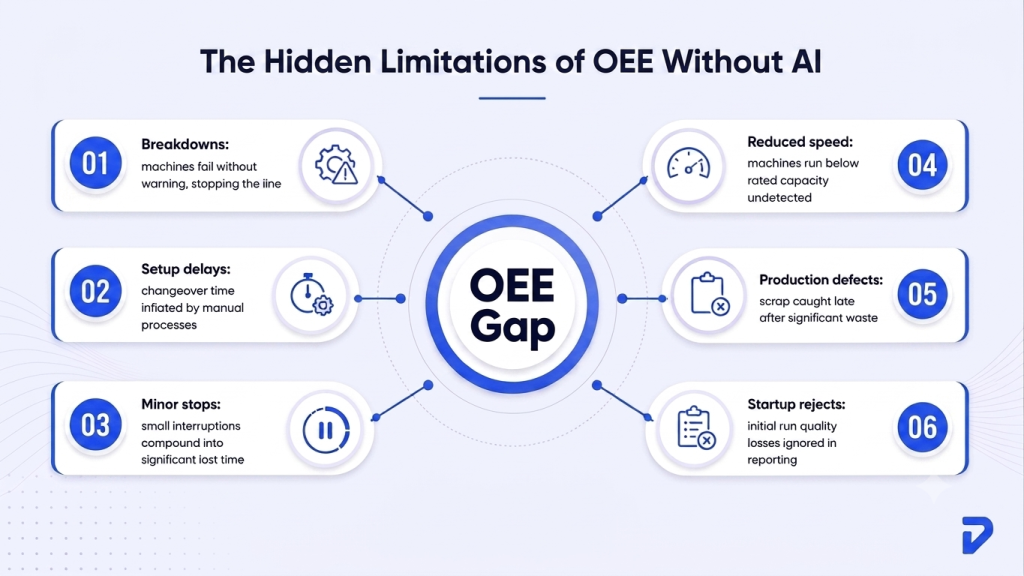
The six root causes of OEE loss break into three categories: downtime losses (breakdowns and setup/adjustment delays), speed losses (minor stops and reduced speed), and quality losses (defects in the production run and startup rejects). AI tools do not address these losses in isolation. They monitor all six simultaneously, flagging when any metric drifts outside its normal envelope and correlating anomalies across machines to identify systemic root causes rather than individual symptoms.
What Does Unplanned Downtime Actually Cost?
The cost of unplanned downtime is large enough to reframe any conversation about AI investment. Unplanned equipment downtime costs Fortune Global 500 companies the equivalent of 11% of total revenues, roughly $1.4 trillion per year, and automotive plants can lose up to $2.3 million for every hour a line stands idle. More broadly, the total downtime burden on the Global 2000 has grown 50% in two years, reaching $600 billion annually, with individual companies losing an average of $300 million each year.
Those figures make the ROI case for AI straightforward. If a mid-market manufacturer runs $50 million in revenue and accepts a 5% downtime drag, the annual cost is $2.5 million in lost production, before accounting for maintenance labor, emergency parts premiums, and customer penalties. Addressing even a fraction of that gap with AI-driven availability management pays for the initiative many times over.
From Reactive to Predictive: The Maintenance Spectrum
Most manufacturers operate somewhere along the reactive-to-predictive spectrum, and the financial gap between the two ends is measurable. Moving from reactive repairs to a structured predictive maintenance strategy, one informed by real-time sensor data and machine-learning models, can cut unplanned machine downtime by 30% to 50% and reduce overall maintenance costs by 18% to 25%, according to benchmarks compiled from McKinsey research.
| Maintenance mode | Trigger | Typical outcome |
| Reactive | Equipment failure | Highest downtime; emergency parts costs |
| Preventive | Fixed schedule | Unnecessary replacements; underutilization of healthy parts |
| Condition-based | Manual sensor checks | Labor-intensive; misses fast-developing faults |
| Predictive (AI) | Continuous anomaly detection | Lowest unplanned downtime; optimized part life |
| Prescriptive (AI + agentic) | AI recommends action, routes work order | Closes the loop without manual dispatch |
The prescriptive tier, where agentic AI services not only detect anomalies but automatically create work orders, source parts, and adjust production schedules, represents the leading edge of what is now in production at forward-leaning facilities.
How AI Drives OEE Improvement in Practice
The mechanisms through which AI for Overall Equipment Effectiveness (OEE) lifts manufacturing performance are concrete and measurable. These improvements span key operational domains, including anomaly detection, predictive maintenance, quality control, production scheduling, and energy management.
1. Anomaly Detection
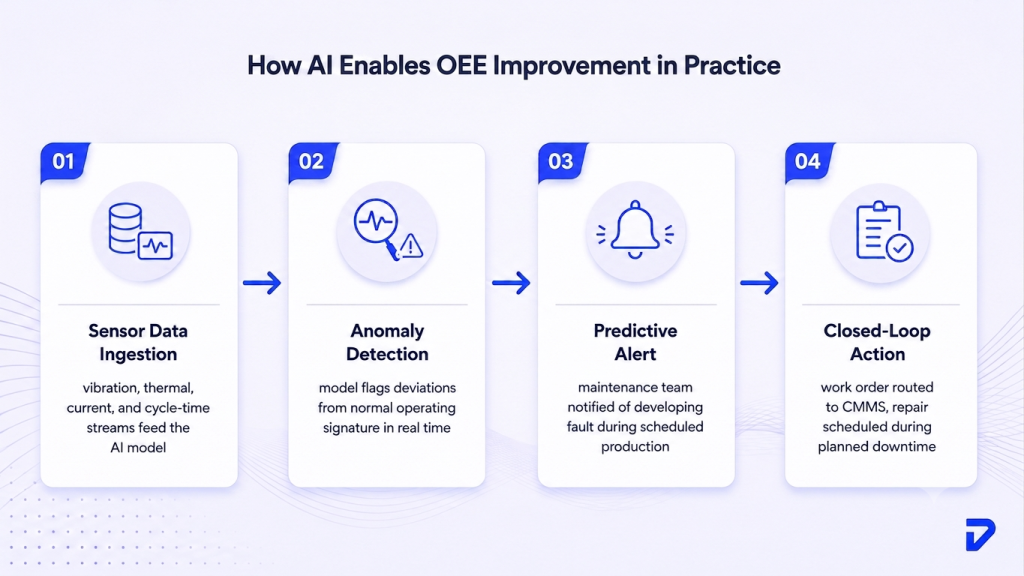
Industrial AI models ingest time-series data from vibration sensors, thermal cameras, current clamps, and process historians. They learn a machine’s normal operating signature across changing operating conditions, including different product runs, seasonal temperature swings, and operator shifts. When sensor readings deviate from this baseline, the system flags the anomaly immediately, often before it affects production or leads to equipment failure.
Early anomaly detection gives operations teams visibility into developing issues, allowing them to investigate root causes before they result in downtime, quality problems, or reduced throughput.
2. Predictive Maintenance
Predictive maintenance builds on anomaly detection by forecasting when equipment is likely to fail and recommending maintenance at the optimal time. Instead of following fixed maintenance schedules or reacting after a breakdown, maintenance teams can perform repairs during planned production windows, minimizing disruption.
Facilities that have deployed digital twins alongside AI-enabled asset management have seen OEE improve by 44% and defect rates fall by 47%, according to research published by the World Economic Forum’s Global Lighthouse Network. These results come from advanced manufacturers that have scaled AI beyond pilot projects into full production environments.
3. Computer Vision for Inline Quality Control
Quality losses, including defects and startup rejects, are among the hardest OEE factors to improve with traditional methods because manual visual inspection is slow, inconsistent, and difficult to scale across high-speed production lines. AI-powered computer vision systems inspect every part in real time, classify defects by type and severity, and feed the findings back into process controls so upstream issues can be corrected before additional scrap is produced.
This closed-loop approach shifts quality management from detecting defects at the end of the line to preventing them at the source. While human inspectors may sample only a fraction of production, AI systems inspect every unit consistently without fatigue.
4. Production Scheduling and Throughput Optimization
Performance losses, such as minor stops and reduced operating speeds, often go unnoticed because individual events are brief. AI analyzes production data to identify these micro-losses, group them by root cause, such as tooling wear, material variation, or operator behavior, and prioritize improvement opportunities for process engineers.
By addressing recurring sources of lost time, manufacturers can recover several percentage points of throughput on high-volume production lines without additional capital investment.
Is Your Operation Ready to Scale AI for OEE?
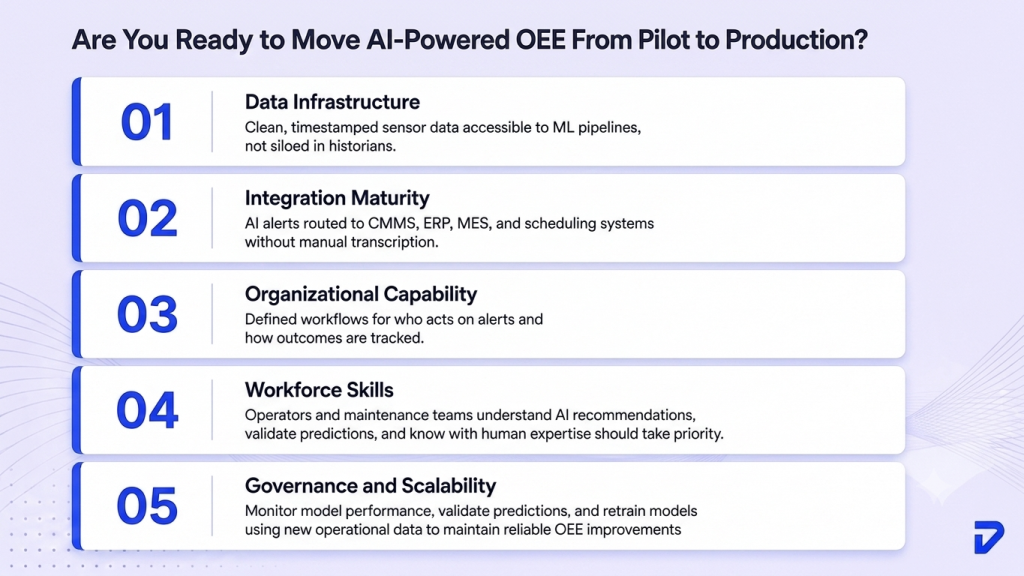
Successfully scaling AI for Overall Equipment Effectiveness (OEE) depends on more than deploying algorithms. Manufacturers need the right technical foundation, operational processes, and workforce readiness to turn AI insights into measurable performance gains.
1. Data Infrastructure
Data infrastructure is usually the first constraint. AI models need clean, timestamped sensor data at sufficient resolution to detect the anomalies that precede failure. Many facilities still store information in disconnected systems. Connecting those data sources through industrial IoT platforms or modern data architectures creates the foundation for reliable AI insights.
2. Integration Maturity
Integration maturity determines how quickly AI insights translate into action. An alert that appears in an isolated dashboard delivers little value if no one responds. Effective AI integration connects predictive models directly with CMMS, ERP, MES, and scheduling systems, allowing recommendations to automatically trigger maintenance workflows and operational decisions.
3. Organizational Capability
Organizational capability is often underestimated. AI tools generate more operational information than maintenance teams have traditionally managed. Success depends on clearly defined workflows, ownership, and response procedures. Organizations that establish accountability for AI-driven recommendations are more likely to achieve consistent improvements in equipment performance and OEE.
4. Workforce Skills
Employees need the skills and confidence to work alongside AI systems. Operators and maintenance teams should understand how to interpret AI recommendations, validate predictions, and know when human expertise should take priority. Regular training and practical experience improve adoption and ensure AI becomes part of daily operations.
5. Governance and Scalability
Long-term success requires governance that keeps AI models accurate as production conditions change. Manufacturers should monitor model performance, validate predictions, and retrain systems using new operational data. A strong governance framework ensures AI for Overall Equipment Effectiveness (OEE) can scale across multiple production lines while maintaining reliable and measurable improvements.
The Bottom Line
AI for Overall Equipment Effectiveness is the clearest single measure of how well a manufacturing operation converts potential into output. The gap between the industry average of 60% and the world-class benchmark of 85% represents significant lost revenue through downtime, slower production, and quality issues. AI helps close that gap with continuous monitoring, predictive insights, and data-driven operational decisions.
Pinnasys works with industrial and manufacturing operators to move AI from proof of concept into production by connecting equipment data, predictive models, and operational workflows. Whether improving one production line or multiple facilities, every successful transformation begins with a structured AI consulting engagement that maps the data, defines measurable outcomes, and creates a system that continuously improves performance over time.
Key Takeaways from the Article
- The average OEE of 60% leaves a 25-point gap from the 85% world-class benchmark that AI helps manufacturers close.
- Unplanned downtime drains $600 billion annually from Global 2000 companies alone.
- Predictive AI reduces unplanned downtime by 30–50% compared with reactive maintenance programs.
- Facilities deploying digital twins and AI asset management have achieved 44% OEE gains, demonstrating measurable operational improvements.
- AI adoption in manufacturing is now mainstream, with 84% of organizations already reporting measurable value.
Frequently Asked Questions
What is OEE and why does it matter for manufacturers?
AI for Overall Equipment Effectiveness (OEE) is a composite metric multiplying Availability, Performance, and Quality. It tells operators what percentage of scheduled production time is truly productive. A score below 85% signals recoverable losses in uptime, throughput, or first-pass yield that directly reduce revenue.
How does AI improve equipment availability specifically?
AI monitors real-time sensor data, vibration, temperature, current draw, and cycle time to detect anomalies before they cause failures. By flagging developing faults days or weeks early, maintenance teams can schedule repairs during planned downtime rather than respond to unplanned stoppages, improving the Availability component of OEE.
What data does an AI-based OEE system require?
At minimum, timestamped process data from machine sensors (PLCs, historians, or IoT edge devices), production counts, and quality inspection records. Richer data, such as energy consumption and operator inputs, improves model accuracy. Data quality and accessibility are typically the first challenges to address before deploying AI.
Is AI for OEE relevant for mid-market manufacturers, or only large enterprises?
AI-driven OEE improvement is now accessible at mid-market scale. Cloud-based ML platforms, pre-trained anomaly detection models, and modular IoT connectivity have reduced the entry cost significantly. Many mid-market deployments show positive ROI within twelve months because the baseline downtime costs are large relative to the implementation investment.
How long does it take to see OEE improvements after deploying AI?
Early wins from anomaly detection and minor-stop analysis often appear within the first two to three months of a properly instrumented deployment. Structural OEE gains, reflected in sustained Availability and Performance improvements, typically consolidate over six to twelve months as models learn equipment-specific patterns and workflows adapt to act on the insights.





Prakash C. Saini
Prakash Saini is the Founder & CEO of Pinnasys. With over a decade in digital transformation and building production systems, he grew an engineering team from 2 to 50 people and has led the delivery of 100+ production digital systems. Products built under his leadership have raised millions in funding and generated over $50 million in revenue. He holds an Executive MBA from IIM Kozhikode and today leads the AI engineering team at Pinnasys.