


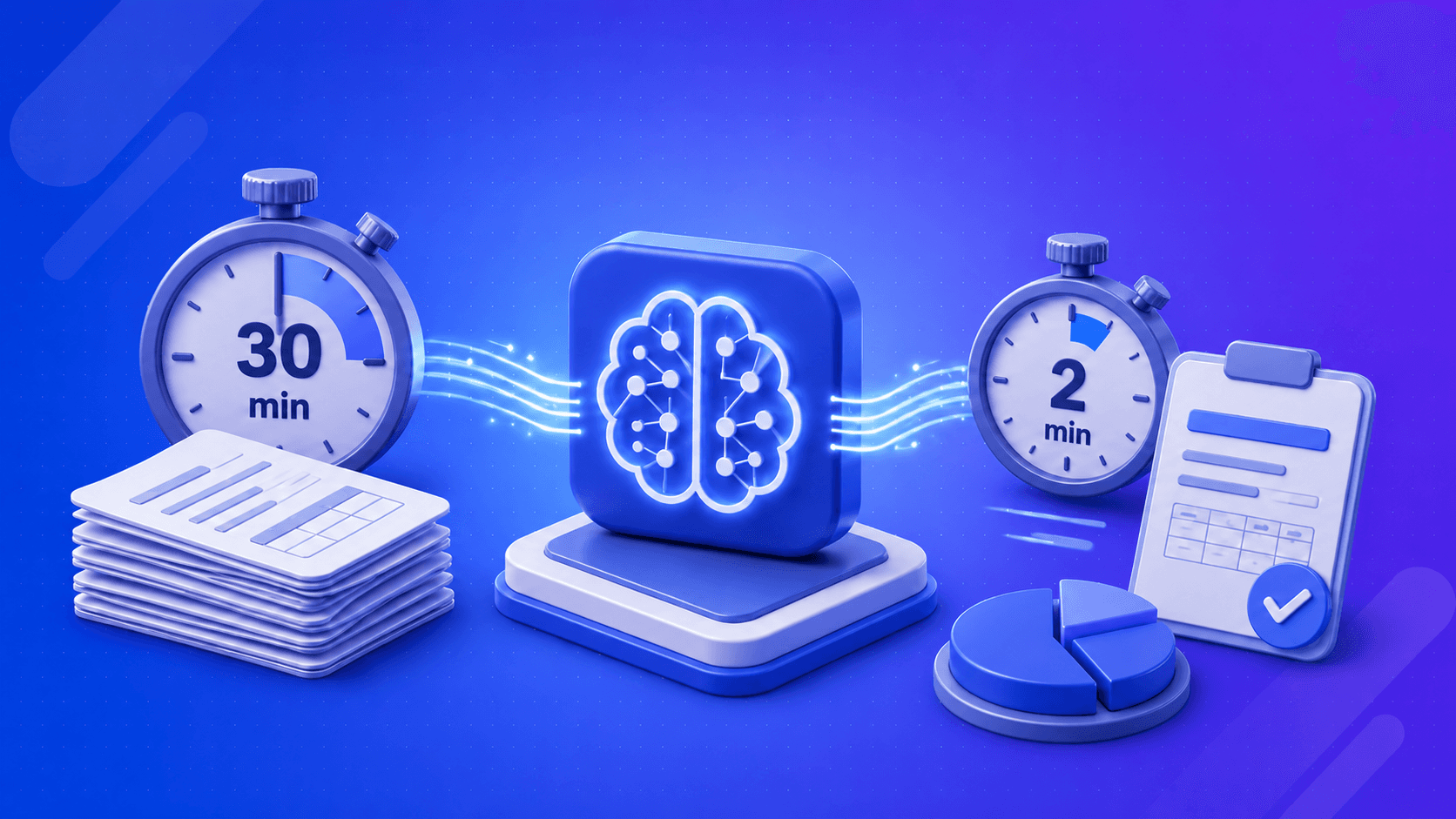
AI quoting cuts quote time from 30 minutes to under 2 minutes by reading catalogs, pricing rules, and customer data in seconds instead of by hand. The result is faster responses, fewer pricing errors, and reps who spend more time selling and less time typing.
McKinsey research shows generative AI can now automate work activities that absorb 60 to 70 percent of employees’ time, and quoting sits squarely inside that bucket. Most sales teams still build quotes by hand: hunting through spreadsheets, checking price lists, and copying data between systems. That process eats 30 minutes or more per quote, and it gets worse as catalogs grow. AI quoting automation flips the math. It reads the catalog, applies pricing rules, and assembles a quote in under two minutes. For distributors and B2B sellers, that speed is no longer a nice-to-have. It is becoming the baseline that buyers expect.
Why Quote Speed Matters
Buyers rarely wait for the best price. They wait for the first credible one. A rep who responds in minutes instead of days controls the conversation and sets the anchor price before a competitor even opens the request. Speed is not just a convenience metric. It is a revenue lever.
Slow quoting also compounds. A 30-minute quote on a simple request stretches into hours once a buyer asks for a revision, a bundle change, or a different tier of pricing. Each round trip resets the clock and gives a faster competitor more room to step in.
What Buyers Actually Notice
Buyers compare vendors on more than price. They compare how each vendor makes them feel during the request. A fast, accurate quote signals competence. A slow, error-prone one signals risk, even if the underlying product is identical.
- A same-day quote keeps a deal in the rep’s hands instead of a competitor’s inbox.
- A clean, error-free quote reduces the back-and-forth that drags out a sales cycle.
- A personalized quote, built from real customer history, shows the buyer they are not just another line item.
Why Traditional Quoting Takes 30 Minutes
Manual quoting is slow for structural reasons, not because reps are inefficient. Most quoting workflows ask one person to act as a researcher, a calculator, and a document formatter, all on a deadline.
A typical quote involves five separate lookups: the current product catalog, the customer’s pricing tier, available discounts, inventory or lead times, and any approval thresholds. Reps pull these from different systems, often a CRM, an ERP, and a spreadsheet that nobody fully trusts. One missed update to a price list, and the quote goes out wrong.
| Step | What the rep does | Typical time |
| Gather product specs | Search catalog, confirm SKUs | 5 to 8 minutes |
| Apply pricing and discounts | Check tier rules, calculate margins | 8 to 12 minutes |
| Check inventory or lead time | Cross-reference ERP or warehouse data | 5 minutes |
| Format and send | Build the document, proofread, send | 5 to 7 minutes |
Add a complex configuration, a multi-line order, or a request that crosses regions, and 30 minutes becomes the floor, not the ceiling.
The Manual Workflow Has No Memory
A spreadsheet does not learn from the last 500 quotes a company sent. Every new request starts from a blank template, even when the customer, the product mix, or the discount pattern looks almost identical to a deal closed last month. That lack of memory is the real cost driver behind slow quoting.
The Hidden Cost of Slow Quotes
Quote time is easy to measure and easy to underestimate. The visible cost is staff hours. The hidden cost is the deals that quietly slip away while a quote sits in someone’s inbox.
Forrester Research has found that the average sales rep burns roughly two days a week on administrative work, much of it tied to quoting, configuration, and approvals. That is time not spent prospecting, following up, or closing. Across a ten-person sales team, two lost days each week add up to the equivalent of two full-time reps doing no selling at all.
Errors carry their own cost. A misapplied discount or a wrong SKU does not just embarrass the rep. It triggers a correction cycle, a credibility hit with the buyer, and sometimes a margin loss that finance only catches after the deal closes. The slower and more manual the process, the more these errors slip through.
How AI Reimagines Quoting
AI quoting automation does not just speed up the existing process. It removes most of the manual lookups entirely. A rep, or even a customer through a self-serve portal, describes what they need in plain language. The system matches that request against the live catalog, applies the correct pricing logic, and returns a complete quote.
The shift is from “find the right answer” to “confirm the answer the system already found.” That single change removes most of the time a human used to spend searching.
Salesforce’s 2026 State of Sales research found that 87 percent of sales organizations already use AI for tasks like prospecting, forecasting, lead scoring, or drafting outreach, and quoting is one of the fastest-growing use cases inside that shift. Sellers expect agents, once fully rolled out, to cut research time on a deal by roughly a third.
Natural Language Replaces Manual Lookups
Instead of clicking through a product hierarchy, a rep can type a request like “endpoint protection for 200 users with cloud backup” and get a configured, priced quote back in seconds. The AI checks compliance rules, suggests the right add-ons, and explains why it picked each line item. That explanation matters. A rep who understands the logic can defend the quote to a skeptical buyer without escalating to a sales engineer.
The Architecture Behind 2-Minute Quotes
Fast quoting is not one tool. It is a stack of smaller systems working together, each handling a piece of the lookup that used to take a human several minutes.
- A connected product catalog. AI needs a single, current source of SKUs, specs, and availability, not three spreadsheets with different update schedules.
- A pricing and rules engine. This layer encodes discount tiers, margin floors, and approval thresholds so the AI never quotes outside policy.
- A natural language interface. Reps and customers describe what they need in plain words instead of navigating menus.
- A validation layer. Before a quote goes out, the system checks it against inventory, lead times, and compliance rules.
- A learning loop. The system tracks which quotes convert and which get rejected, then adjusts pricing and bundling suggestions over time.
This layered approach matters because production-grade quoting cannot afford to guess. A single tool bolted onto a spreadsheet will break the first time a real edge case shows up. A connected stack, with validation and human review built in, holds up under real catalog complexity.
Industry Use Cases
AI quoting automation shows up differently depending on the product and the buyer, but the underlying pattern is the same: remove the manual lookup, keep a human in the loop for judgment calls.
| Industry | What slows manual quoting | Where AI quoting helps most |
| Distribution and supply | Thousands of SKUs, regional pricing | Catalog-matched quotes in seconds |
| Industrial and field services | Custom configurations, parts lead time | Configuration plus live inventory checks |
| Insurance | Underwriting rules, risk tiers | Faster, rule-consistent quote generation |
| SaaS and technology | Usage-based pricing, bundle logic | Natural-language quote requests |
Distribution is the clearest case. A wholesale distributor juggling tens of thousands of SKUs and regional price books cannot realistically train every rep to memorize every rule. AI quoting acts as a shared brain that already knows the catalog, so accuracy does not depend on tenure.
Why Distribution Leads the Pack
Distributors often serve repeat customers with predictable buying patterns. That repetition is exactly what AI is good at recognizing. A system that has seen a customer’s last twenty orders can pre-fill likely quantities and flag unusual requests for a human to double-check, cutting both time and risk.
Still quoting by hand while competitors automate?
Pinnasys builds AI that turns your catalog into accurate quotes in seconds, so your team closes faster and frees up hours every week.
Before vs. After: Traditional vs. AI Quoting
The difference between manual and AI-assisted quoting is not subtle. It shows up in time, accuracy, and how well the process holds up as volume grows.
| Aspect | Manual Quoting | AI-Assisted Quoting |
| Time per quote | 30+ minutes | Under 2 minutes |
| Error rate | High on large catalogs | Low, catalog-validated |
| Scales with volume | No, adds headcount | Yes, same team handles more |
| Personalization | Limited, generic templates | Based on real customer history |
| Rep focus | Searching and formatting | Reviewing and selling |
Salesforce’s State of Service research backs up the productivity side of this shift: reps using AI spend 20 percent less time on routine work, freeing up roughly four hours a week for higher-value tasks. Quoting is exactly the kind of routine work that gets reclaimed first.
Example Transformation Scenario
Picture a mid-market industrial parts distributor with 8,000 SKUs and four regional price books. Before AI quoting automation, a rep handling a 40-line custom order spent close to 45 minutes: checking specs, confirming regional pricing, verifying lead times with the warehouse, and formatting the proposal.
After the company connected its catalog and pricing rules to an AI quoting automation layer, the same request took under three minutes. The rep typed the customer’s request, the system pulled live inventory and applied the correct regional pricing automatically, and a validation step flagged one part nearing a stock-out before the quote went out. The rep reviewed the draft, made one manual adjustment, and sent it.
The win was not just speed. The validation step caught an error that would have gone unnoticed in the old spreadsheet workflow, the kind of mistake that usually surfaces only after a customer complains.
Common Implementation Mistakes
Most failed AI quoting rollouts fail for the same handful of reasons, not because the technology does not work.
- Connecting AI to a messy catalog. If product data is incomplete or contradictory across systems, the AI inherits those errors and quotes them with confidence.
- Skipping the validation layer. Speed without a check against inventory and pricing rules just produces fast mistakes instead of slow ones.
- Treating it as a one-time project. Pricing rules and catalogs change constantly. A system that is not maintained drifts out of date within months.
- No human review for edge cases. Unusual requests, large discounts, or new customer segments still need a human in the loop before the quote goes out.
- Underestimating change management. Reps who do not trust the AI’s output will quietly revert to spreadsheets, undoing the investment.
In practice, the teams that succeed treat AI quoting as infrastructure that needs ongoing care, not a tool they install once and forget.
The Future of AI-Powered Sales Operations
Quoting is one piece of a larger shift. McKinsey’s most recent research found that 57 percent of US work hours could already be automated with technology that exists today, not technology that is coming in five years. Sales operations, with its repetitive lookups and approvals, sits near the front of that wave.
Expect quoting to keep moving from reactive to predictive. Instead of waiting for a request, AI will increasingly flag renewal opportunities, suggest bundles before a customer asks, and route unusual requests straight to the right approver. Salesforce’s own research shows 55 percent of sales professionals already use AI for prospecting, with more planning to adopt it. That same momentum is reaching quoting and configuration next.
The Pinnasys Perspective
Most AI pilots die before they reach production. A quoting bot that works in a demo but breaks on a real 200-line order is not a win; it is a liability with a friendlier interface. Pinnasys builds AI automation that holds up against real catalogs, real edge cases, and real approval chains, not staged examples.
That means starting with the data: a clean, connected catalog and pricing rules before any natural-language layer gets added. It means keeping a human in the loop for the requests that genuinely need judgment, while letting AI handle the repetitive 80 percent. And it means measuring success the way Pinnasys measures every engagement: hours saved, errors reduced, and revenue unlocked, not a flashy demo that never makes it to a real sales floor.
The Bottom Line
Manual quoting takes 30 minutes because it forces one person to act as researcher, calculator, and proofreader under deadline pressure. AI quoting automation removes most of that manual work by connecting the catalog, the pricing rules, and the customer history into one system that drafts a quote in under two minutes. The result is not just faster paperwork. There are more deals won by the team that responds first, with fewer errors along the way. Pinnasys helps mid-market teams build AI automation that turns quoting from a bottleneck into a competitive edge. If quoting is the slowest part of your sales cycle, that is usually the easiest place to start.
Key Takeaways from the Article
- Manual quoting slows teams because reps act as researcher, calculator, and formatter at once, turning even simple quotes into a time-heavy process.
- Speed matters because buyers often choose the first credible quote they receive, making faster quoting a direct revenue advantage.
- AI quoting connects catalogs, pricing rules, and customer history in one workflow, reducing manual effort and speeding up quote creation.
- Validation layers catch pricing and inventory errors before quotes go out, fixing mistakes that spreadsheets often miss.
- Most failed rollouts happen because teams skip catalog cleanup and validation, not because the AI itself does not work.
Frequently Asked Questions
How long does it take to set up AI quoting?
Most mid-market AI quoting rollouts take six to twelve weeks, depending on catalog complexity, approval workflows, and the number of systems involved. Clean, centralized product and pricing data usually shortens implementation time significantly.
Does AI quoting replace sales reps?
No. AI quoting removes repetitive work like product lookups, pricing checks, and formatting, so sales reps can focus more on customer conversations, negotiation, solution fit, and relationship building instead of spending time on manual quote preparation.
What data does AI quoting need to work accurately?
AI quoting needs a current product catalog, pricing and discount rules, approval logic, and ideally customer quote or order history. Incomplete, inconsistent, or outdated data is one of the biggest reasons AI-generated quotes become inaccurate.
Can AI quoting handle complex, multi-line configurations?
Yes, but only when it is connected to a rules engine and validation layer. These systems check compatibility, dependencies, and pricing logic. Without them, complex multi-line configurations are where AI quoting is most likely to produce mistakes.
Is AI quoting only useful for large enterprises?
No. Mid-market distributors, manufacturers, and service businesses often see fast returns because they handle high quote volumes without large sales operations teams. AI quoting helps them reduce manual effort, improve response speed, and scale more efficiently.
How is AI quoting different from a standard CPQ tool?
Standard CPQ tools follow fixed rules, menus, and pricing logic. AI quoting adds natural-language input, learns from historical quotes, and flags unusual errors or gaps before a quote is sent, making the process faster and more adaptive.





Prakash C. Saini
Prakash Saini is the Founder & CEO of Pinnasys. With over a decade in digital transformation and building production systems, he grew an engineering team from 2 to 50 people and has led the delivery of 100+ production digital systems. Products built under his leadership have raised millions in funding and generated over $50 million in revenue. He holds an Executive MBA from IIM Kozhikode and today leads the AI engineering team at Pinnasys.