



Generative AI isn’t coming to insurance. It’s already here, sitting inside claims departments, underwriting desks, and call centers, quietly changing how the work gets done. The gap between carriers who’ve figured out how to use it well and those still watching from the sidelines is widening fast.
Insurance has never had a reputation for moving quickly. Underwriting decisions that drag on for days, customer service that feels more like a maze than actual help, for a long time, this was just accepted as “how insurance works.” That’s starting to change, and not in small increments. Carriers are cutting claims processing times, writing tighter, more precise policies, and personalizing the customer experience in ways that simply weren’t practical even three years ago.
The numbers back this up. According to Precedence Research, the global market for generative AI in insurance was valued at roughly USD 818.78 million in 2024. It is projected to reach around USD 14,297.94 million by 2034, with a compound annual growth rate of 33%. Platforms like ZBrain are turning that shift into something practical, making sense of messy data, and building services that actually fit individual customers instead of lumping everyone into broad risk categories. Let’s walk through how all of this is playing out.
The Evolution of Generative AI in Insurance
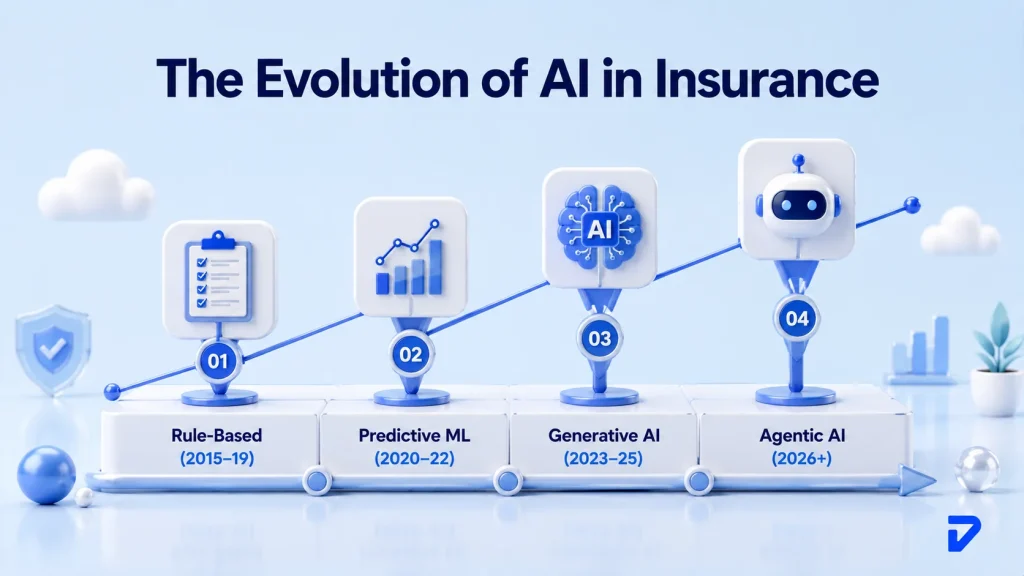
Phase 1 (2015–2019): Rule-based automation
The first wave was all about automating the repetitive stuff using fixed rules. Insurers used basic automation to process straightforward claims, send policy renewals, validate customer details, and handle the routine admin work nobody wants to do by hand. It helped, no doubt, but these systems were rigid. They followed the rules they were given and nothing more. Context and complex documents were beyond them.
Phase 2 (2020–2022): Predictive ML at scale
With the development of machine learning, insurers increasingly rely on predictive models to calculate claim costs, identify high-risk clients, detect potential fraud, and enhance pricing decision-making. Indeed, the predictive models used by insurers were efficient at handling historical data, but that was all they could do. They could not prepare reports, summarize documents, or provide any assistance with knowledge-related activities.
Phase 3 (2023–2025): Generative AI enters production
Today, large language models have emerged, enabling insurers to use them for purposes such as creating policy summaries, writing responses to clients’ inquiries, reviewing claims documentation, and supporting underwriters during complex submissions. Phase 3 is associated with many insurers deciding to implement AI across their processes at scale and use it as a production-ready product rather than a scientific one.
Phase 4 (2026 onward): Agentic AI and multi-step workflows
The next stage, referred to as agentic AI insurance in 2026, involves using systems capable of completing a set of interrelated tasks without human intervention. While the above examples refer to performing one task at a time, agents complete several tasks at once by collecting necessary information, analyzing documents, generating recommendations, and routing work to relevant departments.
Insurance AI Examples to Take Inspiration From
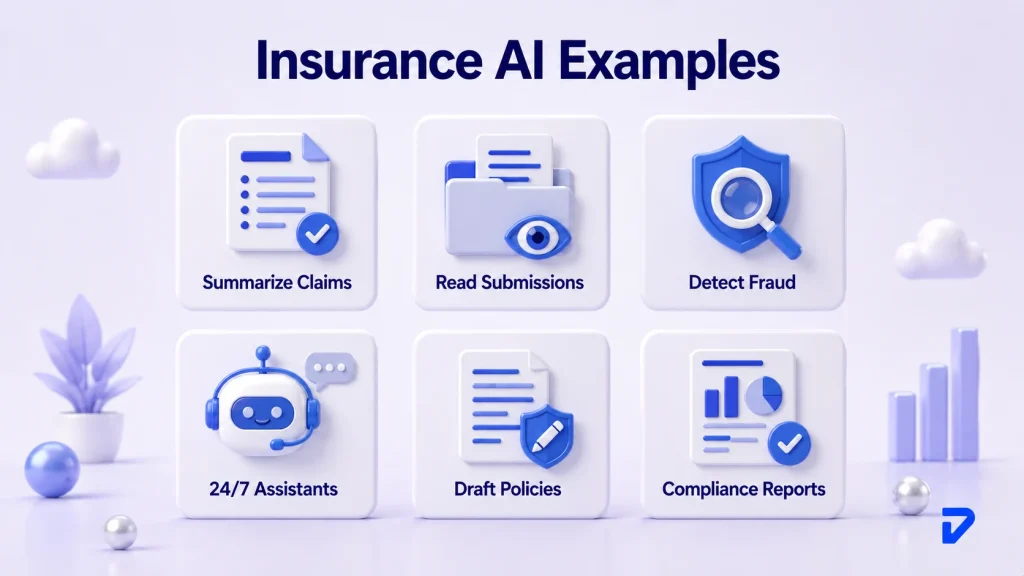
A lot of insurers are getting real value out of AI, not by reinventing their business, but simply by improving the workflows they already have. A few practical examples worth noting:
- Using AI to summarize claim files before adjusters even start their review.
- Helping underwriters pull key details out of lengthy submission documents.
- Catching unusual claim patterns that might point to fraud.
- Powering virtual assistants that answer policy questions at any hour.
- Generating policy documents and renewal communications automatically.
- Helping compliance teams summarize regulatory updates and prepare reports.
What these examples have in common is that they’re not about replacing people; they’re about speed, accuracy, and giving employees more room to do the parts of the job that actually need a human.
7 Most Effective Generative AI Use Cases in Insurance
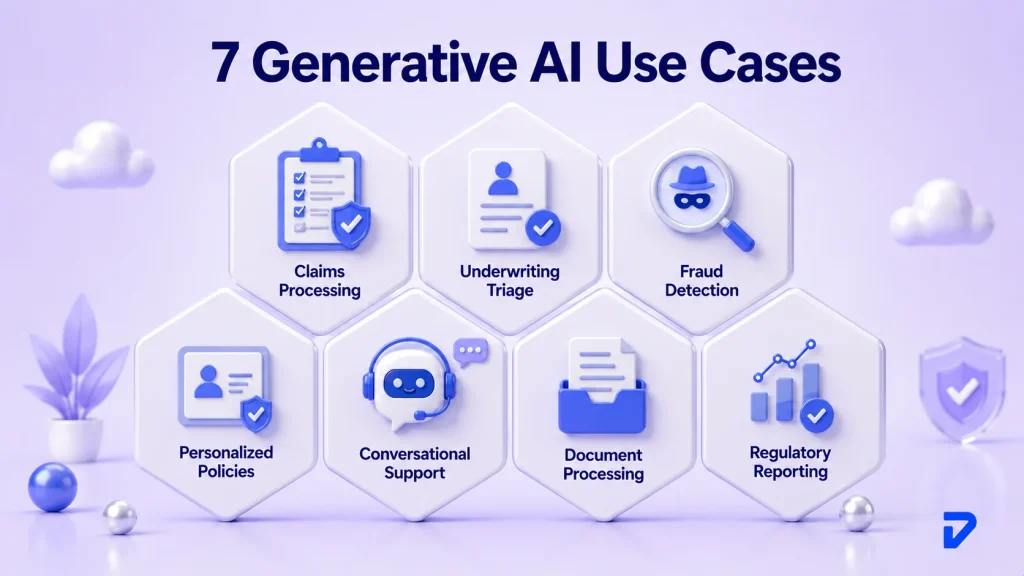
AI-Powered Claims Processing and Document Synthesis
Claims processing usually means wading through accident reports, medical records, repair estimates, policy documents, and customer statements, and doing that by hand slows everything down and pushes up administrative costs. This is where document synthesis earns its keep as one of the more valuable genAI insurance use cases today. Generative AI can pull information together from multiple sources, point out what’s missing, generate claim summaries, and prepare a first draft for the adjuster to work from.
Intelligent Underwriting and Submission Triage
Commercial and specialty insurance submissions may contain hundreds of pages that include financial documentation, inspection documents, and whatever else you could imagine. Manually going through all of this information takes much more time than is needed to make a decision. Generative AI technology is helpful in this process by gathering useful information, identifying gaps, summarizing submissions, and prioritizing applications based on their complexity. This technology does not replace underwriters, but gives them a jumpstart. In the use of AI in insurance, this particular case starts providing benefits right away.
Fraud Detection with Structured Reasoning
Fraudsters never fail to find new ways to commit insurance fraud. Traditional rules-based approaches struggle to handle increasingly complex cases, and the involvement of Generative AI can improve fraud detection by analyzing discrepancies across multiple documents and cross-referencing claims and invoices. Moreover, Generative AI can prepare summaries of investigations so that fraud analysts can concentrate on the cases worth investigating. People will still have to make decisions; however, AI will clearly facilitate that process.
Personalized Policy Creation and Dynamic Pricing
In recent years, clients have grown tired of cookie-cutter insurance and seek coverage that matches their actual circumstances. With the help of Generative AI, insurance companies can create personalized policy recommendations based on such factors as the client’s profile, coverage needs, previous claims, and other relevant parameters. When combined with predictive analytics, it enables dynamic pricing models that adjust as risk conditions change. Such an approach helps increase client engagement and provide better-fitting policies.
24/7 Conversational AI for Customer Support
Modern people always want prompt responses regardless of the communication channel they choose. Old-school chatbots cannot handle more complex questions, whereas conversational virtual assistants powered by Generative AI can explain policy coverage, guide clients through the claims-filing process, and more. Furthermore, if the case requires a person, such assistants can transfer the dialogue with the full history, which is one of the most visible applications of AI in the insurance industry.
Intelligent Document Processing for Policy Administration
The work of insurance companies involves handling large amounts of paperwork: applications, endorsements, renewals, compliance documents, etc., which is a very time- and resource-consuming task. Generative AI can take responsibility for the extraction, summarization, drafting, and classification of such documents, enabling administrative teams to handle these processes faster.
Regulatory Reporting Automation
Regulations require preparing comprehensive reports, reviewing various documentation, and maintaining an audit trail for compliance teams, which adds significant workload in addition to their primary responsibilities. However, generative AI can help summarize regulations, draft compliance reports, and organize necessary documentation, while human specialists will still review and approve the results. It is one of the most practical uses of AI for the insurance industry in the current environment.
How to Implement Generative AI in the Insurance Business?
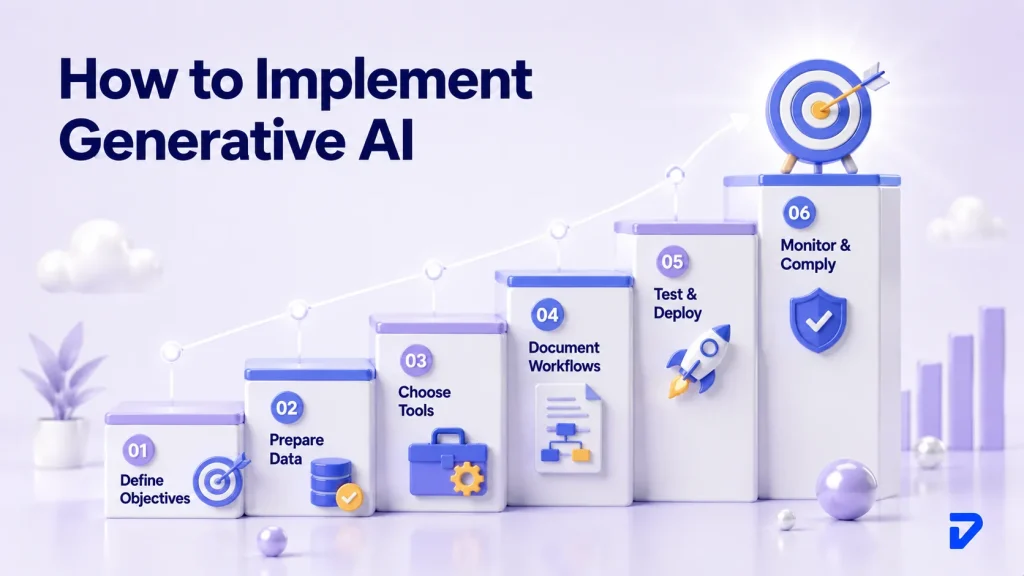
Step 1: Define Objectives Tied to Business Outcomes
Start with the actual problem you’re trying to solve. Faster claims? Better underwriting? Stronger customer service? Whatever it is, get specific, clear objectives, which make it far easier to measure progress and decide where to invest first.
Step 2: Audit and Prepare Your Data Foundation
AI only performs as well as the data behind it. Take stock of your policy records, claims data, customer information, and document repositories, and look for gaps, duplicates, or quality issues before you go any further.
Step 3: Choose the Right AI Tools and Integration Approach
Pick platforms that plug into your existing insurance systems rather than sitting off to the side as their own isolated thing. Scalability, security, regulatory compliance, and how well a vendor actually supports you all matter when you’re choosing a technology partner.
Step 4: Document Workflows Before Deploying Models
Map out your current processes so you know exactly where AI will make the biggest difference. This also lays the groundwork for governance, accountability, and human oversight once things are up and running.
Step 5: Train, Test, and Deploy in Controlled Environments
Don’t go straight to a company-wide rollout. Pilot projects let you check accuracy, surface risks, gather feedback from the people actually using the tool, and fix problems before they scale up across the rest of the system.
Step 6: Monitor Performance and Maintain Compliance
Deployment isn’t the finish line. Keep an eye on model performance, review outputs regularly, refresh training data, and stay on top of regulatory changes. Ongoing governance is what keeps accuracy, transparency, and customer trust intact over the long haul.
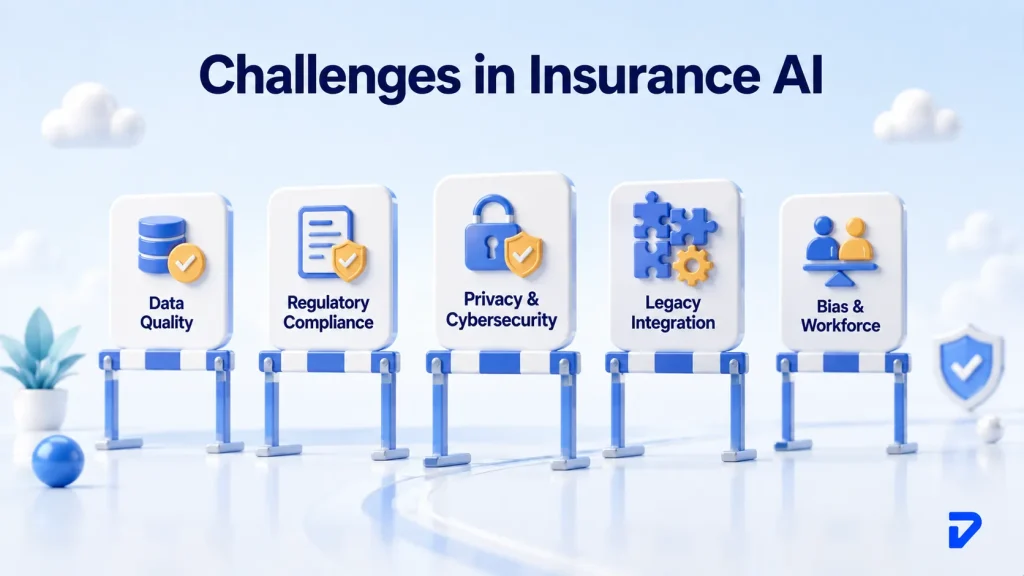
Challenges in Implementing Insurance AI
Data Quality and Legacy System Constraints
Many insurers are still running on legacy systems, with data scattered across multiple platforms. Incomplete or outdated information undermines AI accuracy and limits how useful any AI application can be. Getting the data foundation right should come before scaling anything.
Regulatory Compliance
AI-generated recommendations and decisions need to remain transparent and explainable and align with any applicable compliance requirements. In the U.S., the National Association of Insurance Commissioners (NAIC) has been actively building out guidance in this space, and state regulators can require insurers to explain exactly how AI tools factor into underwriting, pricing, or claims decisions.
Data Privacy and Cybersecurity Risks
Insurers handle some of the most sensitive data out there: financial records, medical histories, you name it. Strong encryption, tight access controls, and responsible AI governance aren’t optional here; they’re what keep customer trust intact while generative AI does its thing in the background.
Integration with Legacy Systems
Bolting AI onto underwriting, claims, or policy management platforms that were never built for modern integrations is rarely simple. A phased rollout tends to cause far less disruption and gives teams room to actually adjust as they go.
Bias, Fairness, and Workforce Adaptation
An AI model is only as good as the data it learned from. Insurers need to regularly check for bias and keep human review baked into underwriting and claims decisions that matter. At the same time, employees need real training to work alongside AI effectively, not just being told to “figure it out” while quietly worried it’s coming for their jobs.
Looking to implement generative AI for your insurance business?
Our AI experts can help you pinpoint the right use cases, integrate AI into your existing systems, and build secure, scalable solutions that actually fit your goals.
Looking to implement generative AI for your insurance business? Our AI experts can help you pinpoint the right use cases, integrate AI into your existing systems, and build secure, scalable solutions that actually fit your goals.
The Future of Generative AI in Insurance
Agentic AI Systems That Handle End-to-End Workflows
The next generation of AI won’t just support individual tasks; it’ll manage entire processes. From the moment a claim comes in to the point a settlement recommendation goes out, AI agents will coordinate the steps in between, while human experts stay in the loop for approvals.
Hyper-Personalized Products Built on Real-Time Data
Insurance products are going to become much more adaptive. By combining customer behavior, telematics, and historical data, insurers can offer coverage tailored to individual risk profiles, leading to happier customers and more accurate pricing. McKinsey’s analysis of where AI is heading in insurance points to exactly this kind of shift, with connected devices and real-time data reshaping how risk gets assessed and priced across the industry.
Predictive Risk Prevention Rather Than Loss Remediation
Rather than being reactive when claims occur, insurance companies will increasingly rely on AI solutions for preemptive risk identification and for advising customers on preventive actions to mitigate them. This reduces both the number of claims and the risk of loss in the first place.
Embedded Insurance Powered by AI at the Point of Sale
With the advancement of AI, embedded insurance will gain momentum due to its ability to deliver personalized offers when customers purchase auto insurance, book plane tickets, or buy electronics.
The Bottom Line
Generative AI in insurance is reshaping how insurers operate, sharpening efficiency, supporting better decisions, and improving the customer experience along the way. With its help, companies can improve their processes related to underwriting, claims management, risk mitigation, fraud detection, regulatory requirements compliance, and other areas. Nevertheless, all these benefits are possible not because of choosing the proper AI platform.
High-quality data, a strong governance strategy, regulatory compliance, and clearly defined goals should be taken into account to reap maximum value from the introduction of AI in insurance companies. Such is the mission of Pinnasys: helping insurance businesses move beyond pilots and develop an AI solution designed specifically for insurance. And if you are still deliberating about where to start, consider how Pinnasys approaches AI for growing businesses in general.
Key Takeaways from the Article
- Generative AI is transforming core insurance operations beyond traditional automation.
- Claims processing and underwriting are among the fastest-growing AI use cases in insurance.
- AI helps insurers improve productivity while supporting human decision-making.
- Strong data quality and governance are essential for successful implementation.
- Human oversight remains critical for compliance, fairness, and customer trust.
- Agentic AI and embedded insurance are expected to shape the future of the industry.
- Businesses should begin with focused use cases before scaling AI across the organization.
Frequently Asked Questions About Generative AI in Insurance
Which AI is best for insurance?
It really depends on what you’re trying to solve. Predictive AI tends to work best for risk assessment and fraud detection, while generative AI shines at document summarization, customer support, underwriting assistance, and policy administration. Most insurers end up getting the best results by combining both rather than picking just one.
How can generative AI help insurers in detecting anomalies?
Generative AI looks across claims, invoices, policy documents, emails, and customer records to catch inconsistencies that might signal fraud or simple errors. It can also generate investigation summaries, which allow analysts to review suspicious cases faster without taking human judgment out of the equation.
How secure is customer data when using AI in insurance?
AI platforms can be very secure, provided they’re built with proper encryption, access controls, governance policies, and regulatory compliance baked in from the start. Insurers should also establish clear data management practices and audit their AI systems regularly to protect sensitive customer information.
Are there specific AI tools tailored for small insurance firms?
Yes, plenty of cloud-based AI platforms now offer scalable options that let smaller insurers automate customer service, document processing, underwriting support, and policy administration without building out a massive in-house infrastructure. The trick is choosing tools that actually integrate with what you already have.
How is AI used in insurance policy-making?
AI helps insurers analyze customer information, determine coverage needs, recommend policy options, generate policy documents, and support pricing decisions. Altogether, this improves efficiency while letting insurers offer more personalized products and services.





Prakash C. Saini
Prakash Saini is the Founder & CEO of Pinnasys. With over a decade in digital transformation and building production systems, he grew an engineering team from 2 to 50 people and has led the delivery of 100+ production digital systems. Products built under his leadership have raised millions in funding and generated over $50 million in revenue. He holds an Executive MBA from IIM Kozhikode and today leads the AI engineering team at Pinnasys.