
Most companies have more dashboards, data, and AI tools than ever, yet many critical decisions still depend on manual analysis and human judgment. A decision intelligence maturity model shows how organizations can progress from basic reporting and descriptive analytics to predictive insights, AI-assisted decisions, and ultimately automated decision-making.
Most companies aren’t short on data. They have dashboards, analytics platforms, and, increasingly, AI tools layered across their operations. Yet in a 2026 Deloitte survey, only 5% of executives said their organizations were leading in AI-enabled decision-making, while 60% said they regularly use AI to support decisions. The gap between using AI and deciding well with AI is large, and it’s exactly what a decision intelligence maturity model is built to close.
This guide walks through what the model is, what each stage looks like in practice, how to assess where your organization sits today, and how to build a realistic roadmap toward decision automation. The goal isn’t maximum automation. It’s the right combination of data, AI, and human judgment for each type of decision you make.
What Is a Decision Intelligence Maturity Model?
A decision intelligence maturity model is a framework for assessing how effectively an organization uses data, analytics, AI, and automation to support or execute business decisions. It is not an AI adoption checklist. Two organizations can have the same AI tools and sit at very different maturity levels, depending on how well those tools are connected to actual decision-making.
Decision intelligence versus business intelligence
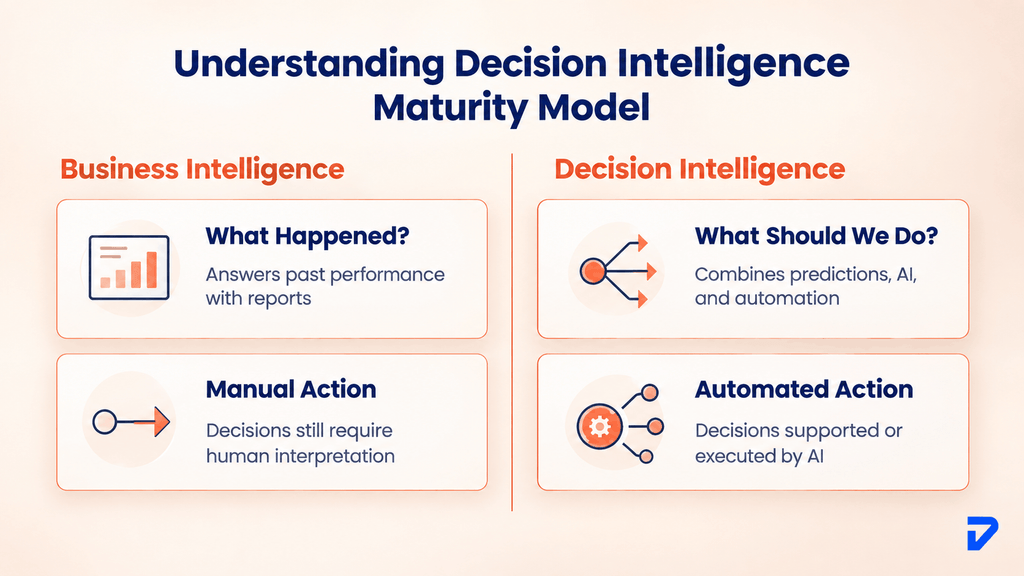
Business intelligence primarily helps teams understand historical and current performance. It answers the question: what happened? Decision intelligence extends that capability toward predicting outcomes, recommending actions, and in mature cases, automating decisions within defined boundaries.
The distinction matters because most organizations invest heavily in BI, and assume that adding an AI layer on top of it constitutes decision intelligence. It often doesn’t. You can have a sophisticated BI stack and still be at Stage 1 of this model if your decisions remain manual, slow, or inconsistently made.
Decision intelligence is decision-centric, not technology-centric. The technology exists to serve the decision, not the other way around.
Why AI adoption alone doesn’t signal maturity
McKinsey’s 2025 research found that 88% of organizations were using AI in at least one business function, yet many organizations have not moved from experimentation to scaled implementation.
Adoption doesn’t mean integration. Integration doesn’t necessarily mean better decisions.
A Decision Intelligence Maturity Model evaluates how effectively organizations translate AI capabilities into better business decisions. It assesses decision speed, consistency across scenarios, reliance on manual intervention, and the ability to track outcomes and incorporate feedback to continuously improve future decisions.
The goal is to move from simply having AI capabilities to building decision systems that can support, improve, and eventually automate repeatable business decisions.
The Five Stages of Decision Intelligence Maturity
The model moves from passive reporting to active, automated decision execution. Each stage builds on the one before it. Organizations don’t skip stages cleanly, and many run different stages simultaneously across different business functions.
| Stage | Name | Primary Capability |
| 1 | Dashboard-Driven | Historical reporting and manual interpretation |
| 2 | Data-Supported | Integrated data and structured decision support |
| 3 | Predictive | Forecasting models and scenario planning |
| 4 | AI-Assisted | AI recommendations and human-in-the-loop workflows |
| 5 | Decision Automated | AI agents executing appropriate decisions autonomously |
Stage 1: Dashboard-Driven
At this stage, decisions are made by people reading reports and dashboards. Data is available, but it requires manual interpretation. Decisions are inconsistent across teams and individuals. The time between an event occurring and a decision being made can be days or weeks. The organization knows what happened. It isn’t yet structured to act on it quickly or consistently.
Stage 2: Data-Supported
Data sources are integrated, and decision frameworks or standard operating procedures are in place to guide how people make decisions. There is more consistency. Decision quality begins to improve because the inputs are cleaner and more accessible. Some basic automation may exist for data aggregation, but decisions still require human judgment at every step.
Stage 3: Predictive
Forecasting models and scenario planning tools enter the workflow. Teams can see not just what happened but what is likely to happen next. Scenario testing lets decision-makers evaluate options before committing. This is where predictive analytics starts to shift decision-making from reactive to proactive.
Stage 4: AI-Assisted
AI recommendations appear at the moment of decision. A team member reviewing an order, a claim, or a pricing decision is shown the AI’s recommended action, with the reasoning behind it. The human remains in the loop, but the cognitive load is reduced. Decisions become faster and more consistent because the AI surfaces the relevant data and a recommended course of action simultaneously.
Stage 5: Decision Automated
At full maturity, decision intelligence enables AI agents to evaluate conditions, select actions, and trigger workflows autonomously, while exceptions are routed to humans. Governance defines which decisions can be automated based on risk, reversibility, data confidence, and required auditability.
How Do You Measure Your Decision Intelligence Maturity?
The assessment covers ten dimensions. Each one can be scored on a simple 1–5 scale, where 1 reflects an ad hoc or manual state, and 5 reflects a fully integrated, continuously improving capability.
| Dimension | What You’re Measuring |
| Data readiness | Quality, accessibility, and integration of the data that decisions depend on |
| Decision visibility | How clearly the decision process is documented and understood |
| AI recommendations | Whether descriptive, diagnostic, and prescriptive analytics are available |
| Forecasting | Presence of predictive models and scenario planning tools |
| AI recommendations | Whether AI surfaces recommended actions at decision points |
| Workflow automation | Degree to which decision execution is automated |
| Human oversight | Quality of review, escalation, and exception handling processes |
| Governance | Policies, accountability, and audit trails around decisions |
| Integration | How well decision support tools are embedded in operational systems |
| Measurement and feedback | Whether decision outcomes are tracked and fed back into the model |
Average the scores across the ten dimensions, and the result maps to a maturity stage. Scores below 2 tend to reflect Stage 1 or 2. A consistent score around 3 reflects Stage 3. Scores of 4 and above, with strong integration and feedback loops, reflect Stage 4 or 5.
Deloitte’s 2026 research found that 57% of organizations operate at low decision-making maturity, and 64% of respondents said decision-making was very important to AI success, while only 5% reported making great progress in that area. Most organizations, when they run this assessment honestly, find themselves somewhere between Stage 1 and Stage 2.
From Business Intelligence to Intelligent Decision Automation
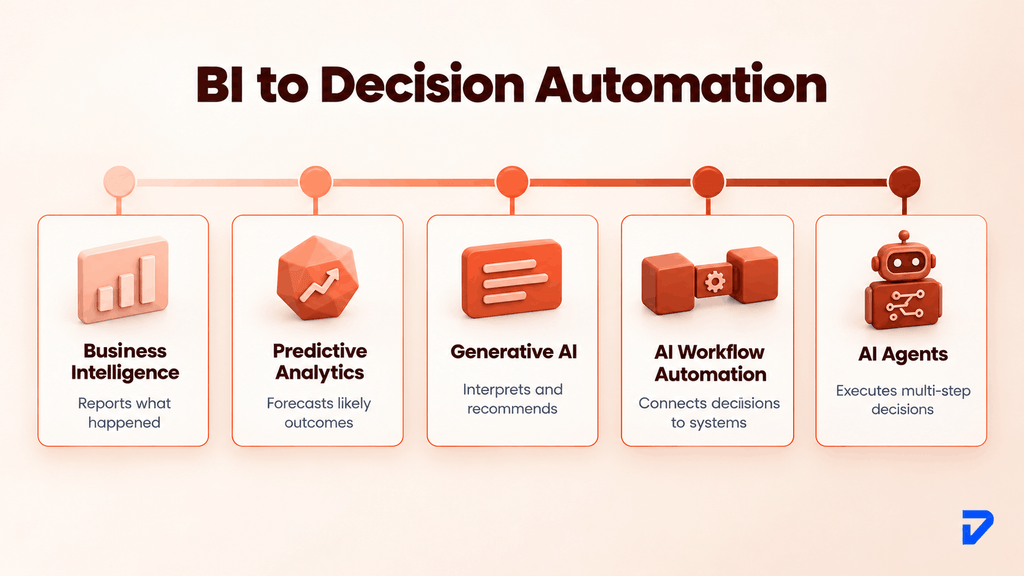
Decision maturity develops in layers, with each capability building toward faster, more consistent, and increasingly automated decisions.
- Business Intelligence: Shows what happened, when it happened, and where performance changed, providing the foundation for data-driven decisions.
- Predictive Analytics: Uses forecasting and machine learning to identify patterns and estimate likely outcomes, helping teams anticipate demand, risk, and operational changes.
- Generative AI: Interprets complex outputs, summarizes insights, and supports scenario analysis and recommendation generation.
- AI Workflow Automation: Connects AI recommendations with CRMs, ERPs, and other business systems, turning decisions into executable workflows.
- AI Agents: Evaluate changing conditions, select actions, and execute multi-step workflows, with AI agent development supporting controlled autonomous decision-making.
- Decision Intelligence Platforms: Connect data, models, recommendations, workflows, and governance to support decision automation at scale.
PwC’s 2025 survey found that 79% of executives said AI agents were already being adopted in their organizations, reflecting the growing shift toward AI-enabled decision processes.
How Do I Approach a Decision Intelligence Maturity Assessment?
A structured assessment helps identify the current maturity stage, gaps, and priorities for improvement.
- Identify high-impact decisions: Focus on pricing, procurement, credit, inventory, claims, routing, and other decisions with measurable business impact.
- Map decision workflows: Document who makes decisions, what data they use, how long decisions take, and where delays or inconsistencies occur.
- Assess data and systems: Identify data sources, integration gaps, accessibility issues, and dependencies affecting decision quality.
- Measure automation and AI: Review existing AI, automation, recommendations, and manual intervention points across decision workflows.
- Evaluate governance: Check accountability, audit trails, human oversight, and escalation processes for exceptions.
- Build the roadmap: Assign the current maturity stage and prioritize the next improvements based on business impact, complexity, risk, and data readiness.
Ready to move beyond dashboards and improve how decisions are made?
Pinnasys can help you assess maturity, prioritize workflows, and build toward decision automation.
How Long Does a Decision Intelligence Maturity Model Take to Implement?
Timelines vary by scope, data quality, and target stage. Breaking the implementation into distinct phases makes it easier to plan and manage.
| Phase | Activities | Typical Duration |
| Maturity assessment | Decision inventory, stakeholder interviews, workflow mapping, dimension scoring | 4–8 weeks |
| Initial implementation | Data integration, decision-support model build, pilot workflow | 3–6 months |
| Advanced implementation | AI-assisted decisions, automation of prioritized decision types, agentic workflows | 6–18 months |
| Ongoing maturity | Monitoring, governance, feedback loop optimization, staged expansion | Continuous |
Building a Roadmap From Dashboards to Decision Automation
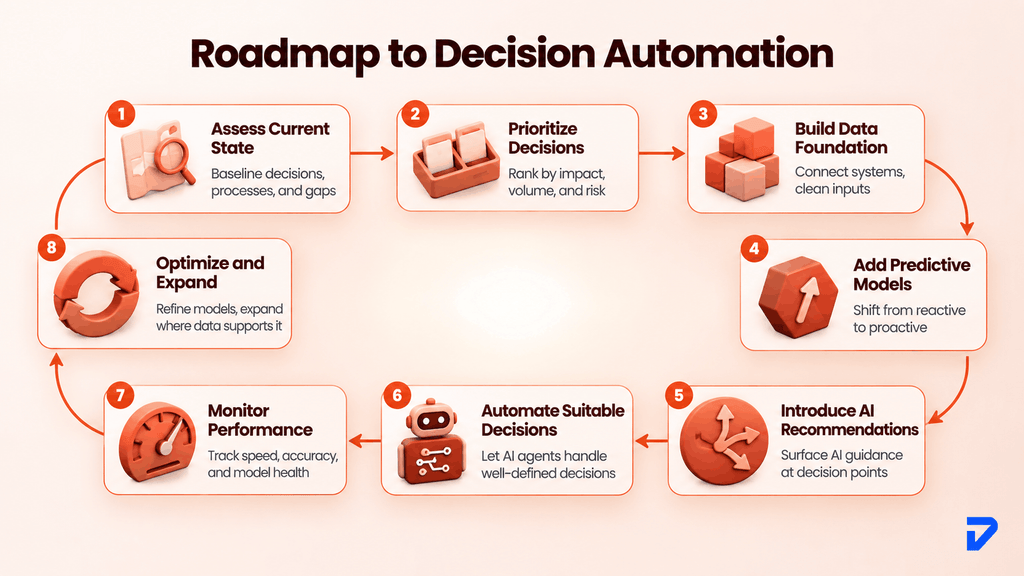
The roadmap follows eight phases. They can run in parallel across different decision types, but the progression moves from assessment to optimization.
1. Assess the Current State
Evaluate the decisions that matter most to the business. Document current processes, data sources, technology, and human involvement. This establishes a realistic baseline and highlights the gaps preventing more consistent, timely decisions.
2. Prioritize Decision Opportunities
Not every decision needs advanced automation. Rank opportunities by business impact, decision volume, data readiness, risk, and implementation complexity. Start where better decision-making can create measurable value without introducing unnecessary operational risk.
3. Build the Data Foundation
Connect the systems and data sources supporting priority decisions. Improve data quality, accessibility, and lineage before introducing advanced models. Reliable decisions depend on reliable inputs, especially when those decisions will eventually be automated.
4. Introduce Predictive Capabilities
Apply forecasting, predictive models, and scenario planning to understand likely outcomes. This moves decision-making beyond historical reporting and gives teams stronger signals about what may happen next, helping establish measurable value early.
5. Add AI Recommendations
Introduce AI-assisted recommendations directly within existing workflows. Decision-makers should see relevant recommendations where action happens, rather than another dashboard to monitor. Track adoption, overrides, and outcomes to understand whether recommendations are improving decisions.
6. Automate Suitable Decisions
Automate decisions where processes are well-defined, data confidence is high, and risk is manageable. AI agents can execute actions and trigger downstream workflows, while humans remain responsible for exceptions, edge cases, and higher-risk decisions.
7. Monitor Decision Performance
Measure decision speed, accuracy, business outcomes, and model performance continuously. Conditions change, and models can degrade over time. Regular monitoring and governance reviews help ensure automated decisions remain reliable, explainable, and aligned with business requirements.
8. Optimize and Expand
Use decision outcomes to refine models, workflows, and decision logic. Expand automation when performance supports it, but retain human oversight where uncertainty or risk remains high. Maturity improves through continuous feedback, not a one-time implementation.
The Bottom Line
A decision intelligence maturity model is not an AI adoption checklist. It shows the gap between how decisions are made today and what becomes possible with better data, AI, and workflow integration.
The progression moves from understanding what happened to explaining why, predicting what could happen, recommending what to do, and automating appropriate decisions. Each stage can deliver value without requiring organization-wide transformation.
The goal is not maximum automation. It is deliberate assignment of decision rights between people and AI based on business impact, risk, and data readiness. Pinnasys helps organizations assess maturity, prioritize workflows, and build decision intelligence capabilities that support measurable outcomes.
Key Takeaways
- Decision intelligence maturity is measured by decision outcomes, not AI tool adoption.
- Most organizations sit at Stage 1 or Stage 2, even with AI tools deployed.
- Data quality is the most common and most consequential bottleneck to maturity progress.
- Human judgment remains essential; the model defines where AI assists or automates.
- Each maturity stage delivers real business value before full decision automation is reached.
Frequently Asked Questions
What is a decision intelligence maturity model?
A decision intelligence maturity model is a framework that measures how effectively an organization uses data, analytics, AI, and automation to support or execute business decisions. It covers five stages from dashboard-driven reporting to full decision automation, assessing ten dimensions including data readiness, forecasting capability, AI recommendations, governance, and feedback loops.
What are the five stages of decision intelligence maturity?
The five stages move from dashboard-driven reporting and data-supported decisions, through predictive intelligence and AI-assisted decisions, to decision automation where AI agents execute appropriate decisions within defined governance boundaries. Most organizations currently sit at Stage 1 or Stage 2, according to Deloitte’s 2026 research, which found 57% operating at low decision-making maturity.
How is decision intelligence different from business intelligence?
Business intelligence answers “what happened?” using reports and dashboards. Decision intelligence answers “what should we do?” by combining predictive models, AI recommendations, and automated workflows. BI is a prerequisite for decision intelligence, not a substitute for it. The shift from BI to DI is a shift from information delivery to decision support and execution.
How long does it take to implement a decision intelligence maturity model?
The initial assessment typically takes four to eight weeks. Moving from Stage 2 to Stage 3 usually takes three to six months of data integration and model work. Reaching Stage 4 or Stage 5 for prioritized decision types can take six to eighteen months or longer, depending on integration complexity, data quality, governance requirements, and the volume and type of decisions being automated.
What is decision automation and how is it different from traditional automation?
Traditional automation executes predefined rules for fixed inputs. Decision automation uses AI to evaluate changing conditions, select an action from a set of options, and trigger the appropriate workflow, without a human making each individual call. It’s context-aware. RPA handles known steps; decision automation handles conditional choices.
What is the biggest risk when building toward decision automation?
Automating a poorly designed or data-deficient decision process is a common failure mode. Automation amplifies existing process quality in both directions. A flawed process, when automated, can produce bad decisions faster. Fix data quality and decision design before building automation on top of them.