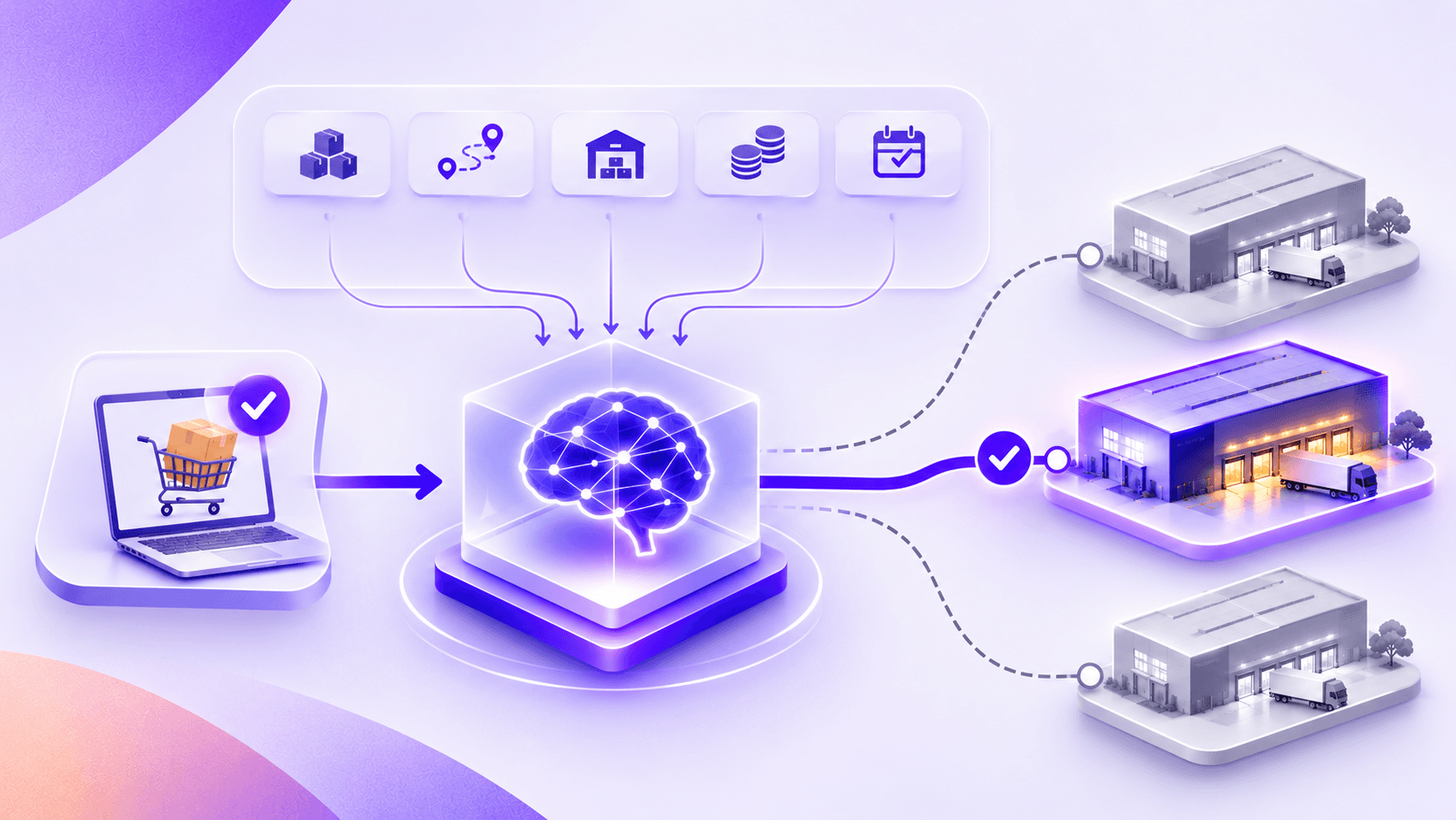
Decision intelligence for distribution turns warehouse-to-order routing from a manual guessing game into a real-time, data-driven decision. The right fulfillment choice, made consistently at scale, cuts logistics costs and accelerates delivery.
Logistics optimization and inventory management ranked as the top two areas where AI and analytics deliver the greatest business impact across 300 distributors surveyed by McKinsey, a result that points directly at the core operational decision most teams still make by hand: which warehouse ships which order. That choice, repeated thousands of times a day, shapes delivery speed, freight costs, and customer satisfaction in ways that spreadsheet-based planning cannot keep up with.
Distribution operations are not short on data. Most mid-market companies already track inventory levels, carrier rates, and fulfillment capacity. The gap is that this data rarely flows into the fulfillment decision at the moment it matters. Decision intelligence for distribution closes that gap by connecting real-time signals to automated, auditable routing choices.
In this blog, we’ll explore how decision intelligence improves warehouse-to-order routing, the data and systems behind it, and where AI can automate distribution decisions.
The Warehouse That Ships the Order Matters
When a customer places an order, the default fulfillment logic at many distributors is simple: ship from the nearest warehouse that has stock. That rule works until it doesn’t. A warehouse running at 95% capacity, a carrier with a three-day delay, or a regional demand spike can all turn “nearest with stock” into the worst possible choice.
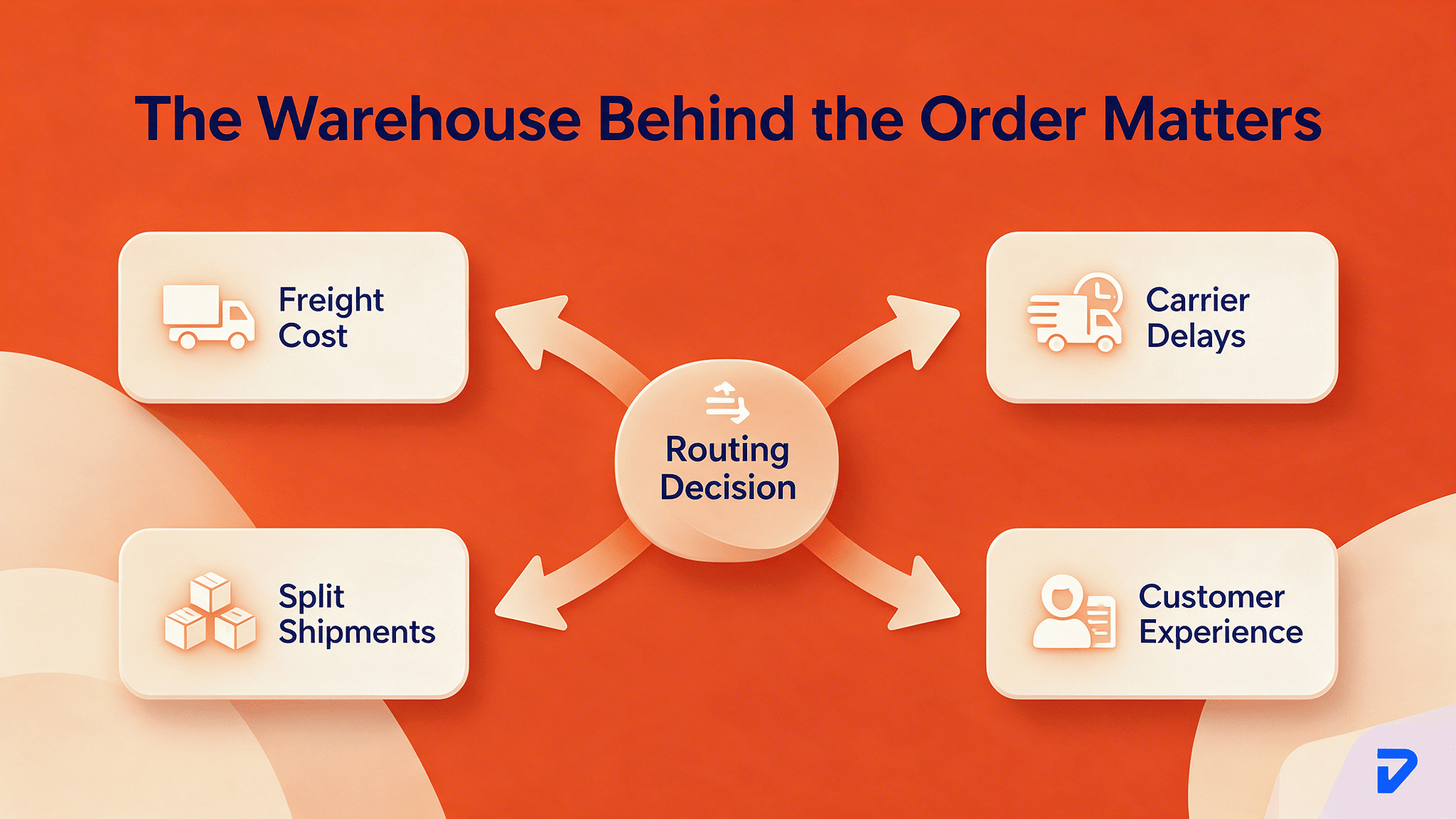
Why the wrong warehouse costs more than freight
A mis-routed order carries compound costs. Direct freight charges are just the start. Split shipments to fix a stock-out, expedited re-routing when the original carrier misses the window, and customer service time spent managing late deliveries all follow. Amazon’s supply-chain optimization team, SCOT (Supply Chain Optimization Technologies), was built specifically to prevent this kind of cascading cost by making the warehouse-to-order decision with precision at massive scale.
The Role of Decision Intelligence in Distribution
Decision intelligence (DI) is the discipline of combining decision modeling, analytics, and AI to support, augment, and automate the choices that drive operations. Gartner defines it as a practical approach that shifts organizations from process-based workflows to decision-centric orchestration, where every material choice is instrumented, traceable, and improvable over time.
For distribution, that definition has an immediate operational shape. Inventory planning, order routing, carrier selection, and warehouse capacity allocation are all decisions. Each one has inputs, constraints, a goal, and a measurable outcome. Decision intelligence gives distribution operators the architecture to handle all of them systematically, rather than relying on experience, habit, or spreadsheets that can only reflect last week’s reality.
How DI differs from business intelligence
Business intelligence (BI) tells you what happened. It answers “our fill rate dropped 4% in Q3.” Decision intelligence answers the operational question that follows: given current inventory, carrier availability, and demand signals, which warehouse should ship this order right now? BI is retrospective; DI is directive. The distinction is not cosmetic. An operator reading a BI dashboard still has to translate data into a decision. A DI system makes the decision, logs the reasoning, and learns from the result.
Inside the Warehouse-to-Order Decision
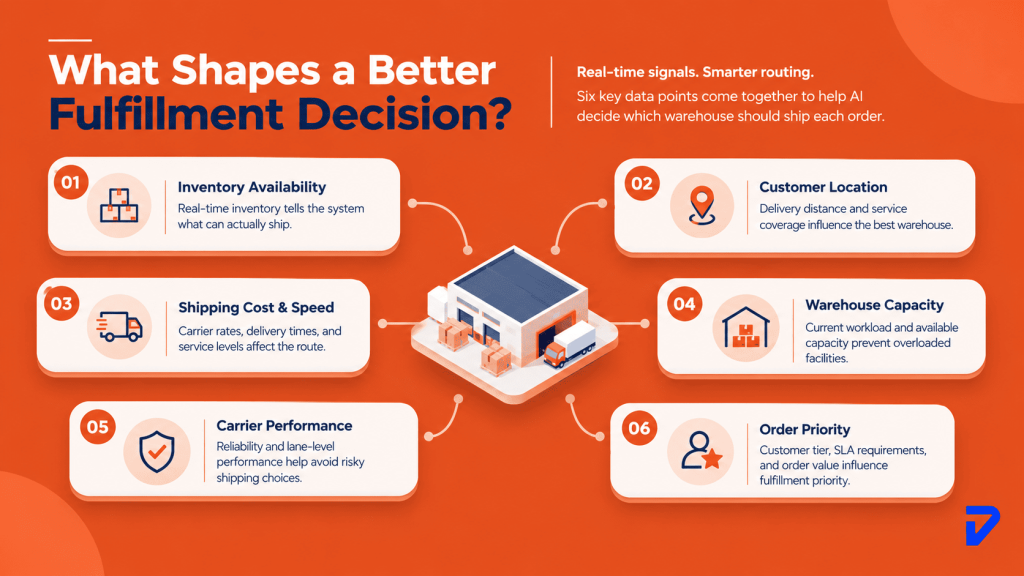
Routing a single order sounds simple. In practice, it involves resolving at least six competing variables simultaneously: where inventory is, where the customer is, what shipping will cost, how fast each carrier can deliver, what capacity each warehouse can handle today, and whether the order carries a priority flag that overrides the cost-optimal path.
Manual planners handle this well for small order volumes. At 2,000 or 20,000 orders a day, the math outpaces human judgment. McKinsey’s September 2026 logistics research found that AI, digital twins, and real-time visibility platforms are moving from experimental pilots into the operational core of logistics, precisely because the decisions are too complex and too frequent for manual resolution to hold.
When a single rule breaks the whole operation
A fixed routing rule (ship from the closest warehouse) performs adequately in stable conditions. Add a regional weather event, a carrier capacity crunch, or a product line with uneven stock distribution and the rule starts producing expensive exceptions. Decision intelligence doesn’t replace the rule; it replaces the assumption that one rule is always right. Instead, the system evaluates each order against the current state of the network and selects the path that best satisfies cost, speed, and capacity constraints simultaneously.
How AI Decides Where Each Order Should Ship From
AI-powered order routing uses optimization models to evaluate available fulfillment options for each order. It balances cost, delivery speed, warehouse capacity, inventory availability, and constraints such as carrier cutoffs.
Amazon’s SCOT system demonstrates this approach at scale. Amazon Science research connects demand forecasting, inventory positioning, and order routing to help determine where inventory should be placed and how orders should be fulfilled.
For mid-market distributors, the same architecture can be applied at a smaller scale. The system checks inventory, warehouse capacity, carrier lead times, and business rules, then recommends or automatically selects the best fulfillment option.
| Routing input | What the AI evaluates | Business outcome |
| Inventory availability | Units on hand, reservation status, replenishment ETA | Prevents ship-then-backorder sequences |
| Customer location | Proximity to each fulfillment node | Reduces transit time and freight cost |
| Carrier performance | Current lead times, historical reliability by lane | Routes around underperforming carriers |
| Warehouse capacity | Current utilization, scheduled outbound volume | Prevents congestion and throughput bottlenecks |
| Order priority | Customer tier, SLA window, order value | Ensures high-value orders ship first |
| Shipping cost | Rate comparison across carriers and routes | Hits cost targets without sacrificing delivery |
The Signals Behind Better Fulfillment Decisions
The quality of any routing decision is a direct function of the quality and freshness of the signals feeding it. Six data categories drive the most material improvements in distribution fulfillment.
1. Inventory availability
Inventory data must reflect real-time status, not last night’s batch update. A warehouse that shows 200 units in the ERP may have 180 of them reserved for pending orders. Routing against the gross number produces a stock-out in fulfillment. Decision intelligence platforms connect directly to warehouse management systems (WMS) to read available-to-promise (ATP) inventory rather than on-hand totals.
2. Customer location
Geographic proximity to the fulfillment node determines both transit time and freight cost. A decision intelligence system scores each warehouse by delivery speed and cost to the customer’s postcode, factoring in carrier service maps rather than straight-line distance. NIST’s 2026 AI in supply chain report notes that handling the high-dimensional, interconnected nature of supply-chain data is a core challenge that AI addresses more effectively than rule-based systems.
3. Shipping cost and speed
Carrier rates fluctuate by lane, day, and volume tier. A static rate table is stale within a week. Real-time carrier APIs feed current pricing into the routing decision, so the system selects the optimal carrier for each order rather than defaulting to a preferred carrier regardless of current rates or available capacity.
4. Warehouse capacity
McKinsey’s distribution research found that AI-powered planning tools can unlock between 7% and 15% of additional effective warehouse capacity. The mechanism is sequencing: by routing orders to warehouses with available throughput rather than always pulling from the primary facility, a DI system smooths workload and keeps pick-and-pack rates consistent across the network.
5. Carrier performance
Historical on-time delivery rates, claim rates, and lane-level reliability data all inform carrier selection. A carrier performing at 91% on-time delivery in the Northeast should be scored differently from one at 97%, even if their quoted rates are similar. Decision analytics convert this performance data into a scoring model the routing engine uses in real time.
6. Order priority
Customer tier, SLA commitments, and order value each create priority signals the routing engine must respect. A standard order and a key-account order with a same-day SLA may share a fulfillment node but warrant entirely different routing paths. Decision automation handles this without requiring a planner to manually flag and reroute each high-priority order.
Beyond Warehouse Routing: Other Decisions AI Can Optimize
Warehouse-to-order routing is where decision intelligence for distribution has the most immediate and measurable impact. It is not the only high-value application. The same data infrastructure and decision modeling that powers routing also serves a broader set of operational choices.
McKinsey’s AI in distribution research identifies the following as the highest-impact use cases across distribution operations:
- Demand forecasting: Predicting order volume by SKU, region, and customer segment to reduce both overstock and stock-outs
- Inventory positioning: Deciding how much of each SKU to pre-position at each fulfillment node based on anticipated demand patterns
- Workforce optimization: Matching labor capacity to inbound and outbound volume so warehouses run at peak throughput without overstaffing
- Supply-chain control towers: Providing real-time visibility into network disruptions and triggering re-routing or re-procurement decisions automatically
- Carrier contract optimization: Evaluating carrier mix and volume commitments based on actual performance data rather than negotiated promises
Each of these decisions shares the same structural characteristic as order routing: multiple competing variables, a time constraint, and a measurable outcome. Decision intelligence platforms apply the same optimization and automation logic across all of them.
Decision Intelligence vs. Traditional Distribution Planning
Traditional distribution planning relies on static rules, periodic batch updates, and human judgment at exception points. Decision intelligence replaces that model with continuous, data-driven decision flows.
| Capability | Traditional planning | Decision intelligence |
| Routing logic | Fixed rules (nearest warehouse) | Multi-variable real-time optimization |
| Data freshness | Batch updates (hourly, daily) | Real-time API feeds |
| Carrier selection | Preferred carrier by default | Performance-weighted, cost-adjusted scoring |
| Exception handling | Manual planner intervention | Automated re-routing with audit trail |
| Learning loop | Annual rule review | Continuous model feedback and retraining |
| Capacity management | Weekly capacity review | Live utilization monitoring per fulfillment node |
Gartner’s supply-chain analytics research describes the modern DI platform as combining predictive analytics, prescriptive analytics, AI, data science, machine learning, and digital supply-chain twins into a unified decision layer. That combination is what separates genuine decision automation from a smarter dashboard.
The practical difference for a distribution operator is this: a dashboard tells you that you have a capacity problem at your Midwest node. A decision intelligence system reroutes orders away from that node before the problem creates a delay.
From Recommendations to Decisions: Where Automation Fits
Decision intelligence ranges from decision support to full automation. The right level depends on decision complexity, risk tolerance, and data maturity. At the support end, systems provide ranked recommendations that planners can approve or override, making this approach useful for high-value decisions such as carrier selection or inventory repositioning.
At the automation end, systems execute decisions within defined guardrails without human approval. Routine order routing is a strong candidate for this approach. NIST research on causal machine learning in supply chain management shows that understanding why patterns work can support more reliable automation when operating conditions change.
A decision support system (DSS) sits between these approaches, automating routine decisions while sending exceptions to planners with relevant context. For most distribution operations, this provides a practical starting point before gradually expanding automation.
Building a Decision Intelligence Layer Across Distribution Operations
A decision intelligence layer is not a single software purchase. It is an architecture of connected data feeds, decision models, and execution interfaces that works across existing distribution systems and improves the quality of operational decisions.
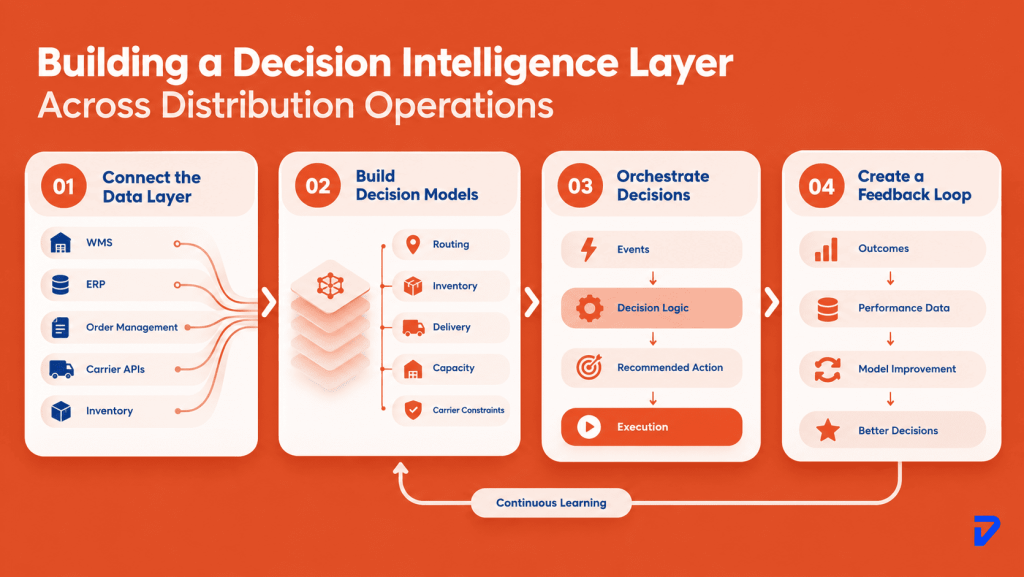
The key steps include:
1. Connect the Data Layer
Start by connecting the systems that contain the information needed for distribution decisions. This typically includes WMS, ERP, order management systems, carrier APIs, inventory platforms, and other operational data sources.
The goal is to create a reliable flow of current information. When orders, inventory levels, carrier availability, and warehouse conditions are accessible in one decision layer, models can work with the same operational context used by distribution teams.
2. Build Decision Models
Next, define the logic behind each operational decision. Models can account for routing priorities, inventory availability, delivery requirements, warehouse capacity, carrier constraints, and business objectives.
These models turn operational data into recommended actions. Instead of relying only on static rules, distribution teams can use models that evaluate changing conditions and identify the most suitable decision for each situation.
3. Orchestrate Decisions
An orchestration engine connects incoming events with the appropriate decision model. For example, a new order can trigger routing analysis, while an inventory change can prompt a different recommendation.
This creates a more responsive decision process across distribution operations. Teams can also determine which decisions require human approval and which can move directly into execution.
4. Create a Feedback Loop
The final step is measuring what happens after each decision. The system can capture outcomes such as delivery performance, routing effectiveness, inventory movement, and planner overrides.
That feedback can then be used to improve the models over time. As operating conditions and business priorities change, the decision intelligence layer becomes more accurate and useful rather than remaining a static rules-based system.
What Data and Systems Need to Be Connected
A decision intelligence platform for distribution requires live data from at least four source systems. Missing any one of them creates a blind spot that degrades routing quality.
NIST’s supply-chain AI report identifies systems integration and interoperability as the primary engineering challenge when applying AI to supply-chain environments. The challenge is not connecting the systems technically; it is connecting them at the latency and data-quality level the decision models require.
The four essential integrations are:
- Warehouse management system (WMS): real-time available-to-promise inventory, pick-and-pack capacity, and outbound scheduling data
- Order management system (OMS): incoming order stream, customer priority flags, and SLA parameters
- Carrier APIs: live rate quotes, capacity availability, and current lead times by lane
- ERP: financial constraints, cost-center allocation rules, and replenishment triggers
Secondary integrations that significantly improve routing quality include demand forecasting outputs, historical carrier performance databases, and network disruption alert feeds.
Measuring the Business Impact
Decision intelligence for distribution generates measurable returns across three cost categories. McKinsey’s distribution AI research quantifies the potential ranges:
- Logistics costs: 5% to 20% reduction through optimized carrier selection and network-wide routing
- Inventory holding costs: 20% to 30% reduction through better positioning and demand signal accuracy
- Procurement spend: 5% to 15% reduction through AI-informed buying decisions
Warehouse capacity utilization improvements of 7% to 15% create an additional return by deferring capital expenditure on new facilities. When a network runs more efficiently across its existing nodes, the decision to build or lease additional space moves further into the future.
The operating model implication is significant. A mid-market distributor processing 5,000 orders per day at an average freight cost of $12 per shipment can reduce annual logistics spend by $1.1M to $4.4M through routing optimization alone. That figure does not include inventory or procurement savings.
Where Distribution Teams Should Start
Most distribution teams start with a question: which decision is causing us the most pain? The answer is almost always order routing or demand forecasting, because those two decisions are made most frequently and carry the highest cumulative cost when they are wrong.
McKinsey’s 2026 distribution research makes a point worth taking seriously: narrow AI applications capture limited savings when the broader operating model stays unchanged. The implication for implementation is that routing optimization should not be bolted onto a broken process. The decision model needs clean data, clear routing objectives, and a defined feedback loop before it can deliver consistent results.
A practical starting sequence:
- Audit the current routing process: how are decisions made, what data is used, and where do exceptions happen most often
- Assess data readiness: confirm that WMS, OMS, and carrier feeds can be connected at the required latency
- Define routing objectives: cost-first, speed-first, or a weighted combination with customer-tier overrides
- Run a pilot on a subset of orders with a decision support configuration before moving to full automation
- Measure and refine: track routing accuracy, freight cost per order, and fill rate against baseline
AI consulting team typically spends the first engagement phase on steps one and two, because those reveal whether the data infrastructure can support a production-grade DI system or whether integration work needs to come first.
Not sure where AI can improve your distribution operations?
Pinnasys helps you identify and implement practical decision intelligence solutions aligned with your business goals.
Choosing Decision Intelligence Software for Distribution
The decision intelligence platform market has matured quickly. Gartner’s 2026 Magic Quadrant for Decision Intelligence Platforms evaluates vendors including IBM, Oracle, SAS, FICO, o9 Solutions, Aera Technology, ACTICO, Pegasystems, and Quantexa, among others.
The evaluation criteria that matter most for distribution-specific applications are:
- WMS and ERP integration depth: Can the platform connect to your specific stack without custom middleware?
- Real-time decision latency: Does the routing decision return fast enough to fit your order processing workflow?
- Explainability: Can planners see why the system made a specific routing recommendation, and can they override it cleanly?
- Configurability of decision logic: Can the routing objectives, priority rules, and cost weights be adjusted by operations staff without a developer?
- Feedback loop architecture: Does the platform track decision outcomes and use them to improve the model?
Vendors with strong supply-chain pedigrees (o9, Aera, FICO) tend to outperform general-purpose analytics platforms on the first two criteria. Platforms built for regulated industries (ACTICO, Pegasystems) tend to lead on explainability and audit trail requirements.
For distributors evaluating AI integration services, platform selection should follow the data readiness assessment, not precede it. The best DI platform in the market produces poor results when connected to stale or incomplete data sources.
Decision Intelligence for Mid-Sized Distributors
A common misconception is that decision intelligence is an initiative reserved for large, logistics-focused operations with dedicated data science teams. The evidence points the other way. Mid-market distributors often have more to gain per dollar invested than larger players, because their operations are simpler to instrument and their routing decisions are more frequently made by habit rather than by data.
McKinsey’s distributor survey, covering companies from small regional operators to large national players, found that AI and analytics create measurable impact at every scale when applied to the right decision types. The prerequisite is not company size; it is data readiness and clear decision objectives.
A mid-sized distributor with 50 warehouse staff and a single ERP can implement a decision intelligence layer for order routing with a focused integration project. The architecture is simpler than at scale, the feedback loop is faster to validate, and the ROI is visible within one to two quarters when routing accuracy and freight costs are tracked rigorously.
Pinnasys’s decision intelligence solutions are designed for this profile: teams that want production-grade AI results without building and maintaining an in-house data science capability. The engagement model covers integration, model build, and ongoing operations so the system keeps improving after deployment.
The Bottom Line
Fulfillment routing is one of the most frequent and costly decisions in distribution. When handled manually or through static rules, it can create inconsistent outcomes across orders. Decision intelligence for distribution turns routing into a data-driven, continuously improving process that reduces freight costs, improves fill rates, and supports growth without adding headcount.
The technology is already being used across routing, inventory positioning, and capacity management. The key question is whether your data infrastructure is ready.
Pinnasys helps distribution teams implement decision intelligence from integration through production, focused on measurable business outcomes.
Key Takeaways from the Article
- Warehouse routing decisions made at scale require real-time data, not batch updates or static rules.
- Decision intelligence platforms optimize six simultaneous signals for every order routed.
- AI-powered routing can reduce logistics costs by 5% to 20% and inventory costs by 20% to 30%.
- Mid-market distributors benefit from DI at the same rate as larger players when data readiness is in place.
- Full automation fits routine routing; human oversight remains important for high-risk, low-frequency decisions.
Frequently Asked Questions
How do distribution companies use decision intelligence?
Distribution companies apply decision intelligence to order routing, inventory positioning, demand forecasting, carrier selection, and workforce scheduling. It helps distribution teams make faster, data-driven decisions while improving freight management, inventory planning, and operational efficiency.
What are the best decision intelligence use cases in distribution?
Warehouse-to-order routing can deliver fast ROI because it is high-frequency and directly measurable through freight costs and fill rates. Demand forecasting and inventory positioning also create significant value by reducing stock-out events and improving how inventory is distributed across locations. Together, these use cases form the decision intelligence foundation for distribution operations.
How do I get started with decision intelligence for distribution?
Start with a data readiness audit: confirm that your WMS, OMS, and carrier feeds can be connected with the required data latency. Then define routing objectives, such as cost-first, speed-first, or weighted priorities. Begin with decision support before moving to full automation, so planners can build confidence in the system before it operates independently.
What ROI can distribution companies expect from decision intelligence?
Decision intelligence can reduce logistics costs, improve inventory management, increase warehouse capacity utilization, and support more efficient routing decisions. The actual ROI depends on factors such as order volume, freight costs, inventory complexity, system integration, and the specific processes being optimized.
Which decision intelligence vendors work with distribution companies?
Several decision intelligence platforms support distribution and supply chain operations, including IBM, Oracle, SAS, FICO, o9 Solutions, Aera Technology, ACTICO, Pegasystems, and Quantexa. Vendors with strong supply chain capabilities can be particularly valuable when distribution teams need deep system integration, real-time data access, and operational decision support.
Is decision intelligence worth it for a mid-sized distribution business?
Yes, when data readiness is established first. Decision intelligence can create measurable impact for distribution businesses of different sizes when applied to the right operational challenges. A mid-sized distributor with an ERP and connected WMS can start with a focused use case such as routing optimization and measure its impact through freight costs, fill rates, inventory performance, and operational efficiency.