


Conversational AI and generative AI are not the same technology. One manages structured dialogue and completes tasks. The other creates new content. Knowing which is which is the first step to choosing one that actually delivers.
According to a Gartner survey of 187 customer service leaders, 85% planned to explore or pilot a customer-facing conversational generative AI solution in 2025. That is a significant signal: the distinction between conversational AI and generative AI has moved from a technical footnote to a real business decision. Yet for many operators, the two terms still blur together, which leads to mismatched investments and disappointed teams.
Conversational AI is built for structured, goal-oriented dialogue. Generative AI is built to produce new content from learned patterns. Both use natural language. Both can improve customer and employee experiences. But they do it differently, and the cases where one outperforms the other are more specific than most vendors admit.
This blog maps out what each technology actually does, where each fits, and how to decide which one your workflows need.
Conversational AI vs Generative AI at a Glance
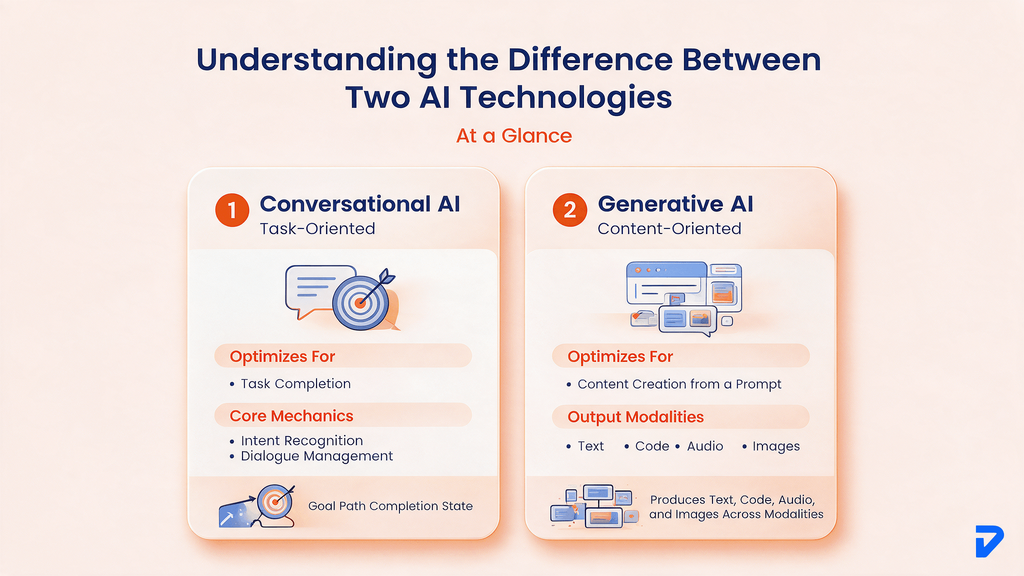
The fastest way to separate them is to ask what each one is optimizing for. Conversational AI optimizes for task completion in dialogue. Generative AI optimizes for content creation from a prompt.
What Conversational AI Does
Conversational AI uses intent recognition (identifying what a user wants) and dialogue management (controlling the flow of an interaction) to complete specific tasks. A customer asks for an order update; the system identifies the intent, fetches the data, and responds within a defined flow. There is a goal, a path, and a completion state.
Conversational AI assistants, chatbots, and voice AI are the most common delivery mechanisms. They excel at high-volume, repetitive, predictable interactions where consistency matters more than creative flexibility.
What Generative AI Does
Generative AI uses large language models (LLMs) to produce new outputs from a prompt: a paragraph, a summary, a block of code, an email draft. Deloitte’s survey of over 2,800 global leaders found that 85% were using generative AI for text generation, 63% for code, 55% for audio, and 53% for images. That range illustrates the breadth. Generative AI is not a chatbot with better answers. It is a content engine that operates across modalities.
Where They Overlap
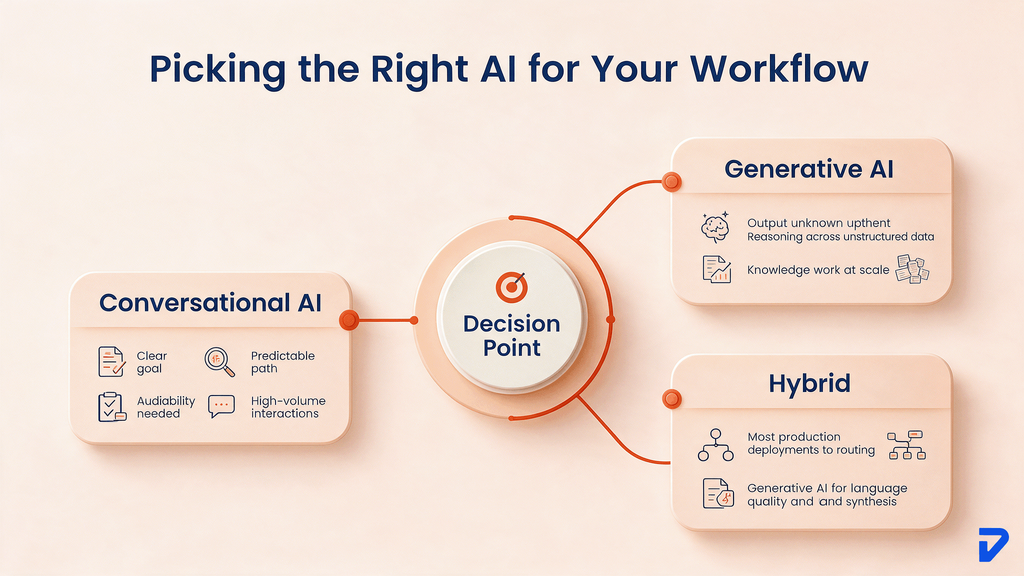
Modern conversational AI assistants frequently use generative models under the hood. An LLM can power a customer support bot’s responses without changing the bot’s structural purpose. This is the hybrid territory: conversational AI for orchestration and control, generative AI for the language quality of each response.
How Conversational AI and Generative AI Actually Work
Both technologies depend on natural language understanding (NLU), the ability to parse what a user means rather than just what they said. Beyond that shared foundation, the internal mechanics diverge.
How Conversational AI Processes a Request
A conversational AI platform receives an input, runs it through NLU to classify intent, matches that intent to a predefined dialogue path, and generates a response within a defined scope. Context carries across turns: if a user says “change my address” and then “for next Tuesday’s delivery,” the system holds that it is tracking a delivery, not starting over.
The constraint is intentional. Conversational AI tools are built for predictability. Every response falls within a designed boundary, which is exactly what regulated industries and high-volume support workflows need. The system does not improvise.
How Generative AI Produces Content
A generative model has no fixed dialogue tree. It uses a transformer architecture (a neural network that attends to the full context of an input) to predict likely, coherent continuations. The model “understands” context not by looking up an intent, but by processing billions of learned patterns and generating a response that fits the prompt.
Accenture estimates that 40% of all working hours across industries can be impacted or augmented by language-based AI, with 98% of business leaders agreeing that foundation models will play an important role in their strategies over the next three to five years. That influence is largely because generative models operate without fixed dialogue paths. They handle open-ended tasks where the output shape is not known in advance.
The Knowledge-Grounding Problem
Raw generative AI output can be fluent but factually wrong. RAG pipelines (retrieval-augmented generation systems that fetch verified source documents before answering) address this by anchoring responses to known facts. Conversational AI systems have historically relied on curated knowledge bases. The two approaches are converging, and which one you choose often comes down to how tightly you need to control the information source.
Conversational AI vs Generative AI: Key Differences
The comparison below is practical, not theoretical. Use it to clarify which technology fits a specific workflow, not to rank one above the other.
| Factor | Conversational AI | Generative AI |
| Primary purpose | Task completion through structured dialogue | Content and output creation from a prompt |
| Core capability | Intent recognition and dialogue management | Generating new text, code, audio, or images |
| Response style | Controlled, workflow-driven | Flexible, open-ended |
| Predictability | High | Lower without guardrails |
| Best suited for | Support, transactions, FAQs, routine interactions | Summarization, analysis, content creation, reasoning |
| Failure mode | Misrouting intent; hitting dead ends | Hallucination; inconsistent tone |
| Typical systems | Chatbots, voice AI, conversational AI platforms | LLM-based copilots, generative AI services, agents |
| Integration complexity | Moderate; maps to existing workflows | Varies; depends heavily on grounding and guardrails |
One important nuance: the boundaries have blurred. Recent research frames it well: “Conversational AI exists to interact. It is multi-turn by design. Generative AI exists to create.” That distinction holds even when the two share a model underneath.
Should You Use Conversational AI or Generative AI?
Most operators frame the question too broadly. The answer is not about which technology is “better.” It is about which workflows you are trying to change and what that workflow requires.
When Conversational AI Is the Right Call
Choose a conversational AI platform when the interaction has a clear goal, a predictable path, and a defined completion state. Customer service queues, appointment booking, order tracking, internal IT helpdesks, lead qualification scripts, and compliance-sensitive Q&A all fit this profile. The value comes from scale and consistency, not from the novelty of each response.
Conversational AI tools are also the right choice when you need auditability. Every turn is logged against a known intent. You can trace why the system said what it said.
When Generative AI Is the Right Call
Choose generative AI services when the output is unknown in advance or when it requires reasoning across unstructured information. Drafting a customer proposal from call notes, summarizing a dense contract, answering a complex product question from a technical catalog, or generating code from a natural-language specification: these are generative AI’s native territory.
The same logic applies to knowledge work at scale. Generative AI can process a library of support tickets and surface patterns that would take a human analyst weeks to find.
When a Hybrid Approach Makes More Sense
Most production deployments settle here. Use conversational AI for the structure, routing, and user interface. Use generative AI for the language quality, content synthesis, and reasoning depth. A customer support agent, for instance, might route interactions via conversational AI logic, then use a generative model to draft responses that the agent reviews before sending.
How Conversational AI and Generative AI Work Together in Practice
The rise of agentic AI (AI systems that plan and execute multi-step tasks using tools) has made the hybrid model standard in mature deployments. Microsoft’s 2026 Work Trend Index found that active agents in the Microsoft 365 ecosystem grew 15x year over year, rising to 18x in large organizations. That growth reflects a broader shift: conversational interfaces, generative models, and retrieval systems are increasingly running together rather than in isolation.
A Practical Hybrid Architecture
A customer contacts a financial services firm with a question about their policy. Conversational AI handles authentication, identifies the intent, and routes the request. A RAG pipeline fetches the relevant policy documents. A generative model drafts a precise, sourced answer. A human reviews it. The response is logged against the intent for compliance purposes.
No single technology could do all of that alone. The conversational AI layer provides control. The generative AI layer provides quality and reasoning. The human layer provides accountability.
Where the Integration Gets Complicated
The biggest operational challenge in a hybrid system is not the models. It is data. Conversational AI systems depend on clean, current knowledge bases. Generative AI quality depends on grounding. Both fail in the same underlying way: when the information they operate on is stale, incomplete, or unstructured.
Teams that invest in their data infrastructure before their AI stack consistently get better results from both technologies. AI integration services start with that layer, because systems that skip it hit the same wall regardless of which model they choose.
Agentic AI as the Next Layer
An AI agent is a system that can plan, use tools, and execute multi-step workflows without constant human prompting. Agents typically combine a generative model for reasoning with a conversational interface for user interaction and tool-calling for external actions. This is where the conversational AI vs generative AI question evolves: in an agentic system, the answer is usually “both, plus orchestration.” Pinnasys’s agentic AI services are built around this architecture for teams ready to move past single-task automation.
Looking to choose an AI approach?
Pinnasys helps mid-market businesses design and build AI systems that deliver measurable results.
Choosing AI Technology for Mid-Market Operations
Mid-market operators face a different set of constraints than large technology companies. The question is rarely “which technology is most powerful?” It is “which technology can we actually integrate, govern, and maintain with the team and data we have?”
McKinsey’s 2025 State of AI survey, covering 1,993 respondents, found that 88% of organizations were using AI in at least one function, but only 7% had fully scaled it across their operations. The gap between adoption and scale is not a technology gap. It is a readiness gap: data quality, integration depth, governance, and workflow design.
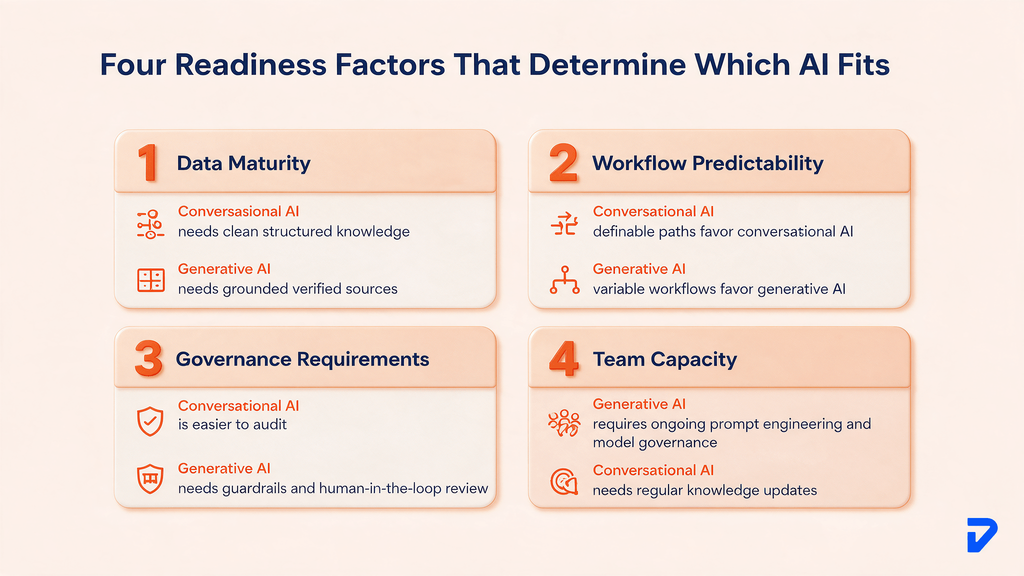
The readiness factors that determine which technology fits
- Data maturity: Conversational AI needs clean, structured knowledge content. Generative AI needs grounded, verified information sources. Operators with fragmented or legacy data systems often find conversational AI easier to stand up first, because the scope is narrower and the failure modes are easier to catch.
- Workflow predictability: If a workflow follows a definable path most of the time, conversational AI is the lower-risk, faster-value option. If the workflow is inherently variable, generative AI handles the variation better.
- Governance requirements: Regulated workflows in insurance, finance, and field services require auditability. Conversational AI is easier to audit because every response traces to a defined intent and path. Generative AI requires additional guardrails, logging, and human-in-the-loop review to meet the same standard.
- Team capacity: Generative AI deployments require ongoing prompt engineering, output monitoring, and model governance. Conversational AI platforms are easier to maintain once the dialogue flows are built, but they require regular content updates to stay accurate. Neither is “set and forget.”
An AI readiness assessment before committing to either architecture can surface these factors early, before they become production problems.
Conversational AI vs Generative AI: Business Use Cases by Function
The table below maps common business functions to the technology that typically fits best, with the caveat that most production systems use a hybrid approach.
| Business Function | Conversational AI | Generative AI | Hybrid |
| Customer support | FAQ handling, ticket triage, status updates | Complex case summarization, draft responses | Routing + drafting + review |
| Sales | Lead qualification, meeting scheduling | Proposal drafting, competitive analysis | Qualification + content generation |
| Employee support | IT helpdesk, HR policy Q&A | Document search, knowledge synthesis | Self-service + deep search |
| Knowledge management | Structured Q&A, guided search | Unstructured document analysis, report generation | Search + summarization |
| Voice AI | Customer calls, IVR replacement, appointment booking | Call summarization, sentiment analysis | Interaction + post-call processing |
| Operations | Workflow routing, alerts, status tracking | Anomaly explanation, predictive insight summaries | Trigger + explain |
The Bottom Line
The conversational AI vs generative AI decision is rarely binary. Conversational AI provides control, consistency, and auditability for structured, goal-driven interactions, while generative AI adds flexibility, reasoning, content generation, and knowledge synthesis for open-ended tasks. Many successful systems combine both, using conversational AI to manage workflows and generative AI to improve language and handle complex information.
Success depends less on choosing one technology and more on preparing clean data, defined workflows, clear governance, and measurable outcomes. Pinnasys helps mid-market operators build production-grade AI systems without requiring an in-house AI team. The right approach starts with understanding the workflow, preparing the data, implementing the right architecture, and measuring meaningful business results.
Key Takeaways from the Article
- Conversational AI manages structured dialogue; generative AI creates new content from prompts.
- Predictable, high-volume workflows favor conversational AI for control and consistency.
- Generative AI handles open-ended tasks: summarization, analysis, drafting, and reasoning.
- Most production deployments combine both technologies with a conversational AI orchestration layer.
- Data quality and workflow readiness determine AI success more than model choice.
Frequently Asked Questions
What is the difference between conversational AI and generative AI?
Conversational AI manages structured dialogue to complete specific tasks, such as answering a support query or booking an appointment. Generative AI produces new content from a prompt, including text, code, or summaries. Both use natural language processing, but they optimize for different outcomes. Conversational AI prioritizes task completion; generative AI prioritizes content creation.
Should I use conversational AI or generative AI for customer service?
It depends on the interaction type. Conversational AI handles predictable, high-volume queries: order status, FAQs, routing, and self-service. Generative AI adds value for complex case summarization and draft response generation. Most organizations deploying AI in customer service use both, with conversational AI managing the dialogue flow and generative AI improving response quality.
Can generative AI replace a conversational AI chatbot?
Not directly. A generative model produces content from prompts but does not inherently manage multi-turn dialogue, intent routing, or task completion logic. Using generative AI without a conversational AI layer typically results in inconsistent, harder-to-audit interactions. According to McKinsey, only 7% of organizations have fully scaled their AI across operations, and unstructured generative deployments are a common reason implementations stall.
What is a RAG pipeline and why does it matter for generative AI?
RAG stands for retrieval-augmented generation. It is the architecture that fetches verified source documents before the generative model answers, grounding its output in known facts rather than learned patterns alone. Without RAG, generative models can produce plausible but inaccurate responses, a failure mode called hallucination. RAG is now a standard component of production-grade generative AI deployments in regulated industries.
How much does it cost to implement conversational AI vs generative AI?
Costs vary by scope, but conversational AI platforms typically have a lower initial implementation cost because the dialogue structure is defined upfront and the failure modes are easier to manage. Generative AI projects carry ongoing costs for prompt engineering, output monitoring, grounding infrastructure, and model governance. A scoped AI consulting engagement is usually the right first step to size both options accurately before committing.
What is intent recognition and why does it matter in conversational AI?
Intent recognition is the process by which a conversational AI system classifies what a user wants from their input, matching it to a predefined category such as “check order status” or “request a refund.” It is the foundation of dialogue management. Poor intent recognition leads to misrouting, broken flows, and user frustration. Conversational AI platforms invest heavily in intent recognition quality because the rest of the interaction depends on getting that first classification right.





Prakash C. Saini
Prakash Saini is the Founder & CEO of Pinnasys. With over a decade in digital transformation and building production systems, he grew an engineering team from 2 to 50 people and has led the delivery of 100+ production digital systems. Products built under his leadership have raised millions in funding and generated over $50 million in revenue. He holds an Executive MBA from IIM Kozhikode and today leads the AI engineering team at Pinnasys.