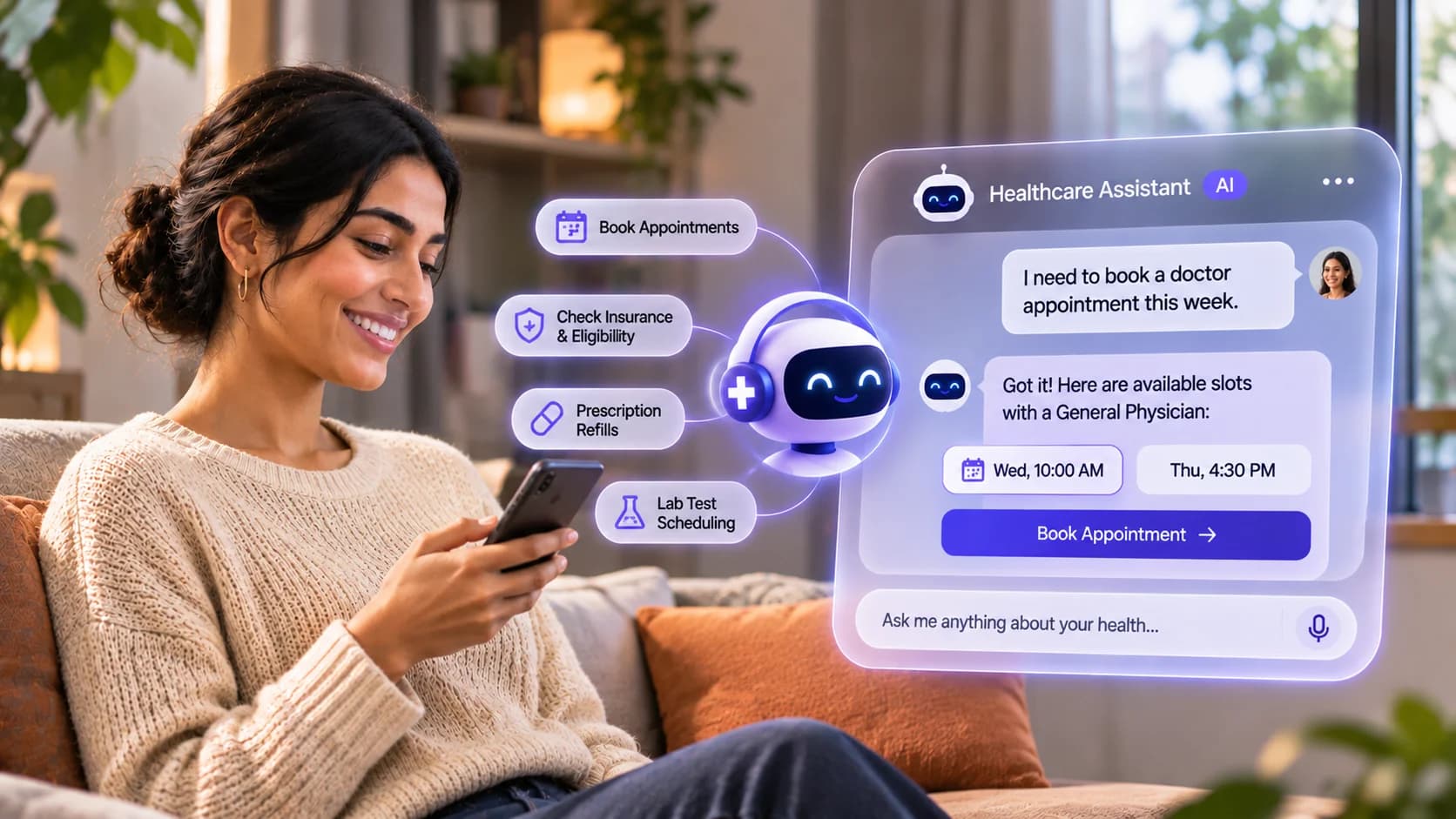
Conversational AI in healthcare helps patients book visits, reach staff, finish intake, and get routine answers without waiting on hold. The strongest use cases connect to scheduling and EHR systems and hand off to humans.
Wait times to see a primary care provider now top 31 days in the US. Meanwhile, 65% of patients say they turned to AI because it is easier than seeing a doctor. That gap is why conversational AI in healthcare has become a front-door priority. Healthcare AI can now answer the phone, book the visit, and hand off cleanly.
Clinics still lose patients before they reach a clinician, through busy signals, long holds, and clunky forms. Every lost contact is a missed visit and one more frustrated patient. The workflows below show how AI workflow automation closes those leaks, which use cases hold up in production, and how to measure the results.
What Is Conversational AI in Healthcare?
Conversational AI in healthcare is software that talks with patients by voice or text, works out what they need, and completes routine tasks. A healthcare chatbot or healthcare virtual assistant uses natural language processing (NLP) to read everyday phrasing. It then identifies intent and acts on approved data.
The difference from older tools is practical. An interactive voice response (IVR) system is the press-1-for-billing phone menu, and a rule-based chatbot follows a fixed script. Conversational AI handles the unexpected.
| Feature | Traditional IVR | Rule-based chatbot | Conversational AI |
| How patients speak | Keypad or fixed phrases | Buttons and keywords | Natural speech or free text |
| Unexpected requests | Fails or loops | Hits a dead end | Interprets intent |
| Completes tasks | Routes calls only | Answers scripted FAQs | Books, updates, collects data |
| Human handoff | Transfers to a queue | Often missing | Warm transfer with context |
Voice suits patients who prefer to call, including older adults and anyone without a portal login. Text suits quick questions and forms that patients can finish at their own pace. Most organizations need both, because patients choose the channel, not the clinic.
Conversational AI sits at the front of the patient access journey: finding a provider, booking, preparing, and following up. Newer voice agents rely on agentic AI, meaning systems that plan and complete multi-step tasks. They do not diagnose or treat. Their job is access, and clinicians own the care.
Why Patient Access Needs Conversational AI
Call volume keeps climbing, and every front desk becomes a bottleneck. Patients sit on hold, hang up, and either call back later or book somewhere else. Meanwhile, staff spend hours on appointment confirmations, directions, and refill status checks that never needed a human.
More menu options rarely fix this, and hiring only goes so far because training takes months and turnover is common. Missed calls become appointment delays, and delays push patients toward competitors.
A production-grade assistant answers on the first ring, handles the routine request, and passes everything else to a person. At Tampa General Hospital, call abandonment dropped 56% after a voice agent began taking inbound calls.
Patient expectations have shifted as well. People book flights and dinner reservations at midnight, so waiting for office hours to schedule care feels dated. AI patient access meets that expectation by letting patients act at any hour, and conversational AI in healthcare does it without forcing another portal login.
7 Conversational AI Use Cases in Healthcare That Improve Patient Access
Seven use cases show up again and again in live deployments. Each one removes a specific point of friction between a patient and care. The sections below cover what each does, where it connects to scheduling and records, and where humans stay in charge.
1. AI-Powered Appointment Scheduling and Rescheduling
AI appointment scheduling lets patients book, cancel, and change visits by voice or chat. The assistant checks real-time provider availability, confirms the slot, and sends appointment reminders by text. When a patient cancels, it can offer the opening to waitlisted patients. That recovers revenue that an unanswered phone call would have lost.
2. 24/7 Patient Support Through Healthcare Chatbots
A healthcare chatbot answers questions about clinic hours, locations, services, and provider availability when the office is closed. Because most of these questions repeat daily, a healthcare virtual assistant can resolve them in seconds. Multilingual support extends the same service to patients who prefer another language. Staff then see fewer routine messages each morning.
3. Voice AI for Healthcare Call Center Automation
Voice AI for healthcare replaces rigid IVR menus with natural conversation. In AI for medical call centers, the agent handles repetitive inbound calls, spots intent, and transfers complex requests to the right department. Call deflection rises because routine calls end without a person. Warm transfers pass a short summary to staff, so patients do not repeat themselves.
4. Automated Patient Intake and Registration
Patient intake bots collect demographics, history, insurance, and consent before the visit and send the data to the right systems. A Lancet feasibility study ran a supervised pre-visit assistant with 98 patients. Physicians found it helpful for visit preparation in 33 of 44 reviewed cases, and supervisors noted one hallucination.
5. Prescription Refill Requests and Medication Reminders
Patients can request prescription refills by voice or text, and the assistant checks request status without tying up a nurse line. It routes approvals to the right clinician and sends medication and refill reminders. Anything involving side effects, dosing changes, or interactions escalates to a pharmacist or clinician. The assistant moves the paperwork but never makes a clinical call.
6. Patient Follow-Ups and Engagement
Patient engagement AI handles the contact that busy clinics skip: post-visit instructions, follow-up reminders, routine check-ins, and feedback requests. For chronic care management, a scheduled check-in can flag worsening symptoms and route that reply to a care team the same day. Consistent outreach keeps patients connected between visits without adding staff hours.
7. Initial Symptom Screening and Care Navigation
Structured symptom conversations support triage by collecting details and pointing patients to the right department or service. The assistant watches for warning signs, such as chest pain or trouble breathing, and escalates urgent or uncertain cases to clinical staff immediately. It guides patients to the right door, but it does not diagnose.
How Conversational AI Works Across the Patient Access Journey
A conversation moves through five stages, from first contact to confirmation or handoff.
- Contact: A patient starts by phone, website chat, or portal, and the assistant answers in that same channel.
- Intent: The AI works out what the patient wants, such as a new visit or a refill, and gathers only the details it needs.
- Data retrieval: The system pulls approved scheduling or patient data through secure interfaces, within defined permissions.
- Action: The AI completes the permitted task, or routes the request when it falls outside the assistant’s limits.
- Confirmation or handoff: The patient receives a confirmation, or a person takes over with the conversation history attached.
The handoff deserves the most design attention, because conversational AI in healthcare earns trust only when every stage has a safe exit. Tampa General’s agent was also trained to recognize abusive language and guide upset callers to a person who could calm the situation.
Struggling with patient access bottlenecks?
Build conversational AI workflows that simplify scheduling, support, and patient communication.
How Conversational AI Connects With EHR and Healthcare Systems
An assistant that cannot see the schedule is just an FAQ page. EHR integration, meaning a live link to the electronic health record, lets it read open slots and write bookings back. That keeps the calendar aligned with what patients were told.
Many connections run on FHIR (Fast Healthcare Interoperability Resources), a standard format for exchanging records through web APIs. Epic documents FHIR interfaces for slots, schedules, and appointments, including operations to find and book visits.
- EHR platforms: Epic and Oracle Health (formerly Cerner) each expose their own interfaces, so every connection needs separate testing.
- Scheduling systems: The assistant reads availability and writes confirmed visits back to the system of record.
- Intake and registration: Demographics and insurance details land in the correct fields, not in a PDF someone must retype.
- APIs: Application programming interfaces, the secure doorways between systems, exchange patient and appointment data on request.
- Record accuracy: Phone, web, and portal conversations all write to one source of truth, so histories match.
Most pilots stall at this layer, which is why AI integration and governance belong in the project plan from week one.
Benefits of Conversational AI for Healthcare Providers and Patients
Conversational AI in healthcare pays off on both sides of the counter. Patients get faster answers and fewer dead ends. Teams get time back for work that needs judgment.
- 24/7 availability: A patient can reach the clinic at 9 p.m. instead of waiting for morning hours.
- Fewer abandoned calls: Routine requests resolve without a staff member, which lightens the administrative load.
- Faster scheduling: Booking takes minutes rather than a callback cycle.
- Consistent communication: Every patient hears the same approved answer, whoever happens to be working.
- Better staff utilization: Front-desk and call-center teams handle exceptions instead of repeating themselves.
- Stronger engagement: Reminders and follow-ups keep patients connected to care between visits.
Patients are already engaged. In Zocdoc’s data, 85% of providers see more AI-informed patients, and over 75% say those patients ask more thoughtful questions. A clinic-run assistant gives that energy a safe, accurate channel, which is where AI patient access and healthcare AI meet.
HIPAA Compliance and Security Considerations for Healthcare Chatbots
A healthcare chatbot that touches patient data falls under HIPAA, the same as any other system. Electronic protected health information (ePHI) covers names, appointment details, and anything a patient says about their health, whether typed or spoken.
Vendor contracts come first. A business associate agreement (BAA) binds a vendor to HIPAA safeguards. HHS cloud guidance confirms that a covered entity may use a cloud provider for ePHI, provided a compliant BAA is in place.
- Access controls and encryption: Limit each role to the minimum data it needs, and encrypt data in transit and at rest.
- Secure EHR integrations: Use scoped credentials, audit logs, and monitored API connections instead of shared logins.
- Consent and AI transparency: Tell patients when they are speaking with an automated assistant, and record consent where required.
- Human escalation: Route sensitive topics, such as self-harm, abuse, or emergencies, to a trained person right away.
Transparency also builds trust. 23% of patients say they have hidden their AI use from a doctor, and fear of judgment is the top reason. That survey covers consumer AI tools, yet the lesson carries over. Disclose the assistant, explain what it does, and make a person easy to reach.
How to Measure the Success of Conversational AI in Healthcare
Measure before you launch. Tampa General Hospital abandoned roughly 40,000 calls a month before its voice agent went live, which gave it a baseline worth beating.
| Metric | What it tells you | Watch for |
| Booking completion rate | Share of scheduling chats that end in a booked visit | Drop-offs at identity checks |
| Handling and wait times | How fast patients reach an answer | Spikes at peak hours |
| Abandonment and call deflection | Dropped calls versus calls resolved without staff | Deflection that hides unresolved issues |
| Self-service resolution | Requests the assistant fully completed | Repeat contacts within 48 hours |
| No-show rate | Whether reminders and rescheduling work | Gaps by clinic or visit type |
| Escalation and transfer rate | How often humans step in | Rates near zero, or very high |
| Satisfaction and engagement | Patient sentiment and response rates | Scores that split by channel |
Put these numbers on one dashboard. Decision intelligence tooling can join call, booking, and no-show data so you see cause and effect instead of isolated charts.
How to Implement Conversational AI in a Healthcare Organization
A phased rollout of conversational AI in healthcare beats a big-bang launch. Tampa General signed its vendor in late June and had the agent answering calls by mid-September, after cleaning up scheduling data so bookings landed correctly.
- Identify high-volume workflows: Rank call types from your logs; scheduling and refill status usually top the list.
- Choose voice, text, or both: Follow patient habits, and start with voice if phone traffic dominates.
- Define boundaries and escalation rules: Write down what the assistant may do, what it must never do, and which phrases trigger a human.
- Integrate with EHR and scheduling systems: Test read and write access in a sandbox before any real patient is booked.
- Pilot with limited interactions: Start with one location or call type, and review transcripts weekly.
- Monitor and improve: Fix failed intents, tune responses, and expand only when the metrics hold.
Plan for what happens next. Once calls get answered, demand for appointments can outrun open slots, a pattern Tampa General’s leaders flagged. If no packaged tool fits your workflows, custom AI development can adapt the assistant to your rules.
The Bottom Line
Conversational AI in healthcare works when it stays narrow, connected, and honest about its limits. The best results come from routine access tasks such as scheduling, intake, and call routing, backed by EHR integration and clear human handoffs. That discipline separates a live assistant from a stalled pilot.
Pinnasys builds and runs these systems for operators who want measured outcomes, not demos. Success means hours saved, errors reduced, and patients reached.
A short AI consulting roadmap can pick the first workflow, set automation boundaries, and define baseline metrics before any build begins. Start with one high-volume call type and prove it. Expand to refills, follow-ups, and intake once the numbers hold.
Key Takeaways from the Blog
- Patient access workflows like scheduling and call routing deliver the clearest early returns.
- Voice assistants beat IVR menus because they understand natural speech and complete tasks.
- Integration with the EHR and scheduling systems separates a working assistant from an FAQ page.
- Escalation rules and BAAs matter as much as accuracy for HIPAA-regulated patient conversations.
- Measure abandonment, booking completion, and escalation rates against a baseline before scaling.
FAQs About Conversational AI in Healthcare
How is conversational AI used in healthcare?
It handles scheduling, intake, reminders, refill requests, and call routing across phone, web, and portal. Voice agents answer routine inbound calls, chat covers common questions, and staff receive the complex cases with context attached.
Can AI schedule patient appointments?
Yes, when it connects to the scheduling system. The assistant checks open slots, books, reschedules, and cancels, then sends reminders. Without write-back access it can only collect requests, so confirm that capability during vendor evaluation.
Is a healthcare chatbot HIPAA compliant?
Only if the vendor and the clinic meet HIPAA requirements together. That means a signed BAA, encryption, role-based access, audit logs, and a documented risk analysis. Ask for each item in writing before patient data flows.
How does conversational AI connect to the EHR?
Through secure APIs, often built on FHIR. Read access pulls schedules, while write access saves bookings and intake data. Epic and Oracle Health each publish interfaces, and every integration needs testing before launch.
Which patient calls can AI handle?
Routine, rules-based calls: scheduling, hours, directions, billing questions, refill status, and intake. Calls with urgent symptoms, clinical advice, or distressed patients go to staff. A useful rule is that AI moves information while people make judgments.
Can conversational AI handle prescription refill requests?
It can take the request, verify the patient, check status, and route the refill to a clinician for approval. It cannot approve a refill or answer dosing questions. Those escalate to a pharmacist or prescriber.
What results do clinics see from conversational AI?
Results depend on the baseline and the workflow. Published examples show fewer abandoned calls, shorter waits, and more booked visits, though several come from vendors or small studies. Pilot first and compare against your own pre-launch call and booking data.