


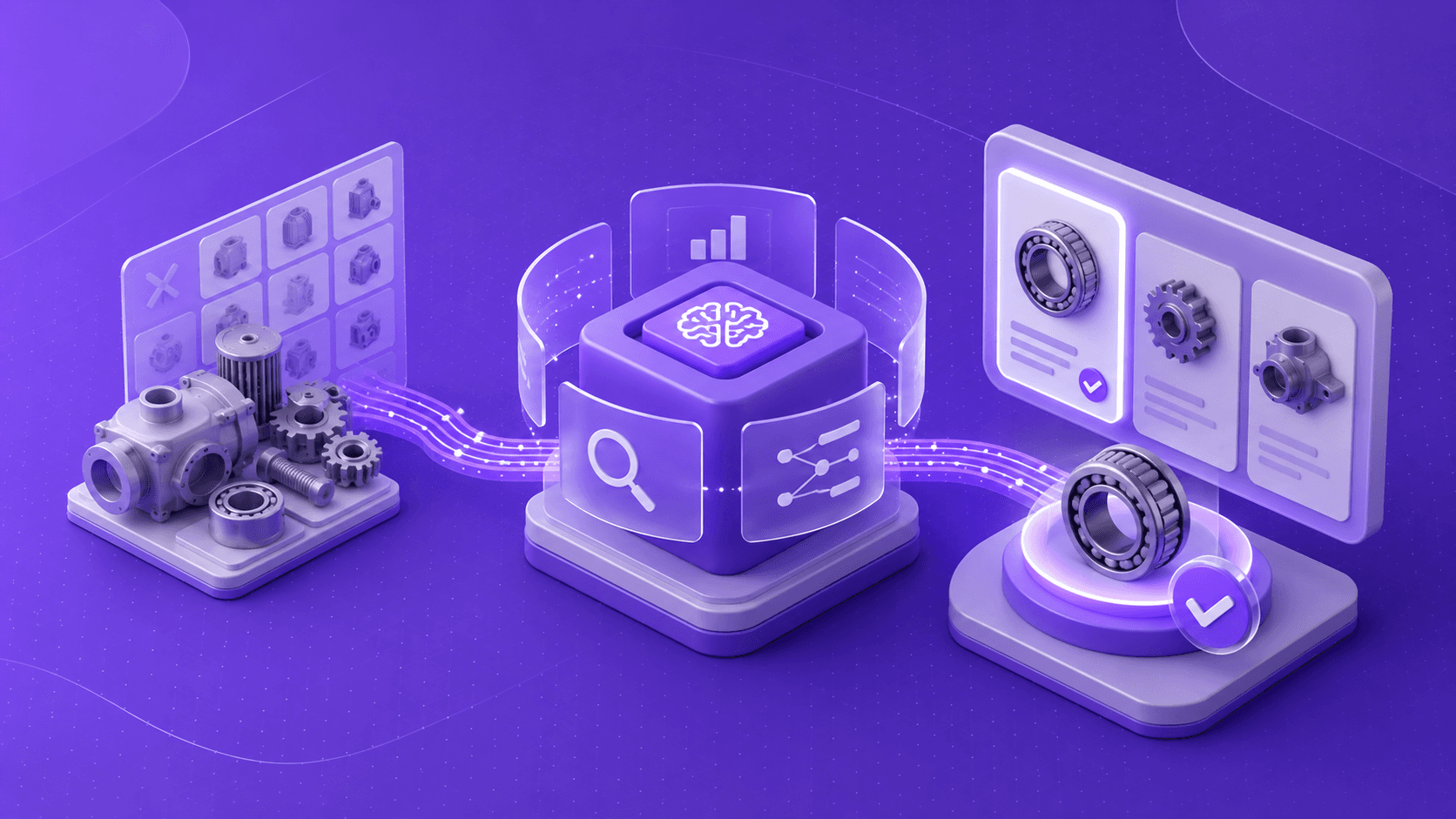
AI product search is transforming how B2B buyers navigate complex product catalogs and find the right parts faster. By understanding intent, specifications, and product relationships, AI delivers more accurate and relevant search results.
Industrial distributors and manufacturers often manage vast product catalogs, but buyers rarely search using exact part numbers. Most searches begin with specifications, equipment details, or incomplete product information, making finding the right part time-consuming. Traditional keyword search is not always equipped to handle these complex queries.
AI product search changes that by understanding buyer intent, technical context, and product relationships, helping customers find relevant parts faster and with greater confidence. In this article, we’ll explore how AI product search works, the technologies behind it, why B2B buyers struggle with traditional search, and how intelligent product discovery supports broader AI transformation initiatives.
What is AI Product Search?
AI product search is an intelligent search technology that helps buyers quickly find relevant products across large and complex catalogs. Unlike traditional keyword-based search, it combines technologies such as natural language processing (NLP), semantic search, vector embeddings, machine learning, and retrieval-augmented generation (RAG) to understand the intent behind a query rather than simply matching exact words.
This allows the system to interpret incomplete product descriptions, technical specifications, equipment names, and industry terminology, even when they differ from the language used in the product catalog.
How Does AI Product Search Work?
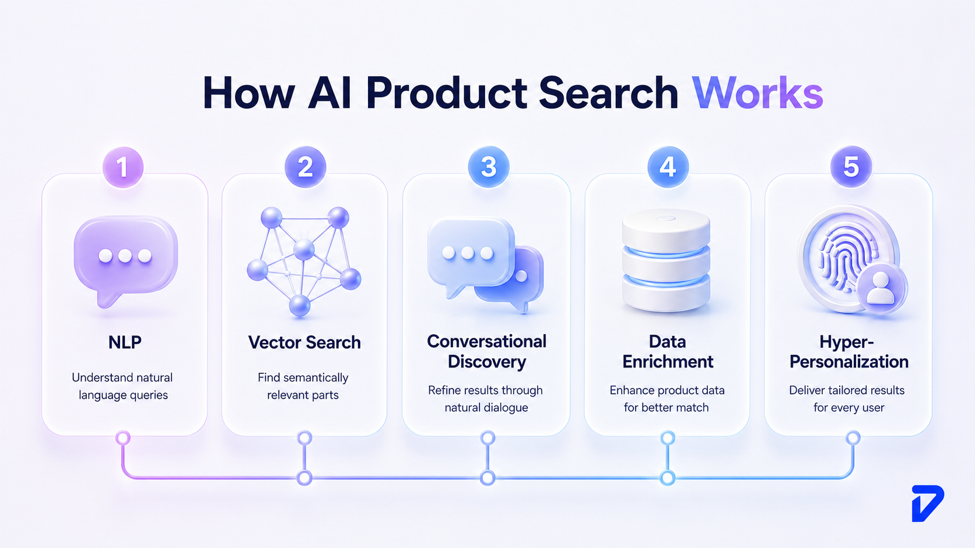
Natural Language Processing (NLP)
Natural Language Processing, or NLP, helps AI understand the meaning behind a search query. Buyers can search using everyday language, technical specifications, or incomplete descriptions, and the system can still identify relevant products.
For instance, if the procurement manager is looking for “replacement hydraulic pump for heavy equipment,” and they do not even put the exact part number in, they might get very relevant results. That is because the technology relies on the context of the query as much as the keywords themselves.
Vector Search and Intent Matching
Traditional search engines look for exact words. Vector search takes a different approach by identifying products that are conceptually similar to what the buyer is searching for. This capability helps buyers discover relevant parts even when product descriptions use different terminology.
Intent matching reduces the chances of missed results and improves product discovery across large catalogs. As a result, buyers can find the right products faster without needing exact keywords or part numbers.
Conversational Discovery
Modern AI search experiences allow buyers to search more naturally and interactively. Instead of entering short keywords, users can describe their requirements as they would when speaking to a sales representative.
A buyer might search for “industrial motors suitable for food processing equipment” and receive tailored recommendations based on those requirements. This conversational approach makes product discovery faster and more intuitive.
Product Data Enrichment
AI product search performs best when product information is complete and well-structured. Product data enrichment enhances catalogs by organizing specifications, attributes, compatibility details, manufacturer references, and related product information.
Richer product data allows AI systems to understand products more effectively and provide more accurate recommendations. Research from McKinsey & Company on Product Data and AI highlights that organizations with stronger data foundations are better positioned to generate value from AI initiatives.
Hyper-Personalization
Hyper-personalization goes beyond basic personalization by using AI, machine learning, and real-time customer data to tailor the search experience for every buyer. Instead of showing the same results to everyone, AI analyzes purchase history, browsing behavior, industry, account preferences, equipment compatibility, and previous interactions to deliver highly relevant search results.
A manufacturing company and an automotive supplier searching for similar products may see different recommendations based on their specific requirements. Personalized experiences help buyers find relevant products faster while creating a more efficient purchasing journey.
Traditional Keyword Search vs AI-Based Semantic Search
| Traditional Keyword Search | AI-Based Semantic Search |
| Matches exact keywords | Understands intent and context |
| Requires precise search terms | Handles natural language queries |
| Misses products with different wording | Finds relevant products despite wording differences |
| Limited product discovery | Identifies similar and related products |
| Same results for most users | Supports personalized recommendations |
| Works best when part numbers are known | Helps buyers find products with incomplete information |
Why B2B Buyers Struggle to Find the Right Parts?
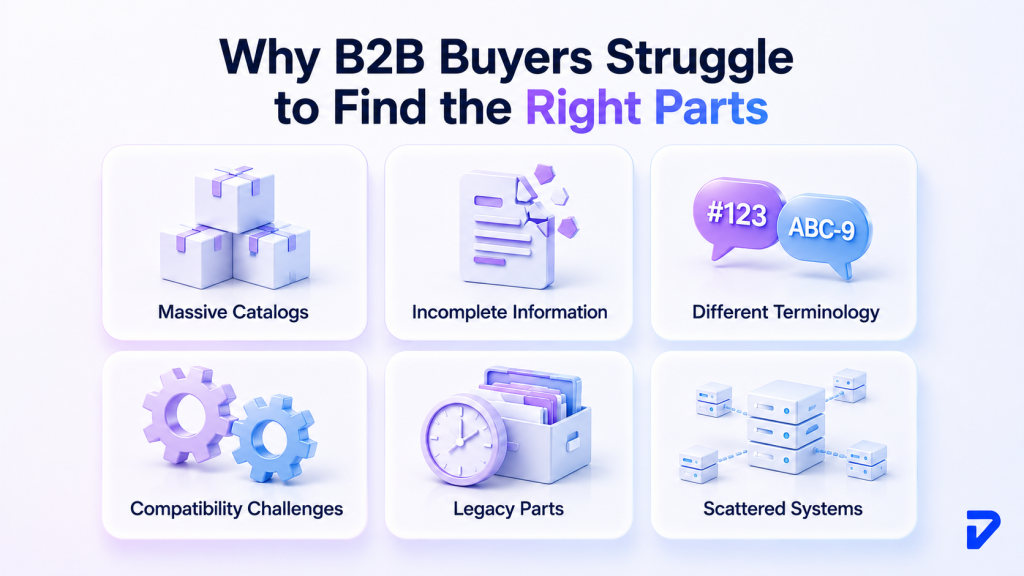
Finding the right part is rarely straightforward for B2B buyers. Large product catalogs, inconsistent product data, technical specifications, and multiple supplier standards make product discovery complex. Without the exact part number, buyers often spend significant time searching, comparing specifications, and validating compatibility before making a purchase.
Massive Product Catalogs
Many distributors manage thousands or even millions of SKUs. Similar products often differ by only a few specifications, making it difficult for buyers to quickly identify the correct option and increasing the time spent comparing products.
Incomplete Product Information
Buyers rarely begin with an exact part number. Instead, they search using equipment names, technical specifications, or partial descriptions, making it difficult for traditional keyword-based search tools to deliver accurate results.
Different Supplier Terminology
The same product is often described differently by manufacturers, distributors, and buyers. Different naming conventions, product descriptions, and industry terminology can confuse traditional keyword searches. As a result, buyers may struggle to locate the right part, even when it exists in the catalog.
Compatibility Challenges
Industrial buyers must ensure that replacement parts are compatible with specific machines, equipment, and operating environments. Verifying dimensions, technical specifications, certifications, and manufacturer requirements often requires significant time and manual effort.
Legacy and Replacement Parts
Many organizations continue to operate legacy equipment with discontinued or obsolete components. Finding compatible replacement parts can be challenging, especially when original part numbers are unavailable or newer alternatives have superseded products.
Information Spread Across Multiple Systems
Product information is often scattered across ERP systems, PIM platforms, inventory databases, supplier catalogs, and technical documentation. As a result, buyers frequently need to search multiple systems to gather the information required to make a confident purchasing decision.
Looking to build an AI-powered product search experience for your B2B catalog?
Partner with Pinnasys to design and implement intelligent product discovery solutions as part of your AI transformation strategy.
How Does AI Product Search Help B2B Buyers?
Semantic Search and Vector Embeddings
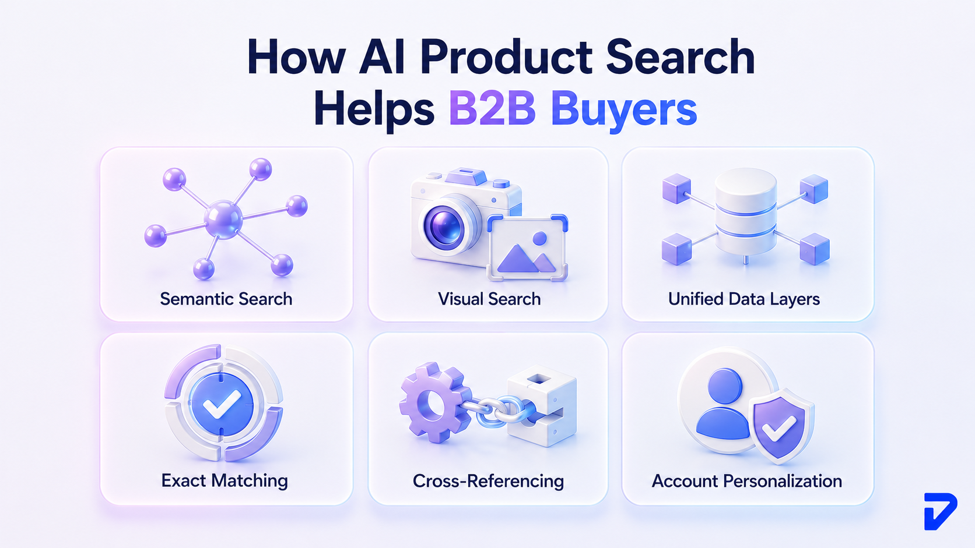
Unlike traditional keyword search, semantic search understands the meaning behind a buyer’s query. Using vector embeddings, AI matches products based on context instead of exact words, helping buyers find relevant parts even with incomplete descriptions or different terminology. This approach captures semantic similarity between search queries and product data, improving search relevance across large catalogs.
Visual and Image Search
Buyers don’t always have a part number or product name. AI-powered visual search lets users upload an image to identify similar or compatible products, reducing search time and improving product discovery. Computer vision models analyze visual features such as shape, dimensions, and product attributes to identify matching items.
Unified Data Layers
Product information often exists across ERP systems, inventory platforms, supplier databases, and technical documentation. AI product search brings these data sources together to provide a more complete view of products and availability. Research from Deloitte on Connected Enterprise Data shows that connected data ecosystems help organizations improve operational efficiency and customer experiences.
Automated Exact Matching
AI compares product specifications, dimensions, compatibility, and technical attributes to identify the closest match. This reduces manual effort, improves search accuracy, and gives buyers greater confidence when selecting the right part. Matching algorithms evaluate multiple product attributes simultaneously instead of relying on a single search parameter.
AI-Assisted Cross-Referencing
Many industries rely on equivalent or replacement parts from different manufacturers. AI automatically identifies cross-referenced products and recommends suitable alternatives when an exact match is unavailable, helping buyers reduce procurement delays. It analyzes compatibility data, manufacturer references, and historical product relationships to generate accurate replacement suggestions.
Account-Level Personalization
Every customer has unique purchasing patterns, pricing agreements, and product preferences. AI uses account history, industry context, and buyer behavior to deliver personalized search results, creating faster and more relevant buying experiences. Machine learning continuously refines recommendations by learning from user interactions and purchasing behavior over time.
AI Product Search for Distributors – Where to Start?
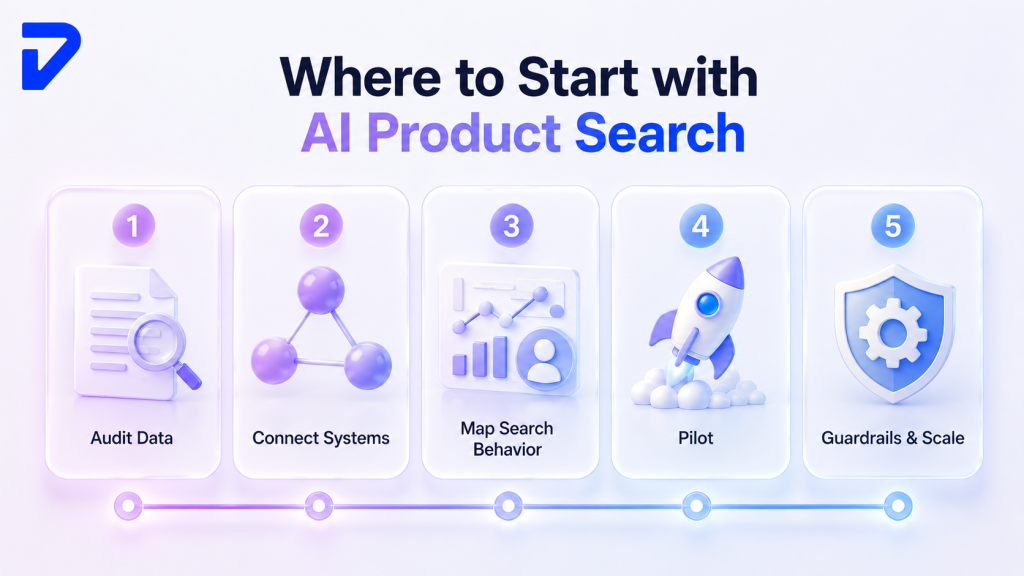
Step 1: Audit and Enrich Your Product Data
The first step is understanding the quality of your existing product data. AI search performs best when product descriptions, specifications, compatibility information, and attributes are complete and consistent. Identifying and filling data gaps early creates a stronger foundation for every stage that follows
Step 2: Connect Your Catalog, ERP, and Live Stock
Once all your data is captured and structured, you’ll want to bring your different systems into sync. Information from catalogs, stock on hand, price lists, and inventory from your ERP will need to flow through to a central repository so buyers don’t have to log in and out of different systems to get product information.
Step 3: Map How Buyers Actually Search
With connected data in place, distributors should analyze how customers search for products. Buyers often use equipment names, technical specifications, industry terminology, or application-based queries instead of exact part numbers. Understanding these patterns helps AI search interpret intent more effectively and deliver better results.
Step 4: Pilot on Your Highest-Traffic Categories
After identifying common search behaviors, launch a pilot within high-traffic or high-value product categories. A focused rollout makes it easier to measure search performance, gather customer feedback, and identify opportunities for improvement before expanding the solution across the entire catalog.
Step 5: Add Guardrails, Then Scale
Insights gained during the pilot phase can be used to refine search relevance, recommendation logic, and data quality standards. Clear governance and performance monitoring help maintain accuracy as AI search expands across additional product categories, customers, and business units.
What Does “Production-Ready” AI Product Search Look Like?
A production-ready AI product search solution goes beyond basic keyword matching. Buyers should be able to search using natural language, specifications, equipment names, or incomplete product information and still find relevant products quickly. The system should also identify compatible alternatives and understand product relationships.
A mature solution connects product catalogs, ERP systems, inventory data, and customer information to deliver accurate results in real time. Search experiences can also be personalized based on customer needs, purchase history, and industry requirements.
The ultimate goal is to improve product discovery, reduce search friction, and support better purchasing decisions. According to Gartner on digital commerce transformation, intelligent digital experiences are becoming increasingly important for organizations looking to improve customer engagement and purchasing outcomes.
The Bottom Line
AI product search has evolved from a convenience feature into a strategic capability for enterprise AI transformation. Technologies such as semantic search, vector embeddings, and AI-driven personalization help distributors and manufacturers simplify product discovery, improve buyer experiences, and make complex product catalogs easier to navigate.
As B2B commerce becomes increasingly digital, intelligent product search enables organizations to connect enterprise data, automate decision-making, and deliver more relevant customer experiences at scale. Pinnasys helps businesses implement AI-powered solutions that transform product discovery into a competitive advantage and support long-term digital growth.
Key Takeaways from the Article
- AI product search helps B2B buyers find the right parts faster by understanding intent rather than relying solely on exact keywords.
- Features such as semantic search, visual search, and AI-assisted cross-referencing improve product discovery across complex catalogs.
- High-quality product data and connected business systems are essential for delivering accurate and reliable search experiences.
- AI-powered search supports broader AI transformation initiatives by improving customer experiences, reducing search friction, and accelerating purchasing decisions.
Frequently Asked Questions About AI B2B Product Search
Can AI help buyers find the right part?
Yes, the AI product search tool can process specifications, equipment names, product descriptions, and incomplete queries. Rather than only matching exact part numbers, AI product search processes context and intent to uncover the most appropriate products to improve buyer speed to purchase.
Is AI product search the same as a chatbot?
No, AI product search is designed to help users discover products, while a chatbot focuses on answering questions and providing assistance. Some modern platforms combine both capabilities, allowing buyers to search for products through a conversational experience.
Does an AI product search need clean product data to work?
AI can improve search performance, but product data quality still matters. Accurate descriptions, specifications, compatibility information, and attributes help AI deliver more relevant results and recommendations. Better data generally leads to better search outcomes.
How long does it take a distributor to launch an AI product search?
It depends on the size of your catalog, how well the data is structured, and your system integrations. Many companies that have good and organized product information can get going relatively fast with the pilots before the product is rolled out to other product categories.
Will AI product search replace sales reps?
No, AI product search helps buyers find products more efficiently, but sales teams continue to play an important role in relationship building, technical guidance, and complex purchasing decisions. AI works best as a tool that supports both customers and sales representatives.





Prakash C. Saini
Prakash Saini is the Founder & CEO of Pinnasys. With over a decade in digital transformation and building production systems, he grew an engineering team from 2 to 50 people and has led the delivery of 100+ production digital systems. Products built under his leadership have raised millions in funding and generated over $50 million in revenue. He holds an Executive MBA from IIM Kozhikode and today leads the AI engineering team at Pinnasys.