


Predictive analytics using AI in healthcare makes use of machine learning algorithms for analyzing patient data and predicting health outcomes even before they happen. Through this technology, early interventions can be made that prevent re-admissions to hospitals, thus making treatment personalized for each patient.
Healthcare has always centered around treating ailments based on the appearance of symptoms. Nowadays, however, the advent of AI predictive analytics technology is facilitating an evolution in this trend towards early treatment and even disease prevention. Doctors today have access to a huge amount of patient information, from health records and medical scans to wearable devices and genetic data.
From early disease detection and hospital readmission reduction to enhanced overall patient care, AI predictive analytics is transforming the delivery of healthcare services. In this detailed trivia, we will explain AI predictive analytics in healthcare, including its use cases, implementation, and challenges. Let’s start with the role of AI in healthcare and see what comes around.
The Role of AI in Healthcare
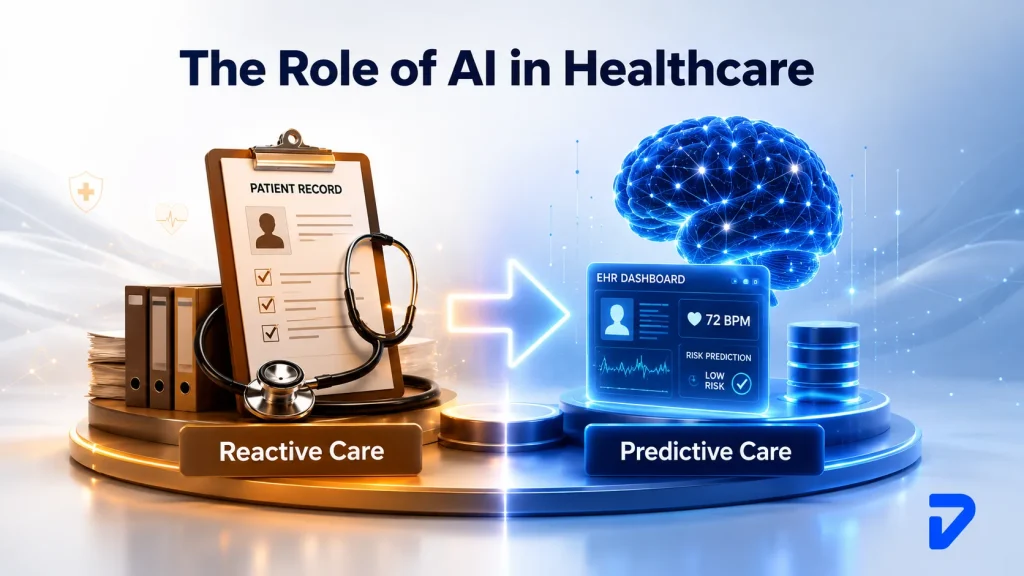
Reactive hospital practices have existed since medicine began. A patient walks in with symptoms, tests are conducted, and treatments start. It’s an effective practice except when it stops being one. This happens with chronic illnesses, terminal cancers, and sepsis, where waiting for symptoms to manifest means it’s already too late. This is what artificial intelligence is helping to solve right now, not just a theoretical solution but one that’s here now.
A PwC report estimates that AI could contribute up to $15.7 trillion to the global economy by 2030, with healthcare among the primary sectors benefiting from its adoption. Clinical decision support AI is helping physicians make better calls at the point of care, not by replacing clinical judgment but by providing sharper inputs.
What is Predictive Analytics in Healthcare?
Predictive analytics in healthcare is the process of examining patient data, including historical records, real-time vital signs, and imaging results, to forecast what is likely to happen next. The expected output includes risk scores, early warnings, and treatment suggestions. Every insight is available to physicians right where they conduct their Electronic Health Record (EHR) work, rather than on separate platforms they have to log into.
The point here is far more crucial than one might imagine. What is the difference? Conventional health care analytics show you what happened in your patient base during the past month. Predictive analytics powered by AI will tell you this particular patient is at a high risk of deterioration within the next 48 hours.
AI Predictive Analytics vs Traditional Healthcare Analytics
| Criteria | Traditional Analytics | AI Predictive Analytics |
| Approach | Retrospective: what happened | Prospective: what will happen |
| Data Types | Structured EHR data only | EHR, imaging, wearables, genomics, social determinants |
| Speed | Batch reports, daily or weekly | Real-time scoring at the point of care |
| Personalization | Population-level averages | Individual patient risk profiles |
| Workflow | Separate BI dashboards | Embedded directly in EHR |
| Accuracy | Rule-based scoring | 65–85% depending on use case |
| Primary Outcome | Reports past trends | Enables proactive clinical intervention |
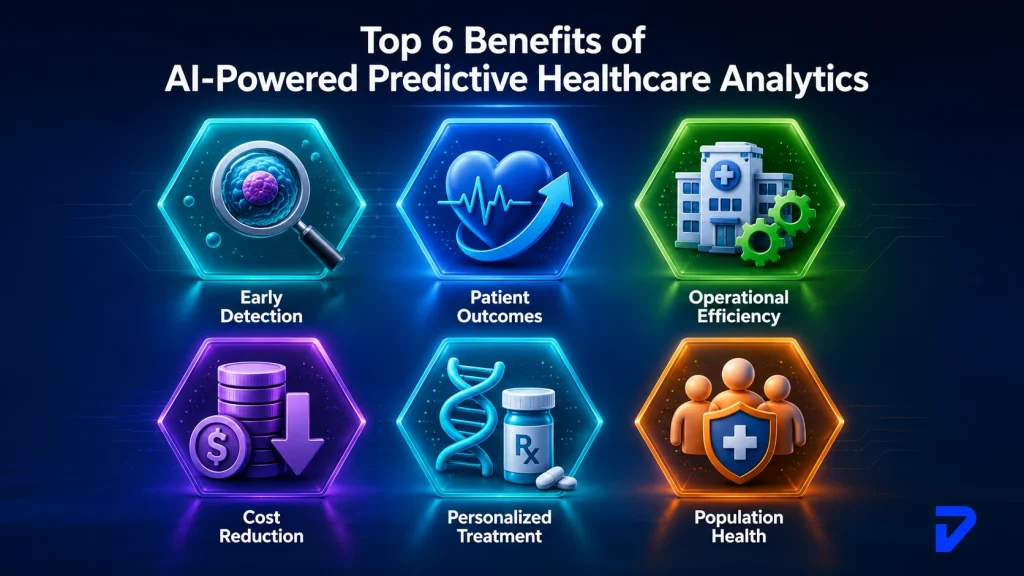
Top 6 Benefits of AI-Powered Predictive Healthcare Analytics
Early Disease Detection and Risk Assessment
Early detection translates to more treatment possibilities and less invasive treatments. AI-based solutions that analyze data from EHRs, genetic profiles, and behavioral data can alert physicians to patients at high risk before any symptoms occur. Take cancer as an example. AI-driven solutions can go beyond routine diagnostics by collecting information on pathological, radiological, and genomic features, providing doctors with useful leads to analyze.
Improved Patient Outcomes Through Preventive Care
Some health systems using predictive analytics have documented up to a 52% reduction in hospital readmissions. That’s not a marketing claim; it represents real patients who received the right care plan before things fell apart again. Prevention has always been better medicine. AI makes it scalable.
Enhanced Operational Efficiency and Resource Allocation
Health facilities not only fail to treat patients adequately in clinical settings but also have insufficient staffing and overcrowded conditions, which can lead to injuries. Using predictive analytics can help hospitals predict admission volumes and ICU space needs well before things get out of control.
Reduction in Healthcare Costs
AI-driven predictions help healthcare organizations cut unnecessary tests and procedures by up to 30%, reducing wasteful spending without compromising patient care. Beyond clinical efficiency, predictive technology is projected to reduce administrative costs across the U.S. healthcare system by $20 billion per year, a number too significant to ignore.
Personalized Treatment Recommendations
Generic protocols are always a compromise for the actual person sitting in front of you. Clinical decision support AI factors in comorbidities, medication history, and genetic data when surfacing recommendations within the EHR, at the moment a physician needs them, not buried in a report nobody has time to pull up.
Better Population Health Management
Under value-based care contracts, health systems need to find high-need patients before they become urgent cases. AI predictive analytics in healthcare enables proper risk stratification at scale. Catching patients who manage three or more chronic conditions early and routing them into the right programs drives real reductions in downstream hospitalizations.
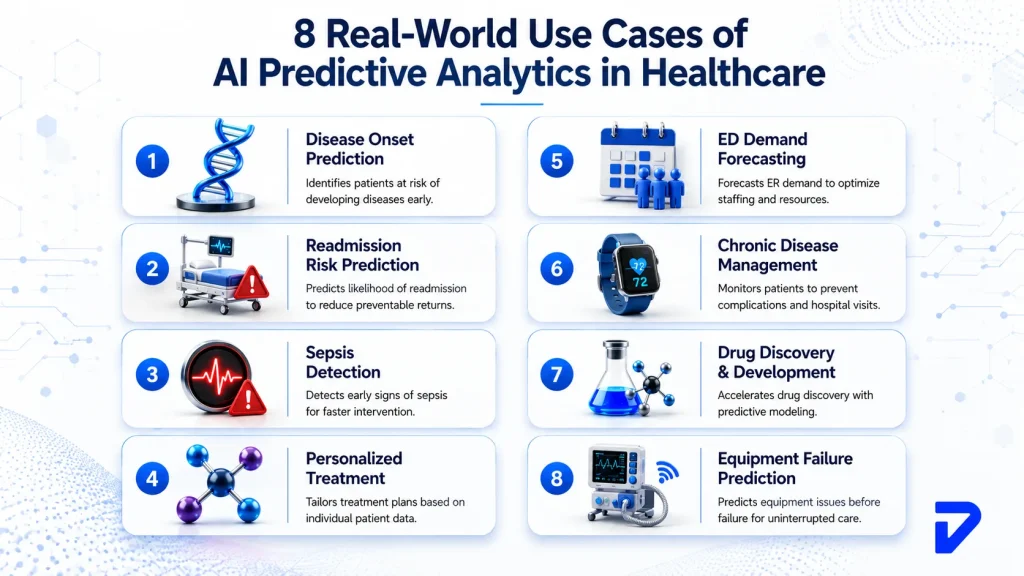
8 Real-World Use Cases of AI Predictive Analytics in Healthcare
Predicting Disease Onset and Progression
Models trained on longitudinal EHR data and genomic profiles can identify patients at risk of diabetes, chronic kidney disease, or cardiovascular conditions years before clinical symptoms appear. That window is where intervention is cheapest and does the most lasting good.
Hospital Readmission Risk Prediction
Predictive analytics has reduced readmission rates by 10–20% in documented hospital programs. Before discharge, the model flags who’s most likely to come back. Care teams build better post-discharge plans, schedule earlier follow-ups, and arrange home support where needed. The AI just makes that process consistent rather than luck-dependent.
Sepsis and Critical Condition Detection
Early identification is everything. AI systems monitoring vitals, lab values, and nursing documentation have flagged deterioration signals 6 to 12 hours earlier than standard screening tools. In sepsis, that time gap is frequently the difference between a patient who goes home and one who doesn’t.
Personalized Treatment Planning
Imaging and genomic sequencing are among the factors that go into the development of personalized treatment programs for oncology. Also, beyond oncology, clinical decision support AI identifies adverse events related to drug interactions, dose optimization, and other risks. This may not be covered in the general guidelines for the general population.
Emergency Department Demand Forecasting
Seasonality, geographic location, and community behavior determine when the emergency department becomes busy. Using past records of patients admitted to the hospital and community demographic data, analytics help forecast the number of patients a couple of days before they arrive. Staff can be better prepared for emergencies with less crowding and fewer ill-prepared patients in the waiting room.
Chronic Disease Management
One American hospital introduced artificial intelligence to its emergency department before deploying the technology for chronic disease management in COPD, diabetes, and heart disease. It would not have been possible without wearables and home-based devices. Early detection meant less need to admit patients for emergencies since conditions were caught beforehand.
Drug Discovery and Clinical Trial Optimization
Besides chronic disease management, drug discovery and clinical trial optimization can also be optimized using AI systems. Machine learning algorithms review large libraries of chemicals and map interactions with proteins while processing trial results, enabling rapid identification of patient groups for which treatments will prove effective.
Predictive Maintenance of Medical Equipment
In medical practice, ventilators and imaging machines can fail, leading to critical consequences. Algorithms learn about changes in equipment status during surgery or other procedures in real time and signal clinicians of imminent breakdowns so they can repair the machinery.
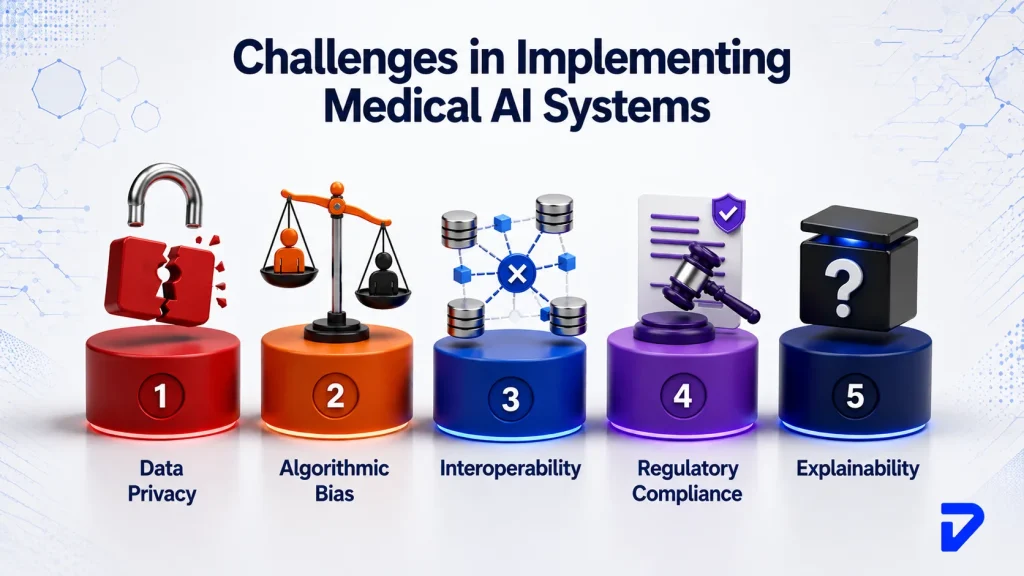
Challenges and Ethical Considerations for Implementing Medical AI Systems
Data Privacy and Security Concerns
AI pulling patient records across multiple platforms creates real exposure. HIPAA (Health Insurance Portability and Accountability Act) is the legal floor, not the standard to aim for. Proper implementation means encryption everywhere, strict access controls, and audits that people actually review. Healthcare breaches cost more than in any other sector. That context belongs in every implementation conversation from day one.
Algorithmic Bias and Fairness Issues
Here’s the uncomfortable reality: AI learns what training data teaches it. When historical care data reflect existing disparities, and in most health systems, they do, models can encode those disparities into their risk outputs. Underestimating risk for populations already underserved by the healthcare system isn’t just an ethics problem. It’s a direct patient safety failure. Bias audits before and after deployment are not optional.
Lack of Data Standardization and Interoperability
There are inconsistencies within patient data across various EHRs, laboratory information systems, and radiology platforms. Incomplete data sets result in unreliable predictions regardless of the quality of the model used. The adoption of HL7 FHIR standards is making strides towards resolving this issue. However, many health organizations have yet to create an environment in which true predictive AI applications can be deployed.
Regulatory and Compliance Challenges
The FDA has cleared hundreds of medical AI systems. Yet the guidance on post-market AI monitoring, accountability for clinical decisions aided by AI tools, and the differentiation between decision support and clearance remains vague. These are not theoretical concerns. They involve real decisions with legal implications, which is why regulatory guidelines lag behind deployment practices.
Explainability and Transparency in AI Models
A predicted risk without explanations is useless in the clinic. Doctors require clear reasons for their predictions to implement them in practice, inform patients, and justify their choices. Explainable models identifying all contributing factors make these applications functional. Black-box models without explanations of the variables underlying AI predictions cannot be considered appropriate.
Future Trends in AI Healthcare Analytics
Integration of IoT in Real-Time Monitoring
Wearables and telehealth devices continuously produce patient data outside scheduled appointments. Directly connected to the pipelines for the AI systems, this enables real-time patient monitoring by the physician, rather than relying on static information collected six weeks ago.
Personalized Medicine at Scale
Pharmacogenomics is moving out of research centers and into clinical practice because AI now handles the complexity at scale. Treatment matched to a patient’s actual genetic profile, rather than a population average, is becoming a practical reality in everyday clinical care.
Advanced NLP for Unstructured Data
Most clinically important information resides in physicians’ notes and discharge summaries, not in structured data fields. NLP converts that narrative text into usable inputs for a predictive model. Real-time integration of those extracted insights into risk scoring is the logical next step.
Enhanced Predictive Models
With a federated learning architecture, prediction algorithms are trained within the network of hospitals without sharing or centralizing patient data, thereby providing better performance, privacy, and generalizability. The performance of health AI applications is progressing at an unrealistic pace compared to just five years ago.
AI-Augmented Clinical Decision Support Systems
The direction is for AI to live within clinical workflows, not as a separate dashboard to consult. Guidance that surfaces in the systems physicians already use, at the exact moment a decision is being made. That is how AI becomes part of the process, not an interruption to it.
Is Your Organization Ready To Implement Such Technologies?
Implementing healthcare analytics without a robust data management system, clinical integration, and governance strategies tends to yield disappointing results. Start with a solid foundation with Pinnasys, and your success will follow.
The Bottom Line
Predictive AI is not coming into the healthcare sector; it has already entered through hospital doors and is making real decisions in emergency rooms, oncology departments, and chronic disease management programs. Whether to use AI predictive analytics in healthcare within the organization’s framework or not, the debate on that topic ended a long time ago. The only thing left for organizations to do is implement the solution efficiently.
Implementing organizations that handle the necessary IT infrastructure, conduct bias audits, and involve clinicians in their work are achieving positive results. Those who treat this as a simple software install rarely get far. That is exactly where Pinnasys comes in. With over 100 AI solutions delivered across industries, including healthcare, Pinnasys brings the engineering, integration, and governance expertise needed to move predictive analytics.
Key Takeaways:
- Healthcare predictive analytics: $16.75B in 2024, heading to $184.58B by 2032
- 65% of U.S. hospitals are running predictive AI as of 2024
- Readmission reductions between 10-70% documented across different programs
- Biggest adoption barriers are data quality, interoperability, and algorithmic bias — not the technology itself
- AI that augments clinical judgment delivers results. AI that tries to replace it causes problems.
Frequently Asked Questions About AI Predictive Analytics in Healthcare
How does AI predictive analytics improve patient outcomes?
It shifts the intervention point earlier, catching deterioration before a crisis develops rather than after. Fewer emergency admissions, lower readmission rates, and better long-term management of chronic conditions all follow from acting earlier rather than later.
What types of healthcare data are used in predictive analytics?
Lab results, vitals, diagnostic codes, medication records, clinical notes, imaging, wearable data, genomic data, and social determinants such as housing and income. Data quality determines prediction quality; incomplete records yield outputs clinicians can’t trust or act on with confidence.
What healthcare departments benefit the most from predictive analytics?
Emergency medicine, oncology, cardiology, ICUs, and population health teams see the clearest documented benefits. But most clinical departments have a relevant use case; medical AI systems aren’t specialty-specific in their application.
Can small and mid-sized healthcare providers adopt AI predictive analytics?
Yes, Epic and Oracle Health both include built-in predictive modules in their platforms. Cloud-based healthcare AI implementation or applications have significantly reduced infrastructure costs. Building custom models from scratch isn’t required to get real value from predictive analytics.
What role do electronic health records (EHRs) play in predictive healthcare analytics?
EHRs are the primary data source for most predictive models. The longitudinal patient history inside them- diagnoses, medications, procedures, and clinical notes- is what these models are built on. Inconsistent or incomplete documentation directly degrades prediction accuracy.





Prakash C. Saini
Prakash Saini is the Founder & CEO of Pinnasys. With over a decade in digital transformation and building production systems, he grew an engineering team from 2 to 50 people and has led the delivery of 100+ production digital systems. Products built under his leadership have raised millions in funding and generated over $50 million in revenue. He holds an Executive MBA from IIM Kozhikode and today leads the AI engineering team at Pinnasys.