
AI MVP development works best when a first release proves one workflow for one user group. Expect 6 to 12 weeks and $25,000 to $120,000 for most builds, depending on data, integrations, and risk.
Eighty-eight percent of organizations now use AI in at least one business function, yet McKinsey reports that nearly two-thirds have not begun scaling it. That gap usually opens at the first release, when teams either try to ship everything or ship a demo that proves nothing. Good AI MVP development avoids both traps by putting one working workflow in front of real users and measuring what changes.
Consider a support team that wants AI to draft refund replies from order history. Version one needs accurate drafts, a human approval step, and a way to log corrections, not a mobile app or an autonomous agent. The same discipline applies to AI-native SaaS and technology products, where early choices on scope, timeline, and cost shape everything after launch.
What Is the Difference Between an AI Prototype and an MVP?
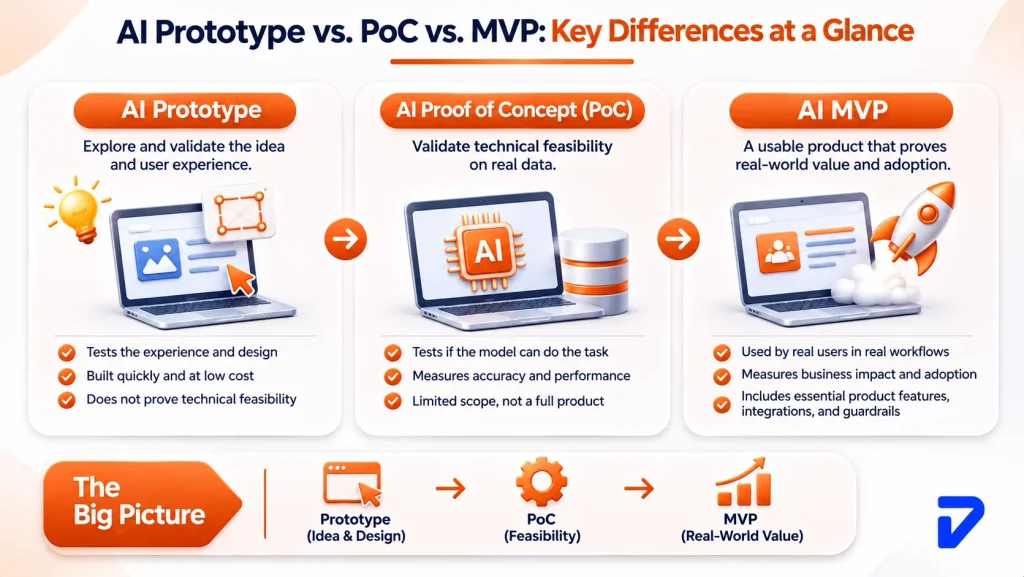
An AI prototype shows what a product could feel like, while an MVP proves real users will rely on it to get real work done. A proof of concept sits between them and answers a narrower technical question about whether the model can handle the task at all.
Teams that treat the three as interchangeable usually pay for it later. Gartner predicted at least 30% of generative AI projects would be abandoned after proof of concept by the end of 2025. The firm pointed to poor data quality, weak risk controls, escalating costs, and unclear business value as the main causes.
Each stage retires a different risk, which is why disciplined AI MVP development treats them as separate decisions with separate budgets.
AI Prototype
An AI prototype is often a clickable mockup or a scripted chat flow running on sample data. For instance, a claims team might review screens where AI summarizes a loss report before anyone connects a real model. The prototype answers design questions cheaply, although it says almost nothing about accuracy, latency, or cost at production volume.
AI Proof of Concept vs MVP
A proof of concept tests whether a chosen model can meet an accuracy bar on your own data, usually inside a notebook or script. Suppose it extracts invoice fields correctly on 92% of 200 samples. That result proves feasibility, yet it cannot show whether accounts payable staff will trust the output enough to change their routine.
AI MVP
An MVP wraps the proven capability in a usable product with logins, data connections, guardrails, and feedback capture. As a result, it measures behavior rather than opinions, including task completion, correction rates, and repeat use over several weeks. Investors, boards, and budget owners need exactly that evidence before they fund a larger build.
What Should an AI MVP Include?
A first release should cover one primary user, one complete workflow, and one measurable outcome, with everything else parked on a written later list. Scope creep hurts AI MVP development more than ordinary software, because every extra feature adds prompts, test cases, and failure modes.
Autonomy is the most common overreach. Gartner expects over 40% of agentic AI projects to be canceled by the end of 2027. The firm also notes that many use cases sold as agentic never needed it.
Before any scoping workshop, confirm that the required data exists and can be used legally. A short AI readiness assessment often saves weeks of rework later.
When Pinnasys scopes a first release, the opening workshop ends with a one-page contract rather than a feature wish list. That single page becomes the yardstick for every later request, so debates about new features turn into quick trade-off decisions.
Write a One-Page Scope Contract First
A team that cannot fill in five short lines is not ready to write code. The contract should name:
- The primary user and the trigger that starts the task
- The AI task and its expected output
- A success threshold, such as 85% of drafts accepted unedited
- The human approval boundary
- A stop condition that ends the pilot early
Five Components Every First Release Needs
Even a lean AI startup MVP needs more than a model call behind a text box. In practice, version one should include an end-to-end user path, representative data, a versioned evaluation set, usage telemetry, and a human fallback. Without these five, nobody can trust the pilot results or explain why a low-confidence answer slipped through.
What to Defer Until Users Ask for It
Native mobile apps, multi-role dashboards, broad analytics, extra personas, and multi-agent orchestration can almost always wait. The test is straightforward: if removing a feature does not break the core decision, it moves to the later list. Security, access control, and privacy are the exceptions, since retrofitting them costs far more than building them in.
How Do You Build an AI MVP Without Overbuilding the Architecture?
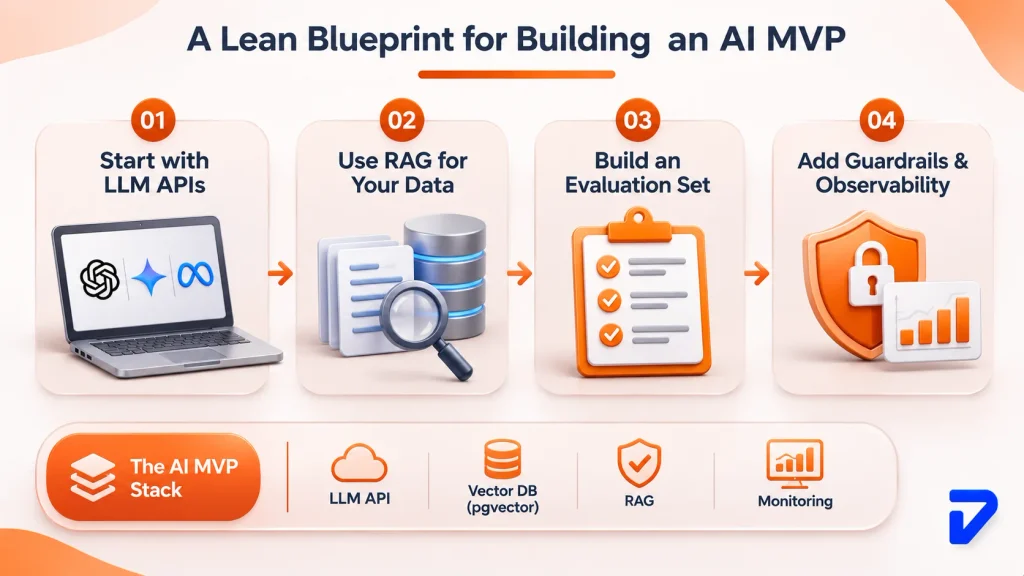
You build an AI MVP by picking the smallest architecture that meets your accuracy, latency, and data-handling targets. After that, you add layers only when evidence from testing demands them. Most first releases share a similar reference stack, and the right column below shows when extra complexity has earned its place.
On the knowledge layer, pgvector adds similarity search directly to PostgreSQL, so many teams skip a separate vector database in version one. That one avoided service is among the cheapest wins in AI MVP development.
Start With LLM APIs Before Training Anything
Hosted LLM APIs let a team test real behavior in days instead of months. Meanwhile, prices keep falling, as the Stanford AI Index found inference costs for GPT-3.5-level performance dropped over 280-fold between late 2022 and late 2024. Custom training makes sense only after usage data reveals a clear accuracy or cost gap.
Use RAG for Private Knowledge and Fine-Tune Last
Retrieval-augmented generation, or RAG (fetching the right documents before the model answers), solves most knowledge problems in a generative AI MVP. For example, a distributor’s quoting assistant can pull current price sheets at query time through AI search over company knowledge. Fine-tuning comes later, usually for tone or format, once you measure retrieval quality.
Build the Evaluation Set Alongside the Product
An evaluation set is a fixed list of real inputs paired with expected outputs, scored after every prompt or model change. The NIST Generative AI Profile names confabulation, where models state false content confidently, as a core risk. Consequently, 100 to 200 representative cases, including tricky and refusal cases, should exist before the first pilot.
Add Guardrails and Observability From Day One
Prompt injection, data leakage, and runaway consumption all appear on the OWASP Top 10 for LLM Applications, and none wait for version two. At a minimum, log every prompt, response, latency figure, and token cost per task. Equally important, cap spend per user so a single runaway loop cannot drain the monthly budget.
Still stuck between a demo and a product your users can trust? Pinnasys scopes, builds, and ships AI MVPs with evaluation, guardrails, and monitoring built in, so your first release produces evidence, not slideware.
AI MVP Development Timeline: How Long Does an AI MVP Take?
Most focused first releases take 6 to 12 weeks from kickoff to a controlled pilot. By contrast, regulated or integration-heavy builds often run 12 to 20 weeks.
Those ranges assume a decision-maker joins a review every week and sample data arrives during the first week. The schedule below reflects a lean LLM-API build with a single integration, which is the shape most first releases take.
| Week | Phase | What you should have at the end |
|---|---|---|
| 1 | Discovery and scope contract | Signed scope, success threshold, data access |
| 1 to 2 | Data and model spike | Sample data reviewed, model shortlist, baseline scores |
| 2 to 3 | UX and architecture | Clickable flow and system design |
| 3 to 6 | Core build | Working end-to-end workflow with LLM integration |
| 6 to 7 | Evaluation and hardening | Passing evaluation set, guardrails, monitoring live |
| 7 to 8 | Controlled pilot | Five to ten users, feedback, and a go or no-go call |
Phases overlap on purpose, so design work continues while the data spike runs. Evidence gates, not calendar dates, should decide when each phase of AI MVP development closes.
What Keeps the Timeline Short
Speed in AI MVP development comes mostly from decisions, not from typing faster. A product owner who answers within a day, early access to realistic data, and weekly demos against acceptance criteria can each save a week. Similarly, booking pilot users during discovery avoids the familiar two-week scramble to find testers once the build finishes.
What Stretches It Past Twelve Weeks
A handful of triggers reliably add time, whether the project is a startup pilot or an enterprise rollout:
- New data collection or labeling
- Connections to more than two legacy systems
- Regulated decisions that need compliance review
- Private hosting or strict data residency
Each deserves its own estimate line, and AI integration services work is where hidden weeks usually surface.
Why Iteration Time Belongs Inside the Plan
The first pilot week almost always exposes prompts that confuse users and edge cases the evaluation set missed. Therefore, reserve at least one sprint after launch for iteration rather than treating launch day as the finish line. Teams that skip this buffer tend to ship fixes under pressure, which quietly erodes user trust in the product.
How Much Does an AI MVP Cost to Build and Run?
A focused AI MVP typically costs $25,000 to $120,000 to build, while regulated or deeply integrated releases can pass $200,000. Labor drives most of that figure, and the BLS median wage for software developers, QA analysts, and testers is $64.44 an hour. At that rate, three people working eight weeks cost about $62,000 in wages alone, before benefits or overhead.
| MVP type | Typical scope | Build cost range | Timeline |
|---|---|---|---|
| Clickable AI prototype | Screens and scripted AI responses | $5,000 to $15,000 | 1 to 3 weeks |
| Lean LLM-API MVP | One workflow, one model, basic guardrails | $25,000 to $60,000 | 6 to 8 weeks |
| RAG or document AI MVP | Retrieval over private documents, evaluation set | $40,000 to $90,000 | 8 to 12 weeks |
| Workflow or agentic MVP | Multi-step actions and system integrations | $60,000 to $120,000 | 10 to 14 weeks |
| Regulated or enterprise MVP | Audit logs, access control, compliance review | $100,000 to $200,000+ | 12 to 20 weeks |
These are planning ranges for blended onshore and offshore teams, not quotes, and all-US teams usually land near the top of each band. A realistic AI MVP cost estimate treats AI MVP development as two budgets: the cost to learn and the cost to operate.
Where the Build Budget Actually Goes
The largest share goes to engineering and integrations, followed by discovery, design, evaluation, and deployment. Builds that trigger actions in a CRM or ERP sit higher, as most AI workflow automation projects show. Every connection needs its own error handling and testing. For that reason, ask any vendor to separate these buckets in writing.
Run Costs: LLM APIs, Hosting, and Monitoring
At pilot volume, model spend is often the smallest monthly line. For instance, Anthropic’s pricing documentation lists a 50% batch processing discount alongside cheaper cached input. Hosting, logging, and tracing tools usually cost more. Track cost per successful task rather than cost per API call, since retries and human review change the real economics.
Hidden Costs First-Time Buyers Miss
Data cleanup is the classic surprise, followed by evaluation work, security review, and post-launch prompt tuning. A sensible plan sets aside 15% to 20% of the build cost each year for maintenance and model updates. Someone must also own monitoring, so budget for the AI agent observability practices that keep traces useful.
User Testing, Iteration, and the Path to Product-Market Fit
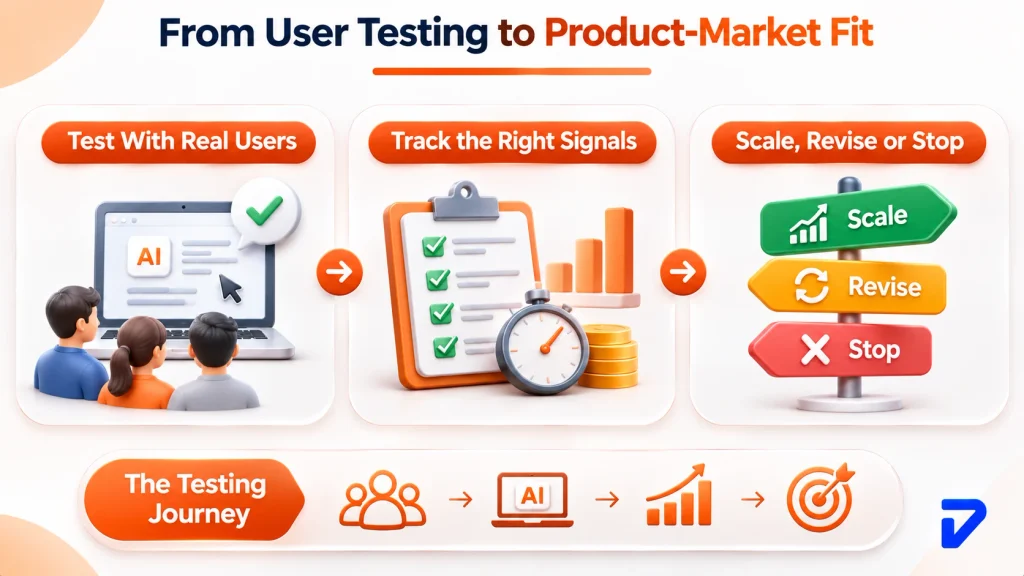
An AI MVP earns its next round of funding only when user testing shows people finishing real tasks faster or better than before. Positive comments in a demo meeting rarely predict whether those same people will open the tool on a busy Monday. That bar matters because CB Insights’ research on startup shutdowns keeps ranking weak product-market fit among the leading reasons companies fail.
The same logic shapes how we judge AI MVP development outcomes for clients. Our AI project case studies show how pilot evidence decided what each team built next.
How Do You Test an AI MVP With Users?
Recruit a small group from the target role and watch them closely. Nielsen Norman Group found that five users uncover about 85% of usability problems in one round. A pilot group of five to ten users is therefore usually enough. Then observe live sessions, log every correction, and interview each user after a week of real use.
Metrics That Separate Signal From Novelty
Early enthusiasm fades quickly, so track behavior for at least two weeks across these signals:
- Task completion rate without escalation
- Edit or correction rate on AI outputs
- Time saved per task against the old process
- Repeat usage after the first week
- Cost per successful task
A sharp drop in repeat usage after week one suggests novelty was doing the work.
Scale, Revise, or Stop
Compare pilot results against the thresholds written into the scope contract, not against how the demo felt in the boardroom. Scale when quality, adoption, and economics all pass, revise when one gap looks fixable, and stop when value or safety fails. An early stop is a good outcome, because it protects the budget for a stronger idea.
The Bottom Line
AI MVP development pays off when the first release is small enough to finish and serious enough to trust. Scope one workflow, build on hosted models with an evaluation set from week one, and budget for run costs as carefully as build costs. After launch, let user behavior rather than demo applause decide the next investment, which keeps a six-figure question from becoming a seven-figure mistake.
If you are weighing a first release, start with a short AI consulting and roadmap engagement. It pins down scope, data readiness, and a realistic budget before anyone writes code. When you are ready to pressure-test your use case, talk with the Pinnasys team about what version one should prove.
Key Takeaways from the Article
- A prototype tests experience, a proof of concept tests feasibility, and an MVP tests adoption.
- Strong first releases cover one user, one workflow, and one measurable outcome.
- Hosted LLM APIs and RAG beat custom model training for most version-one builds.
- Focused builds usually need 6 to 12 weeks and $25,000 to $120,000 in budget.
- Pilot decisions should rest on completion, correction, and repeat-use data, not demo reactions.
Frequently Asked Questions on AI MVP Development
Can a no-code tool build an AI MVP?
No-code builders work well for an AI prototype or internal demo, often within one to two weeks. However, most teams outgrow them once they need custom data connections, audit logs, or the security reviews that serious AI development requires.
Should an AI startup MVP train its own model?
A custom model usually adds months of data labeling before you know whether users want the product. Most AI startup MVPs ship faster on hosted LLM APIs and consider fine-tuning only after real usage reveals a specific gap.
Who should own the code and data after an AI MVP is built?
Your company should own the repository, prompts, evaluation set, and cloud accounts from day one. Confirm this in the contract, because recreating prompts and test data after a vendor dispute can cost several weeks of engineering work.
Is a generative AI MVP safe enough for insurance or healthcare?
It can be, provided version one includes access controls, audit logs, and human approval for consequential decisions. Expect compliance review and security testing to add roughly four to eight weeks compared with an unregulated build.
What happens after an AI MVP proves itself with users?
The next phase hardens the product for production through load testing, MLOps pipelines for monitoring and model updates, broader integrations, and a support model. This scale-up phase often takes 8 to 16 weeks after a documented go decision.