



AI-powered insurance policy servicing automation replaces slow, manual back-office workflows with intelligent systems that process endorsements, renewals, billing, and claims without human intervention, cutting costs by 30–75% while dramatically improving policyholder experience.
AI policy servicing automation is transforming how insurers manage policy changes, renewals, billing, claims support, and customer service. By automating high-volume servicing tasks with AI, carriers can reduce operational costs, accelerate response times, improve accuracy, and deliver a better policyholder experience.
Full AI adoption among insurers increased from 8% to 34% in a single year, demonstrating how quickly the industry is embracing AI-powered operations. Yet many carriers still handle policy servicing much as they did a decade ago, with manual workflows, disconnected systems, and long processing times. The gap between AI’s capabilities and day-to-day servicing operations remains significant.
This guide explores how AI policy servicing automation works in production, the insurance functions ready for automation today, the technology and data infrastructure required to support it, and the governance practices insurers need to scale AI responsibly.
What Is Policy Servicing Automation?
Insurance policy servicing automation is the application of AI agents, workflow orchestration, and intelligent document processing to post-bind tasks, endorsements, billing inquiries, coverage changes, renewals, cancellations, and status updates, with minimal or no manual intervention. The scope covers every interaction between issuance and expiry that does not require underwriting judgment on a new risk.
Where Automation Fits in the Insurance Value Chain
Insurance automation delivers the strongest impact in processes with high volumes, structured workflows, and clear decision rules. The breakdown below shows key servicing functions, automation readiness, and the technologies driving each area.
| Servicing Function | Automation Readiness | Primary Technology |
| Policy issuance and onboarding | High | OCR, KYC APIs, STP rules engines |
| Premium billing and reconciliation | High | RPA + ML for exception handling |
| Endorsements and amendments | High | NLP classification + re-rating engines |
| Renewal propensity and outreach | High | Predictive ML, multi-channel orchestration |
| Claims FNOL and triage | High | Conversational AI, severity scoring models |
| Customer service and query resolution | High | LLM-powered virtual agents, agent assist |
| Complex underwriting decisions | Low to medium | Human-in-the-loop, AI advisory |
| Litigation and coverage disputes | Low | AI research tools, human judgment required |
Automation delivers the most value in the first six rows, where tasks are high-volume, rule-consistent, and data-rich. The final two remain human-led, with AI in a support role.
Automation Maturity: From RPA to Agentic AI
RPA started insurance automation by handling repetitive, rule-based tasks, but it struggles with complex customer requests and unstructured workflows. Modern policy servicing requires AI systems that can understand context and make intelligent decisions.
AI agents go beyond automation by interpreting intent, applying policy rules, executing changes, and escalating exceptions when needed. Conning’s 2025 Survey found strong generative AI adoption among U.S. insurers, with many deploying it across servicing workflows.
Key AI Technologies Driving Policy Servicing Automation
AI technologies are enabling insurers to automate complex servicing workflows, improve decision accuracy, and deliver faster policyholder experiences at scale.
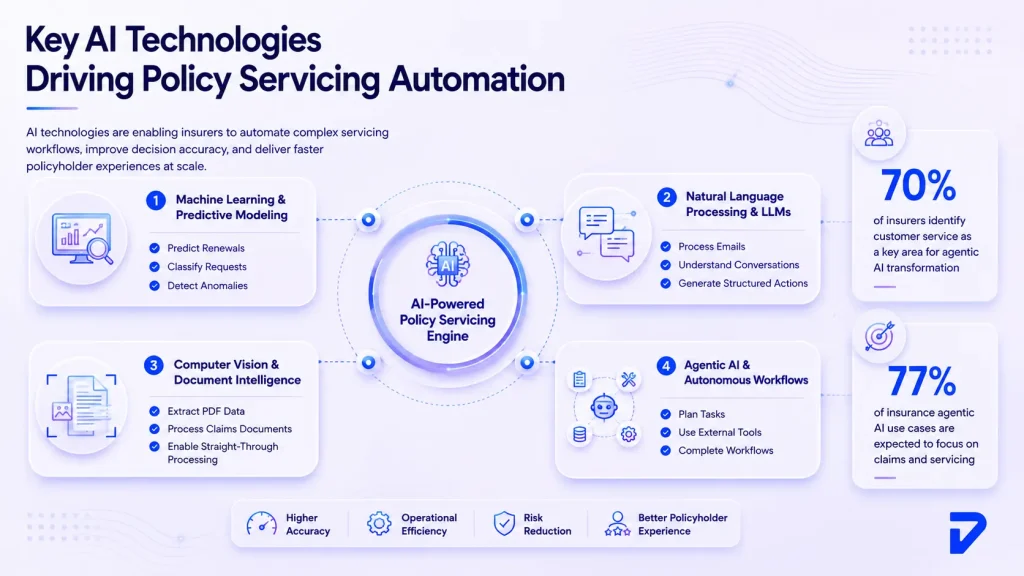
Machine Learning and Predictive Modeling
Machine learning models analyze historical policy data to predict renewals, classify service requests, and detect anomalies. MLOps practices help insurers continuously improve models as customer behaviour changes. These capabilities reduce manual effort while improving proactive policy servicing decisions.
Natural Language Processing and LLMs
NLP transforms emails, documents, chats, and call transcripts into structured data, while LLMs enable AI agents to handle complex customer conversations. Around 70% of insurers identify customer service as a key area for agentic AI transformation.
Computer Vision and Document Intelligence
Computer vision and intelligent document processing extract data from PDFs, claim documents, and inspection reports. By converting unstructured files into machine-readable information, these technologies reduce manual data entry and enable faster straight-through processing across insurance operations.
Agentic AI and Autonomous Workflows
Agentic AI systems can plan tasks, use external tools, and complete policy servicing workflows autonomously. IBM research indicates that 77% of agentic AI use cases in insurance will focus on claims, with servicing becoming a major adoption area.
How AI Automates the Insurance Policy Servicing Lifecycle
AI automation is improving insurance servicing by streamlining workflows, reducing manual tasks, and enabling faster, more accurate policyholder experiences.
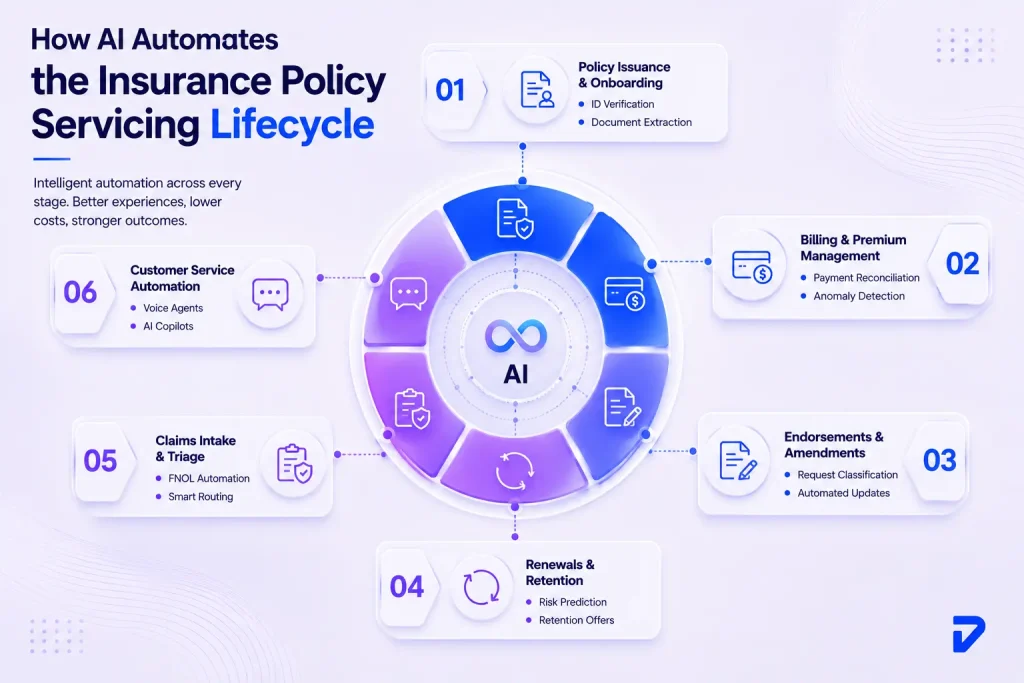
1. Policy Issuance & Onboarding
AI automates document extraction, identity verification, and application processing during onboarding. Intelligent document processing reduces manual data entry while enabling faster policy creation. Insurers using automation can achieve higher straight-through processing rates across routine policy workflows.
2. Billing & Premium Management
AI improves premium calculations, payment reconciliation, and billing exception handling through automated workflows. Machine learning models analyze payment patterns, detect anomalies, and help insurers reduce revenue leakage while improving billing accuracy and operational efficiency.
3. Endorsements & Amendments
AI simplifies policy changes by classifying requests, validating eligibility, and updating policy systems automatically. NLP-powered workflows process changes like vehicle additions or coverage updates faster, reducing manual intervention and improving turnaround times for policyholders.
4. Renewals & Retention
Predictive AI models analyze customer behavior, claims history, and policy data to identify renewal risks. Insurers can use these insights to create personalized offers and proactive engagement strategies that improve retention and reduce policy lapses.
5. Claims Intake & Triage
AI accelerates claims processing by automating FNOL intake, severity assessment, and claim routing. Computer vision and predictive analytics help insurers identify complex cases early, while simple claims move faster through automated settlement workflows.
6. Customer Service Automation
AI-powered chatbots, voice agents, and copilots help insurers resolve customer queries faster across multiple channels. Gartner predicts that conversational AI will handle a growing share of customer interactions, enabling 24/7 support while improving service efficiency.
Fraud Detection and Compliance at Scale
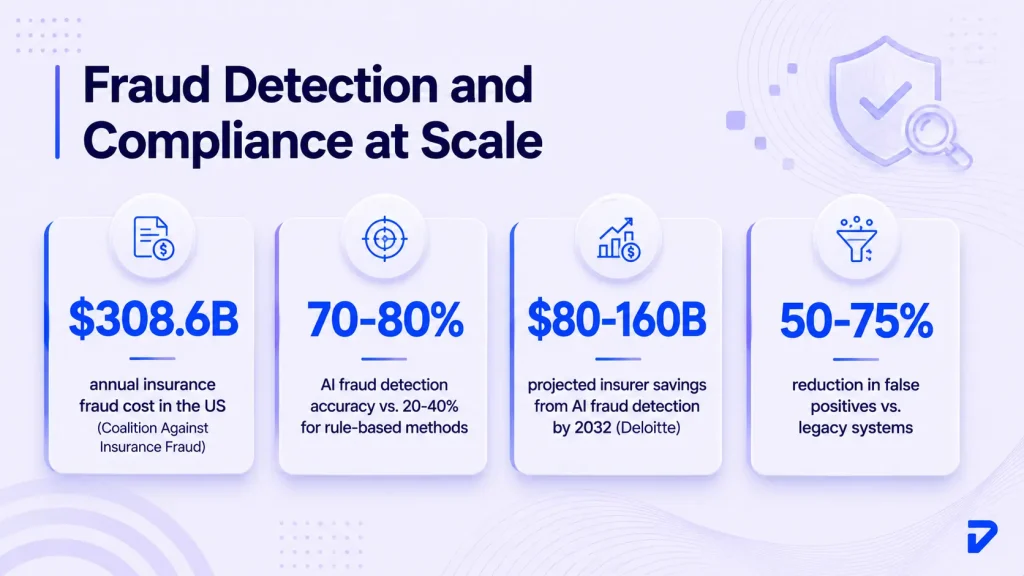
Fraud detection and regulatory compliance are becoming strategic advantages rather than operational necessities. By combining supervised and unsupervised AI models, graph analytics, real-time fraud scoring, automated reporting, and explainable AI, insurers can reduce financial losses, strengthen governance, and improve decision accuracy across the insurance value chain.
According to the Coalition Against Insurance Fraud, insurance fraud costs U.S. insurers an estimated $308.6 billion every year, highlighting the need for intelligent detection systems. When paired with automated compliance workflows and transparent AI governance, insurers can accelerate regulatory reporting, improve audit readiness, and build greater trust with regulators and policyholders alike.
The Data Foundation Behind Intelligent Insurance Operations
AI-powered insurance servicing depends on a modern data foundation that brings together structured and unstructured data, supports both real-time and batch processing, and maintains strong governance. With the right infrastructure in place, insurers can improve model accuracy, accelerate decision-making, and confidently scale automation across policy servicing operations.
According to Gartner, poor data quality costs organizations an average of $12.9 million annually. Investing in data quality, data lineage, and scalable data architectures helps insurers reduce operational risk, improve AI performance, and ensure trusted, compliant data is available throughout the policy lifecycle.
Challenges of Scaling AI in Insurance
The production failures happen not at the proof-of-concept stage but at scale. Four challenges account for the majority of stalled deployments.
- Legacy Core System Integration: Many legacy PAS platforms have limited APIs and outdated architectures, making AI integration difficult. Middleware and custom connectors help bridge the gap but increase maintenance complexity.
- Data Silos and Poor Data Quality: Disconnected policy, claims, billing, and customer data limits AI performance. Unifying and governing data is essential for accurate predictions and automation.
- AI Talent and Domain Expertise Gaps: Successful AI deployments require collaboration between insurance experts and AI engineers. Combining business knowledge with technical expertise leads to better implementation and adoption.
- Evolving Regulatory Requirements: AI regulations continue to evolve, requiring greater transparency, fairness, and accountability. Strong model governance and documentation help insurers maintain compliance across jurisdictions.
Ready to modernize insurance policy servicing?
Partner with Pinnasys to build AI-powered automation that streamlines policy servicing, improves customer experiences, and scales with your business.
Ethics, Bias, and Responsible Automation
Responsible AI requires more than high-performing models. Insurers must identify bias, validate fairness, maintain human oversight, and document every stage of the AI lifecycle to ensure automated decisions remain transparent, consistent, and aligned with evolving regulatory expectations.
According to IBM’s Global AI Adoption Index, 74% of organizations cite trustworthy and explainable AI as essential for wider AI adoption. Embedding fairness testing, governance, and explainability into every deployment helps insurers reduce risk while building confidence among regulators and policyholders.
As AI adoption accelerates, ethical governance will become a competitive advantage rather than simply a compliance requirement. Insurers that invest in responsible AI practices today will be better positioned to scale automation, strengthen customer trust, and adapt to future regulatory changes.
The Future of AI-Powered Policy Servicing Automation
Insurance policy servicing is moving beyond task automation toward fully autonomous ecosystems. Multi-agent AI systems will enable specialized agents for intake, compliance, pricing, and customer communication to work together, reducing human involvement in routine workflows.
Embedded insurance will also drive the need for real-time policy issuance and updates through API-driven platforms. Customers will expect instant coverage, while IoT and telematics will enable insurers to adjust policies based on real-time risk signals from vehicles, homes, and equipment.
Parametric insurance and smart contracts will further automate claims and settlements by triggering payouts based on predefined events. While adoption is growing in specialty insurance, wider use will depend on regulatory readiness and customer trust.
The Bottom Line
AI-powered insurance policy servicing automation is delivering measurable business value today by reducing manual work, accelerating response times, and improving operational efficiency. Insurers that automate high-volume servicing workflows first achieve faster ROI and create a stronger foundation for long-term AI adoption.
Pinnasys helps insurers build production-ready AI servicing solutions that automate policy operations, improve customer experiences, and scale with business growth. By identifying the highest-impact workflows first, organizations can reduce costs, streamline servicing, and maximize the return on every AI investment.
Key Takeaways from the Article
- Full AI adoption among insurers jumped from 8% to 34% in a single year, with policy servicing leading.
- AI raises straight-through processing rates from 10–15% to 70–90% on standard policy transactions.
- Claims resolution time drops from 30 days to an average of 7.5 days with production AI automation.
- Fraud detection accuracy improves from 20–40% to 70–80% when AI replaces rule-based screening.
- Data infrastructure, not model sophistication, is the most common bottleneck when scaling servicing automation.
Frequently Asked Questions
What is AI-powered policy servicing automation?
AI policy servicing automation applies machine learning, natural language processing, and agentic AI workflows to post-bind insurance tasks, endorsements, billing, renewals, and FNOL, processing them without manual intervention. Leading carriers now achieve STP rates above 70% on standard personal lines transactions.
Which insurance lines benefit most from automation?
Personal auto and standard homeowners lines have the highest automation readiness because transactions are high-volume and rule-consistent. Commercial lines benefit significantly in billing and endorsement workflows. Specialty lines and complex commercial policies still require substantial human judgment in underwriting and claims assessment.
How does AI handle regulatory compliance in servicing?
Automated reporting pipelines produce IFRS 17, Solvency II, and RBC outputs without manual spreadsheet consolidation. Explainable AI tools generate model decision summaries required for adverse-action notices and regulatory audits. Data governance frameworks enforce GDPR and CCPA residency rules at the infrastructure level.
What is straight-through processing in insurance, and why does it matter?
STP means a policy transaction completes from intake to resolution without any human touchpoint. Manual processing costs roughly $75 per transaction; automated STP costs around $15. Across tens of thousands of monthly servicing requests, the cost differential makes STP the highest-ROI automation target in policy administration.
How do insurers ensure fairness in AI-driven decisions?
Fairness testing measures whether model outputs produce statistically disparate outcomes across protected class proxies; geography and credit tier are the most common in insurance AI. Models that fail disparate impact testing require rebalanced training data or post-processing corrections before deployment. Testing must repeat after every retraining cycle, not only at initial launch.
What separates a successful AI servicing deployment from a failed pilot?
Production deployments start with one high-volume, well-defined use case (typically endorsement classification or FNOL intake), build the data integration required to support it properly, and measure performance against a clear baseline before expanding. Pilots that attempt broad transformation before demonstrating point-solution results rarely survive budget review.





Prakash C. Saini
Prakash Saini is the Founder & CEO of Pinnasys. With over a decade in digital transformation and building production systems, he grew an engineering team from 2 to 50 people and has led the delivery of 100+ production digital systems. Products built under his leadership have raised millions in funding and generated over $50 million in revenue. He holds an Executive MBA from IIM Kozhikode and today leads the AI engineering team at Pinnasys.