
AI in revenue cycle management works best as a connected workflow. It extracts clinical facts, suggests codes, scrubs claims, and predicts denials, while rules and human reviewers keep every financial decision accurate.
1. Introduction
Experian Health’s 2026 survey found that 40% of providers say 10% or more of their claims are denied. Each denial sends staff back into rework and pushes payment further out. CAQH sees a $20 billion annual savings opportunity in moving administrative workflows from manual to electronic, though that figure covers healthcare administration broadly, not AI alone.
Revenue cycle management (RCM) covers the entire process from patient registration and insurance verification to medical coding, billing, claim submission, and final payment. AI strengthens these workflows through automated document processing, denial prediction, and intelligent task routing.
This blog examines how AI can improve each stage, reduce manual work, and support better revenue cycle outcomes while keeping human expertise central to critical decisions.
2. Where Revenue Cycle Management Breaks Down
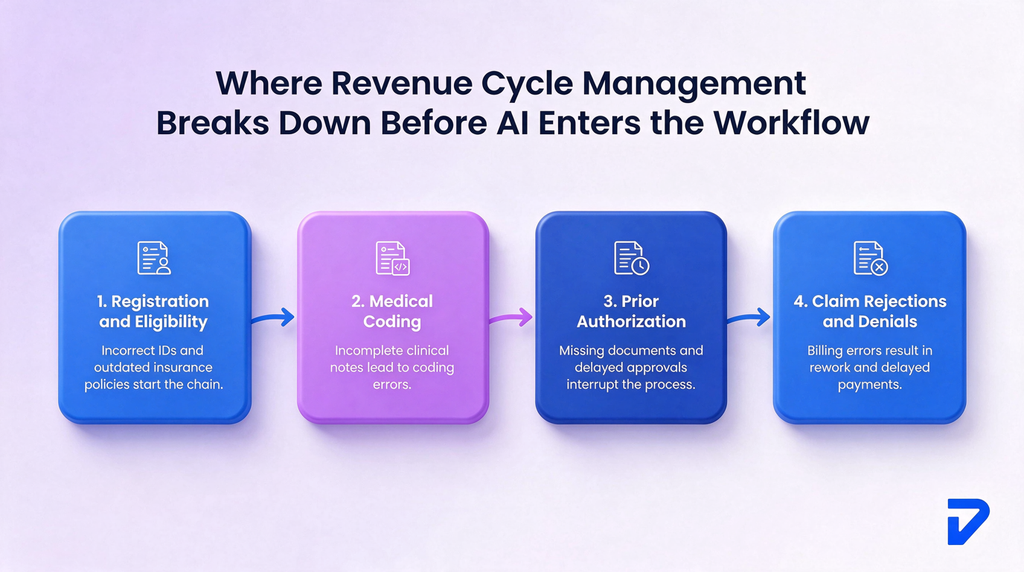
Revenue cycle management involves several connected processes. Errors in one stage can create coding issues, authorization gaps, claim denials, and payment delays.
Patient Registration and Insurance Eligibility Errors
Registration establishes the patient and insurance details required for accurate billing. Incorrect member IDs, outdated coverage, or missing subscriber information can cause claims to fail during payer verification.
Manual Medical Coding and Documentation Gaps
Medical coders translate clinical notes into standardized ICD-10-CM, CPT, and HCPCS codes. Incomplete documentation, incorrect code selection, and inconsistent diagnosis details can lead to billing errors, claim rework, and denials.
Prior Authorization and Payer Requirements
Different insurers follow different authorization rules, making approval tracking difficult. Missing clinical documentation, delayed requests, and expired approvals can interrupt treatment and create reimbursement problems. The AMA’s 2024 survey found that 93% of physicians say prior authorization can delay patient care.
Claim Rejections, Denials, and Payment Delays
Rejected claims fail initial checks, while denied claims are refused after payer review. Incorrect billing details, missing authorization, non-covered services, and changing payer policies create additional correction work. Experian’s 2026 report found that 75% of providers report rising claim denials.
3. How AI Supports Medical Coding Expertise
Coding is the most accuracy-sensitive task that AI in revenue cycle management touches. AI medical billing and coding works best as a pipeline: extract clinical facts, propose candidate codes, validate them against rules, and hand uncertain cases to certified coders.
A 2025 npj Health Systems study tested domain-specific fine-tuning on ICD-10 coding. After training on 74,260 ICD-10 code-description pairs, exact-match accuracy rose from under 1% to 97% on a code-matching evaluation. On real-world clinical notes, the enhanced model reached 69.20% exact match and 87.16% category match.
Keep those two results separate. The 97% figure measures code matching on a controlled test, not accuracy on real charts. The real-world figures are encouraging evidence for domain-specific models, but they do not prove that AI medical coding can run without certified coders.
Extracting Clinical Information From EHR Documentation
NLP (natural language processing, software that reads free text) pulls diagnoses, procedures, medications, and dates from structured fields and unstructured notes. It also flags conflicts, such as an infection documented without an organism. Clinical documentation improvement (CDI) specialists then query the provider, so the chart supports the code before anyone assigns it.
Mapping Clinical Documentation to ICD-10-CM, CPT, and HCPCS Codes
Given clinical context, AI proposes candidate codes. Terminology mapping and coding-rule checks then validate each one against maintained code sets, and retrieval from current code descriptions keeps suggestions grounded. When the chart supports two plausible codes, the system flags the case for a coder instead of assigning an unsupported answer.
AI-Assisted Coding Audits and Documentation Validation
Audit models compare proposed codes with the chart and applicable guidelines. They surface missing specificity, likely undercoding, and overcoding that raises compliance risk. A pre-bill sweep might catch an unspecified diabetes code when the note documents complications. Every recommendation and coder correction is logged, which builds an audit trail and a training set.
AI Medical Coding vs. Traditional Computer-Assisted Coding
Traditional computer-assisted coding matches rules and dictionaries to text. AI-assisted coding reads context, which lets it handle free-text notes and generate candidates that keywords would miss. Both approaches keep a certified coder in the loop. The difference is how much unstructured documentation each can process and how it handles ambiguity.
| Evaluation area | Traditional computer-assisted coding | AI-assisted coding |
| Information processing | Structured rules and terminology | NLP and contextual extraction |
| Clinical documentation | Primarily rule-based analysis | Processes structured and unstructured text |
| Code suggestions | Rule and dictionary matching | Contextual candidate generation |
| Ambiguity handling | Predefined exception rules | Context-based flagging and review |
| Human involvement | Coder validation | Coder validation and exception handling |
4. Automating Billing From Eligibility to Claim Submission
Healthcare billing automation pays off when it sits on top of the transaction standards payers already accept. The 2024 CAQH Index estimates that automation helped the industry avoid $222 billion in administrative costs. It also found that electronic prior authorization standards could save $515 million a year. Neither number is AI-specific.
AI does not replace these standards. It interprets, validates, prioritizes, and orchestrates work around them. These are the X12 transactions developers meet most often. X12 is the electronic data interchange format U.S. healthcare uses, and FHIR (Fast Healthcare Interoperability Resources) is HL7’s web-based exchange standard that increasingly sits beside it.
| Standard | What it does | Where AI helps |
| X12 270/271 | Eligibility and benefit inquiry and response | Flags inactive coverage and mismatched IDs |
| X12 278 | Prior authorization and referral certification | Assembles documents and tracks status |
| X12 837 | Electronic claim submission | Scrubs claims before they ship |
| X12 276/277 | Claim status inquiry and response | Surfaces stalled claims for follow-up |
| X12 835 | Electronic remittance advice | Reads adjustments to drive posting and denial triage |
| HL7 FHIR | API-based clinical and administrative data exchange | Pulls chart data for coding and authorization |
AI-Powered Insurance Eligibility and Benefits Verification
Before a visit, the system sends the eligibility inquiry and checks the response against the registration record. It catches inactive coverage, wrong member IDs, and benefit restrictions, and it extracts copays and deductibles for the estimate. Discrepancies surface at scheduling, when staff can still fix them, rather than after the claim fails.
Automating Prior Authorization and Referral Workflows
The system identifies which services need authorization, retrieves each payer’s documentation rules, and assembles supporting clinical records. It tracks request status and flags incomplete submissions before the payer does. A scheduler sees a missing imaging order days before the visit. Exceptions route to administrative or clinical staff, so nurses review only cases needing clinical judgment.
Intelligent Claim Scrubbing Before Submission
A scrubber works like a spellchecker for payer rules. It validates patient, provider, and insurance data, checks ICD-10-CM, CPT, and HCPCS combinations, and spots missing modifiers. Deterministic rules handle pass-or-fail payer edits, while AI ranks flagged claims by risk so staff fix the costliest problems before claims reach the clearinghouse.
Automating Claim Submission and Payment Reconciliation
AI-powered workflow automation prepares 837 claim files, monitors acknowledgments from the clearinghouse (the intermediary that routes claims to payers), and routes rejections for correction. On the back end, it reads 835 remittance advice and compares each payment with the expected reimbursement. Underpayments surface automatically instead of hiding inside bulk posting.
Ready to improve your revenue cycle operations with AI?
Pinnasys helps healthcare organizations build intelligent automation solutions for medical coding, billing, and denial management.
5. How AI Predicts and Manages Claim Denials
AI helps healthcare providers identify potential claim denials before submission and reduce manual work during denial management. Experian Health’s 2026 report found that 89% of providers consider denial reduction an organizational priority, while only 9% currently use AI for claims management.
AI systems analyze historical claims, payer responses, and billing patterns to identify risks and improve claim accuracy. They can flag missing authorization, detect coding errors, categorize denial reasons, and prioritize claims for review. Predictive scores help teams focus on high-risk claims, while human reviewers remain responsible for final corrections and appeal approvals.
Predicting Denial Risk Before Claim Submission
AI models analyze historical claim data, payer requirements, and billing patterns to identify claims likely to be denied. High-risk claims receive additional checks before submission, allowing staff to correct missing information or authorization gaps.
Identifying Denial Reasons From Payer Responses
AI extracts denial codes and adjustment details from electronic remittance advice (ERA) files. It categorizes denials related to eligibility, coding, authorization, and medical necessity, helping teams identify recurring problems.
Automating Denial Work Queues and Appeals
AI routes denied claims to the appropriate billing or coding specialists with relevant claim history and supporting documents. Generative AI can also draft appeal letters, which staff review and approve before submission.
Preventing Repeat Denials Through Feedback
AI analyzes corrected claims and previous denial patterns to identify recurring billing issues. Teams can use these insights to update validation rules, improve documentation, and reduce similar denials in future submissions.
6. Technical Blueprint of an AI-Powered RCM System
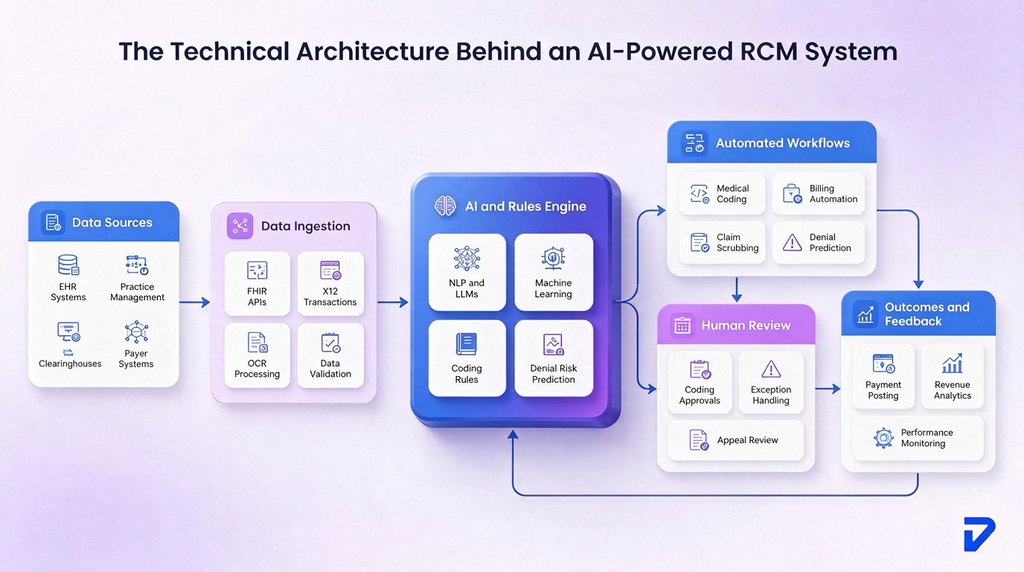
A reliable AI-powered RCM system connects data sources, AI models, business rules, and human reviewers. Each component handles a specific task, from processing clinical records to validating claims and tracking payments. AI development services can help build this architecture around existing healthcare systems.
Data Collection From EHR and Billing Systems
The system collects patient records, clinical notes, insurance details, claims, and payment information from EHR platforms, practice management systems, and clearinghouses. A data normalization process converts information from different formats into a consistent structure for accurate processing.
The AI and Rules Engine Layer
The AI and rules engine layer processes collected information and supports different RCM tasks. Each component has a specific responsibility:
- NLP and LLMs: Extract clinical information, summarize records, and assist with appeal drafting.
- Machine Learning: Predict denial risks, identify billing patterns, and score claims.
- Rules Engines: Validate medical codes and apply payer-specific billing requirements.
- OCR and Document Intelligence: Extract information from scanned forms, insurance cards, and supporting documents.
- Workflow Orchestration: Route tasks, manage exceptions, and track claim status.
EHR and Payer Integration Through APIs
Healthcare systems use HL7 FHIR and X12 standards to exchange patient, insurance, and claims information. FHIR supports API-based data exchange, while X12 handles transactions such as eligibility checks, claim submissions, and payment remittances. AI integration services help connect these interfaces with existing healthcare platforms.
Human-in-the-Loop Review and Auditability
Human reviewers remain essential for medical coding, clinical documentation, and financial approvals. AI can flag errors, suggest corrections, and route uncertain cases to certified medical coders. Maintaining records of AI recommendations, corrections, and approval decisions also supports auditing, compliance, and ongoing model evaluation.
7. Where AI Should Stop and Human Oversight Should Begin
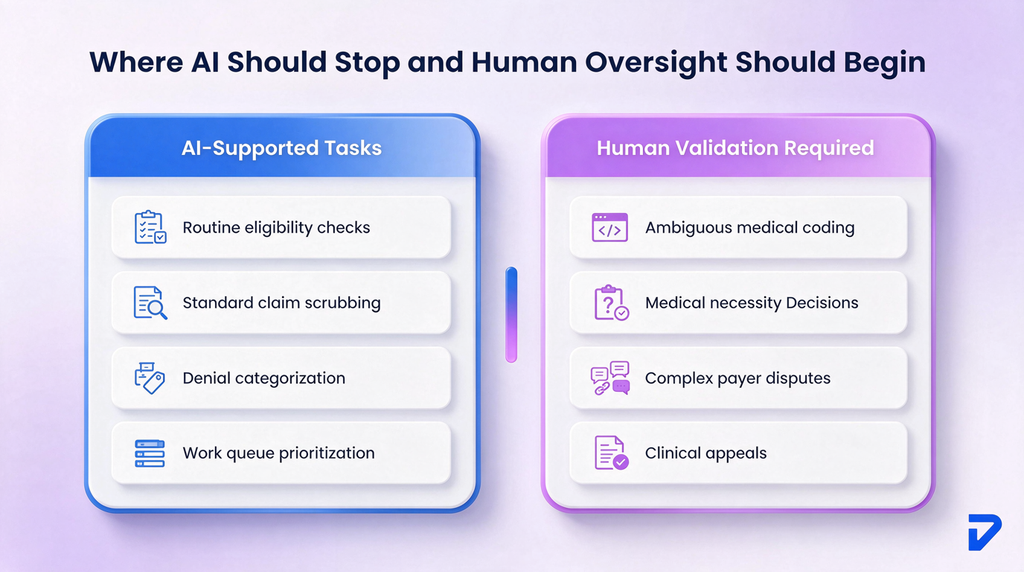
Fully autonomous workflows are not the right goal everywhere, and AI in revenue cycle management shows the limit fastest in coding. The table below shows who decides what across the claim lifecycle.
| Claim stage | AI decides | Rules decide | Humans approve |
| Eligibility | Reads responses, flags mismatches | Coverage active or inactive | Complex coordination of benefits |
| Coding | Proposes candidate codes | Code validity and edits | Ambiguous or conflicting documentation |
| Scrubbing | Ranks flagged claims by risk | Payer edits pass or fail | Sensitive billing exceptions |
| Denials | Categorizes and drafts appeals | Filing deadlines | Medical necessity and clinical appeals |
Tasks AI Can Handle With Limited Human Intervention
Routine eligibility checks, data extraction and classification, standard claim scrubbing, claim status monitoring, denial categorization, and work queue prioritization fit this group. Each has clear inputs, measurable outputs, and low clinical risk. Even so, sampling a small share of results each week catches drift before it spreads. A weekly sample is cheap insurance.
Tasks That Require Human Validation
Ambiguous coding, conflicting clinical documentation, medical necessity assessments, complex payer disputes, appeals involving clinical judgment, and sensitive billing exceptions all need a qualified person. A wrong call is costly, because errors invite audits as well as denials, and the evidence takes interpretation. AI can assemble the packet and draft the summary, but a human signs off.
Why AI Medical Coding Accuracy Cannot Be Assumed
A 2025 JMIR study found that medical coding was the weakest task for the LLMs it evaluated. In zero-shot ICD-9 prediction, meaning no task-specific training, OpenAI o3 reached 45.3% and ChatGPT-4 reached 40.6%. Hallucinated codes, guideline updates, and model drift make confidence thresholds and mandatory escalation essential. Performance depends on the model, task, code set, and training data.
8. Implementing AI Without Disrupting RCM Operations
RCM automation works best as a phased upgrade, starting small and expanding based on results. AI consulting services help align implementation with staffing, payer mix, and integration needs.
1. Start With a High-Volume, Measurable RCM Workflow
Begin with repetitive tasks that consume significant staff time, such as eligibility verification, claim scrubbing, or denial categorization. Review existing billing bottlenecks to identify where automation can deliver measurable improvements.
Record baseline metrics before implementation, including processing time, denial rates, and manual touches per claim. These measurements help determine whether the AI pilot improves performance.
2. Prepare Clinical, Claims, and Payer Data
AI systems depend on accurate data to generate reliable results. Review clinical records, claims information, and payer requirements to identify missing, duplicate, or inconsistent information before implementation.
Standardize medical codes, establish data access controls, and create processes for updating payer policies. This helps maintain data quality as billing requirements change.
3. Integrate AI With Existing EHR and Billing Systems
AI should work alongside existing electronic health records (EHRs), billing platforms, clearinghouses, and payer systems. Replacing functional infrastructure can increase implementation costs and disrupt daily operations.
Start with limited integrations using available APIs and existing interfaces. Introduce automation into one workflow or department before expanding it across the organization.
4. Test Accuracy Before Expanding Automation
AI recommendations should be tested against existing manual processes before handling larger workloads. This helps identify incorrect coding suggestions, inaccurate predictions, and workflow gaps.
Compare AI-generated recommendations with staff decisions and track claim rejection rates, denial patterns, and correction requirements. Human reviewers should remain involved in sensitive coding and financial decisions.
5. Monitor Compliance, Privacy, and Model Performance
AI systems handling patient information must follow healthcare data protection requirements. The HIPAA Security Rule requires safeguards for electronic protected health information.
Healthcare providers should maintain access controls, audit logs, and appropriate vendor agreements. Regularly monitor model accuracy and update systems as payer policies, medical codes, and compliance requirements change.
9. Measuring the ROI of AI-Powered Revenue Cycle Automation
Judge RCM automation by your own workflow costs, not a universal percentage. Recovery is an obvious place to look: only 30% of providers recover most of their denied revenue, according to Experian’s 2026 survey.
Financial Metrics to Track
Track net collection rate, cost to collect, days in accounts receivable (A/R), first-pass claim acceptance rate, denial rate, denial recovery rate, and net revenue leakage. Together they show whether cash arrives faster, costs fall, and fewer dollars slip away. A higher first-pass acceptance rate paired with a lower cost to collect is the clearest sign the automation is working.
Operational Metrics to Track
Operational metrics explain why the financial numbers moved. Watch medical coding turnaround time, manual touches per claim, eligibility verification time, prior authorization turnaround, appeal preparation time, and claims processed per employee. If touches per claim fall but turnaround does not, a human approval step may be the bottleneck, and thresholds need review.
Build an ROI Model Around Actual Workflow Costs
Benefits include labor hours saved, reduced claim rework, recovered denial revenue, and lower administrative costs. Costs include AI software, integration, maintenance, and oversight. Label every assumption, and keep recovered revenue, cash-flow acceleration, and cost savings separate so nothing is counted twice.
10. What’s Next for AI in Revenue Cycle Management?
Three developments could reshape RCM operations: agentic AI, predictive revenue intelligence, and better data interoperability. Agentic AI can coordinate multi-step workflows, including eligibility checks, authorization tracking, claim preparation, and follow-ups. These systems work through existing APIs and workflow platforms, while human approval remains essential for financial and clinical decisions. Agentic AI solutions can help connect these tasks into more coordinated processes.
Predictive revenue intelligence will also help providers identify reimbursement risks, detect changes in payer behavior, and forecast cash flow using historical claims and payment data. At the same time, improved interoperability will make data exchange between providers, payers, and RCM platforms more efficient. The CMS Interoperability and Prior Authorization Final Rule advances API-based data exchange, with most API requirements beginning January 1, 2027, depending on payer type. Together, these developments could make RCM operations more connected, predictive, and efficient.
The Bottom Line
AI in revenue cycle management pays off when it connects clinical documentation, coding rules, payer requirements, claims data, and human review into one reliable workflow. AI medical billing and coding, claim scrubbing, and denial prevention carry the most value. Each depends on clean data, accurate codes, interoperability, and clear approval points.
Start with one measurable workflow instead of automating the entire cycle at once. Pinnasys works as an AI engineering partner for organizations building integrated AI workflows, from architecture through production support, with human approval built in.
To find where a first workflow could fit, explore our end-to-end AI services and bring a recent denial report, so the conversation starts with real numbers.
Key Takeaways from the Article
- Certified coders should review every ambiguous or low-confidence AI coding suggestion.
- Standards like X12 and FHIR carry the data, while AI interprets and prioritizes the work.
- Predictive denial scores measure risk, so high scores should trigger review, not automatic holds.
- Fine-tuned models look promising, but a 97% lookup score is not 97% real-world coding accuracy.
- Baselines, shadow testing, and staged rollout prove value before automation expands across payers and specialties.
Frequently Asked Questions About AI in Revenue Cycle Management
How is AI used in revenue cycle management?
AI verifies eligibility, extracts clinical facts for coding, assembles prior authorization packets, scrubs claims, predicts denial risk, reads remittance advice for payment posting, and prioritizes A/R follow-up. AI for RCM works best on high-volume, measurable tasks, with staff approving sensitive decisions.
Can AI perform medical coding accurately?
Accuracy varies by model, code set, and training, so credentialed coders (CPC or CCS) should validate suggestions. AI medical coding performs best on well-documented, routine encounters and worst on ambiguous charts, where it should flag the case for review instead of guessing.
How does AI reduce medical claim denials?
Predictive scoring ranks claims by denial risk before submission. Payer-specific validation, documentation checks, and pattern analysis then remove the causes. Effective AI claim denial programs prevent errors rather than only appealing them. Teams track first-pass acceptance to confirm the effect.
Which revenue cycle management tasks should remain human-controlled?
Humans should own ambiguous coding, conflicting documentation, medical necessity decisions, and sensitive financial approvals. Denial management AI can draft appeals, but a person should sign any appeal that involves clinical judgment. Routine eligibility checks and status monitoring suit automation.
Can AI-powered RCM software integrate with existing EHR systems?
Yes. Healthcare billing automation connects through HL7 FHIR APIs, HL7 v2 interfaces, X12 transactions, and clearinghouse links, so the EHR stays in place. Legacy systems may need interface engines or file-based exchange. CMS’s 2027 API deadlines should ease connectivity.
What ROI can healthcare organizations expect from RCM automation?
No universal percentage exists. Returns depend on workflow volume, integration cost, and implementation quality. Measure cost to collect, days in A/R, denial rate, first-pass acceptance, recovered revenue, and labor savings against a baseline taken before launch.
Is AI-powered revenue cycle management HIPAA compliant?
Compliance depends on the complete implementation, not on the AI itself. Covered entities need business associate agreements with vendors, role-based access, audit logging, and minimum-necessary handling of protected health information. Using AI does not exempt any of it.