


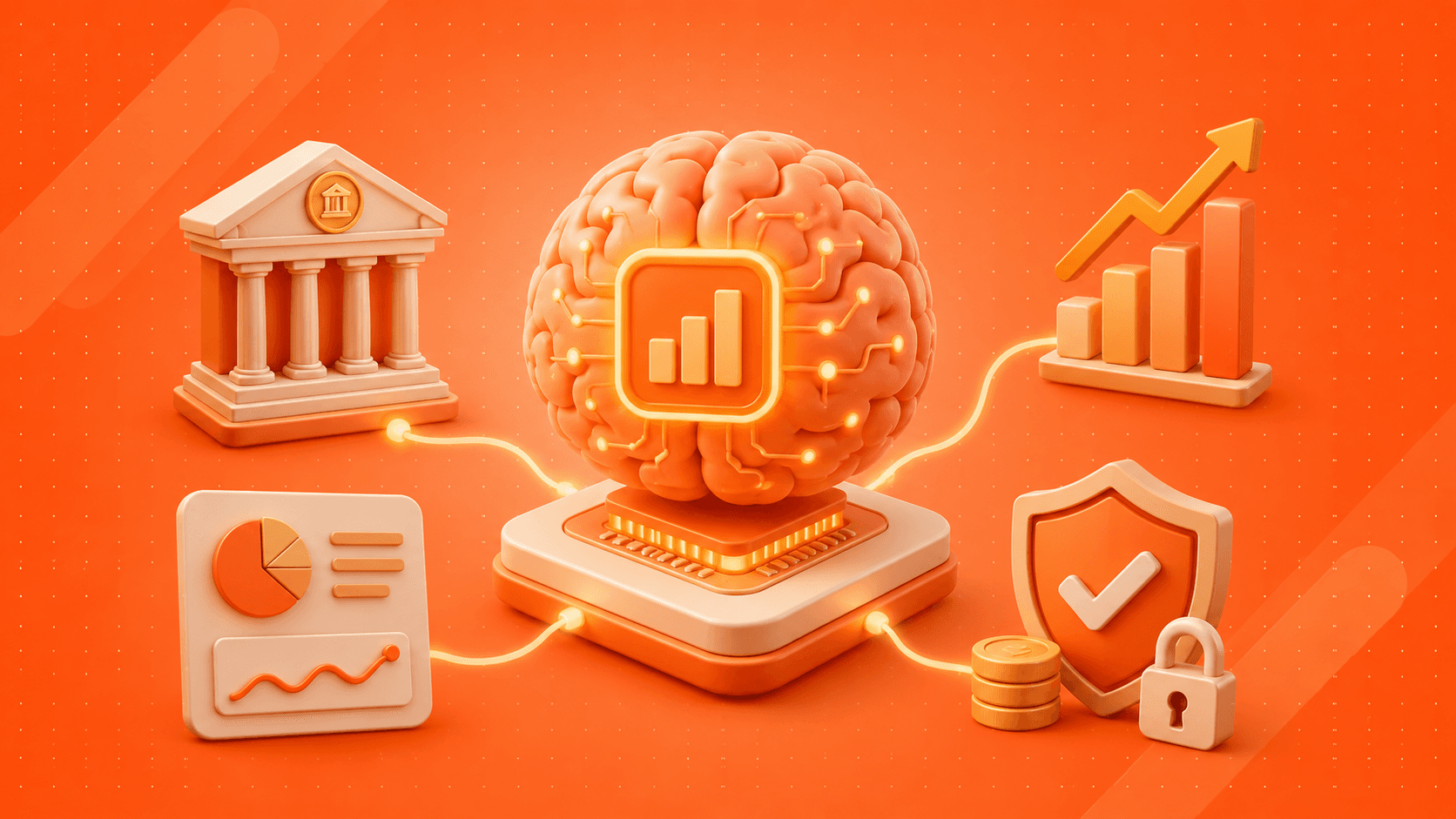
AI in finance helps organizations automate operations, detect fraud, assess risks, improve customer experiences, and strengthen regulatory compliance. Financial institutions use AI to analyze large volumes of data, identify patterns, and make faster decisions, while successful implementation depends on strong data management, security practices, and skilled teams.
Financial institutions have always depended on data to make decisions, manage risk, and serve customers. Today’s banking environment generates far more information than traditional systems were designed to handle, creating new opportunities for AI-driven automation and analysis. Fraud prevention has emerged as one of the strongest use cases for AI in finance.
Advanced systems can review thousands of transactions in seconds, spot unusual activity, and help teams respond before a minor issue turns into a costly problem. MDPI Research shows that machine learning is becoming a key tool in detecting complex financial fraud schemes.
This guide explores how AI is being used across financial services, where it delivers the most value, and what organizations should consider before moving from experimentation to implementation.
AI as a Game-Changer in Fraud Detection
Financial fraud is no longer limited to stolen cards or unauthorized transactions. Criminal networks now use sophisticated tactics that can move across multiple accounts, devices, and channels in a matter of minutes. AI offers a different approach.
Instead of fixed rules, they analyze transaction data, customer behavior, and historical trends to recognize fraudulent actions in real-time. According to the World Economic Forum, research indicates that AI is playing an increasing role in supporting financial organizations in enhancing their fraud prevention and risk management capabilities and threat response time.
Behavioral Modeling
Each customer behaves differently in their financial habits. Some customers purchase online regularly, while others use the account mainly for their regular bills and small transactions. AI studies these patterns over time and develops a clear picture of what normal activity looks like. A transaction that suddenly deviates from established behavior can trigger an alert. This allows financial institutions to identify potential fraud without disrupting legitimate customer activity.
Constant Adaptation
Fraudsters don’t stay in the same patterns for long. New methods of attack are constantly arising; traditional systems have the limitation of having to be updated frequently, which is overcome using machine learning. The machine learns from new transactions and emerging threats, making detection models more effective over time without constant manual updates, giving you peace of mind.
Network-Level Visibility
A single transaction rarely tells the whole story. Many fraud schemes involve connected accounts, shared devices, unusual login locations, or coordinated activity across multiple channels. AI helps uncover these hidden connections by analyzing relationships across large datasets. This broader perspective allows institutions to identify patterns that might remain invisible when transactions are reviewed individually.
Real-Time Decisions
Timing can determine whether a suspicious transaction becomes a minor incident or a costly fraud case. Waiting hours to review an alert is often no longer an option. AI analyzes transactions as they happen and evaluates potential risks within seconds. Financial institutions can respond immediately, reducing losses and protecting customer accounts before fraudulent activity escalates.
Scalability and Cost-Effectiveness
With increasing digital banking, online payments, and m-commerce, the volume of transactions is also constantly increasing. It is impractical to analyze each transaction on an individual basis manually, due to time and resource constraints. AI enables this monitoring on a massive scale without increasing the number of fraud investigators proportionally. A fraud investigation team can focus its efforts on cases that pose the highest risks, while regular monitoring continues in the background.
8 Best Use Cases of AI in Finance
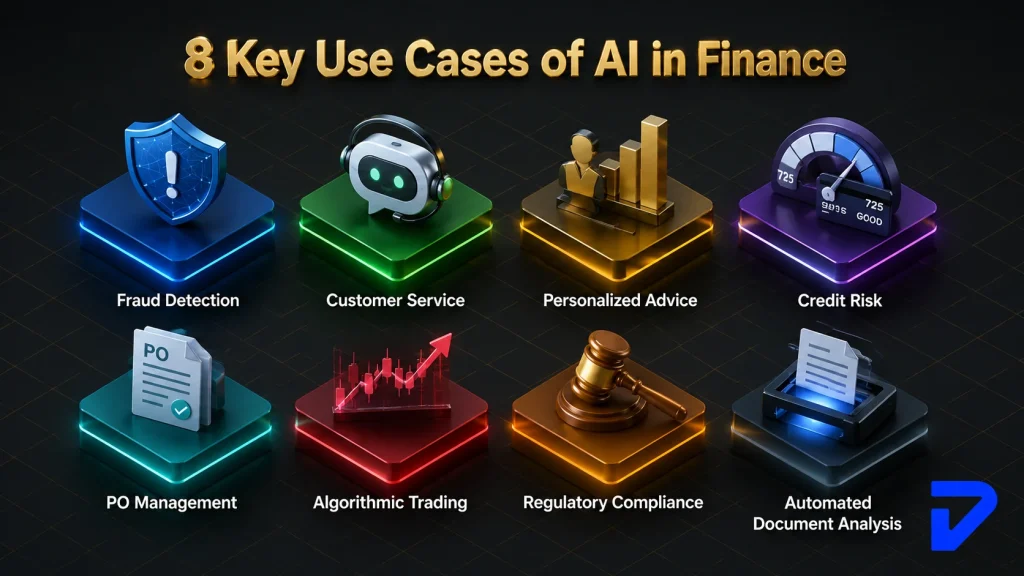
Fraud Detection & Prevention
The detection of fraud is a common use case for AI in the financial sector. Systems can review transactions, customer behavior, device behavior, and spending habits to identify fraud instantly. Since machine learning can adapt better to emerging fraud techniques than static rule-based systems, it enables institutions to avoid financial losses and enhances the security of their customers.
Customer Service Automation
Banks and financial institutions use AI-powered chatbots and virtual assistants to handle routine customer inquiries, account requests, and service issues. Customers receive faster responses without waiting for human agents, while support teams can focus on more complex cases. This improves service quality and helps organizations operate more efficiently.
Personalized Financial Advice
AI can allow a financial institution to give highly personalized advice and recommendations by analyzing their spending patterns, financial aspirations, risk appetite, and investment choices. Highly personalized advice gives the customer a feeling of understanding, helps them make educated choices, and gives them more valuable and personalized banking interactions.
Credit Risk Assessment
For the conventional method of credit scoring, financial data tends to be rather restricted. AI takes a step further than that and analyzes much more extensive data sets, ranging from transaction history, repayment patterns, and overall financial trends, which aids lenders in making accurate lending decisions.
Purchase Order Management
Managing purchase orders can be time-consuming, especially for organizations handling large transaction volumes. AI automates purchase order tracking, approval workflows, invoice matching, and balance calculations. Faster processing reduces administrative effort and improves financial visibility across procurement operations.
Algorithmic Trading
Investment firms use AI to analyze market data, identify trading opportunities, and execute trades at optimal times. AI models can process vast amounts of information much faster than human analysts, helping traders react to market changes with greater speed and precision.
Regulatory Compliance
Regulated financial institutions are subject to stringent requirements. AI assists in maintaining compliance with its functions, including transaction monitoring, anomaly detection, alert generation, and reporting support. Automation of compliance processes lowers the burden on personnel.
Automated Document Analysis
Financial teams process large volumes of contracts, invoices, statements, loan applications, and compliance documents. AI can extract key information, classify documents, identify anomalies, and summarize content automatically. Faster document processing improves accuracy and allows employees to focus on higher-value tasks.
Real-World Case Studies on Fintech AI Solutions
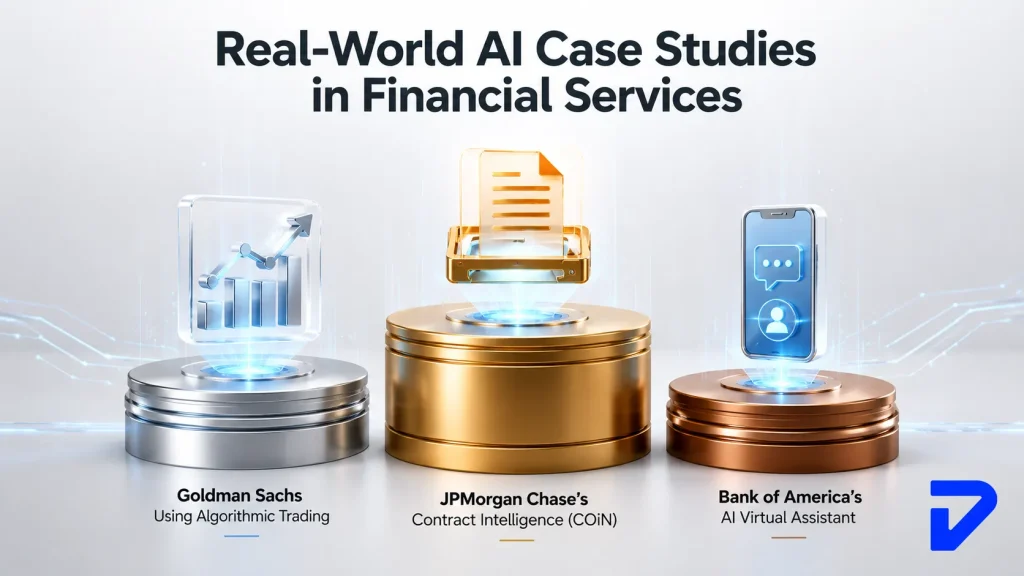
AI adoption in financial services is no longer limited to pilot projects or innovation labs. These examples show how AI is creating value across different areas of the financial sector.
JPMorgan Chase’s Contract Intelligence (COiN)
Reviewing commercial loan agreements and legal contracts had always been a time-consuming affair for banks and financial institutions. JPMorgan Chase launched an AI platform called COiN to solve this problem. It allows the AI system to instantly review dense legal documents and pinpoint the key data points.
Goldman Sachs Using Algorithmic Trading
Financial markets generate enormous amounts of data every second, making it difficult for traders to evaluate every opportunity manually. Goldman Sachs uses AI and advanced analytics to support algorithmic trading strategies that can process information at a much larger scale. AI models analyze market movements, historical trends, and trading signals to identify patterns that may influence investment decisions.
Bank of America’s AI Virtual Assistant
Recent years have seen a dramatic change in the way customers want to be dealt with, and Bank of America’s answer is Erica, their AI virtual financial assistant. The assistant is used to view accounts, monitor spending, get reminders on bills, and give customized financial advice using the method of natural dialogue.
AI Technologies Transforming Financial Services
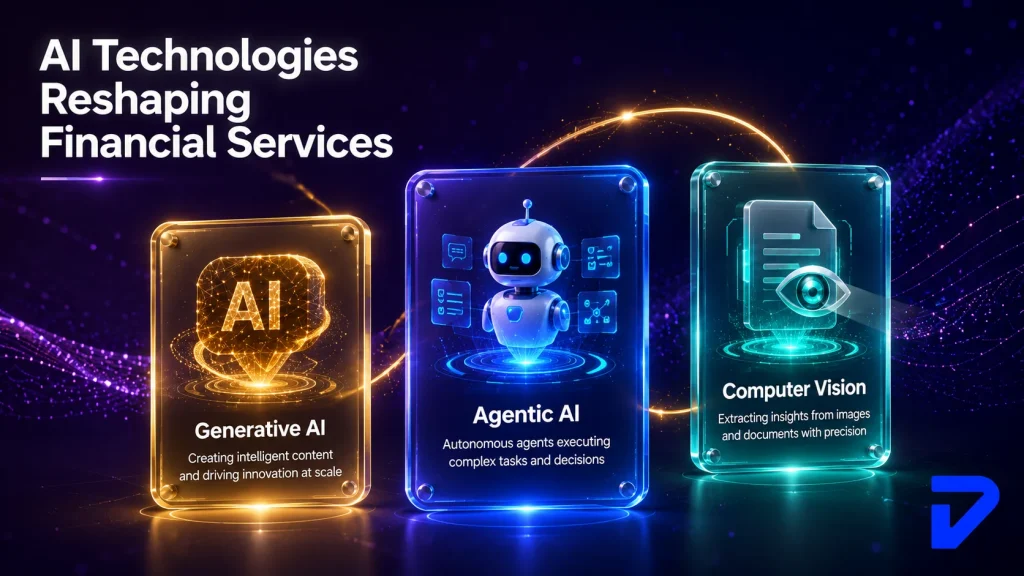
Generative AI
Content creation, report summarization, generation of insights, and customer service interaction have all been supported with Generative AI in financial institutions. Vast amounts of financial data can be digested quickly, and replies are provided consistently and swiftly.
The areas banks are utilizing generative AI for have included research, document creation, reporting on compliance issues, and customer communication. Quicker access to information enables more informed decision-making, along with operational efficiencies.
Agentic AI
An Agentic AI is capable of performing tasks, making decisions, and taking action with minimal human assistance. They are able to manage workflows, analyze financial activities, and react to changing situations based on their defined goals.
Financial institutions are investigating the use of agentic AI for the automation of processes like risk surveillance, fraud detection, and the management of customer service. With greater automation, teams can concentrate on more strategic tasks.
Computer Vision
Computer vision enables AI systems to analyze and interpret visual information such as scanned documents, identity cards, invoices, and financial records. This technology helps organizations process data that would otherwise require manual review.
Several banks employ computer vision for customer onboarding, document verification, and fraud prevention activities. Quicker verification increases customer satisfaction and lowers operational costs.
How to Implement AI in Finance and Financial Services?
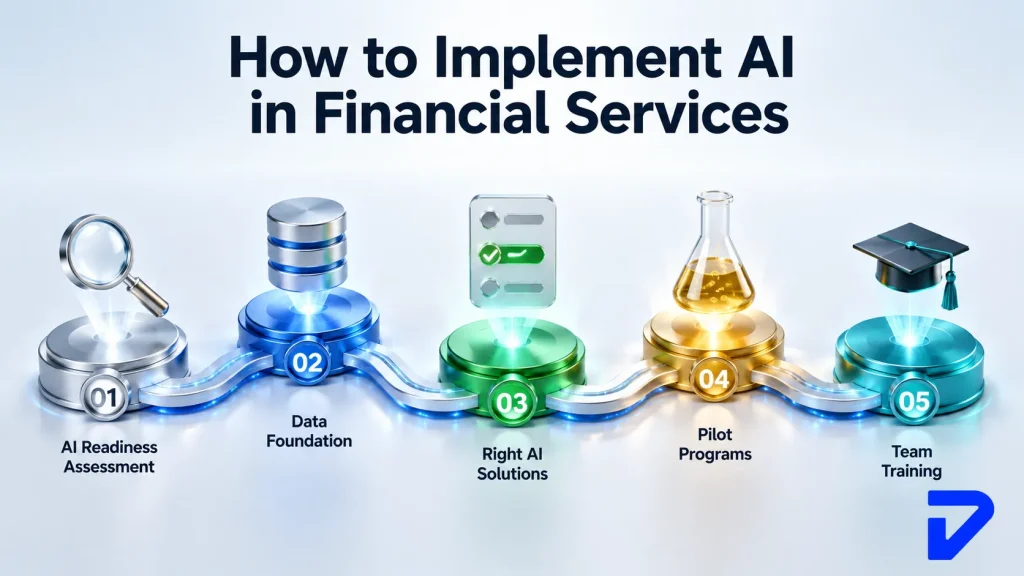
AI Readiness Assessment
The AI readiness assessment is an evaluation of a company’s data maturity, technological environment, and business goals before the implementation of any AI project. The aim is to reveal any possible deficiencies or strengths in the business context. The AI readiness assessment framework can guide companies towards the successful implementation of AI solutions and minimize possible problems.
Build a Strong Data Foundation
AI models require quality data inputs in order to develop relevant insights and accurate forecasts. Financial services organizations must take steps to improve their accuracy, completeness, governance, and integration capabilities. An adequate data framework supports the performance of AI models and ultimately yields improved business outcomes.
Select the Right AI Solutions & Experts
Choosing the right technology partner is critical to successful implementation. Organizations should look for AI solutions that align with their business objectives, compliance requirements, and scalability needs. Experienced partners such as Pinnasys can help financial institutions identify high-value use cases, develop implementation roadmaps, and accelerate AI adoption with confidence.
Execute Pilot Programs
With pilot projects, businesses can confirm AI applications are working as they expect prior to rolling them out organization-wide. The short-term tests measure performance and help surface risks and identify the areas where the feedback of key stakeholders will be most valuable in helping to make investment decisions.
Empower Teams Through AI Training
Employees require the skills and assurance to interact with AI systems. Training plans will allow individuals to understand how an AI operates, extract value from the analysis, and also change workflows. Successful user adoption of the AI solution will ultimately determine its long-term success.
Ready to unlock the full potential of AI in finance?
Learn how Pinnasys can support you in adopting secure, scalable AI solutions to enhance efficiency, improve fraud detection, and achieve smarter decision-making.
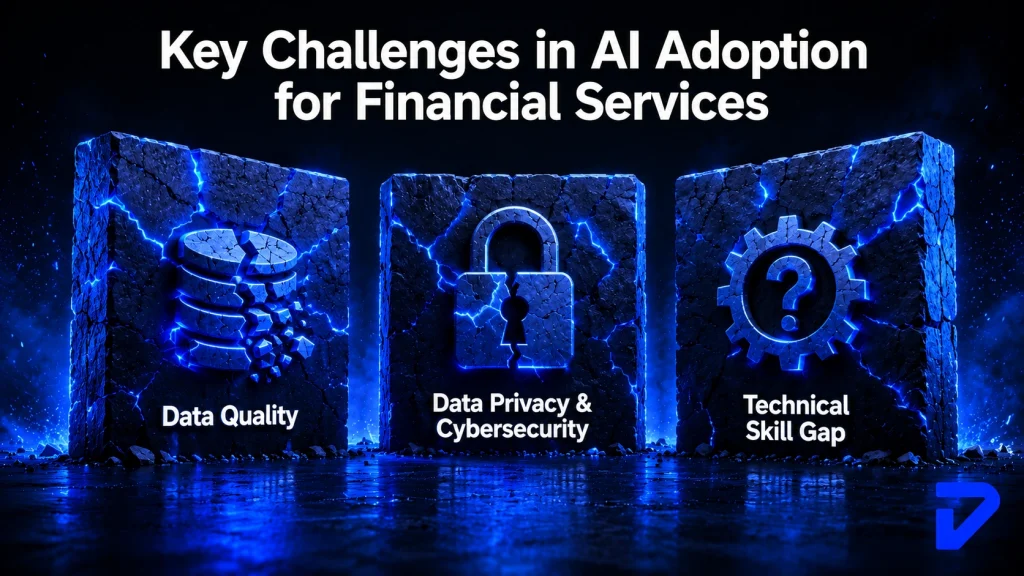
Challenges Faced by Fintech Companies While Implementing AI in Finance
Lack of Data Quality & Availability
AI models are only as effective as the data they receive. Many financial institutions struggle with incomplete records, siloed systems, and inconsistent data formats, making it difficult to generate accurate insights. Poor-quality data can reduce model performance and limit the value of AI investments.
A report from McKinsey & Company highlights that data-related challenges remain one of the biggest barriers to successful AI adoption. Organizations that invest in data governance and quality management are better positioned to achieve reliable outcomes from AI initiatives.
Data Privacy & Cyber Security
Due to the extreme sensitivity of the data they handle regarding customer information and transactions, the issue of security and privacy remains the top concern for financial institutions. Organizations such as banks must adhere to data protection regulations like GDPR.
A recent IBM Security study shows the extent of damage, both financial and reputational, from a data breach. Through proper encryption, authentication, access controls, and monitoring, organizations can mitigate such security threats.
Technical Skill Gap
Expertise in data science, machine learning, cloud services, and financial operations skills is necessary for AI implementation. The main problem that many fintech businesses encounter is the ability to attract and keep talented individuals to develop, implement, and manage AI systems.
The World Economic Forum’s report shows that AI and data-related skills are some of the fastest-growing skill demands in the industry. The training of staff, as well as strategic partnerships, allows the companies to shorten the skill gap and embrace AI.
The Bottom Line
In financial services, AI has come way past the experimentation stage. What was first a technology to automate mundane back-office functions is now used by organizations for better and quicker fraud detection, more precise risk analysis, and smarter decision-making across the business.
At Pinnasys, we have seen that successful AI projects are rarely driven by technology alone. Clear business goals, reliable data, and a practical implementation strategy often make the biggest difference. The right approach can help financial organizations turn AI from a promising idea into measurable business value.
Key Takeaways
- AI helps financial institutions detect fraud faster, improve risk management, and streamline daily operations.
- Technologies such as generative AI, agentic AI, and computer vision are driving innovation across financial services.
- Strong data quality, skilled teams, and a clear implementation strategy are essential for successful AI adoption.
- Organizations that embrace AI can improve efficiency, strengthen compliance, and gain a competitive advantage.
Frequently Asked Questions About AI in Finance
What’s the difference between AI and traditional automation like RPA in finance?
Traditional automation, such as Robotic Process Automation (RPA), follows predefined rules to complete repetitive tasks. AI goes a step further by learning from data, identifying patterns, and making predictions. This allows AI to handle complex financial processes such as fraud detection, risk assessment, and personalized customer interactions.
How does AI detect fraud in banking?
AI detects fraud by analyzing transaction data, customer behavior, device activity, and account patterns in real time. Machine learning models can identify unusual activity that may indicate fraud and continuously adapt as new threats emerge. This helps banks respond faster while reducing false positives and financial losses.
What regulations govern the use of AI in financial services?
Financial institutions must comply with regulations related to data privacy, consumer protection, anti-money laundering (AML), and financial reporting. Requirements may vary by region, but organizations are expected to maintain transparency, data security, fairness, and accountability when deploying AI-driven systems in financial operations.
How do companies measure the ROI of AI in finance?
Organizations measure AI ROI by tracking improvements in operational efficiency, fraud detection rates, cost savings, compliance performance, and customer satisfaction. Many companies also evaluate reductions in manual workloads and processing times to determine whether AI investments are delivering measurable business value.
How do financial institutions prevent bias in AI credit and lending decisions?
Financial institutions reduce bias by using diverse datasets, regularly testing AI models, and monitoring lending outcomes for fairness. Strong governance practices and human oversight help identify potential issues before they affect decision-making. Continuous audits also ensure AI systems remain transparent, accurate, and compliant with regulations.





Prakash C. Saini
Prakash Saini is the Founder & CEO of Pinnasys. With over a decade in digital transformation and building production systems, he grew an engineering team from 2 to 50 people and has led the delivery of 100+ production digital systems. Products built under his leadership have raised millions in funding and generated over $50 million in revenue. He holds an Executive MBA from IIM Kozhikode and today leads the AI engineering team at Pinnasys.