


AI contract review cuts review time by up to 76% by automating clause extraction, risk flagging, and data entry. Legal teams process more contracts with fewer errors and no additional headcount.
Manual contract review is one of the most resource-intensive responsibilities in any legal department. According to McKinsey, generative AI could automate up to 23% of a lawyer’s work, much of it involving document review, contract analysis, and other repetitive legal tasks. Rather than replacing legal expertise, AI accelerates the first-pass review so lawyers can focus on negotiation, strategy, and risk.
This blog explains how AI contract review automation works, what it delivers in practice, and what legal and operations teams need to know before adopting it.
What Happens When AI Reviews a Contract?
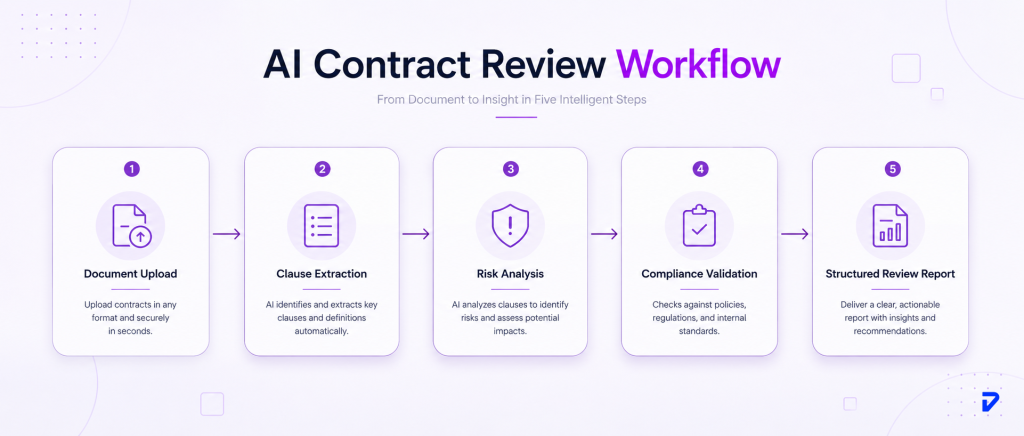
AI contract review is not a single feature. It is a pipeline of tasks, clause extraction, risk identification, data capture, and comparison, that previously required a lawyer to do line by line.
When a contract is uploaded, the AI uses natural language processing to parse the document and identify known clause types: indemnification, limitation of liability, termination, governing law, IP ownership, and others. It checks each clause against a prebuilt or custom playbook that encodes your preferred language and fallback positions. Clauses that fall outside those standards are flagged with a priority rating. Missing clauses trigger an alert. Non-standard terms get a redline.
The output is a structured review report in minutes, not a summary for a partner to read two days later.
Research has confirmed that manual review averaged 92 minutes per contract. With AI first-pass assistance, the same contracts averaged 22 minutes. That is a 76% reduction for standard commercial agreements, before accounting for the additional hours saved on data entry, tracking, and version control.
The Role of Machine Learning in Getting Better Over Time
The AI does not stop at pattern matching. Machine learning systems learn from the feedback legal teams provide when they correct a flag, accept a redline, or override a clause call. Similar to other AI in finance applications, the model improves over time by learning from real-world decisions and feedback. Over time, it calibrates to your contract portfolio, risk tolerance, and preferred language. Most organizations report that accuracy rates above 90% require two to three months of feedback-based refinement. After that, the system becomes a consistent reviewer that performs reliably, even across high contract volumes.
Manual Review vs. AI-Assisted Review: How the Numbers Compare
The gap between manual and AI-assisted contract review is not marginal. It is structural. Manual review depends on a finite number of experienced reviewers working in sequence. AI review scales horizontally; more contracts do not mean more people.
| Aspect | Manual Review | AI-Assisted Review |
| Time per standard contract | ~92 minutes | ~22 minutes |
| Clause identification accuracy | ~80% (drops under time pressure) | 94–97% on standard clauses |
| Scales with volume | No, needs more headcount | Yes, handles volume spikes |
| Consistency across reviewers | Variable | Consistent against a fixed playbook |
| Data extraction to CLM | Manual re-entry | Automated population |
| Language coverage | Limited by team languages | Multi-language capable |
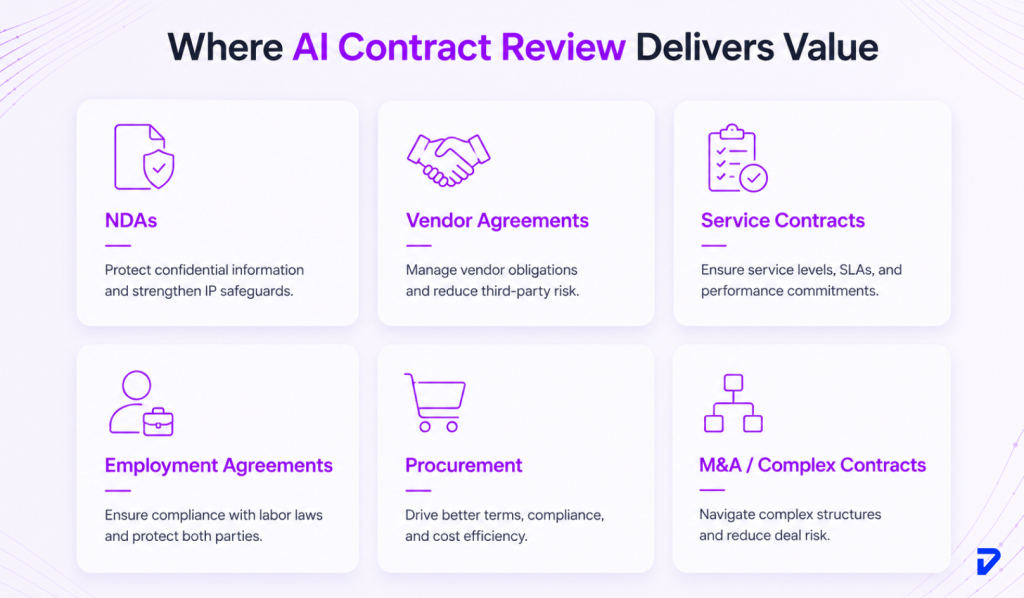
AI contract review delivers the greatest value on high-volume contract types such as NDAs, vendor agreements, and service contracts, where the same clauses appear repeatedly. By automating routine clause identification and risk flagging, legal teams can review contracts more consistently while focusing their time on negotiation and complex legal judgment.
The cost picture is just as stark. Deloitte’s analysis found that contract inefficiencies erode up to 9% of total contract value across organizations. AI contract management solutions deliver roughly one-third cost reductions compared to traditional manual processes.
Where AI Contract Review Delivers the Most Value
AI contract review is not equally effective across every contract type. Understanding where it delivers the greatest value helps legal teams prioritize the right workflows and maximize the return on AI adoption.
High-Volume, Standardized Contracts
NDAs, vendor agreements, and service agreements deliver the quickest value because they follow predictable structures. AI reviews recurring clauses consistently, flags deviations, and reduces repetitive manual work for legal teams.
Moderately Complex Commercial Agreements
Licensing agreements, SaaS contracts, and master service agreements benefit from AI-assisted clause analysis and risk identification. Lawyers can spend less time reviewing routine language and more time negotiating business-specific terms and legal strategy.
Employment and HR Agreements
Employment contracts, offer letters, and contractor agreements often follow standardized templates, making them ideal for AI-powered review. AI helps legal and HR teams validate policies, identify missing clauses, and improve review consistency.
Procurement and Supplier Contracts
Supplier agreements contain recurring commercial terms that AI can review consistently across large contract volumes. Thomson Reuters’ 2024 Future of Professionals Report found that legal professionals expect AI to improve productivity by reducing time spent on routine legal work.
Complex Bespoke Transactions
M&A agreements, strategic partnerships, and highly negotiated contracts still benefit from AI during due diligence, document comparison, and clause extraction. However, experienced lawyers remain essential for legal judgment, negotiation, and managing complex commercial risks.
Is your legal team still spending 90 minutes per contract on standard reviews?
Pinnasys builds AI document intelligence systems that flag risks, extract data, and free your lawyers to focus on strategic work — not repetitive clause checks.
How AI Improves Accuracy (and Where Human Review Still Matters)
Speed is the headline. Accuracy is the more durable advantage.
AI improves contract review by applying the same review standards to every document. It consistently identifies missing clauses, highlights non-standard language, and flags potential risks based on predefined playbooks. This reduces manual oversight and helps legal teams maintain greater consistency across high volumes of contracts.
AI does not get tired. It does not have a different reading of “reasonable endeavours” on a Friday afternoon than on a Monday morning. Every contract is reviewed against the same playbook, every time. That consistency is something a team of human reviewers cannot replicate at volume.
That said, accuracy has clear boundaries. AI clause identification runs at 94 to 97% on standard contract types. On complex or bespoke agreements with novel structures, accuracy drops. AI misses context that an experienced lawyer reads between the lines: what this clause means given the counterparty’s behaviour last year, or how a court is likely to interpret this term in your jurisdiction. Human review stays essential for:
- Contracts with non-standard or highly negotiated structures
- High-value transactions where a missed clause carries significant financial or legal risk
- Jurisdictions with nuanced local law requirements
- Any contract where the business context is as important as the language
The right operating model is not AI instead of lawyers. It is AI on first-pass, lawyers on review and exception handling. That model is how most successful implementations work in practice.
What a Good AI Contract Review Implementation Looks Like
Most legal teams do not struggle to decide whether AI contract review is worth it. They struggle with how to implement it without spending six months in configuration and another six months fixing what the tool got wrong.
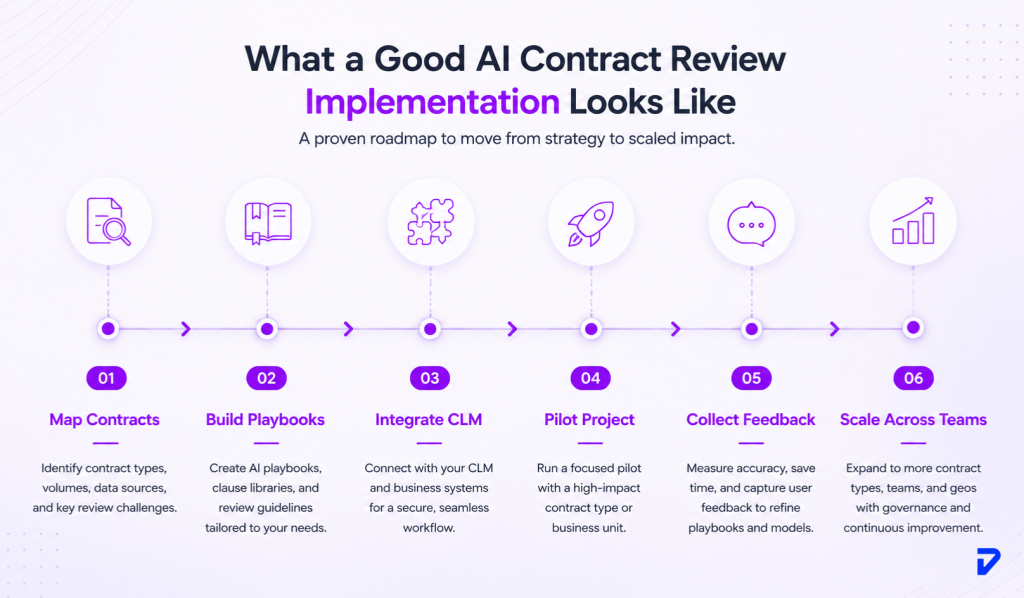
A production-grade implementation follows a clear sequence:
- Map your contract types. Start with your highest-volume, most standardized agreements, NDAs, vendor MSAs, and SOW templates. These deliver the fastest return and generate the training data the model needs.
- Build or adopt playbooks. Playbooks are the rulebook the AI reviews every contract against. If your team lacks formal playbooks, start with attorney-vetted pre-built templates for your contract types and refine from there.
- Integrate with your CLM. AI-extracted data should flow directly into your contract lifecycle management system. Manual re-entry defeats much of the point. Legal teams currently spend over 30% of their time searching contracts at $300 to $500 per hour; automated CLM population cuts that sharply.
- Run a focused pilot. Process 50 to 100 real contracts, compare AI output against manual review, and calibrate the model before scaling. This is where most of the accuracy refinement happens.
- Establish a feedback loop. Every correction your lawyers make, accepted redlines, overridden flags, corrected clause calls, feeds back into the model. Without this, the system does not improve.
- Scale to secondary contract types. Once the model is calibrated on your core contract types, extend to moderately complex agreements where the accuracy and time savings are still substantial.
McKinsey’s legal operations analysis confirms that AI can automate roughly 23% of a lawyer’s total work. Contract review, data extraction, and first-pass due diligence account for the bulk of that. The lawyers who implement AI effectively do not lose work. They redirect it toward the higher-value tasks where human judgment is genuinely irreplaceable.
The Bottom Line
AI contract review is no longer experimental. Industry benchmarks and real-world production deployments consistently show that legal teams using AI for first-pass contract review process more contracts, reduce errors, and free lawyers to focus on higher-value work. The question is no longer whether to adopt AI contract review. It is how to implement it so it delivers reliable results in production, not just in a demo.
Pinnasys builds and runs AI document intelligence systems for mid-market legal and operations teams: systems calibrated to your contract types, your playbooks, and your CLM, not generic tools shipped with a licence key and a handshake. If your team is spending lawyer hours on clause checks that a well-built AI system should handle, book a discovery call and we will map out where the time is actually going.
Key Takeaways from the Article
- AI contract review automates clause extraction, risk detection, and data capture, reducing first-pass review time by up to 76% while improving consistency.
- Instead of replacing lawyers, AI handles repetitive review tasks, allowing legal teams to focus on negotiation, legal strategy, and complex risk assessment.
- Machine learning continuously improves review accuracy through lawyer feedback, enabling the system to adapt to an organization’s contract portfolio and preferred language over time.
- AI delivers the greatest value for high-volume, standardized contracts, including NDAs, vendor agreements, service contracts, and employment agreements, where repetitive clause review is common.
- The most successful implementations combine AI-powered first-pass reviews with human legal oversight, supported by clear playbooks, CLM integration, pilot testing, and continuous feedback for reliable production-scale results.
Frequently Asked Questions
How does AI contract review work?
AI contract review uses natural language processing to identify clauses, compare them against predefined playbooks, and automatically flag missing, risky, or non-standard terms. It generates structured review reports within minutes.
Can AI contract review replace lawyers?
No. AI automates repetitive tasks like clause identification, risk flagging, and data extraction. Lawyers remain essential for negotiations, complex agreements, legal interpretation, and decisions requiring business context and professional judgment.
How accurate is AI at reviewing contracts?
AI achieves 94% to 97% accuracy on standard contract clauses. Accuracy is lower for complex or highly negotiated agreements, making human review essential for legal judgment and final approval.
How long does it take to implement AI contract review?
Most organizations can launch a pilot within weeks and achieve 90%+ accuracy after two to three months of refinement. Full CLM integration typically takes one to three months.
What contracts benefit most from AI review?
High-volume contracts like NDAs, vendor agreements, and service agreements deliver the greatest time savings. AI also accelerates commercial contracts and supports faster analysis of complex, highly negotiated agreements.
Does AI contract review work across multiple languages?
Yes. Modern AI contract review platforms support multiple languages, helping organizations manage global contracts. Accuracy depends on the language, contract type, and the quality of the model’s training data.





Prakash C. Saini
Prakash Saini is the Founder & CEO of Pinnasys. With over a decade in digital transformation and building production systems, he grew an engineering team from 2 to 50 people and has led the delivery of 100+ production digital systems. Products built under his leadership have raised millions in funding and generated over $50 million in revenue. He holds an Executive MBA from IIM Kozhikode and today leads the AI engineering team at Pinnasys.