
For a mid-market company, AI consulting costs can vary significantly based on your business goals, existing AI maturity, project scope, and implementation complexity. The budget typically depends on whether you need strategy, use-case development, AI integration, or end-to-end implementation.
Introduction
The question most mid-market operators ask first is the wrong one. “How much does AI consulting cost?” is useful only after a more important question: “What problem are we actually trying to solve?” The global AI consulting services market was valued at $11.07 billion in 2025, according to Future Market Insights, reflecting the growing demand for AI strategy, implementation, and advisory services.
A focused readiness assessment might cost $15,000, while a multi-function AI strategy roadmap with integration planning can run $250,000 or more. The difference is not simply about quality or seniority. Scope, organizational readiness, technical complexity, data requirements, and the number of business problems covered can significantly change the final cost.
This guide is for finance, operations, and IT leaders at mid-market companies in the $50M to $500M revenue range. The goal is to understand what actually drives AI consulting costs before requesting vendor quotes.
What Does AI Consulting Cost for a Mid-Market Company?
AI consulting can cost $15,000 to $500,000+, depending on scope, complexity, and implementation needs. Deloitte found that 66% of organizations reported productivity and efficiency gains from AI, making it important to align consulting spend with specific business outcomes.
That spread reflects how differently firms define the same words. “AI consulting” can mean a four-week assessment from one firm and a six-month transformation program from another. The table below maps the most common engagement types to realistic price ranges:
| Engagement Type | Typical Duration | Price Range (US, 2026) | What It Covers |
| AI readiness assessment | 3 to 6 weeks | $15,000 to $60,000 | Data, talent, process, governance gaps |
| AI strategy roadmap | 6 to 12 weeks | $50,000 to $150,000 | Use-case identification, prioritization, phased roadmap |
| Single use-case pilot with consulting support | 2 to 4 months | $40,000 to $150,000 | One workflow from discovery to proof of concept |
| Multi-function AI transformation | 4 to 9 months | $150,000 to $500,000+ | Multiple use cases, systems integration, governance |
| Ongoing AI advisory retainer | Monthly | $5,000 to $25,000/month | Iteration, optimization, governance oversight |
For mid-market companies, boutique AI firms often charge $10,000–$150,000, while global strategy firms can start in the mid-six figures, depending on scope.
Why Company Size Is a Weak Predictor of Consulting Cost
Project scope usually has a greater effect on consulting cost than revenue alone. A $200 million distributor running one focused inventory forecasting pilot may require less consulting support than an $80 million manufacturer evaluating AI for customer service, procurement, and quality inspection.
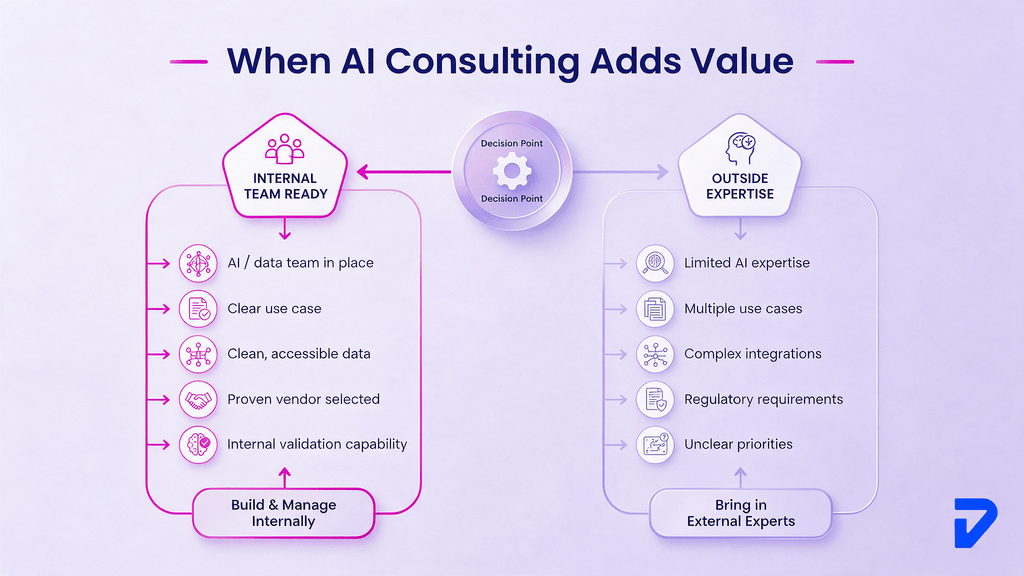
The key cost drivers are the number of use cases, technical complexity, data readiness, integration requirements, governance needs, and implementation depth. Company size provides context, but it does not determine the consulting budget by itself.
What Factors Determine AI Consulting Cost Mid-Market Companies Should Expect?
Several factors can move AI consulting costs up or down for mid-market companies. Understanding them before requesting proposals helps separate necessary scope from avoidable complexity.
AI Maturity at the Start of the Engagement
Companies with limited AI capabilities usually need more foundational work. BCG found that only 26% of companies had developed the capabilities to scale AI beyond proofs of concept, making readiness, data, and governance important parts of many consulting engagements.
Number and Complexity of Use Cases
A single workflow requires less consulting than a multi-function AI program. McKinsey found that 44% of surveyed CFOs used generative AI across more than five use cases in 2025, up from 7% the previous year. More use cases generally mean more discovery and prioritization work.
Data and Infrastructure Readiness
Data quality, integration architecture, security, and existing infrastructure can significantly affect project scope. Companies with fragmented systems may need additional consulting before AI implementation begins, increasing both the timeline and overall engagement cost.
Governance and Compliance Requirements
AI projects involving customer data, financial information, or regulated processes require additional governance. This can include privacy controls, model monitoring, human oversight, and risk documentation, all of which add consulting requirements beyond the core AI solution.
Integration Depth
Integration can significantly expand the scope of an AI project. Connecting an AI tool to an existing ERP or CRM requires less work than embedding AI across multiple operational systems, automating workflows, and enabling data to move between applications.
Expected Business Outcome
The desired outcome also affects consulting scope. PwC found that the top 20% of companies captured 74% of AI-driven returns, with the most AI-fit companies achieving 7.2 times higher AI-driven financial performance than others. Clear business objectives help define where consulting effort should be concentrated.
Where should your AI budget go first?
Pinnasys can help you assess opportunities, prioritize use cases, and plan the right engagement.
How Much Does an AI Strategy Roadmap Typically Cost?
An AI strategy roadmap typically costs $50,000 to $150,000 for a mid-market company and runs six to twelve weeks. A structured engagement usually covers use-case prioritization, feasibility analysis, implementation planning, resource requirements, and governance requirements before development begins.
Strategy-only engagements separate planning from implementation. The consultant delivers the roadmap and prioritized backlog, while your internal team or another partner handles development. This works well when you need clarity on what to build before deciding who should build it.
What Is Included in AI Consulting Services?
The deliverables inside an AI consulting services engagement vary by firm and scope. The table below maps the most common service components to the types of engagements where they typically appear:
| Service Component | Readiness Assessment | Strategy Roadmap | Full Transformation Program |
| Business and workflow assessment | Yes | Yes | Yes |
| AI opportunity identification | Partial | Yes | Yes |
| Technical feasibility analysis | Yes | Yes | Yes |
| Data readiness evaluation | Yes | Partial | Yes |
| AI solution recommendations | Summary | Detailed | Full architecture |
| Implementation planning | No | Yes | Yes |
| Governance and risk framework | Partial | Yes | Yes |
| Integration planning | No | Partial | Yes |
| Ongoing advisory | No | No | Optional retainer |
Many companies assume an AI strategy roadmap is implementation-ready. In practice, strategy deliverables guide implementation scope. Budget for separate discovery and scoping if development needs to begin immediately.
Do Mid-Market Companies Really Need AI Consulting?
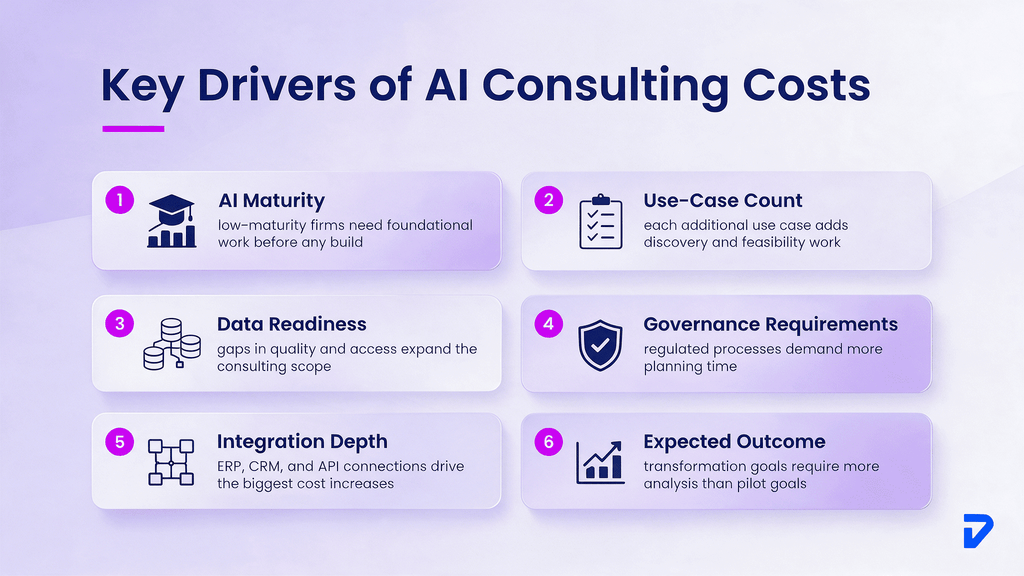
The need for AI consulting depends on internal capabilities, project complexity, and the cost of making the wrong decision.
When Internal Teams Can Lead
- A data science or AI team already exists.
- The use case is clearly defined.
- Data is clean and readily available.
- A proven AI vendor is already in place.
- Internal teams can handle validation, vendor selection, and pilot design.
- Targeted technical or governance support may be enough instead of broad consulting.
When Outside Expertise Adds Real Value
- Internal AI expertise is limited.
- Multiple business functions or complex integrations are involved.
- The project has significant regulatory or governance requirements.
- Teams disagree about which AI use cases to prioritize.
- An independent assessment is needed before committing to a vendor or implementation.
2026 Mid-Market Report found that 55% of mid-market AI investors used consultants for AI guidance, while average AI spending exceeded $600,000, highlighting the role of external expertise.
How Do Mid-Market Companies Typically Approach AI Consulting Budgets?
The most common mistake is treating the consulting budget as a one-time expense rather than the first phase of a multi-year investment.
Deloitte’s 2025 AI ROI research found that a typical AI use case takes two to four years to reach satisfactory return, with only 6% of organizations reporting payback in under a year. That timeline does not mean the consulting engagement lasts four years. It means the financial return on the total AI investment, including development, integration, change management, and optimization, accumulates over time. Setting a consulting budget that accounts only for the initial strategy engagement and ignores the downstream implementation, maintenance, and optimization work leads to cost overruns.
The mid-market companies that control their AI consulting spend well share a consistent pattern:
- They start with a clearly scoped use case, not a company-wide transformation ambition
- They budget for strategy and implementation separately, rather than assuming the consulting fee covers both
- They prepare their data, documentation, and process maps before the engagement begins, reducing the billable hours spent on discovery
- They establish measurable success criteria at the outset, so the engagement has a defined end point rather than an open scope
- They plan for a phased approach: readiness assessment first, strategy roadmap second, implementation third, with budget decisions made at each gate
This structure keeps consulting costs proportional to what has been validated rather than what has been proposed.
What Should You Know Before Buying AI Consulting Services?
The most important thing to understand before signing an AI consulting engagement is that the scope you agree to at the start is the primary driver of what you pay at the end.
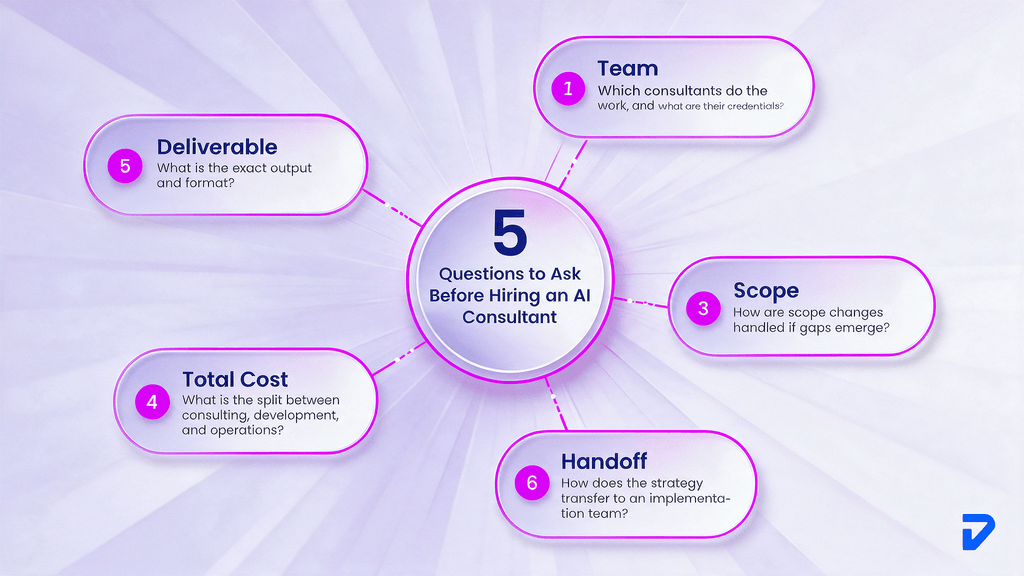
Consultants should be able to answer these questions clearly before you sign:
- What is the specific deliverable, and what format does it take?
- What does your involvement look like after the strategy document is delivered?
- Which members of your team will actually be doing the work, and what are their credentials?
- How do you handle scope changes if the assessment reveals problems we did not expect?
- What is your handoff process to an implementation team?
A focused AI readiness assessment typically costs 15,000–60,000 over three to six weeks. Keep consulting separate from technology costs, including development, infrastructure, integration, and ongoing model operations, when setting the total budget.
The Bottom Line
Pinnasys builds, ships, and runs AI systems for mid-market operators, and the conversations we have most often are with companies that received a strategy document and had no idea what to do with it next. The budget question matters, but the readiness question matters more. A company that knows exactly which workflow to automate, has clean data behind it, and has a partner that stays through deployment will spend less on consulting and get more from their AI investment than one that funds a broad strategic assessment and then starts from scratch.
For most mid-market companies, a realistic AI consulting budget starts at $15,000 for a scoped readiness check, rises to $50,000 to $150,000 for a full strategy roadmap, and grows further when integration complexity and governance requirements increase the scope. The number that actually matters is not the consulting fee in isolation; it is the total AI investment, including development and operations, measured against a defined business outcome. Start with AI integration services planning only after the strategy work has produced a use case with a clear ROI case and a data foundation that can actually support it.
Key Takeaways from the Article
- AI consulting cost for mid-market companies ranges from $15,000 for a readiness assessment to $500,000+ for a multi-function transformation program.
- Scope, not company size, is the primary driver of what a consulting engagement actually costs.
- Readiness gaps in data, talent, and governance add real consulting work before implementation can begin.
- Budget for strategy, development, and operations as separate line items to avoid mid-project surprises.
- A typical AI use case takes two to four years to reach satisfactory ROI, so the consulting fee is the beginning of a longer investment cycle.