


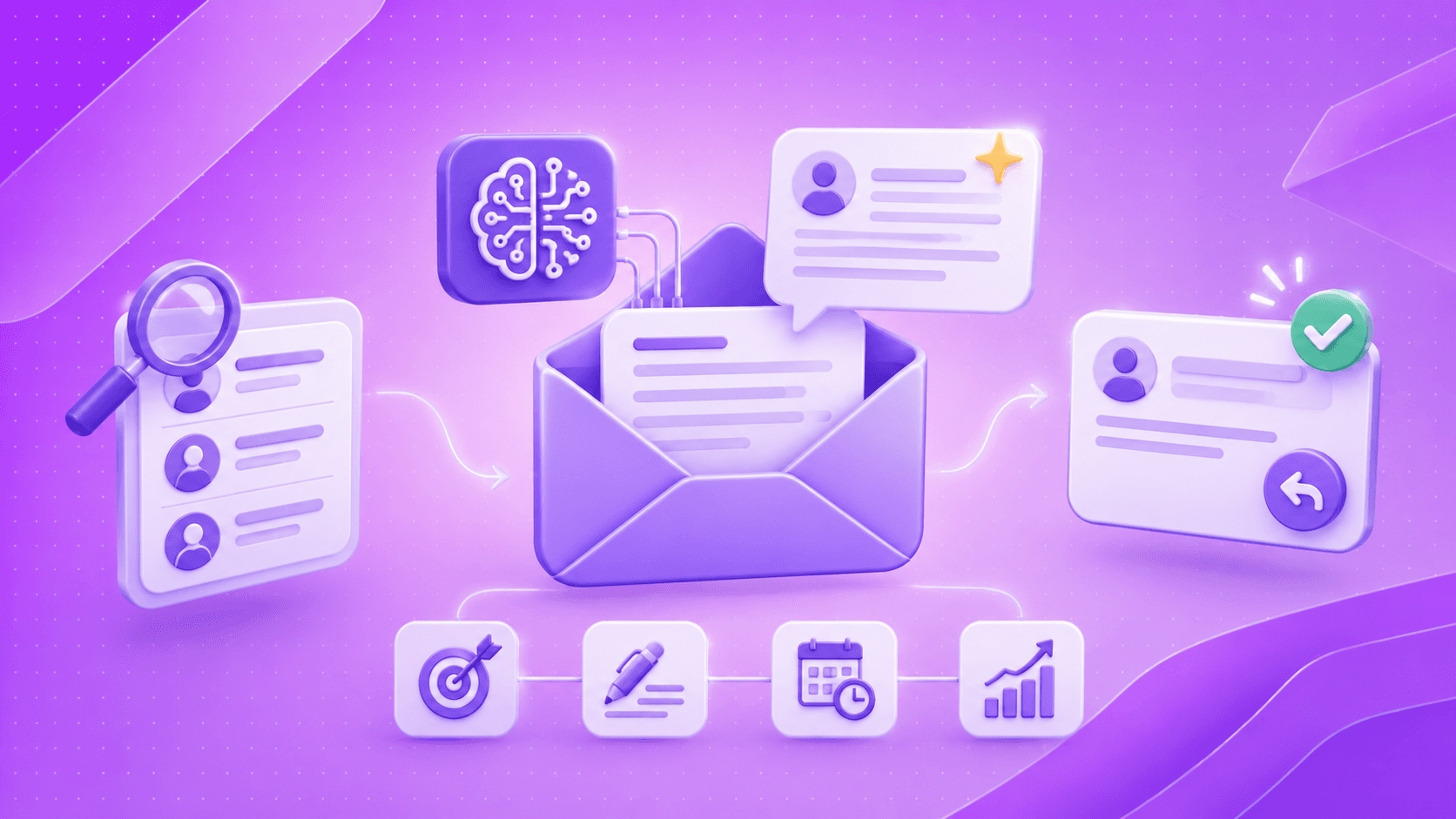
AI cold outreach works when personalization runs on real signals, not name tags. Automation handles volume and sequencing. Human judgment, clean data, and deliverability keep replies coming and inboxes open.
Gartner projects that 30% of outbound messages will be synthetically generated by 2025, up from under 2% in 2022. AI cold outreach has gone mainstream. That is also the problem. Prospects now spot generic, machine-written emails in seconds and delete them. The average cold email reply rate has slid to roughly 3%, and low-effort automation is a named cause.
Volume alone no longer moves the needle. The teams that win use AI to research deeper and personalize better, not to blast faster. This guide shows how to build AI outreach automation that sounds human, respects the inbox, and books real meetings. The difference starts with one distinction most teams miss.
What Is AI Cold Outreach, and Why Most of It Fails
AI cold outreach uses machine learning to research prospects, draft messages, and run follow-up sequences at scale. Done well, it frees reps to focus on live conversations. Done badly, it floods inboxes with forgettable emails. Reply rates have fallen from 8.5% in 2019 to around 3% in 2026. Low-effort AI content is a big reason why. The tool is not the problem. The way most teams use it is.
The Difference Between Automation and Personalization
Automation and personalization solve different problems. Automation handles scale: it sends, sequences, and tracks without manual work. Personalization handles relevance: it makes each message feel written for one person. Most teams automate hard and personalize barely at all. That combination sends more bad emails, faster. The goal is to automate the busywork while keeping every message specific.
Why Generic AI-Generated Emails Get Deleted in Seconds
Buyers can smell a template. Vague praise, filler openers, and value claims that fit any company all signal a mass send. A decision-maker who gets 30 cold emails a day scans for effort in the first line. When the opener could go to anyone, the email goes to trash. Generic scale is not outreach. It is noise.
How Does AI Automate Cold Outreach? A Look Inside the Workflow
AI does not replace the outreach process. It compresses each step. A good system moves from a raw lead list to a personalized, sequenced send with far less manual effort. The human still sets the strategy and reviews the output. The machine handles research, drafting, and timing.
From Lead List to Send: The End-to-End Process
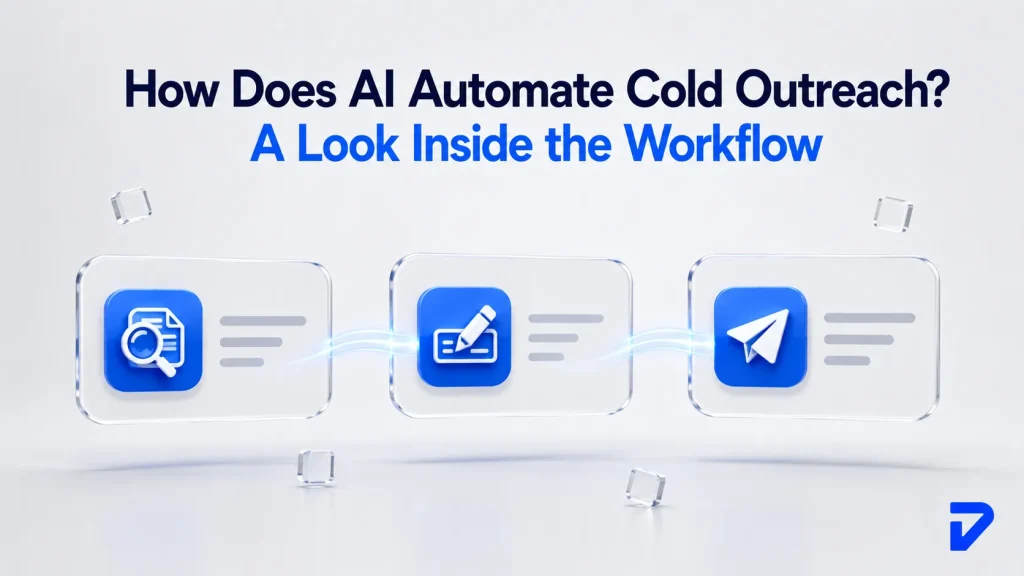
The pipeline runs in clear stages. AI enriches each contact with firmographic and signal data. It then drafts a message tied to those signals. A validation layer checks the copy against rules. The system schedules the send, spaces follow-ups, and logs every reply. Each stage feeds the next, so one clean input produces one relevant email.
Where Humans Still Need to Stay in the Loop
AI handles the volume, but people own the judgment. Humans define the ideal customer, approve the messaging angle, and spot-check drafts before they send. They also read the tricky replies that need nuance. Skip this oversight and small errors scale into a reputation problem. The best systems pair machine speed with a human checkpoint.
AI Cold Email Personalization: The Levels That Actually Convert
Personalization is not one thing. It runs on a spectrum, and the level you reach decides your reply rate. Personalized emails can lift replies by up to 142%, yet only about 5% of senders personalize every message. That gap is the opportunity. Here is how the three levels compare.
| Level | What it uses | Typical reply impact |
| Surface | Name, company, title | Little lift over generic |
| Signal | Hiring, funding, tech stack, content | Strong lift when specific |
| Insight | A fresh view of their problem | Highest lift, hardest to scale |
Surface-Level Personalization (Name, Company, Title, and Why It’s Not Enough)
Merge tags feel personal but rarely are. Dropping a first name or company into a template does not prove you researched anyone. Buyers have seen this trick for years. Surface fields are table stakes, not a differentiator. They stop an email from looking broken. They do not earn a reply on their own.
Signal-Based Personalization (Hiring, Funding, Content, Tech Stack)
Signals are events and facts that reveal intent or fit. Examples include a funding round, a new senior hire, a job post, or a specific tool in their stack. Each one gives you a real, timely reason to reach out. AI can pull these signals from public sources at scale. A message tied to a live signal shows effort and lands as timely rather than random.
Insight-Led Personalization: Adding a Perspective the Prospect Hasn’t Considered
The strongest emails teach. Insight-led personalization pairs a signal with a point of view the prospect has not weighed. You connect what you noticed to a risk or opportunity they may have missed. This level is the hardest to automate fully. AI can draft the frame, but a human sharpens the insight. That blend converts best.
Can AI Write Cold Emails That Sound Human?
Yes, but only with the right constraints. Left alone, models default to a polished, generic voice that readers now recognize as machine-written. The fix is not a better model. It is better instructions, cleaner data, and honest gaps. Treat AI as a fast first-draft writer, then hold it to human standards before anything is sent.
The Tells That Give AI-Written Emails Away
Certain patterns scream automation. Overlong openers, corporate buzzwords, and hollow flattery are common tells. So are perfect grammar with zero specifics and phrases like “I hope this finds you well.” Readers pattern-match these fast. If your email could have been sent to a thousand people, it reads like it was.
Guardrails and Prompting Rules That Remove the “AI Voice”
Guardrails shape the output. Give the model a tight brief: short sentences, plain words, a banned-phrase list, and a hard word cap. Feed it real signal data, not adjectives. Tell it to write like a busy peer, not a brochure. Clear rules turn a generic draft into a message that reads as a person wrote it.
Why Empty Fields Beat Guessed (or Hallucinated) Details
Models fill gaps by inventing. A made-up detail about a prospect destroys trust the moment they notice. The safer rule: when a signal is missing, leave the field empty and use a solid default line. An honest, slightly generic sentence beats a confident, wrong one. Never let AI guess facts about a real person.
The Anatomy of a High-Converting Automated Cold Email
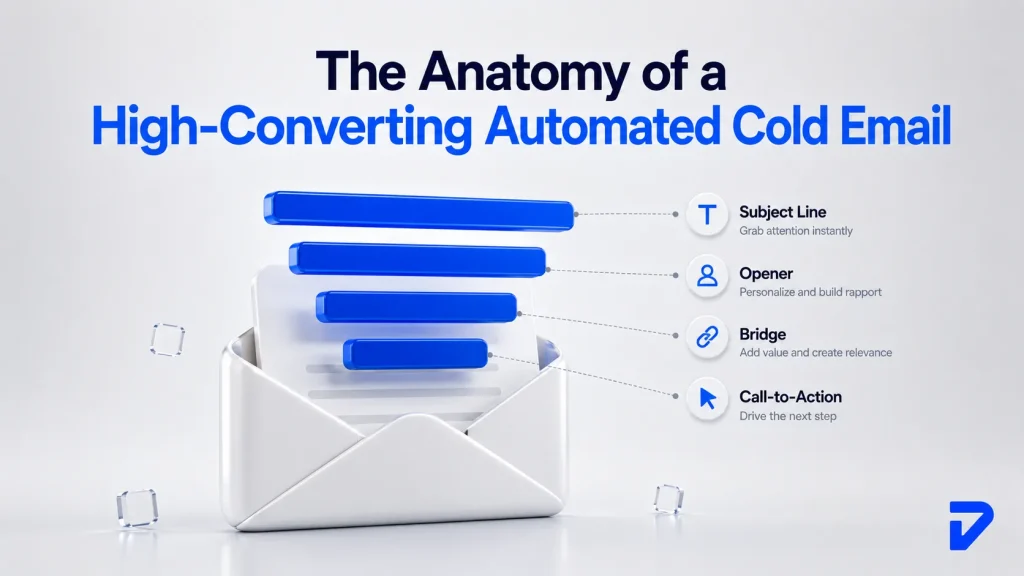
Structure carries the message, and shorter emails win. One study of three million sends found that 50-to-125-word emails earned 2.4x the reply rate of 200-word messages. Four parts do the work: the subject, the opener, the bridge, and the ask. Each has one job.
Subject Lines That Earn the Open
The subject decides whether anything else gets read. Keep it short, specific, and free of hype. Reference the signal or the outcome, not your product. A line like “your Q3 hiring push” beats “a quick question.” Avoid spammy words and all caps. The best subjects sound like a note from a colleague.
The Opening Line: Where Personalized Outreach AI Proves Itself
The first line is where personalized outreach AI earns its keep. It must show you did the work in one sentence. Name the signal, not their industry. “Saw you just opened a second warehouse” lands. “As a leader in logistics” does not. If the opener could fit any recipient, rewrite it before you send.
The Bridge: Connecting Their Problem to Your Solution
The bridge links what you noticed to what you fix. Move from their situation to a specific, likely pain, then to a brief hint of the outcome you deliver. Keep it to one or two sentences. Do not list features. Show that you understand their problem better than the last ten emails they deleted.
A Low-Friction Call to Action
The ask should cost the reader almost nothing. Request interest, not a 30-minute meeting on the first touch. “Worth a quick look?” or “Open to me sending details?” lowers the bar. One clear ask beats three. Make saying yes easy, and more prospects will.
Wondering if your outreach needs automation or a full AI SDR?
Pinnasys builds production-ready outreach systems that research prospects, write like a human, and actually book meetings, not just send emails.
Cold Email Automation vs. AI SDR Outreach: What’s the Difference?
Cold email automation and AI SDR (Sales Development Representative) outreach are not the same tool. Automation runs sequences on rules. An AI SDR reasons about each prospect and adapts. Knowing which you need saves money and prevents overreach. The table below draws the line.
| Factor | Cold email automation | AI SDR outreach |
| Core engine | Sequence rules and merge tags | Reasoning agent that plans and adapts |
| Personalization | Templated fields | Research-driven, per prospect |
| Handles replies | No | Yes, drafts and books |
| Best for | High-volume, simple offers | Complex, considered sales |
Sequence Tools vs. Reasoning Agents
Sequence tools follow a fixed script. They send email one, wait, then send email two. Reasoning agents work differently. They research a lead, choose an angle, write for that person, and adjust based on replies. One executes steps. The other makes decisions. The gap shows most on hard-to-reach, high-value accounts.
When Simple Automation Is Enough, and When You Need an AI SDR
Match the tool to the deal. For a simple offer to a broad, well-defined list, sequence automation is plenty. For complex sales with fewer, higher-value targets, an AI SDR pays off. Agents that draft replies and book meetings often lean on conversational AI to handle the two-way exchange. Start simple, then add reasoning where the deal size justifies it.
Building a Repeatable AI Sales Outreach Workflow
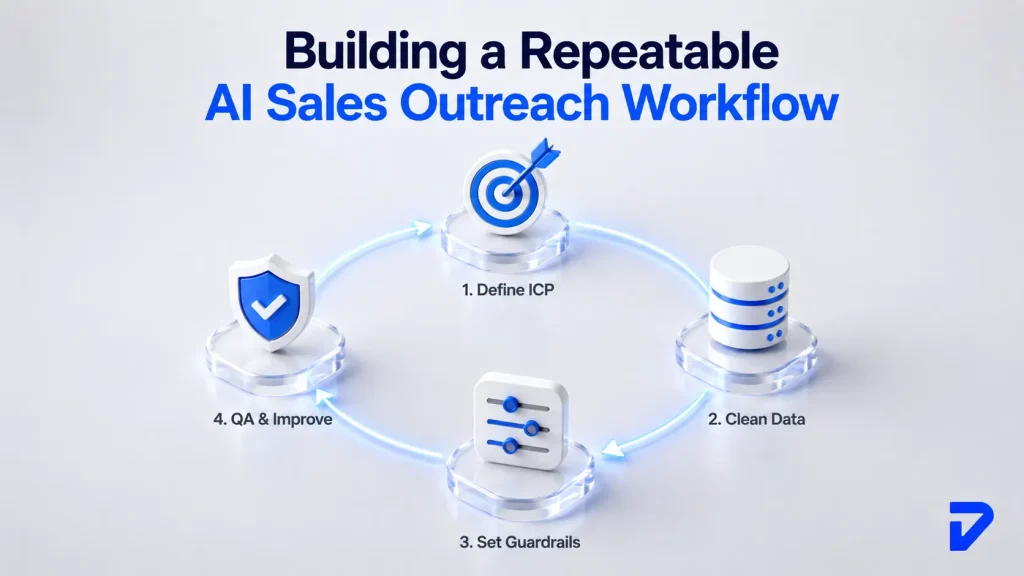
A one-off campaign is not a system. Repeatable AI sales outreach follows a fixed sequence you can run, measure, and improve every week. Four steps make it reliable. Skip any of them, and results get noisy.
Step 1: Define Your Ideal Customer Profile and Signal Sources
Start with who and why. Write a sharp ideal customer profile: industry, size, role, and the trigger that makes now the right time. Then name the signal sources you will watch, such as job boards, funding feeds, or tech-stack data. Vague targeting wastes every step that follows.
Step 2: Build a Clean Data Schema Before You Automate Anything
Clean data is the foundation. Verified email lists earn roughly twice the reply rate of unverified ones. Define the fields your emails need, validate every contact, and remove duplicates and bad addresses. A messy list breaks personalization and burns your domain. Fix the schema first, then let AI write against it.
Step 3: Set Prompting Rules and Brand Voice Guardrails
Codify how the AI writes. Store your prompt rules, banned phrases, tone, and word limits in one place. Add brand-voice examples so drafts stay consistent across campaigns. These guardrails are what keep automated outreach on-brand and human. Treat them as living documents and refine them as replies teach you what works.
Step 4: QA, Send, and Measure Before Scaling Volume
Test before you scale. Run a small batch, read the drafts, and check deliverability and replies. Only raise volume once the quality and inbox placement hold. This QA gate catches errors while they are cheap. Scaling a broken campaign just multiplies the damage.
Deliverability: The Silent Killer of AI Outreach Automation
Great copy fails in the spam folder. Deliverability decides whether your email is ever seen, and most teams ignore it until reply rates crater. Since February 2024, Google and Yahoo require senders to keep spam complaints below 0.3%. They also require authentication with SPF (Sender Policy Framework), DKIM (DomainKeys Identified Mail), and DMARC (Domain-based Message Authentication, Reporting & Conformance). Miss these, and volume works against you.
Domain Warming and Sending Infrastructure
New domains need time to build trust. Warming means ramping up send volume slowly over weeks so mailbox providers learn you are legitimate. Use a separate domain for cold outreach, not your main brand domain. Set up SPF, DKIM, and DMARC before the first send. Rushed infrastructure is why many campaigns land in spam from day one.
Safe Sending Volumes and Inbox Rotation
Volume discipline protects your reputation. Keep each inbox under a modest daily cap, often around 30 to 50 cold emails. Spread sends across several inboxes and domains to stay under provider limits. Rotate them so no single mailbox carries the whole load. Steady, low-volume beats a large blast that trips filters.
Why Even Great Copy Fails Without This Layer
Copy quality cannot rescue a bad sender reputation. An email in the spam folder gets a 0% reply rate no matter how good it reads. Deliverability is the layer beneath everything else. Fix it first, then optimize your message. Skip it, and every other improvement is wasted effort.
Metrics That Matter When You Automate Cold Email with AI
When you automate cold email with AI, measure the right things. Vanity metrics hide the truth and lead to bad decisions. Focus on replies, meetings, and pipeline. These tell you whether the system actually works.
Reply Rate and Positive Reply Rate
Reply rate is the headline number, but positive reply rate matters more. A high reply count means little if most responses say “remove me.” Track positive replies separately: real interest, questions, and requests to talk. That figure shows whether your targeting and message resonate with the right people.
Meeting Conversion and Show Rate
Meetings are where outreach turns into a pipeline. Track how many positive replies become booked calls, then how many of those actually happen. A weak show rate points to unclear value or friction in booking. These two numbers connect your outreach directly to revenue, unlike opens or clicks.
Why Open Rate Is No Longer a Reliable Signal
Open rate has broken as a metric. Apple Mail Privacy Protection pre-loads tracking pixels, which inflates reported opens for a large share of recipients. A 50% open rate can be mostly noise. Treat opens as directional at best. Judge campaigns on replies and meetings, the metrics you can trust.
Where AI for Sales Outreach Is Headed Next
AI for sales outreach is moving from writing emails to running the whole motion. Gartner predicts that 60% of B2B seller work will run through generative AI by 2028. That is up from under 5% in 2023. Expect agents that research, write, sequence, reply, and book with lighter human input. As generic AI floods inboxes, deep research and genuine relevance will separate winners from the noise.
How Pinnasys Approaches AI Outreach Automation Differently
Most vendors hand you a prompt template and wish you luck. Pinnasys builds outreach systems that run in production and stay there. We start with your ideal customer, your signals, and your data, then design a system around them. The measure of success is booked meetings and pipeline, not a slick demo.
Building Production-Ready Systems, Not Just Prompt Templates
A prompt is not a system. Production outreach needs clean data, guardrails, deliverability, and monitoring to work together. Pinnasys builds and runs that full stack, so your team gets replies instead of a tool to babysit. We treat outreach as engineering, with the same rigor we bring to every AI workflow we ship.
The Bottom Line
AI cold outreach rewards the teams that combine machine scale with human judgment. Automation gives you volume and consistency. Personalization on real signals gives you relevance. Clean data and strong deliverability keep your emails in the inbox. Skip any of these layers, and reply rates fall. Get them right, and outreach becomes a repeatable engine, not a gamble. Pinnasys builds agentic AI systems that research each prospect, write like a human, and book meetings at scale. If your outreach feels like a losing numbers game, it may be time to rebuild it as a system. Book a discovery call and map out an outreach engine built for real replies.
Key Takeaways from the Article
- Volume alone no longer works; relevance on real signals now drives replies.
- Personalization can lift reply rates by up to 142% over generic templates.
- Empty fields beat guessed details, since one hallucinated fact destroys prospect trust.
- Deliverability decides everything; a spam-folder email gets zero replies regardless of copy.
- Measure replies and meetings, not opens, which Apple privacy changes have made unreliable.
Frequently Asked Questions
How many follow-ups should an automated cold email sequence include?
Most B2B sequences work best with four to seven touches over two to three weeks. Replies climb through the first few follow-ups, then flatten. Past five emails, spam risk rises, and returns shrink.
Is AI cold outreach compliant with CAN-SPAM and GDPR?
Yes, when done correctly. CAN-SPAM (Controlling the Assault of Non-Solicited Pornography and Marketing Act) allows cold email with accurate headers, a valid physical address, and a working opt-out. GDPR (General Data Protection Regulation) requires a lawful basis, usually legitimate interest, plus an easy unsubscribe for EU recipients.
What reply rates should I realistically expect?
Expect roughly 3% on average across all senders. Well-targeted, deeply personalized campaigns reach 8% to 15%. Below 1% usually signals a data, targeting, or deliverability problem, not weak copy.
Does using AI mean I should disclose it to prospects?
No law requires disclosing AI use in outreach. What matters is accuracy and consent. A message that implies false personal knowledge erodes trust. Honest, relevant, well-researched emails matter far more than any disclosure.





Prakash C. Saini
Prakash Saini is the Founder & CEO of Pinnasys. With over a decade in digital transformation and building production systems, he grew an engineering team from 2 to 50 people and has led the delivery of 100+ production digital systems. Products built under his leadership have raised millions in funding and generated over $50 million in revenue. He holds an Executive MBA from IIM Kozhikode and today leads the AI engineering team at Pinnasys.