


AI automation cost for distributors varies widely, from $50,000 for a focused single-workflow pilot to $1.5M+ for enterprise-wide programs. The right number depends on what you automate, how clean your data is, and which systems need to connect.
AI is becoming a practical investment for distributors looking to improve efficiency, reduce operational costs, and optimize decision-making. McKinsey research shows that AI adoption in distribution can reduce inventory by 20–30%, lower logistics costs by 5–20%, and decrease procurement spend by 5–15%.
But before investing, most distribution leaders ask the same question: what will AI automation actually cost?
This guide breaks down the AI automation cost for mid-market distributors, including implementation pricing, the biggest cost drivers, hidden expenses, and the workflows that deliver the fastest ROI. It’s designed to help business leaders budget and plan AI investments with confidence.
What Determines AI Automation Costs for Mid-Market Distributors?
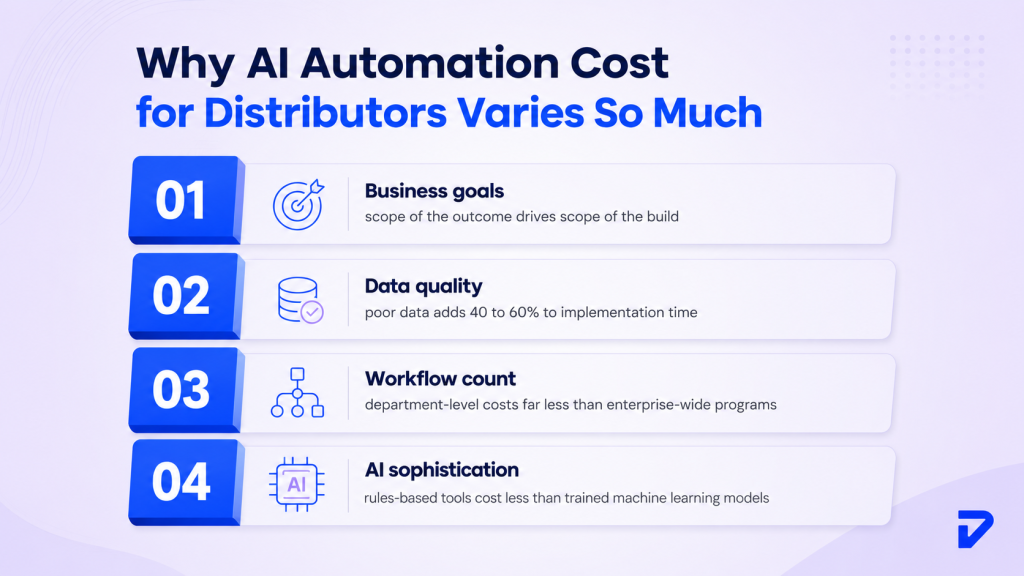
Ask five vendors about the AI automation cost for mid-market distributors, and you will get five very different numbers. That is not evasion. Four key factors determine the final investment.
Business goals determine the investment
The cost of AI automation depends first on the business outcome you want to achieve. Automating order entry for a single location requires far less investment than building an AI system that optimizes inventory, forecasting, and warehouse operations across multiple facilities.
Data quality and system readiness
Data preparation is often one of the largest cost drivers in an AI project. When data is spread across disconnected systems or outdated software, additional time is required for integration and cleanup. Well-structured, accessible data significantly reduces implementation time and overall project costs.
Number of workflows being automated
Automating one business process costs far less than connecting multiple departments through a unified AI platform. Gartner found that only 23% of supply chain organizations have a formal AI strategy, making phased, disconnected projects more common and often more expensive to scale over time.
Level of AI sophistication required
Not every AI solution requires advanced machine learning or an agentic AI workflow. Rule-based automation is typically faster and more affordable to implement. As business needs evolve, distributors can gradually adopt more intelligent AI systems that learn, adapt, and automate increasingly complex decisions.
AI Automation Cost Breakdown for Mid-Market Distributors
Before comparing AI automation costs for mid-market distributors by project scope, it helps to understand where the money goes. The components below are part of nearly every AI automation engagement, whether you spend $8,000 or $80,000.
| Cost Component | Share of Budget | What It Covers |
| Discovery and process assessment | 8–12% | Mapping current workflows, identifying integration points, scoping the build |
| Solution design and development | 25–35% | Model selection, pipeline architecture, prompt engineering, custom logic |
| System integrations (ERP, WMS, TMS, CRM) | 20–30% | Connecting AI to existing tools so data flows without manual export/import |
| Data preparation | 10–20% | Cleaning, structuring, and enriching historical data for model training |
| Testing, deployment, and training | 8–12% | QA, user acceptance testing, rollout, staff onboarding |
| Ongoing monitoring and optimization | $2K–$8K/month | Drift monitoring, retraining, performance reviews, model updates |
The last row surprises most buyers. An AI model is not a one-time install; it degrades as order patterns, suppliers, and product catalogs change. Production-grade AI requires active upkeep, closer to running a software service than installing an appliance.
AI Automation Cost by Project Scope
Three deployment tiers cover the majority of mid-market distribution engagements. These ranges are drawn from 2026 market data and reflect production deployments, not demo-grade pilots.
Department-level automation (single workflow)
- Typical use cases: automated order entry and document processing, AI-driven purchase order generation, customer service triage for order status inquiries, basic demand forecasting for a single product category.
- Estimated investment: $50,000 to $150,000 for Year 1, including build, integration to one or two systems, and three months of post-launch optimization. Ongoing support runs $2,000 to $4,000 per month after stabilization.
- Implementation timeline: 6 to 12 weeks for a well-scoped single workflow with clean data.
Multi-workflow automation
- Typical use cases: combined order processing and inventory replenishment automation, warehouse picking optimization paired with demand sensing, AI customer support across channels plus automated returns processing.
- Estimated investment: $150,000 to $500,000 for Year 1, depending on the number of integrated systems and the complexity of the workflows. A 2026 analysis from Truvisory puts the all-in Year 1 cost for one production-grade mid-market AI workflow at $75,000 to $300,000, with multi-workflow builds running $300,000 to $500,000 before enterprise integrations add cost.
- Implementation timeline: 3 to 6 months for connected workflows with parallel data prep.
Enterprise-wide intelligent automation
- Typical use cases: end-to-end supply chain AI covering demand planning, procurement, warehouse operations, and customer-facing automation; multi-site deployments; custom AI models trained on proprietary SKU and pricing data.
- Estimated investment: $500,000 to $1.5M+ for Year 1. At this tier, system integration complexity, connecting ERP, WMS, TMS, and CRM in a real-time data fabric, is the dominant cost driver, not model licensing.
- Implementation timeline: 9 to 18 months with phased rollout across functions.
Cost Breakdown by Distribution Use Case
The following table translates scope tiers into specific workflow costs, so you can estimate the investment against the workflows that matter most to your operation.
| Use Case | Typical Investment Range | Primary Integration |
| Order entry and document processing automation | $25K–$75K | ERP |
| Demand forecasting (single category) | $40K–$100K | ERP, WMS |
| Stock replenishment automation | $50K–$120K | ERP, WMS, supplier EDI |
| AI customer support agent (order status, FAQs) | $30K–$80K | CRM, OMS |
| Warehouse picking optimization | $60K–$150K | WMS, labor management |
| Invoice and PO processing automation | $35K–$90K | ERP, AP system |
| Full demand planning and inventory intelligence | $150K–$400K | ERP, WMS, TMS |
| End-to-end supply chain AI program | $500K–$1.5M+ | ERP, WMS, TMS, CRM |
These estimates reflect AI automation costs for mid-market distributors working with an experienced implementation partner. While SaaS tools have a lower upfront price, many distributors still need customizations to support complex SKU catalogs, pricing rules, and fulfillment workflows.
The Hidden Expenses of AI Automation Projects
The investment ranges above assume clean data, cooperative legacy systems, and a team that is ready to adopt new tools. In practice, those three assumptions fail often enough that every budget should include contingency for the following.
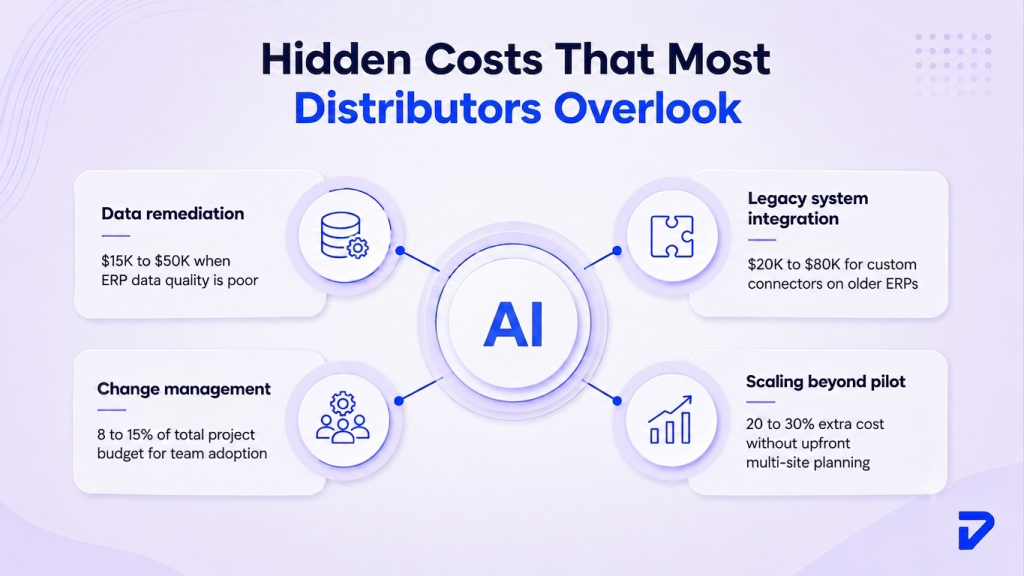
Poor data quality remediation
AI models are only as reliable as the data behind them. Research on supply chain AI forecasting shows data preparation can consume 40–60% of implementation time when historical data lacks consistency. Budget $15,000–$50,000 for data cleanup if ERP data quality is poor.
Legacy system integration
Many mid-market distributors use ERP systems without real-time API access. Connecting AI solutions may require custom connectors or middleware, adding $20,000–$80,000 and 4–8 weeks to implementation timelines. Integration complexity is why many companies rely on AI integration specialists instead of building internally.
Change management and employee adoption
BCG’s 2026 logistics survey found unclear ROI and internal capability gaps are leading barriers to AI adoption, exceeding technology cost concerns. Allocate 8–15% of project costs for training, workflow redesign, and human-in-the-loop validation to ensure successful adoption.
Scaling beyond the pilot phase
AI automation costs for mid-market distributors increase as projects expand across multiple sites. Scaling requires model retraining, new integrations, and location-specific data updates, making early planning essential to control long-term costs.
Build vs. Buy vs. Partner: Which Path Delivers the Best ROI?
When distributors evaluate AI automation costs, the biggest decision is whether to build internally, buy existing solutions, or partner with an AI specialist. Each approach has different trade-offs in cost, flexibility, implementation speed, and long-term ROI.
1. Building an Internal AI Team
Building an internal AI team requires significant investment that many mid-market distributors underestimate. A senior AI engineer costs $280,000–$450,000 fully loaded, takes an average of 114 days to hire, and has a 28% first-year attrition rate. For companies generating $50M–$200M in revenue, this is a major commitment before automation begins.
2. Buying Off-the-Shelf AI Software
Off-the-shelf tools can lower the initial AI automation cost for mid-market distributors, but customization costs often increase as businesses adapt them to unique pricing rules, SKU structures, and fulfillment workflows.
3. Partnering with an AI Development Firm
Partnering with an AI development firm balances cost, flexibility, and expertise. A qualified partner provides engineering capabilities without hiring risks and builds solutions around your workflows. For mid-market distributors, this approach often delivers faster ROI by handling complex ERP, WMS, and integration challenges.
Wondering what AI automation will cost your distribution business?
Partner with Pinnasys to assess your workflows, estimate investment, and build AI automation solutions that deliver measurable business value.
AI Automation ROI for Mid-Market Distributors
Before any buy decision, the question that matters most is not what AI costs but what it returns. The evidence base is now substantial enough to give honest ranges.
1. Labor Savings
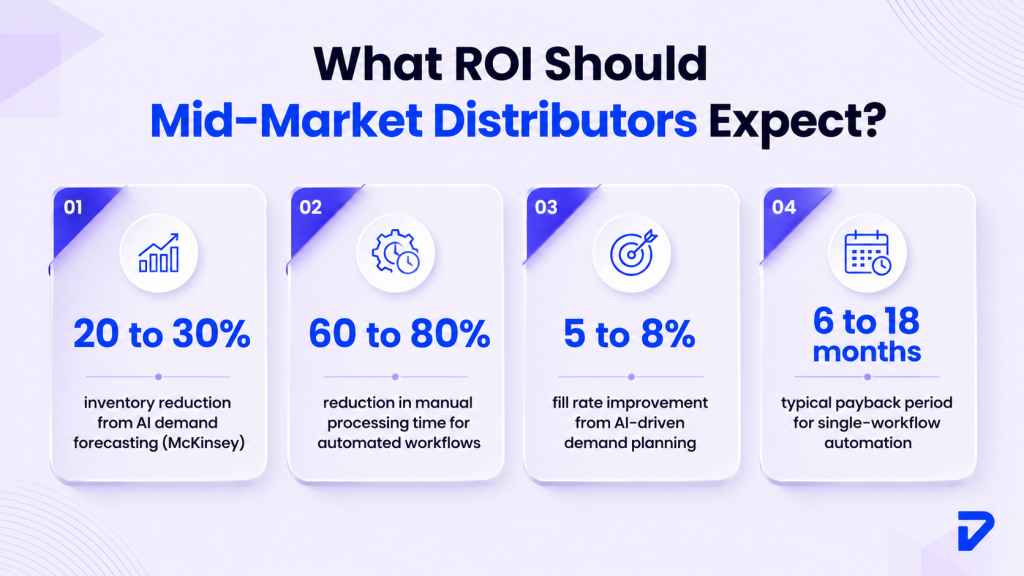
Automating order entry, invoice processing, and customer inquiries can reduce manual processing time by 60–80%. This can save 2–5 FTE equivalents in mid-market operations and create significant annual cost savings.
2. Inventory Cost Reduction
AI-driven demand forecasting and replenishment can help reduce excess inventory. McKinsey research shows distributors can achieve 20–30% inventory reductions, improving working capital and reducing storage costs.
3. Improved Order Fulfillment
AI-powered decision intelligence helps distributors improve demand planning and order accuracy. Companies using these systems report 5–8% fill rate improvements, reducing missed sales and costly expedited shipping.
4. Payback Timeline
Single-workflow AI automation typically achieves payback within 6–18 months, while broader automation programs often reach full ROI within 12–24 months. Capgemini’s 2025 supply chain research highlights AI-driven logistics improvements, including 10% lower logistics costs and 15% faster transit times.
How to Reduce AI Automation Cost Without Sacrificing Results
Four decisions made at the start of a project have more impact on total cost than any vendor negotiation after the fact.
Start with the highest-ROI workflow, not the most visible one
The workflow that generates the most boardroom conversation is rarely the one with the best payback math. Map labor hours, error rates, and downstream rework costs for each candidate workflow before selecting the starting point. Order entry and demand forecasting consistently top this ranking for distributors.
Reuse existing infrastructure
If your ERP already has an API layer or your organization uses a cloud data warehouse, build the AI integration to those surfaces rather than creating a parallel data pipeline. Reusing infrastructure cuts integration cost by 25 to 40% compared to greenfield builds.
Prioritize integration-ready platforms
When evaluating off-the-shelf tools, the integration surface matters more than the AI feature set. A tool with pre-built connectors for your ERP cuts weeks of custom integration work. An AI readiness assessment before vendor selection identifies which platforms will connect cleanly and which will require expensive middleware.
Implement in phases, with defined handoffs
A phased approach helps reduce AI automation costs for mid-market distributors by 20 to 35%. Starting with a single workflow creates the data needed for more advanced AI later, while delivering faster ROI and lowering overall implementation costs.
The Bottom Line
Pinnasys helps mid-market distributors facing operational challenges without lengthy transformation cycles. AI automation costs can range from $50,000 for a focused workflow to $1.5M for broader intelligence systems, depending on data quality, integration complexity, and clearly defined business goals.
The fastest ROI comes from solving one high-impact workflow first, then scaling over time. This approach reduces AI automation costs for mid-market distributors, speeds up implementation, and can deliver measurable ROI within 12 months. Pinnasys helps businesses estimate realistic costs before they invest.
Key Takeaways from the Article
- Single-workflow AI automation for distributors typically costs $50,000 to $150,000 in Year 1.
- Data quality and ERP integration complexity drive 60 to 75% of total implementation budget.
- AI-driven demand forecasting can reduce distributor inventory carrying costs by 20 to 30%.
- Specialist partners deliver production-grade AI at twice the success rate of internal builds.
- Phased implementation reduces total program cost by 20 to 35% versus big-bang deployment.
Frequently Asked Questions on AI Automation Pricing for Distributors
How much does AI automation cost for a mid-market distributor?
A focused AI automation project typically costs $50,000–$150,000 in Year 1, including development, integration, and optimisation. Multi-workflow programs range from $150,000–$500,000, while larger supply chain AI systems can exceed $500,000.
Which distribution workflows deliver the fastest ROI from AI automation?
Workflows like order entry, invoice processing, and demand forecasting usually deliver the fastest returns. These areas reduce manual effort, improve accuracy, and help distributors optimise daily operations while creating measurable cost savings within a shorter timeframe.
How long does an AI automation implementation take for a distributor?
Implementation timelines depend on workflow complexity and system readiness. Single-workflow automation can take 6–12 weeks, while multi-workflow solutions may require 3–6 months. Larger deployments involving multiple systems typically need more time.
Can AI automation integrate with our existing ERP and WMS?
Yes, AI solutions can integrate with existing ERP and WMS platforms. However, the timeline depends on system age, APIs, and data accessibility. Legacy systems may require additional middleware or custom connectors to enable reliable AI integration.
What ongoing costs should distributors expect after AI deployment?
AI systems require continuous monitoring, maintenance, and occasional model updates as business data changes. Ongoing support typically ranges from $2,000–$8,000 per month, depending on workflow complexity, system requirements, and the level of optimisation needed.
Is AI automation worth it for a distributor with under $100 million in revenue?
Yes, smaller distributors can benefit by starting with targeted automation areas like order processing, customer service, and forecasting. A phased approach allows businesses to achieve measurable improvements without requiring the budget or complexity of large-scale AI deployments.





Prakash C. Saini
Prakash Saini is the Founder & CEO of Pinnasys. With over a decade in digital transformation and building production systems, he grew an engineering team from 2 to 50 people and has led the delivery of 100+ production digital systems. Products built under his leadership have raised millions in funding and generated over $50 million in revenue. He holds an Executive MBA from IIM Kozhikode and today leads the AI engineering team at Pinnasys.