


AI automation costs vary based on workflow complexity, integrations, customization, and business goals. Learn how AI automation pricing is structured, what drives the cost of business automation, how to calculate AI automation ROI, and what to include when planning your automation budget.
AI automation promises faster operations, lower costs, and greater productivity, but one of the first questions every business asks is: how much will it actually cost? The answer isn’t straightforward. A simple AI chatbot may cost a few thousand dollars, while an enterprise-wide automation platform can require an investment of hundreds of thousands.
The final price depends on several factors, including workflow complexity, integrations, customization, data readiness, and ongoing operational costs. Understanding these variables helps businesses avoid unrealistic budgets and make informed investment decisions from the start.
In this guide, we’ll break down AI automation pricing in 2026, explain the factors that influence implementation costs, uncover hidden expenses, and show you how to calculate ROI so you can confidently plan your automation budget.
What is AI Automation?
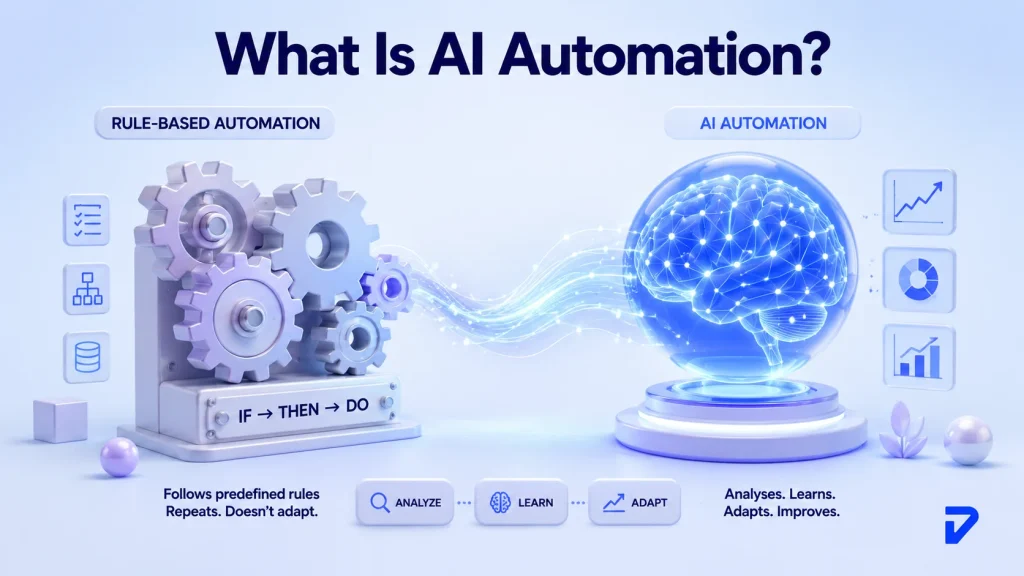
AI automation uses artificial intelligence to automate business processes that traditionally required human intervention. Unlike rule-based automation, which follows predefined “if-then” instructions, AI-powered systems can analyze information, understand context, and adapt their responses as conditions change.
According to McKinsey’s State of AI research, many organizations encounter data quality and integration challenges when moving AI from pilot projects to enterprise-scale deployment, making these factors critical to both implementation costs and project timelines.
AI Automation Pricing Breakdown & Cost Structure
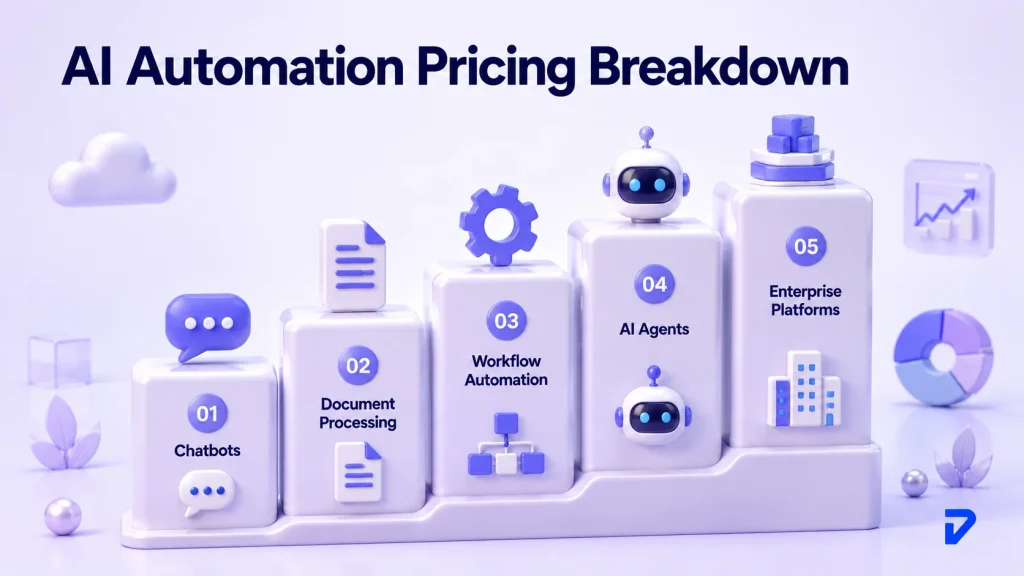
The price of an AI automation solution depends on several aspects, namely, the types of solutions, the complexity of the workflow, and the extent of customization. Although basic automation can be put to use with minimal expenditure, large-scale industrial-grade AI automations are usually costly because of integration, compliance, and maintenance.
| AI Automation Solution | Typical Cost Range* | Best Suited For |
| AI Chatbots & Virtual Assistants | $2,000 – $10,000 | Customer support, FAQs, and lead qualification |
| Intelligent Document Processing | $5,000 – $25,000 | Invoice processing, contracts, forms, OCR |
| Workflow Automation | $10,000 – $50,000 | HR, finance, procurement, approvals |
| AI Agents & Multi-Agent Systems | $25,000 – $100,000+ | Decision-making, research, complex business workflows |
| Enterprise AI Automation Platforms | $50,000 – $250,000+ | Organization-wide automation across multiple departments |
Agent AI Cost vs Cost of Traditional Business Automation
| Comparison Factor | Agent AI Automation | Traditional Business Automation |
|---|---|---|
| Initial Investment | Higher due to AI models, training, and intelligent workflows | Lower for rule-based workflows with predefined logic |
| Decision-Making | Adapts to changing inputs and handles complex scenarios | Executes only predefined rules and conditions |
| Implementation Complexity | Moderate to high, depending on data and integrations | Low to moderate for structured processes |
| Integration Costs | May require AI APIs, LLMs, vector databases, and enterprise integrations | Typically integrates with existing business systems and applications |
| Scalability | Easily scales across dynamic workflows and business functions | Scaling often requires additional rule creation and maintenance |
| Ongoing Costs | Includes model updates, API usage, monitoring, and optimization | Primarily involves maintenance, software updates, and workflow modifications |
Factors Affecting AI Automation Pricing in 2026
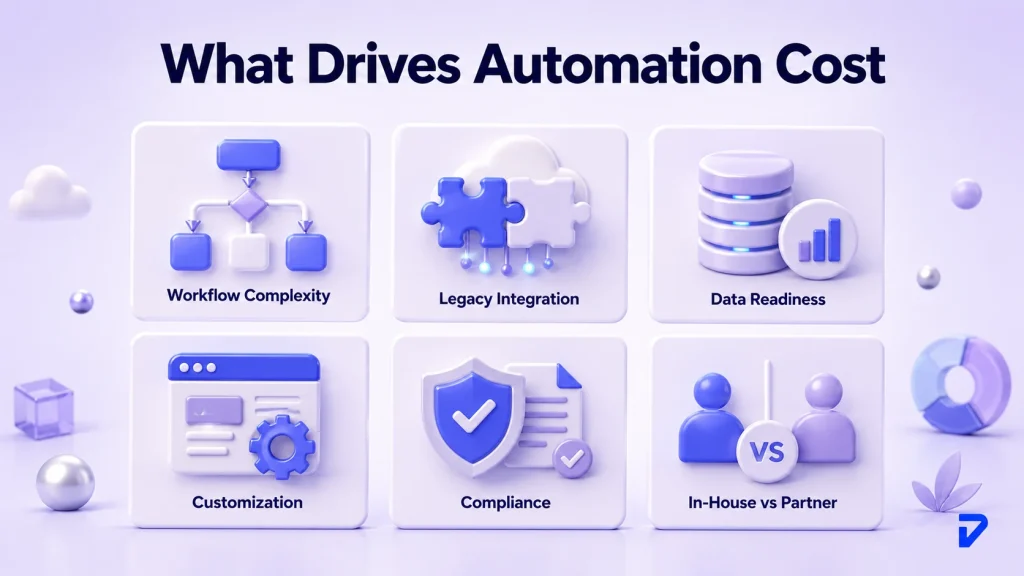
Workflow Complexity and Process Volume
A workflow that contains few decisions and is driven by clear rules tends to be relatively faster and less costly to automate. Processes that have several steps and contain approvals, exceptions, or AI-driven decisions necessitate more development effort, testing, optimization time, and cost.
The frequency of the processes also impacts the price. A larger number of processes requires scalable systems capable of handling those transactions efficiently, resulting in higher utilization of compute resources, which directly drives the operating costs of larger workloads higher.
Integration Depth and Legacy Systems
Connecting AI automation with modern business applications is usually straightforward, but integrating legacy software can significantly increase implementation effort. Every additional system adds complexity, testing requirements, and ongoing maintenance.
Businesses with multiple applications, custom databases, or outdated infrastructure should account for integration work in their AI automation budget. Early planning helps reduce delays and prevents unexpected development costs later in the project.
Data Readiness and Quality
AI automation performs only as well as the data it receives. Clean, well-structured, and consistent data enables AI models to deliver more accurate results while reducing implementation effort and testing time.
Businesses with incomplete, duplicate, or poorly organized data often spend additional time on data cleansing, validation, and migration before automation can begin. These preparation activities increase project costs but significantly improve long-term performance and reduce deployment risks.
Customization vs. Off-the-Shelf
Off-the-shelf AI tools are generally more affordable because they are designed to support common business use cases with minimal configuration. They offer faster deployment and lower upfront costs for standard workflows.
This means additional effort has gone into your unique business case, integration with your current software, or any sector-specific needs that are applicable. There are more upfront costs for these types of projects, but a unique solution could provide more long-term value to your complex business case.
Compliance and Regulatory Requirements
AI automation cost planning for regulated businesses must include compliance costs in estimation of costs for AI. It may include extra planning, execution time, and budget needs like security controls, audit trails, data privacy standards, governance structures, and regulations.
Planning for regulatory requirements from the beginning reduces the risk of delays during security reviews and helps ensure the solution meets industry standards without costly redesigns later.
In-House vs. Partner Build
Building out the AI automation using an internal team gives you long-term ownership over the functionality. But it comes at the cost of acquiring the right expertise (both hiring and training), hardware and infrastructure, and the management of people and tools long-term.
An experienced AI implementation partner can help businesses deploy AI more quickly while leveraging subject matter experts. Businesses often opt for this strategy during their initial AI initiative, before growing in-house AI expertise over time.
Hidden Costs to Consider During the AI Automation Budget
Change Management and Staff Training
AI automation succeeds when employees understand how to work alongside it. New workflows often require teams to adapt their daily processes, learn new tools, and trust AI-generated outputs. Without proper training, employees may continue relying on manual methods, reducing the value of the investment.
Change management can be built into the budget of every AI automation from the outset. Process documentation, internal communications, training programs, and the ongoing ability to improve them will lead to the technology being embraced as time goes on to deliver the desired business results.
Ongoing Model Maintenance
The launch of your AI solution is only step one. With the flow of business data, shifting consumer habits, and new use cases coming to life, you’ll need to keep an eye on how your AI performs to retain value.
Maintenance activities such as model retraining, performance testing, and workflow optimization require ongoing investment. Planning these costs helps businesses maintain accuracy and avoid unexpected performance issues after deployment.
API and Compute Scaling Costs
Many AI automation solutions rely on cloud-based APIs and computing resources that are billed based on usage. Costs may appear manageable during testing but can increase as transaction volumes grow and more users adopt the solution.
Estimating costs using expected production volumes instead of pilot usage creates a more realistic automation budget. This approach helps businesses prepare for long-term operating expenses without unexpected increases.
Security, Governance, and Audit Infrastructure
AI systems that process customer, financial, or business-critical data require strong security and governance controls. Access management, audit trails, encryption, and compliance measures are essential for protecting sensitive information and meeting regulatory requirements.
Governance should not be treated as an optional add-on after deployment. Building security and audit capabilities into the project from the beginning reduces implementation risks and supports long-term compliance as the solution scales.
Not sure what AI automation should cost for your workflows?
Pinnasys scopes each engagement against your real processes and data, so you get a firm number and a payback case, not a vague range. Get a Custom Scope Today
How to Calculate AI Automation ROI?
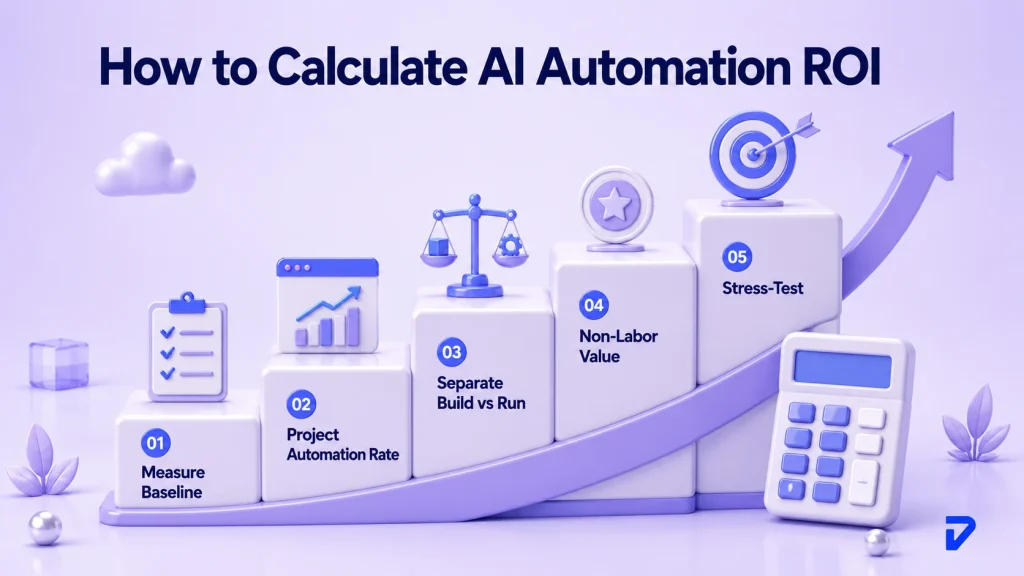
Calculating AI automation ROI is about more than comparing implementation costs with savings. A reliable estimate considers operational improvements, ongoing expenses, and the long-term value created by automation. Following a structured approach helps businesses build a stronger investment case and set realistic expectations.
Step 1: Measure the Baseline
Start by documenting the current process before introducing automation. Measure task volumes, time spent, labor costs, error rates, and rework efforts to understand the true cost of manual operations.
This provides you with a tangible baseline to work with in order to identify future opportunities and potential savings. Without having it, proving the true ROI of AI automation becomes much more of a challenge.
Step 2: Project the Automation Rate Realistically
Each process also needs at least some human involvement, particularly with special circumstances and tough judgments. Don’t get overconfident; make a sensible estimation for your likely rate of automation.
Conservative projections create more reliable ROI estimates and help businesses avoid unrealistic expectations during implementation.
Step 3: Separate Build Cost from Run Cost
Implementation costs cover the initial design, development, and deployment of the solution, while operating costs include API usage, cloud infrastructure, monitoring, and ongoing support. Both should be included when evaluating total investment.
Separating one-time and recurring expenses provides a clearer view of total ownership costs and helps calculate the expected payback period more accurately.
Step 4: Account for Non-Labor Value
Labor savings represent only one part of the return on investment. Faster processing, fewer errors, improved customer experience, higher productivity, and better compliance also contribute significant business value.
Focusing on the operating costs associated with the automation in many cases provides a more honest view of the business impact of AI automation ROI.
Step 5: Stress-Test the Projection
Review the business case using different assumptions, such as lower adoption rates, slower implementation, or higher operating costs. Testing multiple scenarios helps identify potential risks before the project begins.
A strong ROI model should remain financially viable even under conservative assumptions. This approach builds confidence in the investment and supports better decision-making.
How Pinnasys Prices the Cost of Business Automation
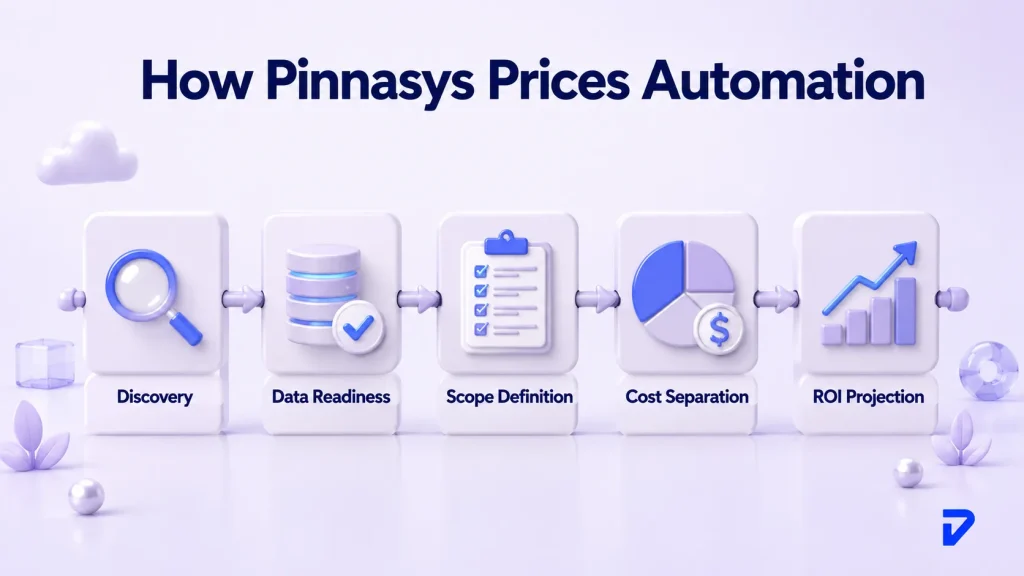
Step 1: Discovery and Business Goals Alignment
The process begins with deeply understanding your business objectives, your current workflows, and the problems you want AI automation to fix. This process of discovery is how we ensure we’re finding the best use cases to make a business impact.
A clear understanding of process volumes, operational bottlenecks, and success metrics allows us to recommend an automation strategy that delivers the greatest business value.
Step 2: Data Readiness Assessment
Your AI automation project can only be as successful as the data it uses. We will explore your current data sources, identify missing data, and consider whether any pre-implementation prep or cleansing is necessary.
This assessment reduces project risks, improves AI performance, and prevents unexpected costs that often arise from poor data quality during development.
Step 3: Automation Scope Definition
Once the business requirements are clear, we define exactly what the automation solution will cover. This includes workflows, integrations, exception handling, compliance needs, and expected automation levels to establish a realistic project scope.
A clearly defined scope minimizes change requests during development and provides greater confidence in the estimated timeline and overall project budget.
Step 4: Build vs. Run vs. Support Cost Separation
We separate one-time implementation costs from recurring operational expenses to provide complete pricing transparency. Development, deployment, cloud infrastructure, API usage, maintenance, and support are estimated independently.
This structured approach helps businesses understand the total cost of ownership and plan their AI automation budget with greater accuracy.
Step 5: ROI and Payback Projection
Every engagement concludes with an ROI assessment based on your current operating costs, projected efficiency gains, and estimated implementation expenses. Our team models realistic adoption scenarios to provide a practical view of expected business outcomes.
Instead of relying on assumptions, we deliver a data-driven business case that helps stakeholders evaluate investment decisions with confidence before implementation begins.
The Bottom Line
AI automation costs can vary significantly, but the real measure of success is the value it delivers over time. A well-planned automation initiative starts with understanding your current processes, defining a realistic scope, and evaluating both implementation costs and long-term ROI before investing.
At Pinnasys, we believe successful AI automation is built on practical business outcomes, not assumptions. We help organizations assess opportunities, estimate realistic project costs, and create ROI-driven automation roadmaps that scale with confidence. Get in touch with us to discuss your automation goals.
Key Takeaways
- AI automation costs span $500 a month for tools to $100,000+ for custom enterprise builds.
- Production upkeep and support often cost more over time than the initial build does.
- Integration depth and messy data drive cost more than model choice in most builds.
- A documented cost baseline is the single strongest predictor of fast, defensible ROI.
- Most focused workflow automations pay back within three to six months in 2026.
Frequently Asked Questions About AI Automation Cost
Is AI Automation Worth The Cost?
AI automation is often worth the investment when applied to repetitive, high-volume business processes. It can reduce manual effort, improve accuracy, and increase operational efficiency. The strongest returns typically come from well-defined workflows where savings, productivity gains, and performance improvements can be measured clearly.
How Much Does AI Consulting Cost Per Hour?
AI consulting rates generally range from $100 to $450 per hour, depending on expertise, project complexity, and engagement scope. Independent consultants often charge lower rates, while specialized AI firms command premium pricing for strategic planning, architecture design, implementation support, and enterprise-scale automation initiatives.
Is AI Automation Worth The Investment For Small Businesses?
AI automation can provide significant value for small businesses when focused on a specific operational challenge. Customer support, lead qualification, scheduling, and invoice processing are common starting points. A targeted deployment helps reduce costs, improve productivity, and establish a measurable return before expanding automation further.
Should I Hire an AI Consultant Or Build In-House?
An AI consultant or implementation partner is usually the faster and more cost-effective option for initial deployments. External specialists bring experience, proven frameworks, and technical expertise. Building an in-house team offers greater control but requires substantial investment in hiring, training, infrastructure, and ongoing management.
How long does it take to see ROI from AI automation?
Most focused AI automation projects achieve measurable ROI within three to six months, particularly when they target repetitive, labor-intensive processes. More complex initiatives involving multiple systems, custom integrations, or enterprise-wide adoption may require additional time before reaching full payback and long-term business value.





Prakash C. Saini
Prakash Saini is the Founder & CEO of Pinnasys. With over a decade in digital transformation and building production systems, he grew an engineering team from 2 to 50 people and has led the delivery of 100+ production digital systems. Products built under his leadership have raised millions in funding and generated over $50 million in revenue. He holds an Executive MBA from IIM Kozhikode and today leads the AI engineering team at Pinnasys.