


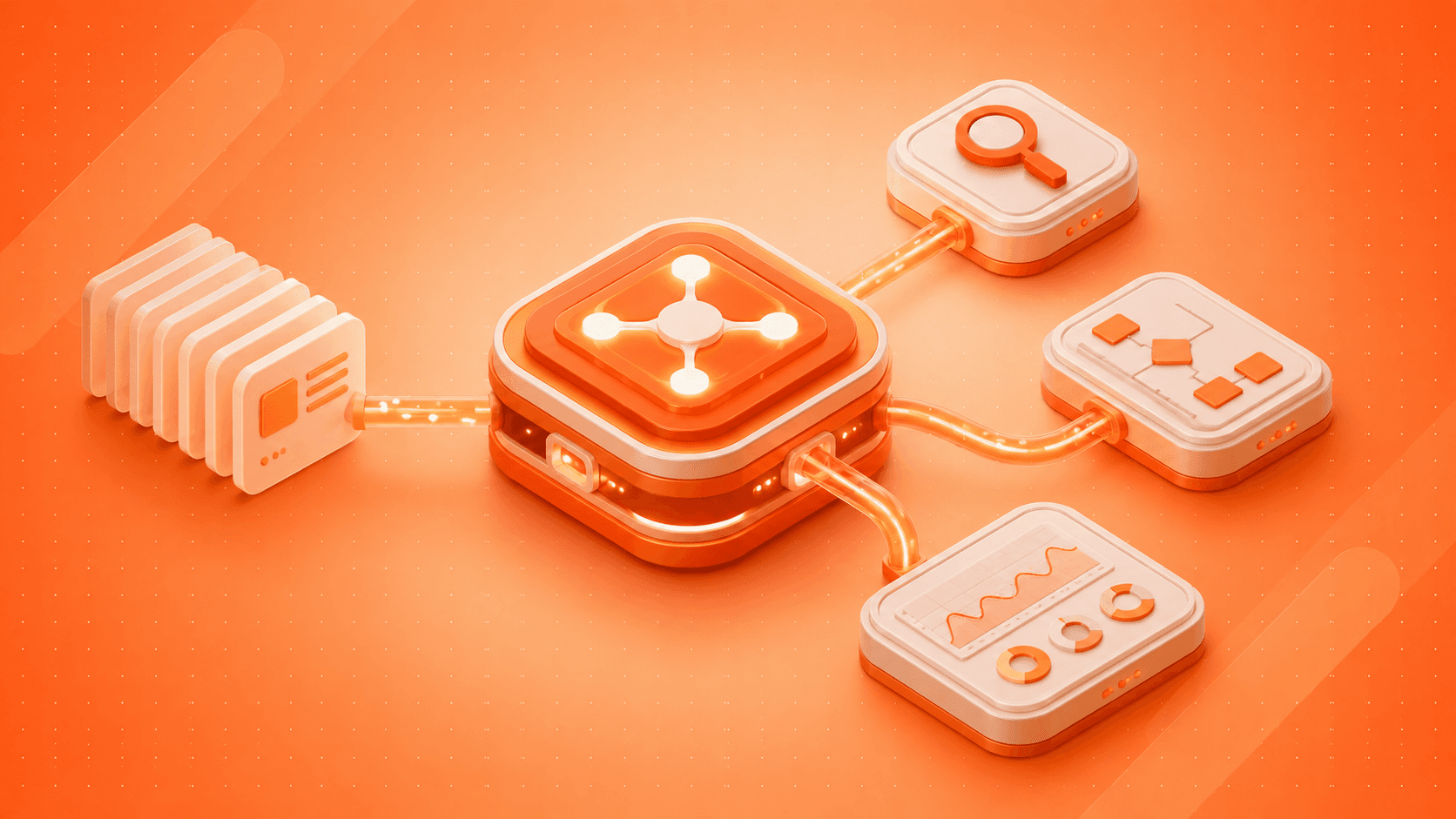
AI agent orchestration is the control layer that assigns tasks, shares context, and resolves conflicts across multiple AI agents. It turns a scattered set of bots into one coordinated, governed system.
Gartner expects 33% of enterprise software applications to include agentic AI by 2028, up from less than 1% in 2024. That growth creates a quieter problem inside most companies. Teams now run a support agent, a data agent, and a sales agent, yet nothing coordinates them. Each one acts alone, and they often duplicate work or contradict each other. AI agent orchestration closes that gap.
It is the layer that decides which agent handles what, passes the right context between them, and steps in when they disagree. For operators moving beyond single-bot pilots, orchestration turns a pile of tools into governed, agentic AI systems that behave predictably. Here’s how orchestration works, which models fit which problems, and how to run it safely at scale.
What Is AI Agent Orchestration?
AI agent orchestration is the discipline of coordinating multiple AI agents so they operate as one system toward a shared goal, rather than as isolated bots. Gartner predicts that by 2028, AI agent ecosystems will let networks of specialized agents collaborate across applications. When it comes to that shift, a single clever agent is no longer the goal. The real work lies in getting many agents to divide tasks, hand off cleanly, and stay aligned. Orchestration is the layer that makes that possible.
The Orchestrator as Control Plane
Think of the orchestrator as the control plane of your agent system, meaning the part that decides where work goes rather than the part that carries it out. It reads each incoming request, chooses the right agent, sequences the steps, and tracks progress until the job is done.
Individual agents stay focused on narrow tasks, while the orchestrator holds the wider view. This split matters because it keeps logic in one place. As a result, you can change one agent without rewiring the whole system, and you gain a single point to log, govern, and debug every decision.
AI Orchestration vs. Agent Orchestration vs. Multi-Agent Orchestration
These three terms nest inside one another, and mixing them up leads to muddled design. AI orchestration is the broadest layer: it coordinates models, data pipelines, and APIs. Agent orchestration sits one level in, coordinating autonomous agents that plan and act on their own.
Multi-agent orchestration is the innermost layer, where the hard problems live: communication between agents, role allocation, and conflict resolution. The table below shows the precise nesting, so you can place any tool or framework at the right level before you buy.
| Layer | What It Coordinates | Core Concern |
| AI orchestration | Models, pipelines, APIs | Moving data and calls in the right order |
| Agent orchestration | Autonomous agents | Giving each agent goals, tools, and limits |
| Multi-agent orchestration | Communication and roles | Message-passing, role allocation, conflict resolution |
How Do Multi-Agent Systems Work?
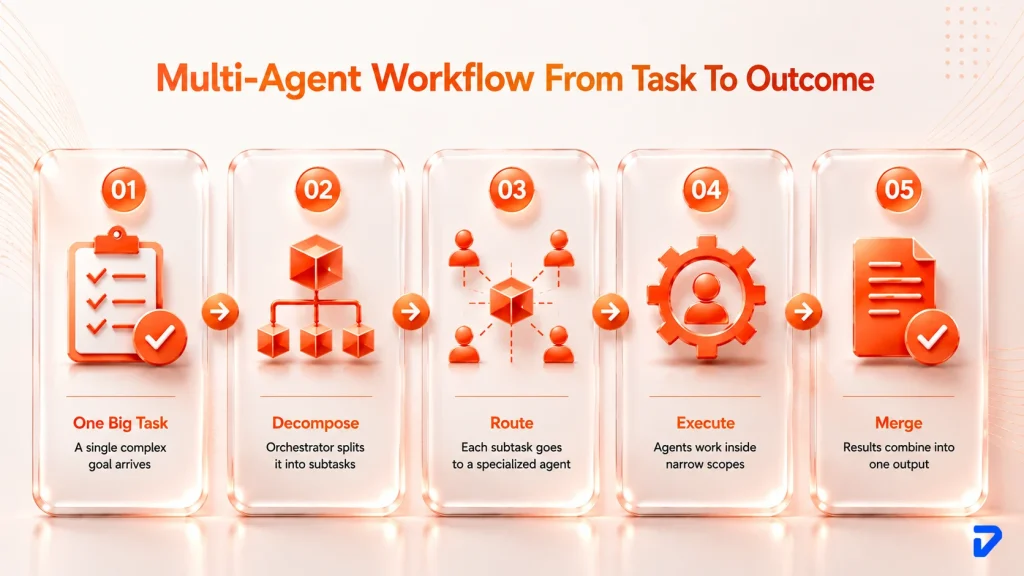
A multi-agent system works by splitting one large task into smaller pieces, assigning each piece to a specialized agent, then merging the results into one output. McKinsey describes AI agents as systems that plan and execute multi-step workflows autonomously. Multi-agent systems build on that idea. Rather than one agent doing everything, a set of narrow agents cooperates under an orchestrator that keeps them synchronized and stops them from working at cross purposes.
What Are The Four Working Parts?
Four parts make a multi-agent system run. The registry is the directory of available agents and what each one can do. The router reads a task and sends it to the agent best suited to handle it. Shared state is the memory both agents and the orchestrator read from and write to, so everyone works from the same facts. The supervisor watches execution, catches errors, and decides when to retry, escalate, or stop. Together, these parts turn a loose collection of agents into a coordinated system with clear accountability for every step.
Task Decomposition: From One Big Ask to Many Small Ones
Task decomposition is where orchestration earns its keep. A request like “onboard this new supplier” hides a dozen steps: validate documents, check credit, create records, notify teams. The orchestrator breaks that goal into discrete subtasks, then routes each to the agent built for it. While a single model can attempt the whole thing, it tends to lose track partway through long chains. The split keeps each agent within a scope it handles reliably, which is the main reason multi-agent orchestration outperforms a single overloaded agent on complex jobs.
What Are The Four Models of Multi-Agent Orchestration?
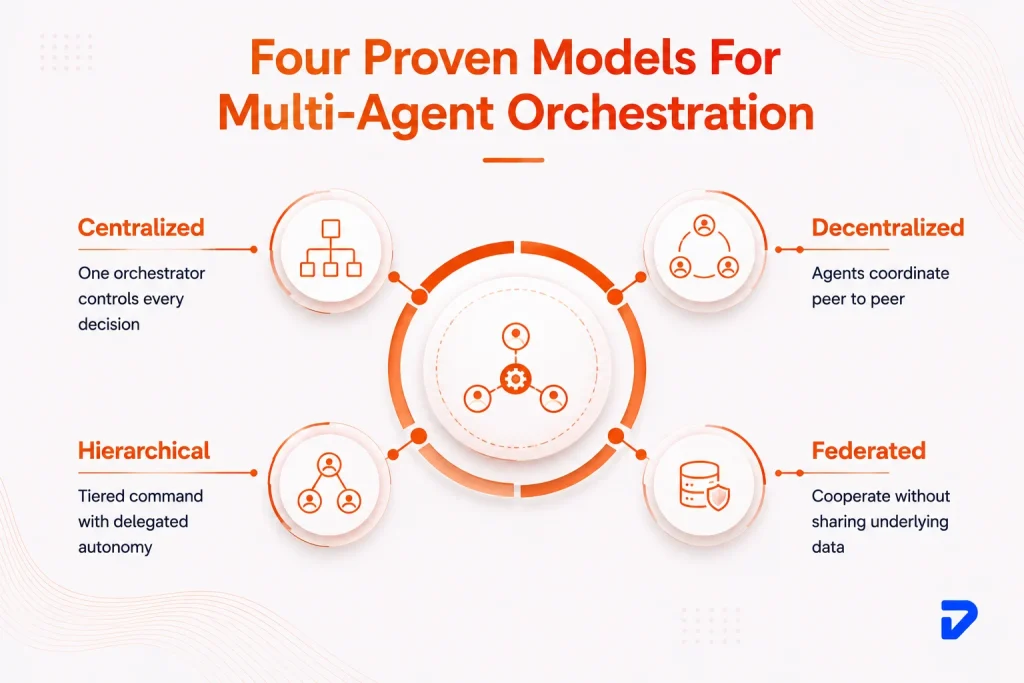
Four architectures dominate multi-agent orchestration, and each trades control for resilience differently. Your choice of model shapes how agents coordinate, how failures spread, and how much autonomy each agent gets. Pick the wrong one and you either bottleneck every decision or lose the ability to govern them. The table after these four sections compares the models side by side.
Centralized Orchestration
Centralized orchestration puts one orchestrator in charge of every decision. It assigns tasks, holds the shared state, and dictates the order of work, while agents simply execute what they are told. This model gives you tight control and clean audit trails, since every choice flows through one place. The trade-off is fragility. When that central brain goes down, the whole system stalls, so centralized designs need strong failover. For most mid-market teams starting, though, this is the simplest model to build, run, and reason about.
Decentralized Orchestration
Decentralized orchestration removes the single controller and lets agents coordinate peer-to-peer. Each agent makes its own decisions and negotiates directly with others, which means no single outage can freeze the system. This resilience comes at a cost: agreement gets harder, and without careful rules, agents can drift, loop, or duplicate work. Agent coordination here relies on shared protocols instead of a boss. The model suits large, distributed setups where uptime matters more than tight central control, and where teams can invest in solid message-passing between agents.
Hierarchical Orchestration
Hierarchical orchestration blends the two by arranging agents in tiers. A top-level orchestrator sets goals and delegates to mid-level managers, who in turn direct worker agents. Each layer owns a slice of the decision, so control stays clear while lower agents keep some autonomy. This structure mirrors how human organizations run, which makes it easier to reason about at scale. For complex workflows with natural sub-stages, hierarchical models balance oversight and speed better than a flat design, though they take more planning to set up correctly.
Federated Orchestration
Federated orchestration lets agents from different teams, vendors, or organizations cooperate without pooling their underlying data. Each agent keeps its data private and exposes only the results or capabilities others need. This model matters most across company boundaries, where privacy rules or trust limits block a shared database. Open standards make it practical: Google’s Agent2Agent protocol, now governed by the Linux Foundation, lets independently built agents discover and work with each other across vendors. Federated designs enable agent collaboration in regulated settings where data cannot leave its home system.
| Model | Control | Best For | Main Trade-Off |
| Centralized | Highest | Early builds, tight audit needs | Single point of failure |
| Decentralized | Lowest | Large distributed systems | Harder to keep agents aligned |
| Hierarchical | Balanced | Multi-stage workflows | More upfront design |
| Federated | Shared across parties | Cross-vendor, privacy-bound work | Complex trust and protocols |
How to Coordinate Multiple AI Agents Across Systems?
Shared Context, Not Just Shared Tasks
Task splitting is the easy part; sharing context is what teams miss. If a sales agent updates a customer record but the support agent never sees it, the two act on different versions of reality. Shared context means every agent reads from the same live state, so decisions stay consistent. Many teams anchor this with a retrieval layer, often a knowledge and enterprise search system that feeds agents the same source documents. Get context sharing right, and most coordination bugs disappear before they ever start.
Standardized Protocols: MCP and A2A
Standardized protocols let agents built by different teams or vendors talk without custom glue code. Anthropic’s Model Context Protocol connects agents to tools and data, acting like a universal port between a model and the systems it needs. Google’s Agent2Agent protocol connects agents to other agents, so they can delegate and coordinate work directly. Both standards are open and vendor-neutral, which is what makes them safe to build on for teams running AI across many systems.
Conflict Resolution and Escalation Paths
Two agents will eventually reach different conclusions, and a system without conflict rules simply picks one at random or stalls. Good orchestration defines who wins when agents disagree, usually by priority, confidence score, or a supervising agent’s ruling. It also defines escalation: when confidence drops below a threshold, the task routes to a human instead of a guess. These rules, paired with tight AI integration and governance, are what keep a multi-agent system trustworthy once real money and real customers are involved.
Platform vs. Framework vs. Tool: Know What You’re Actually Buying
Vendors blur the lines among these three categories, and the confusion costs money. Gartner warns of agent washing, where existing products are rebranded as agentic, estimating that only about 130 of the self-described agentic vendors are the real thing. Whether you are buying a framework, a platform, or a tool tells you what work you still have to do yourself.
Frameworks Define the Logic
A framework is a code library that defines how agents plan, call tools, and pass messages. LangGraph, CrewAI, and AutoGen sit here. Frameworks give you the most control and the lowest license cost, but they hand you a blank canvas. You write the logic, host the infrastructure, and own the reliability. For teams with strong engineers, a framework is the right foundation. For teams without them, it becomes a project that stalls because a framework solves the how, not the running and scaling that come after.
Platforms Operationalize It
A platform wraps a framework with hosting, monitoring, security, and a management layer, so you run agents instead of building the plumbing. Think of it as the difference between an engine and a finished car. Platforms cost more and give you less low-level control, yet they remove most of the operational burden that sinks agent projects. For teams scaling AI agents without a large in-house group, a platform is often the pragmatic choice, since it turns orchestration into a configured system rather than a custom build.
Tools Solve One Problem at a Time
A tool handles a single narrow job: a vector database, a monitoring dashboard, a prompt tester. Tools are not orchestration on their own, but every orchestration setup depends on several of them. The mistake is buying a point tool and expecting it to coordinate agents, which it was never built to do. Match tools to gaps in your stack, then let the framework or platform tie them together. Used this way, tools sharpen a system that already has a coordinating layer in place.
| You Are Buying | What It Gives You | What Do You Still Own | Best Fit |
| Framework | Agent logic and structure | Hosting, reliability, scaling | Strong engineering teams |
| Platform | Hosting, monitoring, governance | Configuration and use cases | Lean teams scaling fast |
| Tool | One narrow capability | Everything around it | Filling a specific gap |
What Are the Implementation Steps to Build a Multi-Agent Orchestration System?
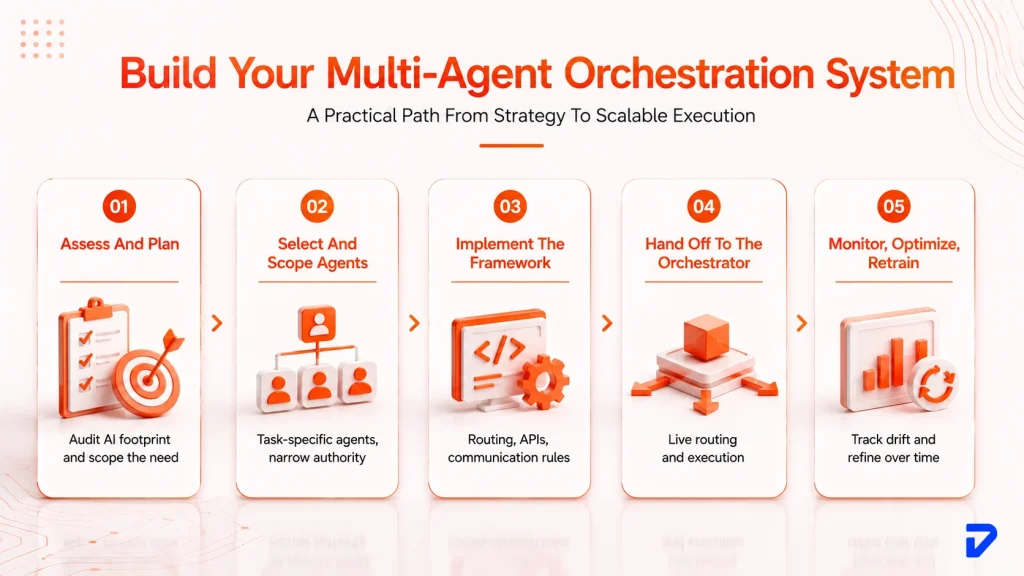
A multi-agent orchestration system comes together in five stages, and skipping the early ones is why many projects stall. McKinsey found that AI high performers capture value mainly by redesigning workflows around AI rather than bolting it on. A disciplined build does the same. Each step below moves from human planning toward supervised autonomy, with oversight never fully removed.
Step 1: Assess and Plan
Every build starts with people, not agents. Audit your existing AI footprint, define clear objectives, and scope which processes actually justify multiple agents. Many workflows run fine on one agent or plain automation, so this step stops you from over-engineering. A short AI readiness assessment surfaces where multi-agent orchestration pays off and where it only adds needless complexity. Get the scope right here, and the rest of the build gets far easier and cheaper to run.
Step 2: Select and Scope Specialized Agents
With the plan set, choose task-specific agents and draw narrow authority boundaries before anything goes live. Each agent should do one thing well and hold only the permissions that the task needs. Broad, do-everything agents are harder to test and easier to misuse. Define what each agent can read, write, and trigger, using scoped access so a single agent cannot reach beyond its job. Tight boundaries now prevent the messy failures and security gaps that show up later at scale.
Step 3: Implement the Orchestration Framework
This step wires the system together. Set up task routing, connect API integrations, and define the agent-to-agent communication rules that govern how work passes between agents. The registry, router, shared state, and supervisor all come online here. Standardized protocols keep the wiring clean, so agents built on different stacks still cooperate. Test each connection in isolation before joining them, because a routing bug found early is cheap, while the same bug found in production is anything but.
Step 4: Hand Off to the Orchestrator: Routing and Execution
Once the wiring holds, the orchestrator takes over live operation. It handles real-time task assignment, sequences steps, and manages dependencies so that one agent waits for another’s output when it must. From here, humans supervise rather than direct. The system runs on its own for routine work, escalating only when confidence drops or the rules demand a check. This is the moment a set of agents becomes an actual working system rather than a wiring diagram on a whiteboard.
Step 5: Monitor, Optimize, and Retrain
Launch is the start, not the finish. Track performance continuously, watch for drift, and let human oversight refine the routing rules and retrain agents as conditions change. Metrics like task success rate, escalation rate, and cost per task tell you what to tune. Over time, patterns emerge that let you tighten some boundaries and loosen others. A system that is measured and adjusted keeps improving, while one that is launched and forgotten quietly decays.
What Are The Major Multi-Agent Orchestration Challenges & How to Solve Them?
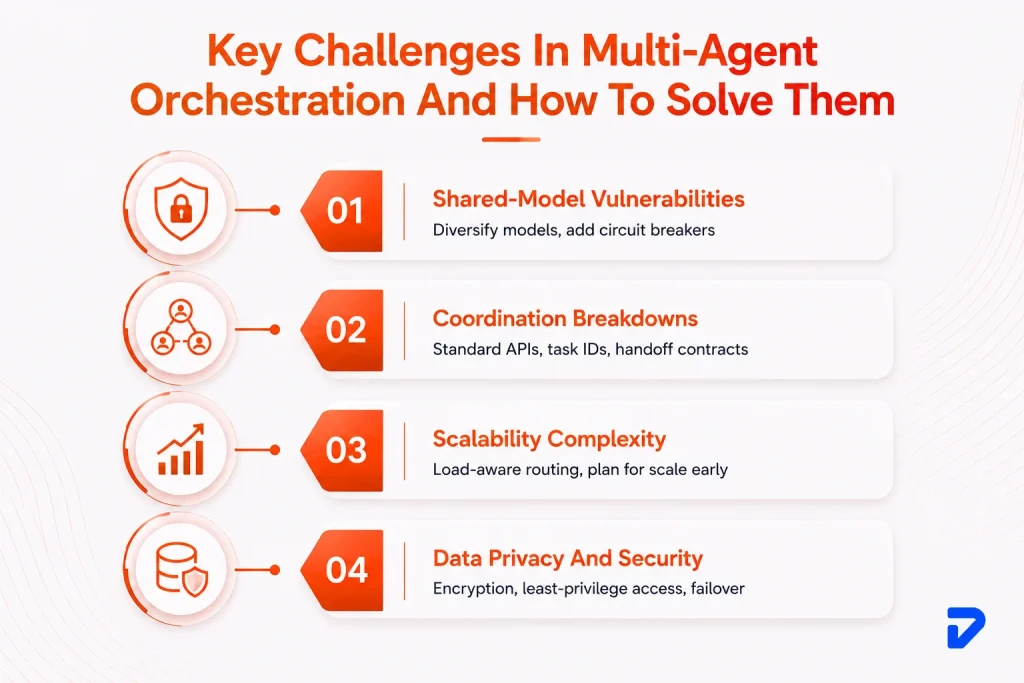
Multi-agent systems introduce failure modes that single agents never face. A UC Berkeley study of more than 1,600 execution traces found failure rates as high as 87% across popular multi-agent frameworks, with most breakdowns tracing to system design rather than weak models. That finding reframes the work: reliability comes from how you architect coordination, not just which model you pick. The four challenges below are the ones that sink most projects, along with solutions for each.
Shared-Model Vulnerabilities and Cascading Failures
Agents built on the same foundation model tend to share the same blind spots. When one model version has a weakness, every agent using it can fail the same way at once, turning a single flaw into a system-wide outage. Diversify where it counts by using different models for critical roles, and add circuit breakers that stop one agent’s error from cascading. Isolated failure domains keep a bad output contained instead of letting it knock out several agents in a chain.
Coordination Breakdowns and Duplicated Work
Without clear protocols and reliable message-passing, agents talk past each other. Two agents may claim the same task, or one may wait forever for a message that never arrives. These breakdowns rarely come from weak models; they come from missing rules. Standardized APIs, unique task IDs, and explicit handoff contracts fix most of them. Assign every task an owner and a status that all agents can read, and duplicated work along with silent deadlocks largely disappears.
Scalability and Decision-Making Complexity
Add agents without a distribution strategy, and you create congestion, not capacity. As agent counts rise, the messages between them can grow faster than the work itself, and the orchestrator becomes a bottleneck. Plan for scale early with load-aware routing and, where it fits, decentralized coordination so no single controller drowns. Sound decision intelligence also helps agents choose the highest-value action instead of thrashing. Done right, scaling AI agents is a design choice made upfront, not a patch applied later.
Data Privacy, Security, and Fault Tolerance
More agents mean more places data can leak and more parts that can fail. Encrypt data in transit and at rest, enforce least-privilege access so each agent sees only what it needs, and build failover so one agent’s crash does not take the system down. Audit every action for a clear trail. When agents touch regulated or sensitive data, these controls are not optional; they are what lets orchestration run in production without becoming a liability.
Is your orchestration built to contain failure, or just hope it doesn’t happen?
Pinnasys agentic AI engineering designs the boundaries and escalation paths that stop one agent’s failure from cascading.
Real-World Use Cases For Multi-Agent Systems & Agent Collaboration
Multi-agent systems already run real work across industries, and the pattern is consistent: narrow agents handling steps a human once chained together by hand. Gartner notes that collaborative agents suit supply chains, coordinating demand forecasting, inventory, and supplier tasks across multiple agents. The examples below show agent collaboration in three settings, from everyday support to tightly regulated workflows.
Customer Service Escalation Chains
Support is a natural fit for multi-agent orchestration. A front-line agent handles common questions, a specialist agent takes billing or technical issues, and a supervising agent decides when a human should step in. Each layer resolves what it can and passes the rest up with full context, so customers never repeat themselves. Teams building this often start with conversational AI and support automation, then add orchestration as volume and complexity grow. The result is faster resolution with fewer dropped handoffs.
Procurement and Supplier Workflows
Procurement chains have many steps that map cleanly to separate agents. One agent validates supplier documents, another checks credit and compliance, a third creates records and notifies buyers. An orchestrator sequences them and holds the shared state, so a delay at one step does not lose the work already done. For distributors and industrial operators, this is where agentic workflow orchestration cuts days of manual coordination down to minutes, while keeping an audit trail on every decision.
Healthcare, Finance, and Regulated Coordination
Regulated industries demand the tightest coordination, and multi-agent systems shine when the rules are strict. In finance, one agent flags a transaction, another gathers evidence, and a third prepares a case for human review, with every step logged. The same pattern holds in healthcare and insurance. Federated and hierarchical models fit here because they keep data contained and humans in the loop. Firms building AI for financial services lean on orchestration to move fast without breaking compliance.
How to Scale Up Agentic AI in Production?
McKinsey reports that 51% of organizations have already experienced an AI-related incident, yet the highest performers manage risk with human-in-the-loop rules and central oversight. Once dozens of agents act autonomously, you cannot watch each one by hand. You need systems that watch for you and rules that decide when a human takes over.
Audit Trails and Anomaly Detection
You cannot govern what you cannot see. Log every agent decision, tool call, and handoff with a correlation ID, so any outcome can be traced back to the exact step that produced it. Anomaly detection then flags behavior that drifts from the norm, such as an agent looping or spending far more than usual. Strong agent observability practices turn a black box into a system you can audit, debug, and defend when someone asks what happened and why.
Human-in-the-Loop Checkpoints at Scale
Full autonomy is rarely the goal; controlled autonomy is. Place human checkpoints where the stakes are highest, such as large payments, irreversible actions, or low-confidence decisions, and let agents run freely everywhere else. The trick at scale is routing only the cases that truly need a person, so reviewers are not buried. Set confidence thresholds and value limits that trigger a human check automatically. Done well, this keeps judgment in the loop without slowing the system to a crawl.
How Pinnasys Builds Multi-Agent Orchestration That Holds Up in Production
Most agent projects stall at the same point: a team has five agents running and no layer holding them together. Pinnasys builds that layer. The work combines AI integration, agentic AI, and governance into one system with defined authority, shared context, and audit trails on every decision.
Rather than shipping a demo and leaving, our engineering team treats orchestration as production infrastructure: monitored, versioned, and built to survive real load. That means agents with scoped permissions, clear escalation paths, and observability from day one. The goal is not more agents. It is a governed system where every agent has a job, a boundary, and an owner, so what works in testing keeps working when customers and revenue are on the line.
The Bottom Line
AI agent orchestration is what turns a scattered set of agents into one coordinated, governed system. The core ideas hold across every model: split tasks cleanly, share context, standardize how agents talk, and keep humans in the loop where the stakes are high. Get those right, and multi-agent orchestration delivers real gains instead of new chaos.
The teams that get multi-agent orchestration right treat it as production infrastructure, with governance and audit trails built in from day one. Pinnasys engineers multi-agent systems using CrewAI, AutoGen, and LangGraph, with defined roles and escalation paths. Book a discovery call to see what production-ready orchestration looks like for you.
Key Takeaways
- Orchestration coordinates multiple agents into one system with shared context and clear control.
- Four models exist: centralized, decentralized, hierarchical, and federated, each trading control for resilience.
- Standard protocols like MCP and A2A let agents from different vendors work together.
- Most multi-agent failures come from weak design and coordination, not weak models.
- Governance, audit trails, and human checkpoints make agentic AI safe to scale in production.
Frequently Asked Questions About AI Agent Orchestration
How is AI agent orchestration different from regular automation?
Regular automation follows fixed rules on a set path. AI agent orchestration coordinates agents that reason, adapt, and decide between steps, handling the variation and exceptions that rigid automation cannot. It manages judgment, not just triggers.
When should I move from a single agent to a multi-agent system?
Move when one agent starts losing track of long, multi-step tasks, or when distinct jobs need different skills and permissions. If a single agent handles the work reliably today, adding agents only adds cost and coordination risk.
What’s the difference between an orchestration platform and a framework?
A framework is a code library you build and host yourself, giving control but demanding engineering. A platform wraps that framework with hosting, monitoring, and governance, so you configure and run agents instead of building the plumbing.
How do you prevent agents from acting on outdated or conflicting context?
Keep one shared, live state that every agent reads from and writes to, rather than separate copies. Add version checks and conflict rules so the system resolves disagreements by priority or confidence instead of guessing.





Prakash C. Saini
Prakash Saini is the Founder & CEO of Pinnasys. With over a decade in digital transformation and building production systems, he grew an engineering team from 2 to 50 people and has led the delivery of 100+ production digital systems. Products built under his leadership have raised millions in funding and generated over $50 million in revenue. He holds an Executive MBA from IIM Kozhikode and today leads the AI engineering team at Pinnasys.