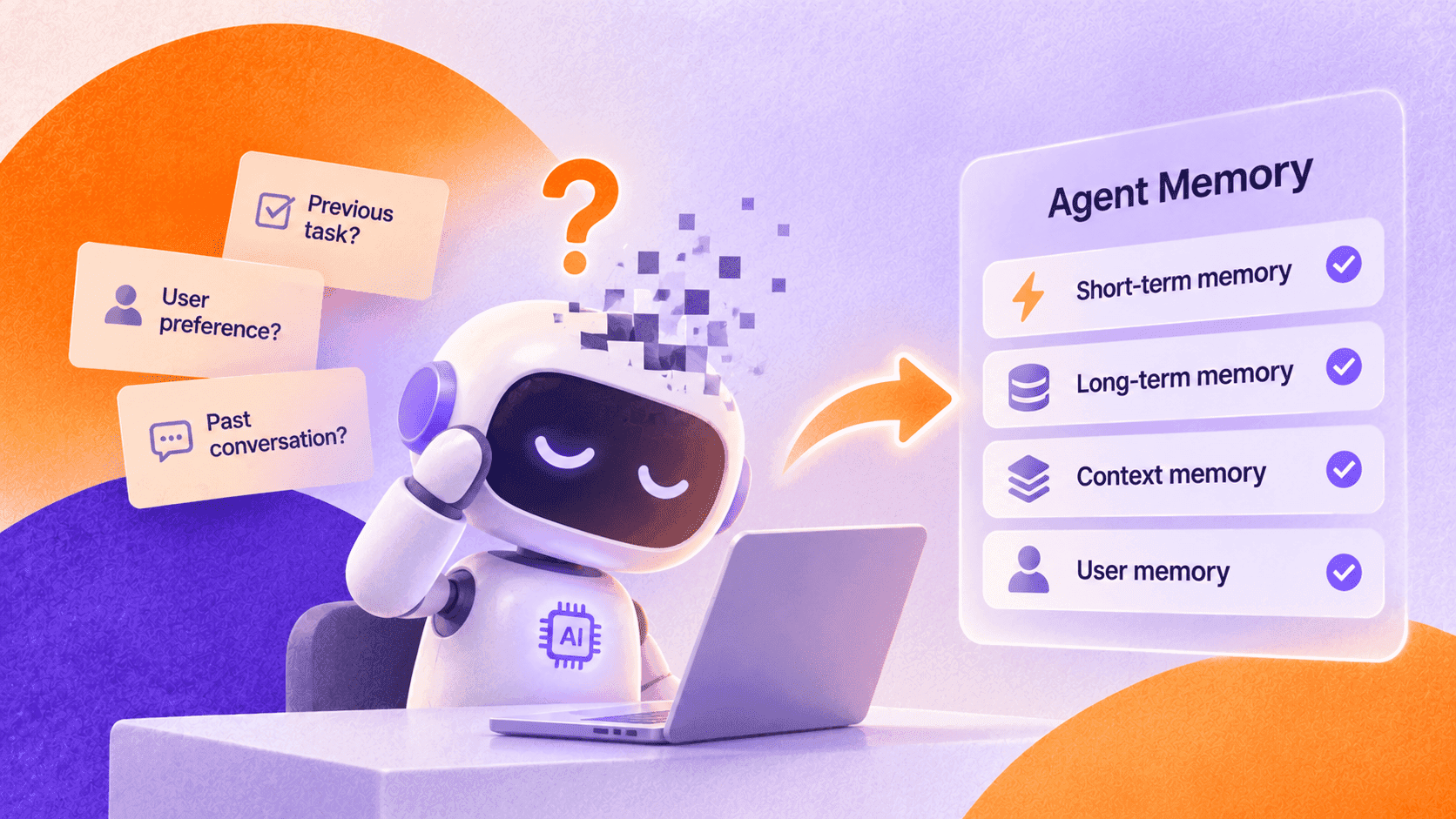
AI agents forget because language models are stateless and have finite context windows. You fix it with AI agent memory: layered storage, smart retrieval, and deliberate forgetting that keep useful facts alive across sessions.
Introduction
Sixty-two percent of organizations are at least experimenting with AI agents, according to McKinsey’s 2025 global survey. Yet many of those agents stumble once a task outgrows a single session. They repeat questions, drop constraints, and contradict earlier decisions. The model is rarely the problem. The real gap is AI agent memory, and most teams have not designed it.
Prompt engineering carried the first wave of agent projects. Persistent memory architectures now carry the second, because agents must recall last week, not just last turn. This guide covers why agents forget and how the agent context window and retrieval-augmented generation (RAG) fit together. It also shows what custom AI agent development looks like when memory comes first.
What Is AI Agent Memory?
Agent memory is the system that lets an agent store, recall, and update information across model calls and sessions. It turns a stateless text predictor into software that remembers users, decisions, and outcomes. Stanford and Google researchers showed the payoff in Generative Agents, where memory, reflection, and planning produced believable long-term behavior.
Three terms get mixed up: knowledge is what the model absorbed in training, and context is whatever sits in the current prompt. Memory is what the agent keeps between prompts and brings back when it matters.
Model parameters stay frozen after deployment, and retraining them is slow, costly, and hard to audit. External memory sits outside the weights, so a team can edit, delete, or version one fact in seconds.
The Four Types of Agent Memory
Cognitive science supplies the taxonomy, and each type answers a different question:
- Working memory: the live context for the current task.
- Episodic memory: time-stamped records of specific past events and outcomes.
- Semantic memory: distilled facts, preferences, and rules about users and domains.
- Procedural memory: learned skills, tool sequences, and playbooks for repeat tasks.
Why AI Agents Forget
Agents forget for six distinct reasons, and fixing the wrong one wastes months.
Context Window Limitations
An agent context window is the total text a model can read and write in one call, including the system prompt, tool results, and history. At the limit, older turns get cut or compacted. A support agent that loses the order number on turn 40 has not failed to reason. It lost the evidence.
Stateless Model Architecture
A language model keeps nothing between calls. Each request starts blank, so the application must resend history or fetch it again. Chat apps hide this by replaying the transcript. An agent that runs overnight cannot lean on that trick, which is why a database, not the model, has to hold the past.
Memory Compression and Summarization Errors
Summaries save tokens but drop details. A note reading “customer wants a refund” may erase the order date, the promised exception, and the customer’s frustration. Errors also compound, because each new summary compresses the last one. Keep raw logs on the side, and summarize only what goes into the prompt.
Retrieval Failures
Stored memory is useless if the agent cannot find it. Three faults cause most misses, and each needs a different fix:
- Missing memories: the fact was never written or was overwritten.
- Poor indexing: weak embeddings or chunking bury the right record.
- Ranking problems: similar but stale items outrank the correct one.
Multi-Agent Coordination Challenges
When several agents share a task, each builds its own picture. A planner may log a deadline that a researcher never sees. Two writers can then create two versions of the truth. Shared state needs ownership rules, timestamps, and one source of record, much like a team wiki with a single editor.
Long-Horizon Task Degradation
Small recall errors multiply across steps. If an agent is right 95% of the time per step, a 20-step workflow succeeds only about 36% of the time. Context also fills with tool noise as work progresses. Reliable long runs need checkpoints, plus state that lives outside the prompt and survives restarts.
Agent Context Window Explained
A context window is the model’s working memory: everything it can read and write in one call, counted in tokens. Anthropic’s documentation notes that current Claude models reach up to 1M tokens. It also warns that accuracy and recall degrade as counts grow, a pattern called context rot.
Long-context models paste more history into each call. Persistent memory decides what deserves keeping and fetches only that. Context engineering, the craft of curating what enters the prompt, matters more than raw window size.
Bigger Context Windows Don’t Solve Memory
Bigger windows delay forgetting without ending it, and four problems remain:
- Cost: every call re-bills the full history.
- Latency: more input tokens mean slower responses.
- Attention dilution: Chroma tested 18 models and found reliability falls as input grows.
- Lost in the middle: recall peaks at the start and end of the prompt and sags in between.
Agentic Memory vs RAG: What’s the Difference?
Teams confuse agentic memory vs RAG because both fetch text before the model answers. The difference is control: RAG reads from documents, while memory lets the agent write, revise, and delete.
How Retrieval-Augmented Generation (RAG) Works
RAG fetches relevant passages from an external knowledge base and adds them to the prompt before the model answers. A pipeline chunks documents, converts them into vector embeddings, stores them in a vector database, and runs a similarity search per query. This grounding reduces hallucination. AI search and knowledge systems usually start here.
What Agentic Memory Adds Beyond RAG
Agentic memory gives the agent write access. It decides what to capture from a conversation, merges duplicates, resolves conflicts, and drops stale entries. Self-RAG hints at the shift by teaching models to decide when to retrieve and to critique what they fetch. Memory extends that idea from reading to curating.
Agentic Memory vs RAG Comparison
In a vendor-run benchmark on long conversations, Mem0 scored about 67% against 61% for the best RAG setup. It also cut p95 latency by 91% versus full-context replay, though replay stayed slightly more accurate. Treat vendor results as directional. The table shows how the approaches differ, from purpose to autonomous decision support.
| Dimension | RAG | Agentic memory |
| Purpose | Ground answers in documents | Retain experience across tasks |
| Data sources | Static document corpora | Conversations, actions, outcomes |
| Learning capability | None; manual reindexing | Writes and refines records |
| Adaptation | Changes with documents | Changes as the agent works |
| Personalization | Limited to the query | Built from user history |
| Long-term reasoning | Weak across sessions | Tracks goals over time |
| Autonomous decision support | Supplies reference facts | Supplies precedent and lessons |
When RAG Is Enough
RAG is enough when the job is answering questions from a stable, shared body of documents. Policy lookups, product manuals, and help-center search fit well. If the agent never has to recall who asked or what it did last time, a tuned retrieval pipeline is cheaper. It is also simpler to govern.
When Persistent Agent Memory Becomes Necessary
Add persistent memory when an agent works across sessions, serves repeat users, or learns from outcomes. A 2026 survey of agent memory reports a telling gap on interdependent multi-session tasks. An active memory agent completed over 80% of them, while a long-context-only baseline managed roughly 45%. Long windows alone cannot close that gap.
Modern AI Agent Memory Architectures (2026)
Early agents bolted a vector database onto a chat loop. Current designs treat memory as layers, a pipeline, and a feedback system. A 2025 ACM survey calls memory key to self-evolving agents.
Memory Layers
Production designs stack four layers:
- Working memory: the live prompt for the current step, cleared when the step ends.
- Session memory: state that survives one conversation, such as open questions.
- Long-term memory: user facts and past episodes that persist across sessions.
- Organizational memory: shared policies and lessons, often fed by decision intelligence.
Memory Pipelines
Memory moves through six stages:
- Capture raw events as they happen.
- Evaluate whether each one matters.
- Store it in the right form.
- Retrieve it at the right moment.
- Update it when facts change.
- Forget what has expired.
Skip evaluation and noise piles up. Skip forgetting and stale facts quietly steer decisions.
Memory Ranking and Relevance Scoring
Retrieval quality depends on scoring, not similarity alone. The Generative Agents work ranked memories by recency, importance, and relevance, and many systems still follow that recipe. Add source trust and decay on top, and penalize memories that get retrieved but never help. Log which memories the agent used, and tune weights against task success.
Reflection and Self-Learning Loops
Reflection lets an agent review outcomes and write lessons for next time. Reflexion stores verbal self-critiques as episodic memory, so later attempts improve without retraining. A simple loop works: act, evaluate, write a lesson, and tag it to the task type. Review each lesson for accuracy before it steers behavior.
Techniques for Building Persistent AI Agent Memory
Production systems rarely rely on one store. They mix techniques by memory type and response speed. MemGPT set the pattern by paging information in and out of the prompt, like an operating system.
Vector Memory Stores
Vector stores embed text and find items by semantic similarity. They suit fuzzy recall, such as what a customer said about shipping. Pair them with metadata filters for user, date, and source. The weakness is that they return similar items, not necessarily correct ones, so add reranking and freshness checks.
Knowledge Graph Memory
Knowledge graphs store entities and relationships, such as customer, contract, and renewal date. They answer multi-hop questions that similarity search misses, like which accounts share a failing supplier. The cost is upfront modeling and extraction accuracy. Start with a narrow schema built around the entities your agent already handles, and expand later.
Structured Relational Memory
Relational databases hold facts that must be exact: preferences, balances, statuses, and permissions. SQL brings transactions, constraints, and easy audits. Agents write through defined tools instead of free text, which prevents sloppy edits and keeps schemas clean. Use this layer for anything where a wrong value costs money or breaks a promise.
Event Logs and Episodic Storage
An append-only event log records what happened: inputs, tool calls, outputs, and outcomes. It is the ground truth for replay, debugging, and compliance. Episodic memory then indexes selected events so the agent can recall similar past cases. Keep raw logs immutable, and derive every summary from them, never the reverse.
Memory Consolidation
Consolidation turns many raw episodes into a few durable facts. A nightly job can merge duplicates, resolve contradictions, and promote repeated patterns into semantic memory. Think of it as sleep for the agent. Track provenance, so every consolidated fact links back to the events that justify it and can be rolled back.
Reflection-Based Learning
Where reflection loops run inside a task, reflection-based learning runs across tasks. The agent reviews batches of outcomes and extracts rules. It then stores them as procedural memory, for example a rule to confirm the shipping address before refunding. Gate promotion with evaluation tests before lessons reach production, because a wrong lesson repeats at scale.
Hybrid Memory Architectures
Most production agents combine stores: relational tables for exact facts, vector indexes for fuzzy recall, graphs for relationships, and logs for history. LongMem pointed the same way by decoupling memory from a frozen model. That adds operational complexity, so start with two stores. Match each memory type to its store.
Best Practices for Managing AI Agent Memory
Eight habits keep stores accurate, fast, and safe:
- Store only useful information: Save decisions, preferences, and outcomes; skip small talk.
- Design memory retention policies: Set a time-to-live per memory class, such as 30 days for session notes.
- Implement memory decay: Lower the weight of unused memories so fresh facts win.
- Prevent hallucinated memories: Write only facts that trace to a user statement or tool result.
- Validate retrieved memories: Check recalled facts against the system of record before acting.
- Separate user memory from business knowledge: Keep personal history and company policy in different stores.
- Optimize memory retrieval latency: Cache hot memories and set a time budget per lookup.
- Protect privacy and sensitive information: Encrypt at rest, redact personal data before writing, and honor deletion requests. AI integration and governance cover access controls and audit trails.
Ready to build AI agents that remember, adapt, and improve over time?
Pinnasys can help design persistent memory architectures for reliable, production-ready AI systems.
Real-World Examples of AI Agent Memory
Memory pays off where context builds over weeks.
Customer Support Agents
A support agent with memory recalls the last three tickets, the product tier, and any promised exceptions. Customers stop repeating themselves, and handoffs to humans arrive with a clean summary. Store resolution outcomes too, so the agent learns which fixes worked and which did not.
AI Sales Agents
A sales agent should remember each contact’s role, objections, and the last commitment made. Without that, follow-ups repeat pitches and miss buying signals, and episodic memory of past deal stages helps time outreach. Tie memory to the CRM record so reps can audit and correct it.
Healthcare Assistants
Healthcare assistants need memory with strict boundaries. A remembered medication list or prior symptoms improves scheduling and triage support, but health data carries heavy privacy duties. Store only what the task requires, apply role-based access, and keep a clinician in the loop. Memory supports staff; it never replaces clinical judgment.
Software Engineering Agents
Agents that write code forget repository conventions between sessions. Procedural memory fixes that by storing build commands, style rules, and past review feedback. Episodic memory records which approach failed and why. Some teams also keep a progress file that the agent reads at the start of every session, so work resumes cleanly.
Financial Operations Agents
Finance agents reconcile invoices, flag anomalies, and chase approvals over weeks. Memory holds vendor quirks, past exceptions, and approval chains. Structured relational storage matters most here, because amounts must be exact and audit logs are mandatory. Fintech AI solutions pair memory with strict permissions and full traceability. Replayable history also speeds audits.
Common Mistakes Teams Make When Implementing Agent Memory
Most failures trace to a few avoidable errors. The table pairs each with a better move.
| Mistake | Why it hurts | Better move |
| Treating RAG as memory | Nothing learned gets saved | Add a validated write path |
| Storing every conversation | Noise buries useful facts | Save decisions and outcomes only |
| Ignoring memory quality | Wrong facts recall confidently | Score, source, and test memories |
| No forgetting mechanism | Stale facts steer decisions | Apply expiry and decay rules |
| Unlimited context stuffing | Cost and latency climb | Retrieve a ranked subset |
| Missing governance and audit trails | Memories cannot be audited | Log every read and write |
The Future of AI Agent Memory
Six directions stand out in current memory research:
- Self-improving memory systems: Agents will tune their own retention rules using evaluation results.
- Lifelong learning agents: Skills and preferences will accumulate over months.
- Hierarchical memory architectures: Fast and slow tiers will extend the paging ideas behind MemGPT.
- Memory-aware reasoning: Models will decide when to recall, verify, or ignore a memory.
- Federated and privacy-preserving memory: Personal data will stay on user devices or in isolated tenants.
- Standards emerging for agent interoperability: Protocols like the Model Context Protocol already standardize tool access, and portable memory may follow.
The Bottom Line
Agents forget because models are stateless, context windows are finite, and many teams treat retrieval as memory. The fix is architectural: layer working, session, and long-term stores. Run every memory through capture, evaluation, retrieval, update, and forgetting. Keep RAG for shared documents, and add agentic memory where the agent must learn from its own work.
Strong AI agent memory depends less on bigger models than on disciplined data design. That means retention rules, validated recall, and audit trails from day one. Pinnasys builds and runs agents with those controls in place.
If you are planning a first memory layer, AI consulting and roadmap work can map stores to workflows before you build.
Key Takeaways
- A larger context window delays forgetting but never replaces selective, persistent storage.
- RAG reads from documents, while agentic memory also writes, updates, and deletes records.
- Memory pipelines need an explicit forgetting step, or stale facts quietly steer decisions.
- Hybrid designs match each memory type to the store that suits it.
- Retention rules, source tracking, and audit logs make production memory safe.
Frequently Asked Questions About AI Agent Memory
What is AI agent memory?
It is the storage and recall layer that lets an agent keep facts, past events, and learned skills between model calls. Researchers describe four types: working, episodic, semantic, and procedural memory.
Why do AI agents forget conversations?
Models are stateless, so each call starts blank. Anything left out of the prompt disappears, and token limits cap what fits. Weak summaries and retrieval lose the rest, even with 1M-token windows.
What is an agent context window?
It is the maximum text, measured in tokens, that a model can process in one request, including prompts, tool results, and its own output. One token is roughly three-quarters of an English word.
What is the difference between agentic memory vs RAG?
RAG retrieves from a mostly static document store. Agentic memory lets the agent write, update, and delete its own records. A 2026 survey notes retrieval quality, not storage, is now the main bottleneck.
Can large context windows replace memory?
Not reliably. Window size delays forgetting but adds cost, latency, and mid-input recall errors. Teams use long context for the current task and external memory for facts that must outlast it.
How do autonomous AI agents maintain long-term memory?
They write important events to external stores, such as a relational database, vector index, or graph, then retrieve relevant records at each step. Scheduled jobs merge duplicates and prune expired entries.
What databases are used for AI agent memory?
Teams commonly pair PostgreSQL for exact facts, Pinecone or Weaviate for similarity search, Neo4j for graphs, and Redis for session state. Managed memory layers often bundle several of these under one API.
Is agent memory safe for business applications?
It can be, with controls. Encrypt stored data, redact sensitive fields before writing, enforce per-user access, and log every read and write. Regulated sectors must also honor GDPR and HIPAA deletion rights.