



Agentic AI in banking is moving KYC, AML, and fraud prevention from reactive, manual workflows to autonomous systems that detect threats faster and at a fraction of the cost. Banks that act now gain a measurable compliance advantage.
Financial crime is not slowing down. According to Nasdaq Verafin’s 2026 Global Financial Crime Report, illicit financial activity reached an estimated $4.4 trillion in 2025, a $1.3 trillion increase since 2023, growing at a 19.2% compound annual growth rate. At the same time, the financial industry detects only about 2% of global financial crime flows despite spending more every year on compliance. The gap between what compliance teams cost and what they catch is the core problem agentic AI is built to solve.
This blog breaks down exactly how banks are applying agentic AI in banking to KYC, AML, and fraud prevention, and what it means for institutions that need to move from pilot to production.
Why Current KYC and AML Models Are Breaking Down
The numbers behind traditional compliance are hard to defend. Banks commonly assign 10 to 15% of their total workforce to KYC and AML activities alone, yet the detection rate for illicit flows sits at roughly 2%. That is a structural inefficiency, not a staffing problem.
According to Fenergo’s Financial Crime Industry Trends 2025 report, financial institutions spend an average of $72.9 million annually on KYC and AML operations. The cost burden does not reflect the outcomes. Rule-based transaction monitoring systems generate false positive rates as high as 90 to 95%, leaving compliance analysts clearing alerts rather than investigating real threats.
Manual KYC processes are equally costly. The cost per customer for manual KYC can run from $1 to $42, while automated processes can bring that figure to as low as $0.10. The problem is not the ambition to do better. It is that traditional tools, including rule-based systems and first-generation analytical AI, only assist humans. They do not replace the inefficient operating model beneath them.
What Is Agentic AI, and Why Does It Matter for Banking?
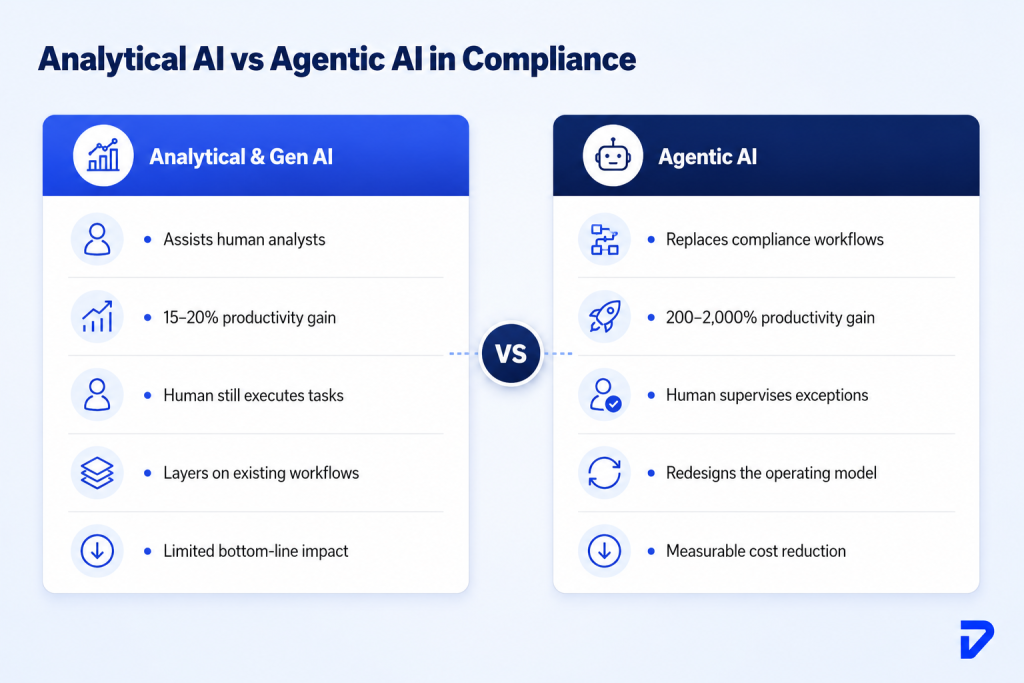
Agentic AI refers to systems where one or more AI agents carry out tasks and make decisions autonomously, with human oversight reserved for exceptions, escalations, and coaching. This is different from analytical AI, which surfaces insights for humans to act on, and generative AI, which drafts content or summaries.
In the KYC and AML context, agentic AI can run an end-to-end workflow: pull customer data, cross-reference it against risk databases, flag anomalies, draft a suspicious activity report, and close the case, all without a human touching each step. A human practitioner supervises the output rather than executing every task.
McKinsey’s research on agentic AI in banking makes the productivity case clearly: when each human can supervise 20 or more AI agents, the productivity gain can reach 200 to 2,000%. That is not a marginal improvement on the existing model. It is a structural change in how compliance work gets done.
Why Gen AI and Analytical AI Fell Short
Most banks that deployed analytical AI or generative AI for KYC and AML reported the same result: efficiency gains of 15 to 20% on individual tasks, but no material impact on the bottom line. The reason is that these tools were layered on top of existing workflows rather than replacing them. Agentic AI, by contrast, replaces the workflow itself. The human role shifts from doing to overseeing.
Agentic AI Use Cases for KYC Automation
Know Your Customer compliance is one of the most resource-intensive processes in banking. It involves identity verification, document collection, beneficial ownership checks, source-of-wealth analysis, and ongoing due diligence for millions of customers at different risk levels.
Agentic AI changes how each stage works:
1. Automated customer onboarding. AI agents can collect documents, verify identity against multiple databases, and assign a preliminary risk rating without human involvement for standard cases. A large Dutch financial institution achieved a 90% reduction in onboarding time and a 30% reduction in staff workload by deploying AI across its KYC and compliance processes.
2. Perpetual KYC. Traditional KYC operates on a periodic review cycle: low-risk customers are reviewed annually, high-risk customers more frequently. Agentic AI enables continuous monitoring, so risk profiles update in real time as customer behavior, sanctions lists, or news data changes. This removes the gap between scheduled reviews where risk can quietly build.
3. Document intelligence. AI agents can extract data from unstructured documents, cross-reference it with policy requirements, and flag inconsistencies. A universal bank that deployed a gen-AI-driven data extraction capability for KYC tested it with more than 50 analysts across a four-week pilot. The system covered more than 50 policy questions and 300 underlying subtasks.
4. Risk stratification. Standard KYC groups customers into two or three risk segments. Agentic AI can segment customers across 10 to 30 categories, directing enhanced due diligence only to accounts that genuinely warrant it, and freeing analysts from spending time on low-risk customers.
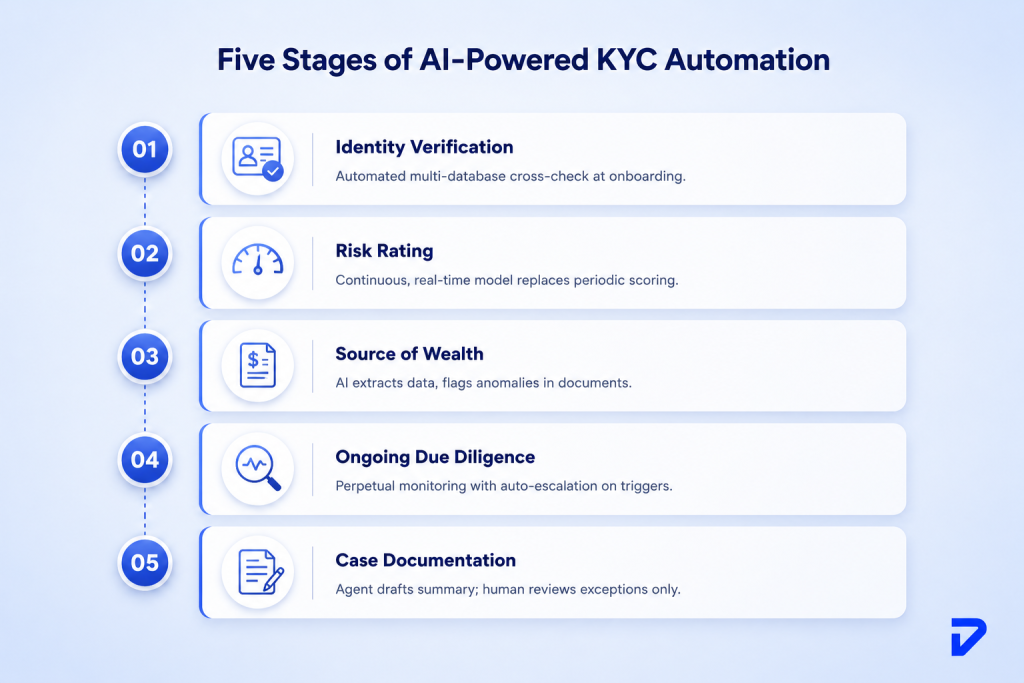
| KYC Stage | Manual Approach | Agentic AI Approach |
| Identity verification | Document review by analyst | Automated multi-database cross-check |
| Risk rating | Periodic scoring by compliance team | Continuous, real-time risk model |
| Source of wealth | Manual document review | AI extraction + flag on anomalies |
| Ongoing due diligence | Annual or event-triggered review | Perpetual monitoring with auto-escalation |
| Case documentation | Analyst writes summary manually | Agent drafts; human reviews exceptions |
Agentic AI Use Cases for AML Compliance
Anti-money laundering compliance is where the detection gap is most visible. Banks spend billions, and Interpol estimates they detect roughly 2% of illicit flows. The failure is not a lack of data. It is a lack of capacity to process that data in real time, at scale, and across all relevant signals simultaneously.
Agentic AI addresses this directly:
1. Transaction monitoring. Traditional rule-based systems flag transactions against static thresholds. Agentic systems correlate transaction patterns, customer behavior, geographic risk signals, and external data in real time. Financial institutions applying AI to AML monitoring report approximately 40% higher anomaly-detection accuracy and materially shorter audit cycles compared to rule-based systems.
2. Suspicious activity report generation. Filing a SAR manually involves gathering evidence, writing a narrative, and meeting regulatory formatting requirements. Agentic AI can assemble supporting documentation, draft the SAR narrative, and route it for human sign-off. This dramatically reduces the time from detection to filing.
3. Sanctions screening. Autonomous systems can screen payments against sanctions lists, assess requirements across multiple jurisdictions, and generate audit trails, all in real time. This is particularly valuable for cross-border payments where compliance complexity multiplies.
4. Network analysis. Agentic AI can map relationships across entities, accounts, and transactions that no human analyst could track manually. It surfaces patterns of layering and integration, the later stages of money laundering that rule-based systems consistently miss.
5. False positive reduction. Traditional AML alert systems generate false positive rates of 90 to 95%, consuming most of the analyst’s day on non-issues. Agentic systems, by correlating more signals and learning from case outcomes, can reduce false positive rates by 40 to 60% while simultaneously raising true positive detection rates.
Ready to modernize banking workflows?
Start with one compliance challenge, define your goal, and deploy AI solutions that deliver measurable impact with Pinnasys.
Agentic AI Use Cases for Fraud Prevention
Fraud is growing faster than scam losses. According to the Nasdaq Verafin 2026 Global Financial Crime Report, fraud scam losses reached $62 billion in 2025 and are growing at a 19.3% compound annual rate. Criminal networks are using AI to generate deepfakes, automate phishing at scale, and create synthetic identities that fool legacy onboarding systems.
Agentic AI for fraud prevention works across several distinct threat types:
1. Real-time transaction fraud. Agentic systems analyze transactions in milliseconds, drawing on behavioral patterns, device fingerprints, location signals, and historical data to make a fraud determination before the transaction completes. An independent bank that deployed AI for ATM fraud detection moved from batch review to real-time detection, catching fraud at the point of transaction rather than after the fact.
2. Synthetic identity fraud. Synthetic identities, where criminals combine real and fabricated data to create a new person, are particularly hard to detect with rule-based systems because no single data point is obviously wrong. Agentic AI can compare identity signals across multiple databases and flag statistical improbabilities that a human reviewer would miss.
Deepfake and document fraud. Deepfake fraud jumped by over 1,100% in the US in recent years, with financial institutions among the most targeted. Agentic AI microservice frameworks, a key part of modern fintech AI solutions, combine liveness detection, deepfake analysis, and document forensics in a single pipeline, stopping presentation attacks that would pass individual checks.
4. Business email compromise. AI agents now embed themselves in compromised email threads and send counterfeit invoices timed to match expected payment schedules. Defending against this requires AI that monitors communication patterns and flags behavioral deviations rather than just scanning for known threat signatures.
| Fraud Type | Legacy Detection Method | Agentic AI Approach |
| Transaction fraud | Rule-based velocity checks | Real-time behavioral + contextual analysis |
| Synthetic identity | Manual document review | Multi-database statistical cross-check |
| Deepfake attacks | Liveness check only | Multimodal AI: liveness + deepfake + document |
| Account takeover | Password and IP monitoring | Behavioral biometrics + device + session signals |
| Business email compromise | Keyword filtering | Communication pattern analysis + anomaly detection |
How Banks Are Implementing Agentic AI for Financial Crime
Moving from understanding the technology to deploying it in production requires a structured approach. Research on leading institutions identifies a consistent pattern in successful agentic AI implementations.
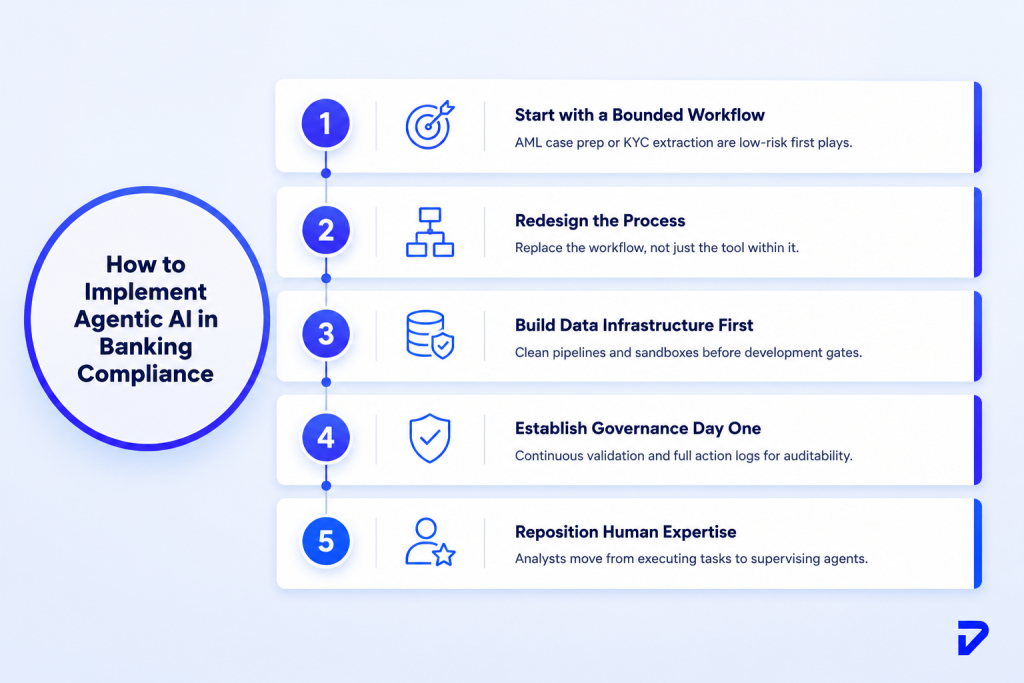
1. Start with a bounded, high-value workflow. The highest-return early deployments are back-office compliance workflows: AML case preparation, KYC document extraction, and suspicious activity report drafting. These have clear inputs and outputs, measurable outcomes, and lower regulatory risk than customer-facing applications. A conservative planning range is 20 to 35% reduction in analyst time in the first year, with payback typically between 18 and 30 months.
2. Rewire the process, not just the tool. Banks that layer AI on top of existing workflows see 15 to 20% productivity gains. Banks that redesign the workflow around agentic AI see the 200 to 2,000% range. The distinction is whether humans are still doing the work with AI assistance, or whether AI is doing the work with human oversight.
3. Build the enabling infrastructure first. Agentic AI requires reliable data pipelines, clean customer data, and integration with core banking systems. Infrastructure gaps are the most common reason production deployments stall. Leading banks prioritize data access and sandbox environments well ahead of software development gates.
4. Establish governance from day one. In the US, the OCC expanded its examination scope in 2025 to include AI model risk management. Banks must implement continuous validation, not static annual reviews, because AI models drift as fraud patterns evolve. Every agent action should be logged for full auditability.
5. Reserve human expertise for exceptions. The agentic model works because humans are not removed from the process. They are repositioned: from executing routine tasks to reviewing escalations, coaching the system on edge cases, and making final decisions on high-risk accounts. This is a different skill set from traditional compliance, and banks that invest in retraining see faster adoption.
What Agentic AI Means for Financial Crime Detection Rates
The ultimate measure of agentic AI in banking is not cost reduction. It is whether financial institutions get closer to detecting more than 2% of illicit flows.
The case that they can is building. Financial institutions applying AI to AML and KYC monitoring report 40% higher anomaly-detection accuracy. Agentic systems that generate SARs with full supporting documentation reduce the cycle time from alert to case closure, which means investigators can handle more cases with the same headcount. And the network analysis capabilities of multi-agent systems surface money laundering patterns at a scale that human analysts cannot reach.
McKinsey estimates that AI could unlock more than $340 billion in annual value for the banking industry. A significant share of that comes from compliance, where the current model is provably broken: high cost, low detection, and growing criminal sophistication on the other side.
The 82% of financial institutions that are already using AI to automate KYC and AML processes have laid the groundwork. The next move is agentic: systems that carry out end-to-end workflows autonomously, not tools that help humans do the same work slightly faster.
The Bottom Line
Financial crime hit $4.4 trillion in 2025 and is growing at nearly 20% per year. Banks spend billions on KYC and AML and detect about 2% of illicit flows. That gap will not close with more analysts or more rules. It closes with a different operating model. Agentic AI gives compliance teams the ability to process more data, at faster speeds, with greater accuracy, while freeing human expertise for the decisions that actually require judgment.
Pinnasys builds and runs agentic AI systems for financial services teams that need production-grade compliance automation, not a pilot that stalls before deployment. The pattern is consistent: start with a bounded compliance workflow, redesign it around agentic AI, and measure the result in analyst hours saved and detection rates improved. If your institution is ready to move from experimenting with AI to running on it, that is where the work starts. Book a discovery call to map your first production deployment.
Key Takeaways from the Article
- Global illicit financial activity reached $4.4 trillion in 2025, growing at 19.2% annually.
- Banks detect only about 2% of financial crime flows despite rising compliance spend each year.
- Agentic AI can deliver 200 to 2,000% productivity gains by replacing compliance workflows, not just supporting them.
- Financial institutions using AI for AML monitoring report roughly 40% higher anomaly-detection accuracy.
- Successful deployments start with bounded back-office workflows, not customer-facing applications.
Frequently Asked Questions
What is agentic AI in banking?
Agentic AI in banking refers to autonomous AI systems that carry out end-to-end compliance and operational workflows without constant human input. Humans provide oversight and handle exceptions. In KYC and AML, agents handle onboarding, monitoring, and case documentation independently.
How does agentic AI improve AML compliance?
Agentic AI correlates transaction data, behavioral signals, and external risk indicators in real time. It generates suspicious activity reports automatically and reduces false positive rates by 40 to 60%. This allows compliance teams to investigate real threats rather than clearing low-quality alerts.
What are the main risks of deploying agentic AI for KYC?
Key risks include model drift (where AI outputs degrade as fraud patterns evolve), data quality gaps that cause incorrect risk ratings, and regulatory risk if audit trails are incomplete. Banks mitigate these with continuous validation, clean data pipelines, and governance frameworks that log every agent action.
How long does it take to see ROI from agentic AI in compliance?
Most institutions that deploy agentic AI in bounded compliance workflows, such as AML case preparation or KYC document extraction, achieve 20 to 35% reductions in analyst time in year one. Payback typically takes 18 to 30 months, depending on the scale of implementation.
Is agentic AI regulated differently from other AI in banking?
Yes. Regulators are increasing scrutiny. The OCC expanded its examination scope in 2025 to include AI model risk management. Banks must treat AI models like managed assets: validated continuously, documented fully, and tested against new fraud typologies. Explainability and auditability are regulatory requirements, not optional.





Prakash C. Saini
Prakash Saini is the Founder & CEO of Pinnasys. With over a decade in digital transformation and building production systems, he grew an engineering team from 2 to 50 people and has led the delivery of 100+ production digital systems. Products built under his leadership have raised millions in funding and generated over $50 million in revenue. He holds an Executive MBA from IIM Kozhikode and today leads the AI engineering team at Pinnasys.