


AI in real estate now runs on three connected systems: voice agents, lead scoring, and property search. Together they qualify callers, rank buyers by intent, and match people to homes faster.
Real estate has adopted AI more slowly than finance or insurance, yet the upside is large. Morgan Stanley research points to operating efficiency as the biggest near-term AI opportunity for property firms. Most of that gain comes from labor savings. AI in real estate now spans three practical fronts. Voice agents answer and qualify inbound calls, lead scoring ranks buyers and sellers by real intent, and property search matches people to homes without endless filter tweaks.
Each front targets a specific bottleneck, from slow follow-up to weak lead triage to buyer frustration. Brokerages that connect these piecesg respond faster and book more appointments. The sections ahead break down how each system works, where it fits, and how a brokerage can start.
What Is AI in Real Estate?
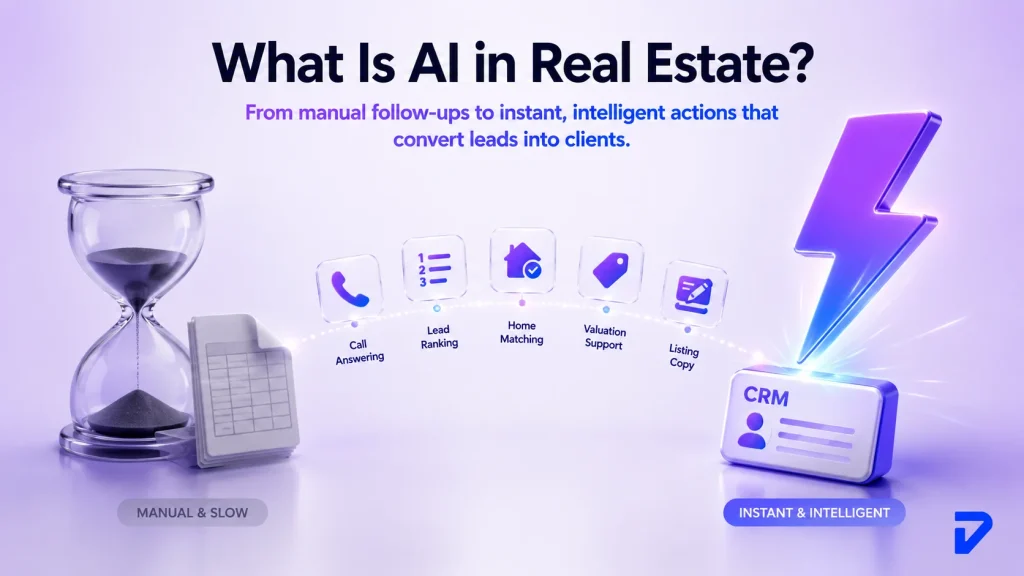
AI in real estate means using machine learning and language models to handle tasks that once needed a person. Think call answering, lead ranking, home matching, valuation support, and listing copy. The goal is not to replace agents, but to remove repetitive work so agents can spend time on advice, negotiation, and relationships. Most tools sit on top of the systems a brokerage already runs, such as the CRM and the listing feed.
Why Real Estate Is a Natural Fit for AI
Real estate produces a steady stream of structured data and repetitive decisions. That mix suits AI well. Listings carry price, location, beds, baths, and photos, most of it flowing in through the MLS. Leads arrive with a source, a timestamp, and a set of actions. Agents repeat the same qualifying questions dozens of times a week. Buyers still lean heavily on people. As per NAR, 88% of buyers used an agent or broker to buy, and many of those agents carry the Realtor® trademark, the familiar R-with-circle logo reserved for NAR members who follow its code of ethics. AI handles the volume and speed. The agent keeps the judgment. That division of labor is why the fit is strong.
From Manual Workflows to Intelligent Systems: The Shift Brokerages Are Making
Most brokerages still run on manual follow-up and spreadsheet triage. A lead comes in, sits in a queue, and gets a call hours later. By then, the buyer has moved on. Intellidgent systems change the sequence. The call gets answered or returned within seconds. The lead gets scored before an agent ever sees it. The best prospects route to the right person automatically. In practice, this shift is less about buying one tool and more about connecting several. That is the harder and more valuable part of the work.
AI Voice Agents for Real Estate
What an AI Voice Agent Actually Does on a Call
On a live call, the voice agent greets the caller and identifies the reason for the call. It asks a few qualifying questions, such as budget, timeline, and area. It checks the listing feed, usually synced from the MLS, to confirm what is available. Then it either books a viewing or routes the caller to an agent. The system logs every detail into the CRM as the call ends. As a result, no lead information is lost to a missed voicemail or a scribbled note.
How an AI Voice Agent Real Estate Deployment Differs From Call Centers and IVR
Old IVR menus force callers through rigid press-one trees. Call centers add cost and still put people on hold. An AI voice agent real estate setup differs on both counts. It understands free speech instead of menu choices. It responds in full sentences, not scripted branches. More importantly, it acts on live data, so it can confirm a listing or open a calendar slot mid-call. That said, it is not a full replacement for a skilled agent. It handles the front door, then hands off complex conversations to a person.
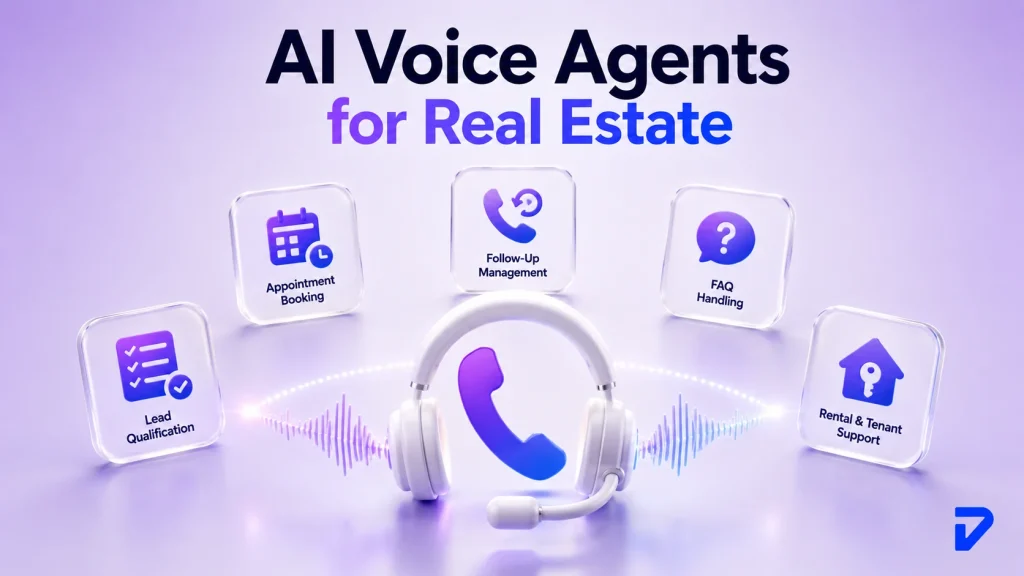
Core Use Cases: Qualification, Appointment Booking, Follow-Ups, FAQ Handling, Rental/Tenant Support
Voice agents earn their keep across a handful of clear jobs. Qualification comes first, since a scored caller saves an agent time. The main use cases include:
- Qualification: Capture budget, timeline, and location, then tag the lead for routing.
- Appointment booking: Offer open slots and confirm viewings directly on the calendar.
- Follow-ups: Call back web leads within seconds and re-engage older, cold contacts.
- FAQ handling: Answer common questions on price, availability, fees, and process.
- Rental and tenant support: Log maintenance requests and answer lease questions after hours.
Each job removes a repetitive task without touching the parts that require human involvement.
Why Speed-to-Lead Makes Voice Agents Non-Negotiable in 2026
Speed-to-lead is the time from a lead’s arrival to a real contact attempt. It decides who wins the deal. Harvard Business Review found a sharp edge for fast response. Firms contacting a lead within an hour were nearly seven times more likely to qualify it. They beat firms that waited a full day by over 60 times. Most brokerages cannot staff phones around the clock. A voice agent can. It answers at 11 p.m. and on a busy Saturday, when human lines are full. For high-volume lead sources, that always-on coverage is the difference between contact and a cold record.
Best Practices for Implementing Voice AI
Start narrow and prove value before expanding. Pick one high-volume call type, such as inbound listing inquiries. Connect the agent to live CRM and calendar data from day one, or the conversation falls flat. Write clear handoff rules so that complex or emotional calls reach a person quickly. Record and review transcripts weekly to catch weak answers. Set an escalation path for anything the agent cannot resolve. In short, treat the voice agent as a teammate you coach, not a tool you switch on and forget.
AI Lead Scoring in Real Estate
AI lead scoring in real estate ranks prospects by how likely they are to transact soon. It reads behavior, not just form fields. A lead who views one home ranks lower than a repeat viewer. Someone who returns five times and requests a valuation ranks higher. The score updates as new signals arrive. This helps real estate agents spend their hours on the few leads most ready to move. Pinnasys builds the predictive analytics and decision intelligence that sits behind this kind of ranking.
What Real Estate Lead Scoring Actually Measures
Lead scoring measures intent, fit, and recency. Intent shows in actions, such as repeat views or a booked call. Fit checks whether the lead matches your inventory and price band. Recency weights fresh activity higher than old activity. A strong system blends all three into a single, readable score. It also decays a score over time when a lead goes quiet. The result is a live ranking that reflects where each buyer or seller stands today, not last month.
How AI Lead Scoring Real Estate Systems Rank Prospects in Real Time
Real-time ranking depends on a steady feed of events. Every page view, email open, and reply becomes a signal. The model weighs each signal and updates the score within moments. AI lead scoring real estate tools, then push that score into the CRM, where it drives routing and alerts. For instance, a lead crossing a threshold can trigger an instant call from a voice agent. The value here is timing. A hot lead gets attention while the interest is still warm, not after it fades.
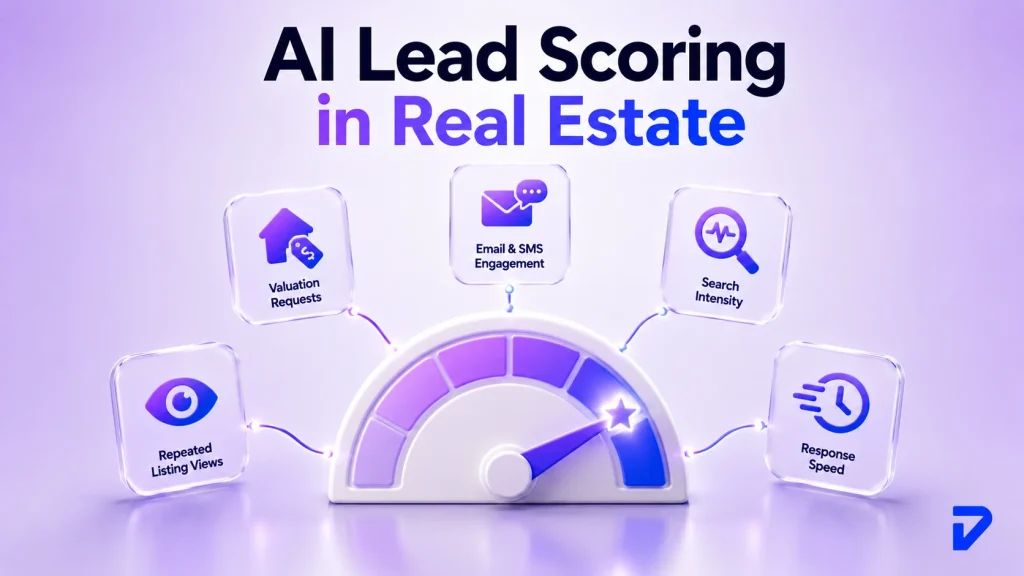
Behavioral Signals AI Tracks: Repeat Listing Views, Valuation Requests, Email/SMS Engagement
Behavior tells you more than a contact form ever will. AI watches patterns that signal readiness to act. Common high-value signals include:
- Repeat listing views: Returning to the same property several times shows real interest.
- Valuation requests: Asking what a home is worth often marks a seller getting ready.
- Email and SMS engagement: Opens, clicks, and quick replies flag an active buyer.
- Search intensity: A jump in saved searches or filters suggests a serious hunt.
- Response speed: Fast replies to outreach point to a motivated prospect.
Together, these signals separate a browser from a buyer with far more accuracy than a static form.
Connecting Lead Scoring to CRM and Agent Routing
A score is only useful when it drives action. The scoring system must write back to the CRM in real time. From there, routing rules send the best leads to the right agent based on area, price band, or specialty. High scores can trigger an instant call, while medium scores enter a nurture track. Clean field mapping matters here, since a score in the wrong field routes to the wrong person. When scoring and routing are properly connected, the strongest leads reach a ready agent within seconds.
Common Pitfalls: Stale Scoring Rules, No Human Review Loop, Poor CRM Field Mapping
Most lead scoring failures trace to a few avoidable mistakes. Stale rules top the list. A model tuned last year drifts as buyer behavior shifts, so scores lose meaning. A missing human review loop is the next trap. Without agents flagging bad scores, errors compound quietly. Poor CRM field mapping causes silent breakage, where scores land in fields that nothing reads. The fix is routine, not clever. Review the rules each quarter and keep humans in the loop. Audit the field mapping before launch and after any CRM change.
AI Property Search: Helping Buyers Find the Right Home Faster
AI property search helps buyers describe what they want in plain language and get back relevant homes. Traditional filters force a buyer to translate a feeling into checkboxes. That translation loses nuance. AI reads intent from natural language and past behavior, then ranks homes pulled from MLS data and displayed through the IDX snippets most brokerage sites already run. This matters because, per NAR, buyers say the hardest part of the process is finding the right home. Better matching cuts that friction. Pinnasys builds the AI-powered search that reads intent across listings and documents, layering smarter ranking on top of a standard IDX feed rather than replacing it.
How AI Property Search Understands Buyer Intent Beyond Filters
A filter knows that a buyer wants three beds within a set price range. It does not know they want a quiet street near good schools with morning light. AI property search reads those softer cues from how a buyer phrases a request. It also learns from what they click, save, and skip. Over time, the system builds a picture of taste, not just specs. As a result, it surfaces homes that a rigid filter would bury on page ten. The buyer feels understood, and the agent gets warmer leads.
Matching Algorithms: Preference Learning, Semantic Search, and Recommendation Engines
Three techniques power modern matching. Preference learning tracks a buyer’s actions and adjusts results toward what they like. Semantic search reads meaning in a query, so “cozy home near the park” returns sensible matches. Recommendation engines suggest homes similar to ones a buyer already favored. A good product blends all three. It starts with the words a buyer types, refines with their behavior, and rounds out with lookalike suggestions. The combination narrows thousands of listings to a short, relevant set fast.
Conversational Search vs. Traditional Portal Filters
Portal filters are fast but blunt. They work when a buyer knows the exact criteria and nothing more. Conversational search fits messy, real questions better. A buyer can type “family home under 600k with a garden and a short commute” and get ranked results. The system asks follow-up questions when a request is vague. It remembers context across the conversation, so each answer builds on the last. Filters still have a place for precise, known needs. For everything else, conversation matches how people actually think about a home.
Property Search as a Lead Capture Layer
Search is not just a buyer tool. It is one of the best lead capture points a brokerage owns. Every query reveals budget, area, and priorities. A saved search signals ongoing intent. An AI search layer can invite a buyer to save results, book a viewing, or ask a question mid-search. Each action feeds into the CRM and the lead-scoring model. In practice, the search box becomes a quiet qualification engine. It turns anonymous browsing into named, scored leads without a pushy form.
Real Estate Automation: Connecting Voice, Scoring, and Search Into One Workflow
Real estate automation ties the three systems into a single flow. Alone, each tool helps. Connected, they compound. Search captures intent, scoring ranks it, and the voice agent acts on it. Pinnasys builds this connective layer through AI workflow automation that links data and actions across tools. The aim is one clean path from the first click to a booked appointment. No manual handoffs drop leads along the way.
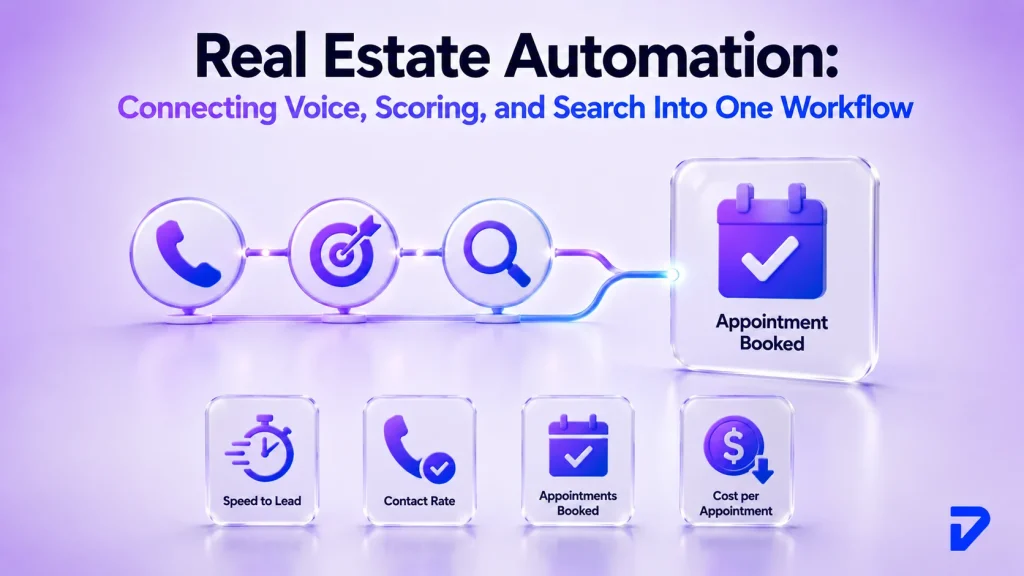
A Sample End-to-End Journey
Picture a buyer at 9 p.m. She types a plain request into AI search and saves two homes. That behavior lifts her lead score above the call threshold. The scoring system writes the update to the CRM. Within seconds, a voice agent calls, confirms her interest, and books a Saturday viewing. The CRM logs every detail, and the assigned agent receives a briefing for the appointment. No one worked a late shift. The buyer felt instant, personal service. That is the point of connecting the pieces.
Where Automation Should (and Shouldn’t) Replace Human Judgment
Automation should own volume, speed, and repetition. It should not own negotiation, pricing strategy, or emotional moments. A voice agent can book a viewing. It should not counsel a nervous first-time buyer through a bidding war. Lead scoring can rank a prospect. An agent still decides how to approach a delicate seller. The rule is simple. Let AI handle the mechanical parts, and reserve the human touch for judgment calls. Cross that line and service quality drops, even as efficiency rises.
Measuring ROI: Speed-To-Lead, Contact Rate, Appointments Booked, Cost Per Appointment
You cannot improve what you do not measure. Four metrics tell the real story. Speed-to-lead tracks how fast a lead gets a real contact attempt. Contact rate measures the share of leads you actually reach. Appointments booked count qualified viewings created. Cost per appointment ties spend to outcomes. Watch these before and after any rollout. If speed-to-lead drops and appointments rise while cost per appointment falls, the system is working. If not, the fix is usually a broken handoff, not the AI itself.
Real Estate AI Use Cases Across the Business
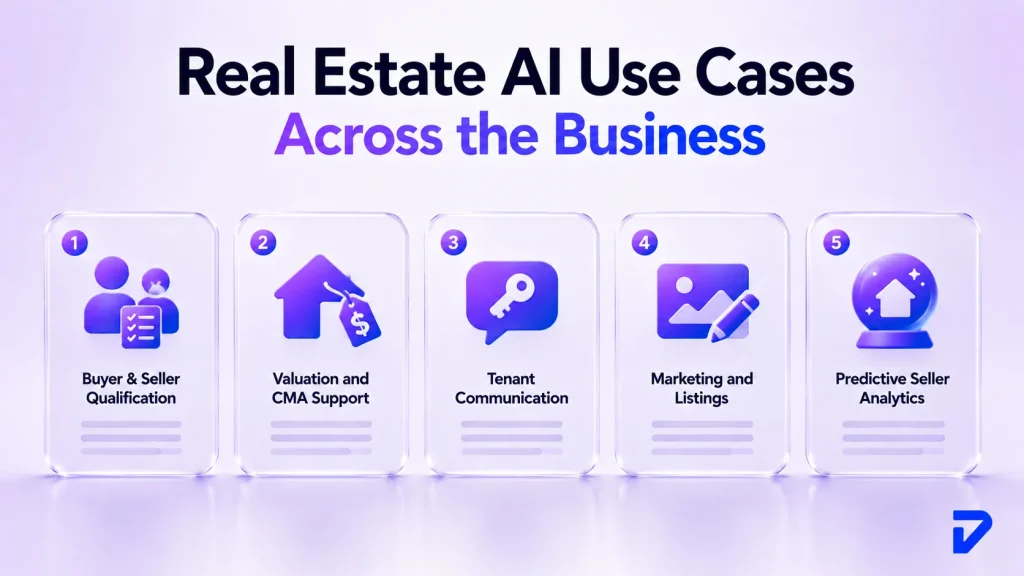
Buyer & Seller Qualification
Qualification decides where an agent spends their day. AI speeds it up on both sides of a deal. For buyers, it confirms budget, financing status, timeline, and area. For sellers, it checks motivation, property type, and price expectations. The system asks these questions by voice, chat, or form, then scores the answers. Agents receive a ready summary instead of a cold contact. That head start means the first human conversation is already informed and useful.
Property Valuation and CMA Support
Valuation tools give agents a fast starting point for price talks. Automated models read public records, comparable sales, and market trends. Zillow reports a median error rate near 1.9% for on-market homes, though off-market figures run higher. That gap matters. An automated estimate is a draft, not a final number. AI can assemble a comparative market analysis in minutes, pulling comps and recent sales. The agent then adjusts for condition, upgrades, and local knowledge no model can see. The mix of speed and human review produces a defensible price.
Tenant and Property Management Communication
Property management runs on constant, repetitive messages. AI absorbs much of that load. It answers lease questions, logs maintenance requests, and sends rent reminders. A voice or chat agent covers after-hours calls, so a leaking tap gets logged at midnight. Routine updates flow automatically, while urgent issues route to a human fast. Tenants get quicker answers, and managers reclaim hours each week. For firms managing many units, this steady communication layer often delivers the clearest early return.
Marketing Content and Listing Descriptions
Every property needs listing copy, and it drains agent time. Generative AI drafts descriptions from the listed facts in seconds. It adapts tone for a starter home or a luxury condo. It can also generate social posts, email campaigns, and ad variants from a single listing. The agent reviews and edits, since accuracy and fair housing language still need a human eye. This keeps quality high while cutting hours of writing. Marketing goes out faster, and every listing gets consistent, polished copy.
Predictive Analytics for “Who’s Likely to Sell Next”
Predictive models flag homeowners who may sell soon. They read signals such as tenure, equity, life events, and local market shifts. An agent then reaches out before the homeowner lists with someone else. This turns cold prospecting into targeted, timely outreach. The models are not certain, and they will miss and misfire at times. Treat them as a priority list, not a promise. They focus prospecting on the households most worth a call.
Getting Started: A Practical Roadmap for Brokerages
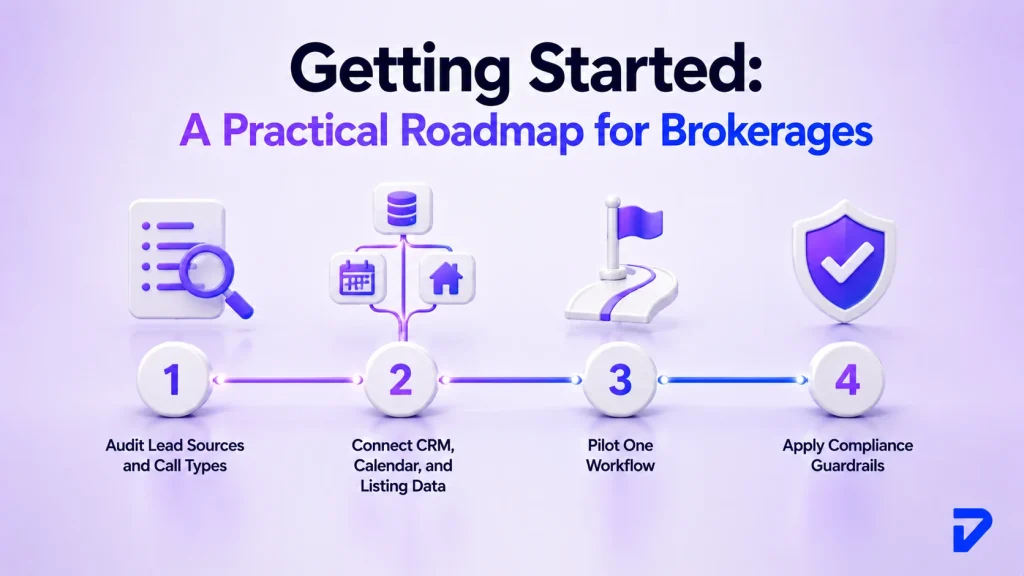
Step 1: Audit Your Lead Sources and Call Types
Start by mapping where leads and calls come from. List each source, its volume, and its typical response time. Group calls by type, such as new inquiries, follow-ups, or tenant issues. This audit shows where speed is at its worst and volume is highest. That intersection is your best first target. Skip the audit, and you risk automating a low-value task while the real bottleneck sits untouched.
Step 2: Connect Your CRM, Calendar, and Listing Data First
AI is only as good as the data it reads. Before adding any agent, connect the core systems. The CRM holds leads and history, whether that’s REW, Follow Up Boss, or another platform your brokerage already runs. The calendar holds availability. The listing feed holds live inventory, typically delivered through an IDX feed pulling directly from the MLS. Wire these together, confirm the data is clean and current, and check that the IDX snippets on your website are actually refreshing on schedule, since a stale feed breaks buyer trust fast. This groundwork feels unglamorous.
Step 3: Pilot One Workflow Before Scaling
Choose a single workflow from your audit and pilot it. Inbound lead response is a common, high-value pick. Run it for a set period against clear metrics, such as speed-to-lead and appointments booked. Compare results to your old baseline. A tight pilot exposes weak handoffs and bad answers early, when fixes are cheap. Once the numbers hold, expand to the next workflow with confidence instead of guesswork.
Step 4: Set Compliance Guardrails (TCPA, fair housing, consent)
Compliance is not optional in real estate outreach. Automated calls and texts fall under TCPA consent rules, so capture and honor consent carefully. Fair housing law applies to AI too. HUD issued guidance on fair housing and AI in tenant screening and advertising. Build guardrails that keep protected characteristics out of targeting and screening logic. Trademark use matters as well: if your team markets under the Realtor® name, keep the R-with-circle logo accurate and properly used in every AI-generated asset. Log consent, keep a human review loop, and audit outputs for bias.
How Pinnasys Helps Real Estate Businesses Build This Without the Guesswork
Most brokerages do not need another point tool. They need the pieces connected and running in production. Pinnasys builds, ships, and runs these systems as one workflow, from voice to scoring to search. The work starts with a short audit of your lead sources and data, not a pitch. From there, the team wires your CRM, whether that’s REW or something else, and your MLS-fed listing feed, including any IDX snippets already live on your site, then pilots one workflow against real metrics.
Compliance guardrails ship as part of the build, not an afterthought. Success gets measured by faster response times, more booked appointments, and lower cost per appointment. The result is practical AI that holds up on a busy Saturday. It is not a demo that breaks after one impressive run.
The Bottom Line
AI in real estate is no longer a single gadget. It is three connected systems that fix real bottlenecks. Voice agents answer and qualify around the clock. Lead scoring ranks buyers by genuine intent. Property search matches people to homes without filter fatigue. Connected through automation, they cut response time and lift booked appointments while agents keep the judgment work.
The brokerages that win will connect these pieces cleanly and guard them with compliance and human review. Pinnasys builds this connective layer with production-grade AI workflow automation that runs past the pilot stage. Ready to move from scattered tools to one workflow? Book a discovery call and map your first pilot.
Key Takeaways from the Article
- Voice agents answer and qualify calls at any hour, closing the speed-to-lead gap.
- Lead scoring ranks prospects by behavior, so agents work the warmest leads first.
- AI property search reads plain-language intent and doubles as a lead capture layer.
- Connecting voice, scoring, and search compounds value that isolated tools cannot match.
- Compliance guardrails for TCPA and fair housing must ship with the build, not later.
Frequently Asked Questions
How is AI used in real estate beyond chatbots?
AI powers lead scoring, property valuation, predictive seller analytics, listing copy, tenant communication, and property search. It also runs voice agents that qualify callers and book viewings. Most tools connect to the CRM and listing data to act on live information.
Can AI voice agents fully replace human agents?
No. Voice agents handle repetitive front-door tasks like qualification, booking, and follow-ups. They cannot manage negotiation, pricing strategy, or emotional moments in a deal. The strongest setups let AI cover volume and speed while human agents handle judgment and relationships.
Is AI lead scoring accurate enough to trust without review?
Not entirely. Lead scoring reads behavior to rank prospects well, but models drift as buyer patterns change. A human review loop catches bad scores and stale rules. Treat the score as a priority guide, not a final decision, and audit it each quarter.
How long does it take to implement real estate AI?
A single workflow pilot often runs in a few weeks once data is connected. The CRM, calendar, and listing feed usually take the most time to connect. Broader rollouts across many workflows span a few months, expanding only after each pilot proves its metrics.





Prakash C. Saini
Prakash Saini is the Founder & CEO of Pinnasys. With over a decade in digital transformation and building production systems, he grew an engineering team from 2 to 50 people and has led the delivery of 100+ production digital systems. Products built under his leadership have raised millions in funding and generated over $50 million in revenue. He holds an Executive MBA from IIM Kozhikode and today leads the AI engineering team at Pinnasys.