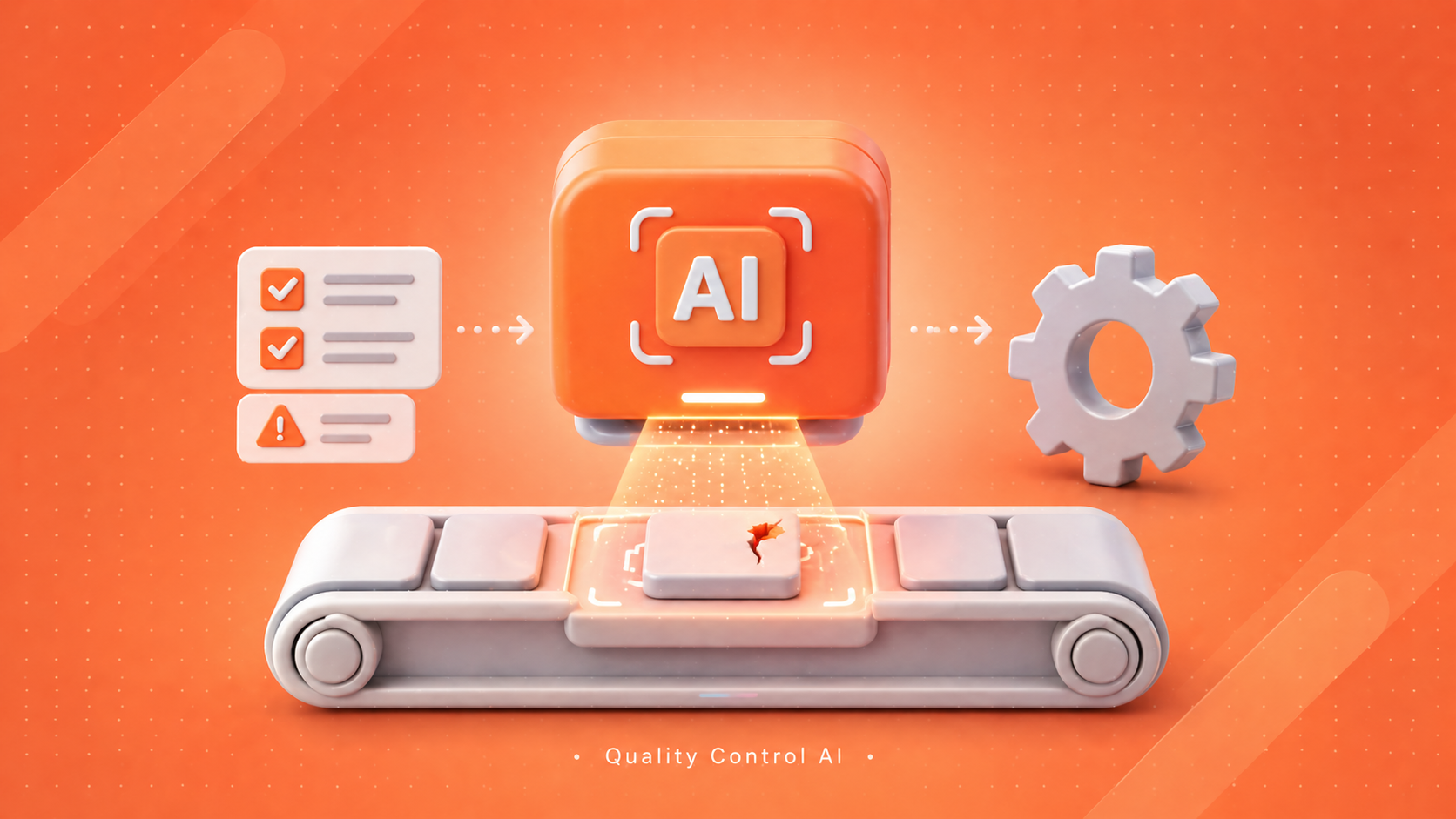
Vision AI now catches 98%+ of surface defects on production lines, with edge inference under 50 milliseconds per part. Manufacturers cut scrap by 20 to 40% and trace every reject back to its batch, machine, and shift.
The manufacturing industry has never relied on anything but sharp eyes, steady hands, and strict quality standards. But nowadays, Lines run faster, tolerances are tighter, and a single missed defect can trigger a recall or kill a customer relationship. Fortunately, we are entering an automation era, and brands have artificial intelligence and machine learning to be their third eye.
Computer Vision in manufacturing is a perfect example and a cornerstone of automated inspection and efficient workflows. It pairs industrial cameras with deep learning models to inspect every part, every cycle, with consistent logic. Being AI experts, we understand how computer vision can significantly improve workflows and have created a detailed guide for you.
What is Computer Vision?
Computer vision is a type of artificial intelligence that enables machines to interpret images and videos. It combines area-scan or line-scan cameras, structured lighting, edge GPUs, and trained convolutional neural networks (CNNs) or vision transformers. The model can identify scratches, cracks, dents, missing components, incorrect labels, barcode errors, weak seals, incorrect shapes, and alignment.
IBM’s research notes that vision models now match or exceed human inspectors on many surface defect tasks, while running 24/7 without fatigue. A production-grade vision setup usually runs on an edge device near the line. That cuts inference latency to under 50 milliseconds per part. The system then signals a PLC to reject, sort, or flag the unit. Cloud sync handles long-term storage, retraining, and dashboards.
Benefits of Using Computer Vision in Manufacturing
Consistent Defect Detection
When employees are exhausted, in a hurry, or distracted, quality inspection can become inconsistent. Manual results may also be influenced by lighting variations and high production rates. Nevertheless, AI quality control uses the same inspection rationale for each product. It measures surfaces, edges, dimensions, colors, labels, and assemblies with consistent results. Thus, defect detection AI assists manufacturers in minimizing missed defects, making judgments subjectively, and enhancing consistency in quality across shifts, lines, and production facilities.
Full Traceability
Traceability assists manufacturers in knowing all quality choices throughout the production and shipment stages. Inspection images, timestamps, defect types, batch information, product identification, and rejection justifications can be stored in a computer vision system. Thus, teams will have an opportunity to examine what has occurred without making assumptions. In case a customer complains of a defect later on, the factory can trace the product to its machine, shift, batch of material, or supplier. This audit trail is critical for ISO 9001, IATF 16949, and FDA 21 CFR Part 11 compliance.
Predictive Maintenance
Computer vision is not just about checking the completed products. It is also capable of tracking equipment, tools, belts, rollers, welds, moving parts, and machine surfaces. When cameras detect wear, leakages, misalignment, abnormal movement, or surface damage, the teams can take action before failure occurs. Thus, the production lines experience fewer abrupt halts. The predictive maintenance also assists the manufacturers in planning the repairs at the appropriate time, decreases the downtimes, and safeguards the output without having to wait until serious equipment failures occur.
Automated Inspection
Automated inspection assists factories in inspecting products without slowing production. As items go through the line, Industrial cameras capture at 60 to 1,000 frames per second. Then, AI models process those photos and indicate issues in real-time. This can facilitate greater manufacturing automation since inspection is now part of the regular workflow. Instead of repetitive visual inspections that are tiresome to perform, operators can prioritize improvement, exception management, and process control.
Real-Time Visibility
The visibility in real time provides the leaders in the factories with a clear view of quality performance as the production occurs. Dashboards may depict the rate of defects, trends of rejections, machine failures, the accuracy of the inspection process, and the flow of products. Thus, the supervisors will be able to take action before minor problems develop into huge amounts of waste. Alerts in real-time also assist teams in correcting process mistakes within a brief period. Rather than finding out the quality failures at the end of a shift, manufacturers can rectify the problems in the running production process.
6 Best Use Cases of Industrial Computer Vision
Surface Defect Detection
Surface quality is important in such industries as automotive, electronics, packaging, medical equipment, metals, plastics, glass, and consumer goods. Scratches, stains, dents, cracks, bubbles, rust, chips, changes of color, and texture abnormalities can be identified as part of industrial computer vision. This is of particular use when products move rapidly or defects are found in small localities. Thus, visual inspection AI can assist teams in identifying defects earlier and avoiding sending damaged products to customers.
Assembly Verification
Errors during assembly can be costly since a single lost or misplaced component can have an impact on the entire product. Computer vision can be used to verify the presence of screws, clips, connectors, wires, seals, caps, labels, and components, and their proper placement. It is also able to make comparisons of the product to a standard image or design requirement. Consequently, the AI for defect detection reduces rework, avoids incomplete products passing through the production line, and enhances reliability in the production line of high complexity.
Packaging Inspection
Inspection of packaging safeguards the safety of the products and the experience of the customers. Computer vision can verify the state of cartons, the quality of seals, the level of filling, the location of labels, the position of caps, the printed codes, date marks, and the position of the product. This will assist manufacturers in identifying damaged packs, missing inserts, incorrect labels, and poor seals before shipment. The errors in packaging may lead to returns, compliance issues, and damage to brands. Thus, automated packaging inspections generate high value towards the end of the production cycle.
Dimensional and Conformance Inspection
Certain products have to conform to specific size, shape, spacing, and alignment criteria. Computer vision has the ability to check length, width, height, angles, holes, edges, gaps, and contours without handling the item. The inspection is a non-contact inspection that is applicable to delicate parts and fast-moving production lines. It also assists manufacturers in being confident that each product is designed as per specifications. So, dimensional inspection enhances accuracy, decreases the delays caused by manual measurements, and assists with a higher level of compliance in regulated manufacturing settings.
Label, Barcode, and Seal Checks
Mislabeling of products and illegible barcodes can generate serious traceability issues and compliance issues. Computer vision can check label location, printed text, QR codes, barcodes, batch numbers, expiry dates, and seal condition. It is also able to identify any missing labels, tilted labels, smudged print, and damaged codes. This is significant in food, pharmaceuticals, electronics, cosmetics, and consumer products. Thus, vision systems can be used as a measure that would protect distribution accuracy and minimize quality failures in shipments.
AI-Powered Quality Assurance
AI-powered quality assurance connects inspection results with smarter factory decisions. It does not just discard bad products. It also categorizes types of defects, patterns, and risk areas and assists the teams in learning about the behavior of the process. Thus, computer vision quality control benefits are reduced scrap, reduced returns, enhanced compliance, expedited root-cause investigation, and improved process learning. As time goes on, quality teams may employ visual information to enhance production rather than merely respond to issues.
Not sure if your stack is ready for production AI?
Six steps look clean on paper. In practice, most in-house teams ship the model and stall on integration, drift, and retraining. Book a discovery call with Pinnasys’s AI consulting team to scope your deployment.
Step-by-Step Process to Deploy AI Quality Control in Manufacturing
Choose an Inspection Problem
The first step is choosing a clear inspection problem. Manufacturers must not attempt to automate all quality checks simultaneously. Instead, they ought to identify a single issue that generates actual cost, delay, waste, or customer dissatisfaction. This can involve surface scratches, missing parts, inadequate seals, misplaced labels, or improper assembly. A focused start makes implementing vision AI in factories easier to manage and measure. It also assists teams in demonstrating value prior to extending the system to additional lines or products.
Define the Defect Classes
Once the inspection problem has been selected, teams need to specify the classes of defects in a concise manner. As an example, a surface inspection project can comprise such classes as scratch, dent, crack, stain, chip, discoloration, and acceptable mark. Such definitions need to be easily comprehensible by engineers, operators, and quality teams in the same terms. Clarity enhances the labeling of images and model precision. AI for defect detection works best when the system learns from well-organized examples with consistent rules.
Collect and Prepare Training Data
Successful AI quality control is based on strong training data. Teams must gather pictures of actual production situations, not just confined to test settings. The dataset must consist of good products, defective products, various lighting conditions, angles of the products, material changes, and the levels of defects. Thereafter, all images should be marked properly. Bad data may result in spurious notifications or overshoot flaws. Good data will assist the model to work reliably on the real production line.
Train and Validate the Model
Engineers train a CNN architecture (ResNet, EfficientNet) or a vision transformer (ViT, Swin) on the labelled dataset. Use a hold-out validation set that the model has never seen. Track four metrics:
- Precision: of all flagged defects, how many were real
- Recall: of all real defects, how many were caught
- False reject rate: good parts wrongly flagged as defective
- Inference latency: milliseconds per image at production resolution
Aim for recall above 98% on safety-critical defects. Precision targets depend on the cost of false rejects. Validation must use real production images, not curated test sets.
Integrate with the Production Workflow
The computer vision model becomes helpful when it is linked to the production workflow. Cameras, lights, edge devices, PLCs, rejection systems, operator screens, dashboards, and quality databases need to cooperate. Gartner Peer Insights defines machine vision software as that which aids in visual inspection, including defect detection, recognition, measurement, and classification. Appropriate integration assists in initiating immediate responses, including alerts, product rejection, or process adjustments.
Monitor and Improve
A vision system should be monitored on a regular basis once deployed. Changes in the production conditions are due to the appearance of new suppliers, materials, lighting, equipment settings, product designs, and defect patterns. Thus, the teams should examine model performance, check the false results, and retrain the system when necessary. This makes the defect detection AI accurate throughout the time. Constant improvement also assists in lessening false alarms, enhancing yield, and enhancing trust in the operators. A good system can be improved when more helpful inspection data is made available.
The Bottom Line
Computer vision in manufacturing has moved past pilots. It now runs production lines for defect detection, assembly checks, packaging validation, dimensional inspection, and predictive maintenance. The factories getting real ROI share a pattern: they pick one defect that costs real money, build clean data, integrate with the MES, and treat the model as a living system that needs retraining. The hype is loud. The work is unglamorous. Pinnasys partners with manufacturers to do that unglamorous work well, from data collection through MLOps. To map your highest-value inspection use case, explore Pinnasys’s AI for manufacturing or book a discovery call with our team.
Key Takeaways from the Article
- Vision AI inspects 100% of parts at line speed with consistent logic.
- Surface defect, assembly, and packaging checks deliver the fastest payback.
- Edge inference keeps latency under 50 ms per part on real lines.
- Production success depends on labelled data, MES integration, and MLOps.
- Continuous retraining handles drift from new materials, lighting, and tools.
Frequently Asked Questions About Computer Vision in Manufacturing
What is the difference between AI visual inspection and machine vision?
Conventional machine vision typically has predetermined rules and algorithmic thresholds. Since it learns by using the data of images, AI visual inspection can be more flexible in handling more variation, complex defects, changing surfaces, and real-world production conditions.
Why can computer vision outperform manual inspection in some tasks?
Computer vision is able to scan and examine all products at high speed without exhaustion and loss of concentration. It is more appropriate in repetitive, detailed, and high-volume checks where a manual check can become inconsistent over time.
Which KPIs are most important in manufacturing inspection deployment?
Important KPIs include detection accuracy, false rejection rate, false acceptance rate, inspection speed, scrap reduction, rework reduction, downtime impact, and customer return rate. These measures indicate the actual value of production.
Can computer vision help beyond defect detection?
Yes, computer vision can be used to support predictive maintenance, safety monitoring, inventory checking, assembly checking, barcode reading, packaging checking, process monitoring, and traceability. It has a value that spans numerous factory activities.