Tag: Agentic AI

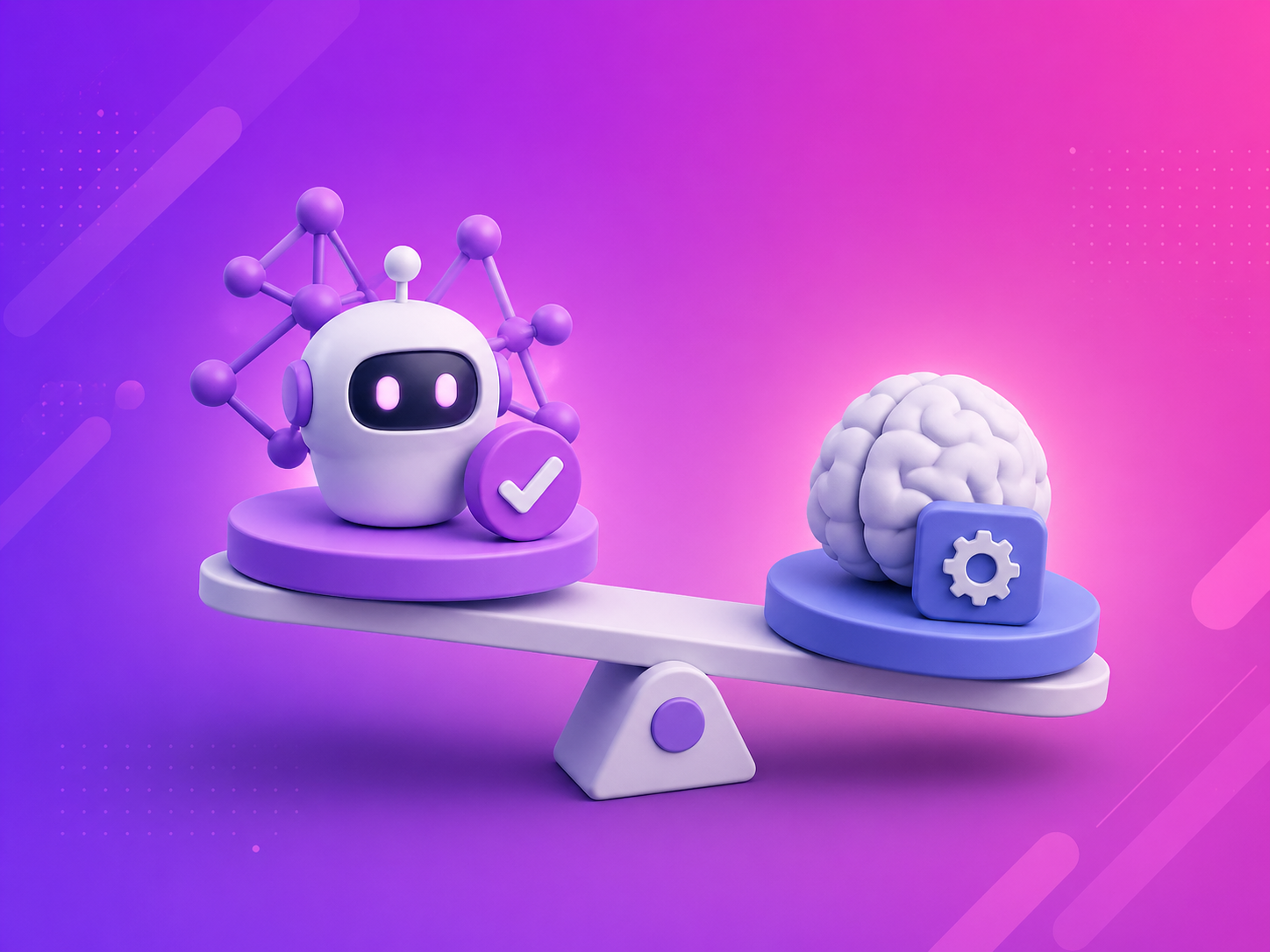
  • Agentic AI vs Traditional AI: Understanding the Next Evolution

    Agentic AI vs Traditional AI: Understanding the Next Evolution

    Agentic AI is the architectural shift from AI you query to AI that closes its own loops. Traditional models score, classify, or reply. Agents plan, call tools, recover from failures, and finish work end-to-end across the systems your team already runs.

    Gartner forecasts that 33% of enterprise software applications will include agentic AI by 2028, climbing from less than 1% in 2024. That kind of curve is rare, and it has put founders under real pressure to ship something agentic before they have decided what the technology is actually for. The cause of most stalled pilots is almost never the model.

    It is a mismatch between the architecture chosen and the shape of the work, and that mismatch is what this article is about. The sections below break down the meaningful differences between agentic AI and traditional AI, the architecture that separates a real agent from a wrapper, and a clear frame for deciding which one belongs in your stack. So, let’s get started.

    What is Agentic AI?

    Agentic AI describes systems that pursue goals through multi-step reasoning and live tool use, with minimal prompting between steps. A traditional model takes input X and returns output Y. An agent takes a goal G and runs whatever sequence of model calls, API requests, document lookups, and approvals it needs to make G true.

    A healthcare prior-authorization agent, given the goal “secure approval for procedure code 47562 on patient #88421,” pulls the patient’s coverage rules from the payer portal, cross-checks the medical record against clinical criteria, fills the authorization form, attaches the relevant chart notes, submits, and watches for the response, escalating to a nurse reviewer only on a denial.

    How do AI Agents Work?

    Modern agents run a structured reasoning loop, most commonly variants of ReAct or Plan-and-Execute. The agent observes its current state, reasons about the next action, executes it via a tool, and incorporates the result before deciding what to do next. Around this loop, four pieces separate a working agent from a demo.

    Memory provides continuity across steps and sessions, usually split between a short-term scratchpad and long-term storage in a vector database. A tool registry defines what the agent can touch, scoped to specific OAuth permissions or service accounts. Guardrails handle policy enforcement, from refusal rules to spend caps. Observability captures every reasoning trace for replay, evaluation, and audit.

    Traditional AI at a Glance

    Traditional AI covers the model architectures most teams already run in production: classification systems, recommendation engines, fraud scorers, forecasting models, and standard LLM chatbots. Each accepts input, runs a single forward pass, and returns output, with no plan, no recovery path, and no persistent memory beyond the current request.

    A SaaS churn model scores one account at a time. A fintech fraud detector decides on a transaction-by-transaction basis. A retail recommender ranks one product list per page view. For tasks with a fixed input shape, predictable latency, and well-defined success criteria, this design is fast, cheap, and reliable. The ceiling shows up when a workflow needs judgment to be chained across multiple systems.

    Difference Between Agentic AI and Traditional AI

    DimensionTraditional AIAgentic AI
    TriggerSingle request from a user or upstream systemA goal handed in from a queue, schedule, or trigger event
    ReasoningOne forward pass through the modelMulti-step plan with re-planning when steps fail
    MemoryStateless, or limited to the current context windowPersistent: short-term scratchpad plus long-term vector store
    Tool useNone, or a single hard-coded integrationDynamic function calling across APIs, databases, and files
    AdaptabilityDegrades on inputs outside the training distributionReroutes, retries with a different tool, or escalates
    Human roleOperator queries, model respondsSupervisor sets goals, reviews exceptions, audits traces
    Typical outputA score, label, or single messageA closed ticket, completed claim, or committed transaction
    Industry exampleHealthcare ICD-10 coding suggestionHealthcare prior-auth agent that submits and tracks the request
    Cost profileLow setup, flat per-call run costHigher build, lower long-term cost per outcome

    Autonomy and Initiative

    Traditional AI is reactive: the user asks, the model answers, and the loop terminates. Agentic AI inverts that posture; you hand it an outcome, and it picks the path. A SaaS support team running a traditional model uses it to draft a single canned reply when an agent clicks “suggest response.”

    Add agentic logic on top, and the same team gets a system that triages the incoming ticket against past similar cases, queries the product API for the customer’s plan and usage history, drafts a response, attaches the relevant runbook, and routes anything ambiguous to a tier-two engineer with full context already gathered.

    Reasoning and Planning

    Traditional AI resolves a problem in one shot, with no plan to inspect or correct. Agentic AI uses chain-of-thought reasoning to decompose a goal into ordered sub-tasks, each capable of calling a different tool. A fintech onboarding agent processing a new business customer runs a KYB lookup against a registry like Companies House.  

    Besides, it screens directors against an OFAC sanctions list, reconciles the entity name across registration documents and bank statements, and flags discrepancies with a confidence score and a citation back to the source. If the registry is rate-limited, the agent backs off and retries. If a director match is ambiguous, it surfaces both candidates rather than leaving it to guesswork.

    Adaptability to Edge Cases

    Traditional AI breaks the moment input drifts outside its training distribution. A logistics dwell-time forecaster trained on clean carrier data misfires the moment a carrier sends malformed timestamps or switches reporting cadence. An agent handles that drift by treating each step as a decision, not a function call.

    If a primary data source returns garbage, the agent reaches for an alternative, retries with adjusted parameters, or escalates with the partial information already collected. A logistics exception-handling agent investigating a shipment delay can pull tracking from the carrier API, fall back to scraping the carrier’s public portal if the API times out, and message the broker for confirmation, all before flagging the case to operations.

    Tool Use and Integration

    Traditional AI lives entirely inside the model. Agentic AI reaches outside it through function calling, the capability that lets a model emit a structured request to call an external function, receive the result, and continue reasoning. This single feature is what makes the agent useful across the five or six systems most workflows actually touch.

    Multi-agent architectures extend the idea by assigning specialized roles to different agents that pass context forward. A retail merchandising team might run a researcher agent gathering competitor pricing, an analyst agent identifying margin opportunities, and a planner agent generating recommended price moves with expected lift, each handing structured artifacts to the next.

    Not sure whether your workflow needs an agent or a plain model?

    Pinnasys runs a 30-minute architecture review that maps your process to the right approach. Book a discovery call today!

    Core Components of Production-Grade AI Agents

    A production agent rests on four architectural layers. Underinvesting in any one is the most common reason pilots fail to graduate.

    The Planner

    The planner is the reasoning core, responsible for decomposing a goal into subtasks and choosing which run in what order. Most modern planners sit on top of a frontier reasoning model like GPT-4 class, Claude, or Gemini, extended with structured techniques such as ReAct, Plan-and-Execute, Tree-of-Thoughts, or reflection loops that critique and revise an in-flight plan. The hallmark of a strong planner is graceful failure handling. When a tool errors out, it logs the failure, picks a different strategy, and continues toward the goal rather than retrying the broken call until the budget drains.

    Memory and Context

    Traditional AI has no memory once the response is sent. Agents need two distinct memory systems. Short-term memory holds the running state of the current task, including intermediate tool results and the reasoning trace behind the latest decision. Long-term memory captures user preferences, past outcomes, and patterns the agent has accumulated across sessions, typically split between a vector database for semantic recall and structured storage for facts the agent must retrieve exactly. The hard problem here is retrieval, which is why production agents almost always run RAG pipelines underneath. Pinnasys’s custom AI development team treats this layer as the first thing to design.

    Tool Layer and Guardrails

    The tool layer defines every API the agent can call, every dataset it can read, and every action it can commit on your behalf. Each tool is registered with a schema, scoped to a specific OAuth permission or service account, and rate-limited at the integration boundary. Guardrails sit alongside it and define what the agent cannot do, regardless of what its planner decides. A fintech agent might be capped at $500 per transaction, blocked from posting to any external counterparty without a human approver, and prohibited from writing to any database outside business hours. Without guardrails, agents drift, and the drift gets expensive.

    Observability and Evaluation

    Every action an agent takes should be traceable, replayable, and measurable. Production teams capture the full reasoning trace for each run, the tool calls made, the data returned, and the outcome, written into a structured log designed to be queried later. On top of that, evaluation frameworks measure metrics specific to agentic systems: task completion rate, tool-call accuracy, recovery rate from failed steps, and the faithfulness of the final output to the underlying data. Without this layer, an agent is a black box that costs real money and produces real consequences.

    When to Use Agentic AI and When to Stick With Traditional AI

    When Agentic AI Wins

    Agents earn their setup cost when the workflow has multiple steps, touches several systems, and requires judgment that a rule engine cannot encode. A SaaS customer success team drowning in renewal analysis is a strong fit, because the work spans CRM data, product usage telemetry, support history, and billing records, and the answer is an opinion rather than a number. Reach for an agent when:

    • The workflow spans three or more systems in its natural execution path.
    • The destination matters more than the exact route taken to reach it.
    • Edge cases and unusual inputs are the rule, not the exception.
    • The current process consumes 30-plus hours a week of skilled human time.
    • A human-in-the-loop checkpoint is acceptable on ambiguous cases.

    The teams that realize the upside redesign the workflow around the agent’s strengths, rather than wrapping an agent around an unchanged process.

    When Traditional AI is the Better Call

    Not every workflow deserves an agent, and defaulting to one is partly why Gartner expects over 40% of agentic AI projects to fail by 2027. Pick traditional AI when:

    • A single classification, score, or response is the entire job.
    • Latency and cost have to be tight, predictable, and defensible per request.
    • Compliance forbids autonomous actions without a human in the loop.
    • The workflow has fewer than two meaningful decision points.
    • A rule engine, RPA system, or fine-tuned classifier already solves it cheaply.

    The discipline is to match the architecture to the actual shape of the work, not the shape of the hype cycle. Most retail product recommendation systems do not require agents. Most fintech transaction scorers do not either. Pinnasys’s AI consulting services team runs the fit assessment before any code gets written, which is usually the cheapest hour you will spend on the project.

    The Bottom Line

    Agentic AI represents a structural shift from request-driven to outcome-driven AI, reshaping what your team must build, govern, and measure. Traditional AI continues to win on narrow, high-volume tasks where predictability is the entire point. Agents earn their cost on multi-step, multi-system work where the destination matters more than the path.

    Mature programs use both, carefully scoped to the jobs each handles well. Pinnasys designs production-grade agents for SaaS, fintech, healthcare, legal, retail, and logistics teams that need more than a proof of concept. If you are evaluating where agentic AI fits in your stack, our agentic AI services team can scope the smallest useful pilot. Book a discovery call to start.

    Key Takeaways from the Article

    • Architecture beats hype: pick agents for outcomes, traditional AI for answers.
    • The planner, not the model, decides whether an agent survives production.
    • Memory, retrieval, and observability are the layers most teams underbuild.
    • Guardrails turn a clever demo into a system worth shipping to customers.
    • Most failed agentic projects solved problems that did not require an agent.

    Frequently Asked Questions

    What does it actually cost to run an agentic AI project?

    A scoped pilot typically lands between $30,000 and $120,000, depending on integration depth. Monthly run costs track LLM tokens, tool calls, and memory storage, and typically range from $500 to $5,000 for a moderately active production agent at startup scale.

    Does agentic AI replace RPA, or do the two work together?

    Agents complement RPA far more than they replace it. RPA handles high-volume, rule-based clicks reliably and cheaply. Agents handle judgment, unstructured inputs, and edge cases. The strongest stacks use RPA for repetitive tasks and agents for decision-making.

    Can agentic AI be deployed safely in regulated industries?

    Yes, provided the guardrails are designed before the agent ships, not bolted on afterward. Scoped tool access, approval workflows, audit logs, and human-in-the-loop checkpoints make agents viable across finance, legal, and healthcare. Safety is a governance decision.

    How long does it take to build a working AI agent?

    A usable first version typically ships in four to eight weeks once the scope is clear. Hardening to production quality, with evaluation, guardrails, and monitoring, takes another three to five months. Complexity scales with the number of tools, integrations, and edge cases involved.

    Should I start with a single agent or a multi-agent system?

    Start with a single agent every time. Graduate to multi-agent only when one agent becomes a context bottleneck, or when distinct roles clearly emerge, like researcher and writer. Multi-agent designs add coordination overhead and should be earned, never assumed upfront.
  • AI Agent Observability Best Practices for Reliable and Compliant Systems

    Introduction

    As autonomous AI systems make decisions impacting customers, operations, and compliance, the question “What is our AI doing, and why?” becomes critical. AI agent observability separates production-ready systems from experimental prototypes, enabling organizations to monitor, understand, and govern autonomous behaviors in real-time. Without comprehensive AI monitoring and governance, even sophisticated agents become operational risks.

    This guide explores best practices for implementing observability in autonomous AI, building governed AI systems, and ensuring reliable AI agents that deliver value while maintaining compliance, trust, and accountability.

    What Is AI Agent Observability?

    AI agent observability extends beyond traditional monitoring, providing visibility into autonomous decision-making processes, reasoning chains, tool usage, and outcome patterns. While conventional systems track metrics like latency and error rates, agentic AI requires understanding why decisions were made, how agents reasoned through problems, and what actions were taken autonomously.

    Core Components:

    • Decision Tracing: Complete audit trails of reasoning steps and choices
    • Action Logging: Records of all autonomous actions across systems
    • Performance Metrics: Success rates, accuracy, efficiency measurements
    • Behavior Analysis: Pattern detection in agent decision-making
    • Anomaly Detection: Identifying unexpected or problematic behaviors

    Unlike black-box AI, observable agents provide transparency essential for debugging, compliance, optimization, and stakeholder trust.

    Why Observability Matters for Agentic AI

    Autonomous agents operate with minimal human oversight, making observability non-negotiable:

    1. Compliance Requirements: Regulators demand explainability for automated decisions affecting customers, financial services, healthcare, and hiring. Ethical AI deployment requires demonstrating fair, non-discriminatory decision-making through comprehensive logging and analysis.
    2. Operational Reliability: AI system reliability depends on quickly identifying when agents deviate from expected behaviors, make suboptimal decisions, or encounter edge cases requiring intervention.
    3. Performance Optimization: Without visibility into agent reasoning and outcomes, improving performance becomes guesswork. AI agent performance monitoring reveals bottlenecks, inefficiencies, and optimization opportunities.
    4. Risk Management: Autonomous systems can propagate errors at scale. Early detection through observability prevents minor issues from becoming major incidents affecting thousands of customers or transactions.
    5. Stakeholder Trust: Customers and employees need assurance that AI agents operate responsibly. Transparency through observability builds confidence in autonomous systems.

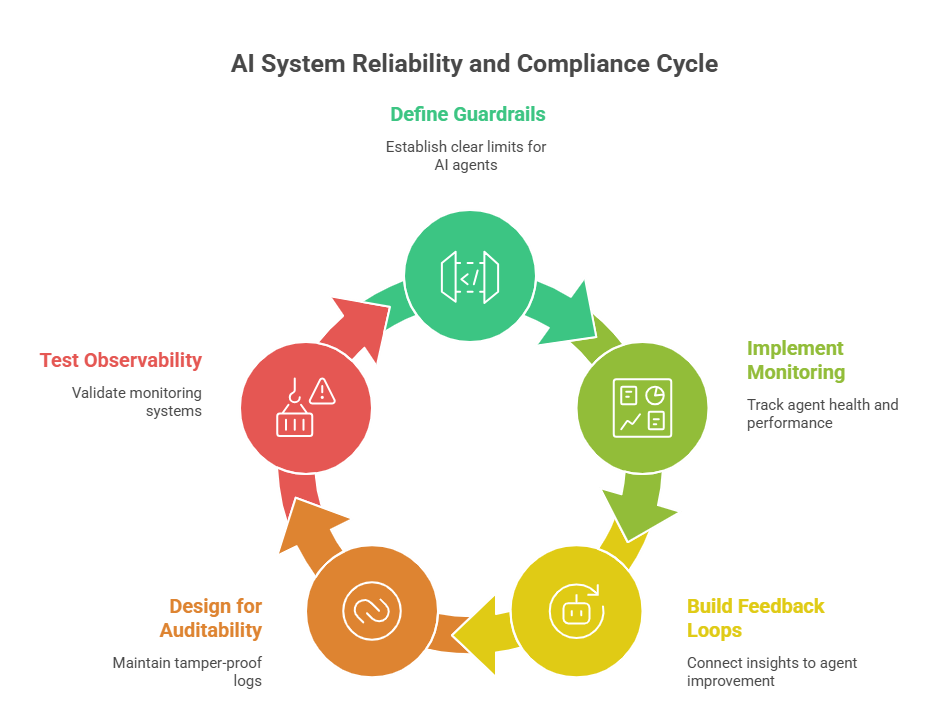
    Best Practices for Reliable and Compliant Systems


    As AI becomes central to business operations, ensuring systems are reliable and compliant is essential. Clear monitoring, feedback, and governance help AI agents operate safely and improve over time.

    1. Define Operational Guardrails and Boundaries

    Establish clear limits for AI agents, specifying what they can do and when human oversight is required. This prevents unintended actions and ensures compliance with business rules.

    Use pre-execution validation and post-action verification to catch errors early. Approval thresholds and automated rollback mechanisms help maintain safety and accountability in high-risk scenarios.

    2. Implement Progressive Monitoring

    Start with detailed logging during development to identify issues, then optimize as patterns emerge. This approach balances visibility, performance, and cost.

    Real-time dashboards track agent health, errors, and resource usage. Focusing on critical decision paths over time ensures efficient monitoring and timely detection of anomalies.

    3. Build Feedback Loops

    Building feedback loops connects observability insights to agent improvement through retraining, prompt optimization, and workflow refinement. This enables continuous learning and better performance.

    Regularly analyzing data and incorporating user feedback allows iterative updates to policies and agent behavior. These feedback loops ensure AI agents remain aligned with evolving business objectives and operational requirements.

    4. Design for Auditability

    Maintain tamper-proof logs and cryptographic verification to support compliance and investigation. Immutable records help track decisions and actions reliably.

    Implement efficient search, retrieval, and privacy controls for sensitive information. Clear audit trails ensure readiness for regulatory reviews and operational oversight.

    5. Test Observability Before Deployment

    Validate monitoring systems under production conditions, ensuring dashboards, alerts, and logs provide actionable insights.

    Perform load testing, alert checks, and query evaluations. This confirms the observability framework works effectively before AI agents go live.

    Also Read : AI Browser Agents: Automating Web-Based Tasks with Intelligent Systems

    Conclusion

    AI agent observability transforms autonomous AI from experimental technology into production-grade systems delivering reliable, compliant, and optimized performance. Implementing comprehensive AI monitoring and governance enables governed AI systems that stakeholders trust and regulators approve.

    Building reliable AI agents requires observability, governance, and continuous monitoring. Amplework, a top AI agent development company, ensures scalable, compliant, and trustworthy AI solutions. Amplework’s expertise helps organizations reduce risks and confidently deploy autonomous AI systems.

  • The ROI of AI Agent Orchestration: Measuring Business Impact Beyond Automation

    Overview

    Organizations investing in AI Agent Orchestration ROI often face a common question: how do you truly measure return? Traditional automation ROI is straightforward: count hours saved, multiply by labor costs, subtract implementation expenses, but orchestration delivers value far beyond simple task automation. Coordinating multiple AI agents across workflows creates measurable improvements in decision quality, error reduction, scalability, and long-term capability gains, making standard ROI frameworks inadequate.

    Why Traditional ROI Falls Short

    Traditional ROI calculations focus on labor savings, capturing only 30–40% of actual orchestration value. For instance, a mortgage processing system automated with basic tools saves time but doesn’t prevent errors or improve workflow decisions. A fully orchestrated system, however, enables 24/7 processing, reduces error propagation, and generates data for continuous optimization. Organizations measuring only labor savings risk underestimating AI Agent Orchestration ROI, leaving competitive advantages unclaimed.

    The Comprehensive ROI Framework

    To capture the full value of orchestration, ROI should be measured across six dimensions:

    1. Operational Efficiency: Beyond labor, consider infrastructure cost reductions, fewer exceptions, and decreased management overhead. 

    2. Error Reduction and Quality: Orchestrated systems improve decision accuracy. For example, in finance, moving from basic automation to agentic workflows raised accuracy to 99.5%, cutting costly rework. 

    3. Revenue Impact: Orchestration enables revenue that automation alone cannot. Improved lead response times, round-the-clock operations, and enhanced personalization can drive measurable revenue growth.

    4. Scalability Value: Orchestrated systems handle higher volumes without proportional staffing increases. For growing operations, this translates to significant cost avoidance and expanded capacity.

    5. Risk Reduction: Orchestration enforces consistency and governance, reducing compliance risk. Organizations in heavily regulated sectors often see ROI from risk mitigation alone.

    6. Capability Compounding: Continuous data collection from orchestrated workflows improves agent performance and decision quality over time, creating increasing returns beyond initial ROI.

    Real-World ROI Examples

    Many organizations are leveraging enterprise AI solutions to achieve measurable AI Agent Orchestration ROI across diverse sectors. Here are examples:

    1. Insurance Claims Processing

    Traditional automation reduced labor costs by 35%, but orchestration synchronized intake, verification, and fraud screening. The result:

    • Quality: 60% drop in claims errors, saving $4.2M/year
    • Customer Retention: 28% boost, reducing churn by $3.1M
    • Scalability: 40% volume growth absorbed without extra staff

    2. B2B Sales Operations

    Standard automation measures time saved per sales rep. Orchestrated lead qualification, outreach, and contract processing delivered:

    • 35% faster lead response times, improving conversions by 18%
    • 12% increase in average deal size
    • Expanded market reach via continuous outreach

    3. Healthcare Revenue Cycle

    Orchestrating billing cycles rather than focusing on task efficiency resulted in:

    • 45% reduction in claim denials, reclaiming $6.8M annually
    • Faster reimbursement cycles are improving liquidity
    • Coordinated coding, reducing audit exposure

    4. Retail Inventory Management

    Using AI Agent Orchestration for supply chain forecasting led to:

    • 25% reduction in stockouts
    • 20% drop in excess inventory costs
    • Improved demand prediction accuracy, increasing revenue

    5. Banking Customer Service

    Orchestrated AI agents handled tier-one support, leading to:

    • 40% faster resolution times
    • 30% improvement in customer satisfaction
    • Labor savings translate to $1.5M annually

    Also Read : AI Agent Orchestration for Cross-Functional Process Automation

    Capturing and Communicating AI Agent Orchestration ROI

    Establishing measurement infrastructure is critical:

    • Baseline Documentation: Record current performance metrics before AI implementation.
    • Attribution Modeling: Assign improvements to orchestration accurately.
    • Continuous Tracking: Use dashboards to monitor efficiency, quality, revenue, and risk metrics over time.
    • Qualitative Capture: Employee experience, leadership confidence, and strategic flexibility also contribute to ROI.

    Present ROI transparently. Break down value contributions from efficiency, error reduction, revenue, and scalability. Finance teams prefer NPV calculations and payback periods, while operations leaders focus on measurable process improvements. Demonstrating these multiple dimensions strengthens the business case for investment.

    Conclusion

    The ROI of AI Agent Orchestration goes beyond traditional automation. Organizations that focus only on task efficiency miss much of the value created. By measuring operational savings, revenue growth, error reduction, and scalability, businesses can fully capture the benefits of AI orchestration and turn their investments into lasting competitive advantage.

    To realize this potential, partnering with Amplework for AI Consulting & Strategy can make all the difference. Their expertise helps organizations optimize workflows, measure ROI comprehensively, and scale AI agent orchestration effectively, ensuring that every investment in AI translates into measurable, long-term business value.

  • Building the Agentic Enterprise: How Governed Autonomy Drives Competitive Advantage

    Introduction

    Enterprises are already using AI across their operations. The focus now is on moving from simple assistance to letting AI act on behalf of the business. The agentic enterprise model uses intelligent AI agents that can sense context, plan actions, and execute workflows across systems with minimal human intervention. But full autonomy introduces real risk. That’s where governed autonomy comes in: it lets AI agents operate independently while staying within defined boundaries set by an AI governance framework that ensures trust, safety, and compliance.

    In this blog, you’ll learn how the agentic enterprise works, why governed autonomy is critical, and how organizations can build AI‑driven systems that are both technically powerful and operationally responsible.

    What Is an Agentic Enterprise?

    An agentic enterprise is an organization that treats AI agents as core operational actors, not just add‑on tools. These agents are capable of understanding context, making decisions, coordinating with other agents, and executing multi‑step workflows across platforms and functions.

    Unlike traditional automation, which follows fixed scripts, agents operate in feedback loops: they observe outcomes, learn, and adjust their behavior accordingly. Already, Gartner predicts that 40% of enterprise applications will be integrated with task‑specific AI agents by the end of 2026, up from less than 5% in 2025, signaling a shift from pilot projects to production‑grade deployments.

    Why Governed Autonomy Matters

    Letting AI agents act freely without guardrails is not a feature; it’s a risk. Accounts, compliance, security, and brand reputation all depend on how AI behaves when given autonomy. That’s why governed autonomy is central to the modern agentic enterprise.

    Governed autonomy means:

    • Agents can operate independently within clearly defined boundaries.
    • Their behavior is shaped by an AI governance framework that includes policies, roles, and escalation rules.
    • Every action is observable, auditable, and explainable, so humans can intervene when needed.

    Recent research shows that over 16% of people have already used AI that acts on their behalf in the past six months, underscoring that autonomy is no longer theoretical but something organizations must actively design and constrain. 

    Also Read : The ROI of AI Agent Orchestration: Measuring Business Impact Beyond Automation

    Key Enablers of the Agentic Enterprise

    Building a resilient agentic enterprise rests on a few core pillars:

    1. Agent‑centric architecture: A platform that supports the creation, orchestration, and monitoring of AI agents across systems and workflows.
    2. Policy‑driven governance: A centralized AI governance framework that defines permissions, data access, security rules, and ethical constraints for every agent.
    3. Observability and traceability: Real‑time logs, dashboards, and audit trails that let teams track how agents behave, detect anomalies, and investigate incidents.
    4. Human‑AI collaboration: Clear roles where humans set goals, define risk appetite, and handle judgment‑heavy decisions, while agents execute the operational heavy lifting.

    Competitive Advantages of Governed Autonomy

    When governed autonomy is well‑designed, it unlocks several tangible benefits for the agentic enterprise:

    1. Faster, more adaptive operations: Agents react to market shifts, customer behavior, and operational disruptions in real time, cutting the delay between insight and action.
    2. Stronger risk and compliance posture: Every agent action is governed and auditable, helping organizations stay aligned with regulations and internal risk policies.
    3. Improved productivity and resilience: Early adopters report measurable productivity gains, with developer and operations workloads accelerating faster than expected.
    4. Scalable AI‑driven innovation: This autonomy lets organizations reuse agents across workflows instead of building siloed tools, enabling faster rollout of new capabilities.
    5. Trust and transparency at scale: An AI governance framework ensures explainable behavior and clear accountability, increasing stakeholder confidence as agents handle more critical tasks.

    A Practical Roadmap to the Agentic Enterprise

    Turning this vision into reality requires a deliberate rollout, not a big‑bang switch. A practical path often looks like this:

    1. Identify High-Impact Workflows

    Start by selecting workflows where AI agents can deliver immediate value, such as customer support, IT operations, or supply chain planning, ensuring quick wins and measurable business impact.

    2. Design an AI Governance Framework

    Establish clear policies, roles, and escalation paths for AI agents, defining data access, security boundaries, and ethical guardrails to ensure controlled, compliant, and accountable decision-making across operations.

    3. Build or Integrate an Agent Platform

    Develop or adopt a scalable architecture that enables agent creation, orchestration, and monitoring, ensuring seamless AI integration with existing systems while supporting flexibility, interoperability, and long-term enterprise growth.

    4. Run Controlled Pilots

    Deploy AI agents in limited, closely monitored environments to evaluate performance, refine rules, and identify risks, helping build stakeholder trust while ensuring alignment with governance and operational expectations.

    5. Scale and Iterate

    Gradually expand AI agent deployment across functions, using continuous feedback and performance data to refine governance models, optimize workflows, and enhance overall efficiency, adaptability, and long-term business value.

    This phased approach mirrors what many leading enterprises are doing: combining in‑house builds with vendor tools to create a flexible, controlled agentic layer.

    Also Read : AI Data Governance: How to Build Secure, Ethical, and Compliant Systems

    Real‑World Applications

    Across industries, the agentic enterprise is already emerging in practice:

    1. In customer service, AI agents manage end-to-end support journeys, resolving common issues, retrieving data, and escalating only complex cases within governed AI frameworks.
    2. In IT and security, agents continuously monitor systems, detect anomalies, and trigger remediation workflows, pausing or alerting analysts when predefined risk thresholds are exceeded.
    3. In supply chains, AI agents coordinate forecasting, inventory, and logistics, dynamically adjusting routes and replenishment while providing transparent, explainable insights to planners in real time.
    4. In healthcare, AI agents streamline patient triage, scheduling, and documentation, operating within strict compliance frameworks to ensure data privacy, accuracy, and controlled clinical decision support.
    5. In finance, AI agents handle fraud detection, transaction monitoring, and risk analysis, proactively flagging anomalies and escalating high-risk decisions to human analysts under governed autonomy models.

    Why Choose Amplework?

    As an AI development services provider, Amplework helps organizations build agentic enterprises that balance innovation with control. We bring hands-on expertise in AI-driven automation, agent design, and governed autonomy, supporting businesses from early experimentation to scalable, production-ready systems. With experience in designing robust frameworks and deploying AI agents across complex workflows, we ensure seamless integration into existing operations. By embedding structured oversight into your operating model, we help turn AI into a trusted, measurable advantage, not just another technology risk.

    Conclusion

    The future belongs to organizations that harness the power of AI agents under the steady hand of governed autonomy and a robust AI governance framework. This combination enables faster decisions, more resilient operations, and a level of adaptability that’s hard to match in a static, rules‑based setup. As agentic AI adoption accelerates, already projected to touch a large share of enterprise applications within the next few years, enterprises that get this balance right will not just adopt AI; they’ll be defined by it. The question is no longer if you’ll journey toward an agentic enterprise, but how deliberately and strategically you’ll build it.