Tag: AI Integration services

  • The Hidden Costs of AI Integration: Infrastructure, Ops, and Organizational Drag

    Introduction 

    Artificial intelligence is gaining rapid attention across industries for its potential to reshape how organizations operate, create, and make decisions. Many teams build impressive prototypes that appear to solve real business problems, but the reality of AI integration costs is often much higher than expected.

    Transitioning from a prototype to a fully deployed, reliable, and cost-effective AI system introduces a range of hidden expenses. The highest costs rarely come from algorithms themselves; instead, they emerge from infrastructure, operational requirements, and organizational friction that quietly increase budgets and delay outcomes.

    Let’s look beyond the demo to understand what really happens when AI meets reality, and how these hidden costs of AI integration impact enterprise AI projects.

    The Three Major Cost Drivers of AI Integration

    The costs of AI integration are primarily driven by three major areas. Understanding them is essential to accurately estimating the cost of implementing AI and avoiding unexpected overruns.

    1. The Infrastructure Iceberg

    What you see in the demo is just the tip of the iceberg. What lies beneath can sink your project.
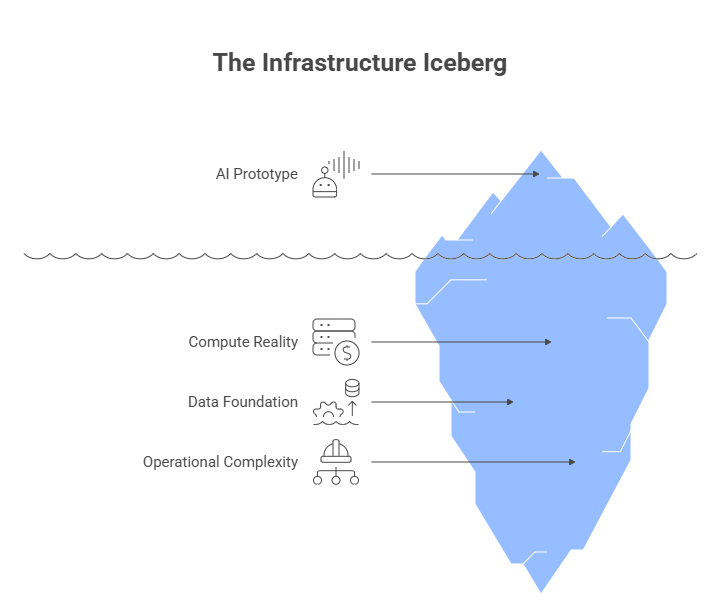
    The Compute Reality

    Infrastructure costs often grow 10–100× from prototype to production

    • Hardware and compute costs: Modern AI models require GPUs, TPUs, and high-performance servers. Training is a one-time expense, but inference occurs continuously, creating an always-on cost that can dominate budgets.
    • Data infrastructure costs: Scalable pipelines, AI-optimized storage, and cloud infrastructure significantly increase the cost of implementing AI in production.


    Infrastructure costs are often the first, and most visible, component of AI integration costs, yet they are frequently underestimated in initial ROI calculations.

    The Data Foundation

    Data engineering is often the largest and most complex part of AI systems

    • Pipeline and workflow costs: Collecting, cleaning, labeling, and serving data at scale requires real-time ingestion systems, quality assurance workflows, and AI-ready storage.
    • Compliance and governance costs: Privacy safeguards and regulatory requirements further increase expenses.

    These data-related expenses are a hidden but major contributor to enterprise AI costs, often exceeding AI model training and deployment.

    2. The Operations Reality

    Getting a model to work once is a science project. Keeping it working is an engineering challenge.

    From Prototype to Product

    Continuous monitoring and maintenance introduce high recurring costs

    • Model management and monitoring: Version control, drift detection, and retraining pipelines are expensive but necessary to avoid costly failures or incorrect outputs.
    • Governance and compliance: Explainability, audit trails, and regulatory oversight increase recurring operational costs.

    Operational costs often exceed initial development costs if organizations do not plan for ongoing AI maintenance and scaling costs, adding tens of thousands of dollars in hidden monthly expenses.

    The Talent Reality

    Building and maintaining production AI requires diverse, expensive talent

    The spotlight often shines on AI researchers and data scientists, but the operational phase demands different, and often scarcer skills:

    • MLOps Engineers: Build and maintain the production pipelines
    • Data Engineers: Design and optimize data infrastructure
    • AI Security Specialists: Protect against novel vulnerabilities
    • DevOps for AI: Manage the specialized infrastructure

    These roles command premium salaries and are in short supply. Many organizations underestimate both the need and the cost.

    3. The Human Element

    Technology is the easy part. People and processes create the real friction.

    Adoption Friction

    Successful AI integration requires changing workflows, training staff, and fostering trust.

    • Trust and validation: Shadow processes and double-checking outputs introduce hidden labor costs.
    • Workflow redesign: Integrating AI into existing operations requires reskilling employees and increasing organizational change costs.
    • Skill evolution: Marketing, customer service, and analytics roles all require training, adding significant AI talent and training costs.

    The Efficiency Paradox

    Organizational friction can erode projected efficiency gains and inflate costs.

    • A projected 40% productivity improvement can shrink to 15% after accounting for validation steps, approvals, and training periods.
    • Hidden costs in adoption and process changes silently reduce ROI, delaying time-to-value and increasing total expenditure.

    A More Complete Cost Framework

    When evaluating AI projects, consider these often-overlooked dimensions:

    Cost CategoryTypical OversightReality Check
    InfrastructureInitial development computeOngoing inference costs, data storage
    OperationsModel developmentMonitoring, retraining, pipeline maintenance
    TalentData scientists onlyMLOps, data engineering, specialized DevOps
    OrganizationalTechnology implementationChange management, training, process redesign
    ComplianceBasic securityExplainability, audit trails, and regulatory approval

    Understanding the True Cost of AI Integration

    A total cost of ownership (TCO) for AI includes:

    • Infrastructure: $10,000–$50,000 for compute, storage, and cloud scaling (covers GPUs, TPUs, cloud storage, and pipelines for enterprise workloads)
    • Operations: $15,000–$50,000 for monitoring, retraining, MLOps pipelines, and governance per year
    • Talent: $80,000–$120,000 per specialized employee annually (MLOps engineers, data engineers, AI DevOps)
    • Organization: $10,000–$40,000 for workflow redesign, adoption programs, and employee training per project
    • Compliance: $5,000–$20,000 annually for audits, explainability, and regulatory oversight

    Accounting for all three major cost drivers, infrastructure, operations, and organizational drag, allows enterprises to plan realistic budgets and avoid unexpected overruns.

    Also Read : Generative AI API Integration: How to Embed LLMs into Your Existing Workflows

    Strategic Approaches

    Effectively managing the hidden costs of AI integration requires planning across multiple dimensions. Let’s discuss the best strategies to control infrastructure, operations, talent, compliance, and organizational change.

    1. Start with the Foundation: Invest in robust data infrastructure early. Clean, accessible, and well-governed data reduces unexpected costs later, accelerates AI initiatives, and lowers overall AI integration costs.
    2. Build for Operations from Day One: Design systems assuming your prototype will need to scale. Include monitoring, retraining pipelines, and automated workflows to minimize AI maintenance and scaling costs.
    3. Budget for Human Factors: Allocate resources for training, change management, and workflow redesign. Neglecting adoption and reskilling can silently inflate organizational drag costs.
    4. Measure Total Cost of Ownership (TCO) Clearly: Track all AI costs, infrastructure, operations, talent, compliance, and organizational overhead, not just model accuracy, to make informed budget decisions.
    5. Plan for Compliance and Risk: Incorporate explainability, audit trails, and regulatory oversight from the start. Early planning prevents costly retrofits and ensures smoother deployment, reducing hidden governance costs.

    Also Read : How to Integrate AI into Your Existing Systems and Stay Competitive

    The Path Forward

    Successfully deploying AI requires understanding and managing the hidden costs of AI integration, including infrastructure, operations, talent, and organizational change. Planning for these costs upfront ensures scalable, reliable, and cost-effective AI with maximum ROI.

  • Choosing the Right AI Integration Platform: iPaaS, Custom Middleware, or Native AI?

    Introduction

    Your AI model works brilliantly in isolation, but production deployment requires integrating AI with enterprise systems spanning CRM, ERP, data warehouses, and legacy applications. The AI integration platform you choose determines whether deployment takes weeks or months, costs thousands or millions, and succeeds or stalls in integration complexity. Understanding the iPaaS vs custom middleware decision and when native AI integration makes sense is critical for enterprise AI integration success.

    This guide examines three AI integration solutions approaches: iPaaS platforms, custom middleware, and native AI capabilities, helping you select the optimal AI integration architecture for your requirements.

    The Three AI Integration Platforms

    1. iPaaS for AI Integration

    Integration Platform as a Service (iPaaS) provides pre-built connectors, workflow automation, and low-code integration tools connecting AI systems to enterprise applications.

    Leading Platforms: MuleSoft, Dell Boomi, Informatica, Workato, Zapier (for simpler workflows)

    How It Works: iPaaS platforms offer visual workflow builders, pre-configured connectors for popular enterprise systems, and managed infrastructure handling authentication, data transformation, and error handling. AI workflow automation becomes a drag-and-drop configuration rather than custom coding.

    Best For:

    • Organizations needing rapid deployment (weeks, not months)
    • Standard integrations with common enterprise systems (Salesforce, SAP, Microsoft Dynamics)
    • Teams with limited integration development resources
    • Multiple AI applications requiring consistent integration patterns

    Advantages:

    • Speed: Pre-built connectors eliminate custom development
    • Maintenance: Vendor manages connector updates when APIs change
    • Scalability: Cloud infrastructure scales automatically
    • Best Practices Built-In: Established patterns for authentication, error handling, and retry logic

    Limitations:

    • Cost: Licensing fees ($30K-$200K+ annually) plus per-transaction costs
    • Flexibility: Limited customization for unique integration requirements
    • Vendor Lock-In: Switching platforms requires rebuilding integrations
    • Complexity Ceiling: Extremely complex transformations may exceed platform capabilities

    Cost: $50K-$300K annually, including licensing, implementation, and ongoing operations.

    2. Custom AI Middleware Solutions

    Custom middleware involves developing bespoke integration layers connecting AI systems to enterprise infrastructure using frameworks like Apache Camel, Spring Integration, or custom-built services.

    How It Works: Development teams build API-based AI integration layers handling data flow, transformation, routing, and orchestration between AI models and enterprise systems. AI middleware solutions provide complete control over integration logic, optimization, and scaling.

    Best For:

    • Unique integration requirements iPaaS can’t address
    • Organizations with strong development teams
    • High-volume integrations requiring performance optimization
    • Complex data transformations or business logic
    • Security-sensitive environments requiring complete control

    Advantages:

    • Flexibility: Complete control over integration architecture and logic
    • Performance: Optimized for specific use cases without platform constraints
    • Cost-Effectiveness at Scale: No per-transaction fees, fixed infrastructure costs
    • No Vendor Lock-In: Full ownership of integration code

    Limitations:

    • Development Time: Months to build comprehensive integration frameworks
    • Ongoing Maintenance: Internal teams manage connector updates, bug fixes, and scaling
    • Talent Requirements: Requires experienced integration developers
    • Operational Overhead: Internal teams responsible for monitoring, incident response

    Cost: $200K-$800K initial development, $100K-$300K annually for maintenance and operations.

    3. Native AI Integration

    Native integration leverages AI platforms’ built-in capabilities, connecting to data sources and applications directly without additional integration layers.

    How It Works: Modern AI platforms with native integration like Databricks, Snowflake with AI features, and AWS SageMaker, provide direct connections to data sources, APIs, and enterprise systems. Data integration platforms with AI capabilities handle both AI workloads and integration natively.

    Best For:

    • AI-first initiatives where enterprise systems adapt to an AI platform
    • Cloud-native architectures without extensive legacy systems
    • Organizations standardizing on comprehensive AI platforms
    • Use cases where the AI platform’s native connectors suffice

    Advantages:

    • Simplified Architecture: Fewer moving parts, reduced complexity
    • Optimized Performance: Native integrations are often faster than external layers
    • Lower Total Cost: No separate integration platform licensing
    • Unified Management: Single platform for AI and integration

    Limitations:

    • Limited Scope: Only connects to systems the AI platform supports
    • Platform Lock-In: Deep integration with a specific AI vendor
    • Flexibility Constraints: Limited customization of integration logic
    • Legacy System Challenges: May not support older enterprise systems

    Cost: $50K-$200K annually (primarily AI platform costs, integration included).

    Decision Framework: Choosing Your Approach

    Start with These Questions:

    1. Integration Complexity: Standard enterprise systems or unique legacy applications?
    2. Timeline: Need deployment in weeks or acceptable to invest months?
    3. Volume: Thousands or millions of transactions daily?
    4. Team Capabilities: Strong integration development team or limited resources?
    5. Budget: Optimize for initial cost or total cost of ownership?

    Decision Matrix:

    Choose iPaaS When:

    • Rapid deployment is a priority
    • Integrating with standard enterprise systems (Salesforce, SAP, Microsoft)
    • Limited integration development resources
    • Need multiple AI applications with consistent integration patterns
    • Willing to trade cost for speed and reduced maintenance

    Choose Custom Middleware When:

    • Unique integration requirements iPaaS can’t handle
    • High transaction volumes are making iPaaS per-transaction costs prohibitive
    • Strong internal development capabilities
    • Complete control and flexibility are required
    • Long-term cost optimization matters more than initial development speed

    Choose Native Integration When:

    • AI platform natively supports required integrations
    • Minimizing architectural complexity is a priority
    • Cloud-native architecture without extensive legacy systems
    • Accepting platform lock-in for simplified operations
    • An AI platform is a strategic standard for an organization

    Also Read : Generative AI API Integration: How to Embed LLMs into Your Existing Workflows

    Best Practices for Scalable AI Integration

    Regardless of approach, AI integration best practices include:

    1. Start with Core Use Cases: Don’t build comprehensive integration frameworks initially, prove value with focused implementations, then expand.
    2. Design for Monitoring: Implement comprehensive logging, error tracking, and performance monitoring from day one.
    3. Plan for Data Quality: Integration failures often stem from data quality issues; build validation and cleansing into integration flows.
    4. Implement Security Properly: Authentication, encryption, and access control are non-negotiable for production AI system integration.
    5. Document Integration Patterns: Whether iPaaS, custom, or native, documentation ensures knowledge transfer and troubleshooting efficiency. 

    Also Read : How to Integrate AI into Your Existing Systems and Stay Competitive

     Conclusion

    Selecting the right AI integration platform, iPaaS, custom middleware, or native AI integration has a direct impact on deployment timelines, scalability, cost efficiency, and long-term maintainability. Most enterprises achieve the best outcomes through a hybrid strategy aligned with their system complexity, AI maturity, and strategic objectives.

    Amplework’s AI integration services help enterprises seamlessly connect AI models with CRM, ERP, data platforms, and legacy systems through iPaaS, custom middleware, or native integrations, ensuring secure, scalable, and future-ready AI deployments.