
Introduction
As AI systems increasingly drive critical business decisions, the question shifts from “Can we build AI?” to “Should we deploy this AI, and how do we govern it responsibly?” AI data governance has emerged from a technical concern to a strategic imperative; regulatory fines for non-compliance can exceed millions, while reputational damage from biased or insecure AI can devastate brands built over decades.
Building secure AI systems that maintain compliant AI operations while upholding ethical AI practices requires comprehensive enterprise AI governance frameworks addressing data management, regulatory requirements, risk management, and accountability. This guide provides actionable strategies for establishing governance that enables innovation while protecting your organization and stakeholders.
Understanding AI Data Governance
AI data governance encompasses policies, processes, and controls ensuring AI systems use data securely, ethically, and in compliance with regulations throughout the AI lifecycle, from data collection through model retirement.
Core Pillars:
- Data Security: Protecting sensitive information from breaches and unauthorized access
- Compliance: Meeting regulatory requirements (GDPR, CCPA, HIPAA, industry-specific rules)
- Ethics: Ensuring fairness, transparency, and accountability in AI decisions
- Quality: Maintaining data accuracy and reliability for trustworthy AI outputs
- Risk Management: Identifying and mitigating AI-related risks proactively
Without robust governance, organizations face regulatory penalties, security breaches, biased outcomes, and erosion of customer trust, risks far exceeding AI implementation costs.
Building Secure AI Systems
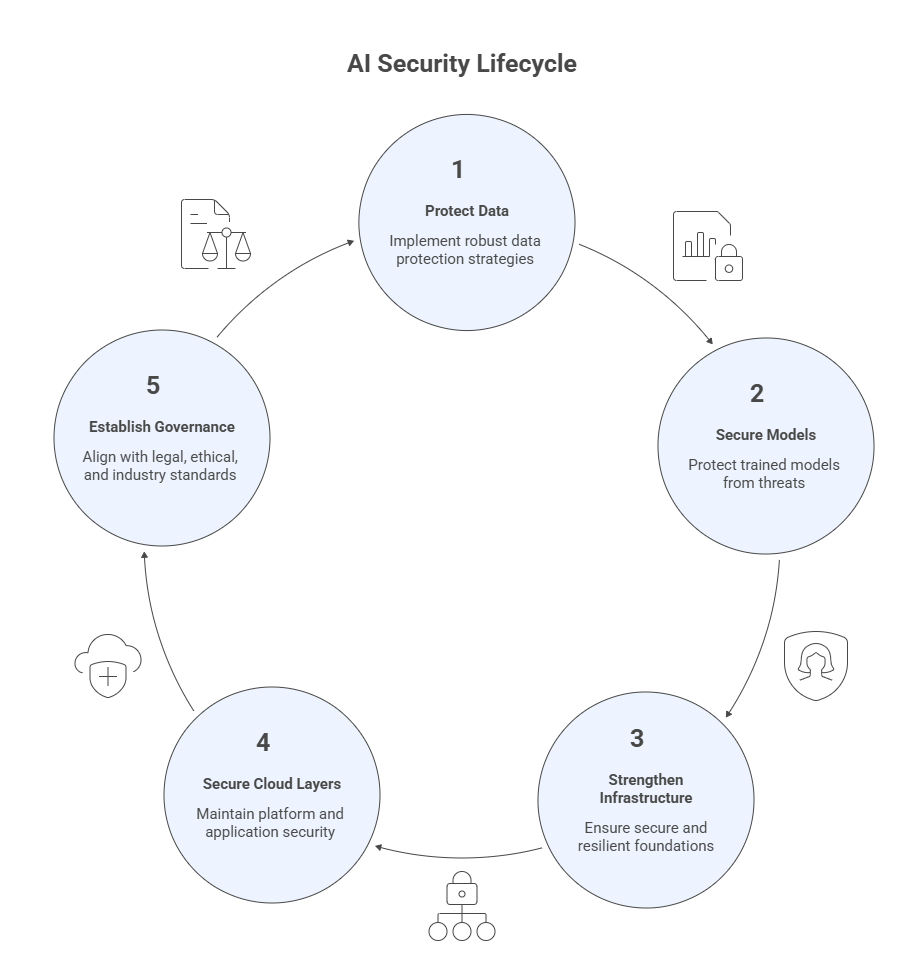
Security forms the foundation of trustworthy AI, protecting both training data and operational systems. Follow these five essential steps to ensure your enterprise solutions are secure, reliable, and compliant:
Step 1: Protect Your Data
Implement robust data protection strategies to safeguard sensitive information throughout the AI lifecycle.
- Encrypt data at rest and in transit using industry-standard protocols like AES-256.
- Apply role-based access control (RBAC) with the principle of least privilege.
- Use data masking, tokenization, and anonymization techniques to protect individual privacy.
- Regularly audit data storage and access practices to prevent unauthorized exposure.
Step 2: Secure Your AI Models
Protect trained models from theft, tampering, and adversarial attacks.
- Implement model versioning and access logging to track changes.
- Enforce deployment controls to prevent unauthorized modifications.
- Monitor for threats such as model extraction, data poisoning, adversarial inputs, and algorithm misuse.
Step 3: Strengthen Your Infrastructure
Ensure your AI systems run on secure and resilient foundations.
- Separate networks to limit access between components.
- Use intrusion detection tools and regularly scan for vulnerabilities.
- Set up clear incident response plans to quickly handle any security issues.
Step 4: Secure Cloud and Application Layers
When using cloud environments, ensure both platform and application-level security.
- Leverage cloud provider features such as AWS PrivateLink, Azure Private Link, or GCP VPC Service Controls.
- Maintain responsibility for securing your AI applications, APIs, and integrations.
- Monitor cloud environments continuously for suspicious activity.
Step 5: Establish Governance and Compliance
Ensure your AI security strategy aligns with legal, ethical, and industry standards.
- Maintain audit trails for data access, model changes, and AI decision-making.
- Follow regulations like GDPR, HIPAA, or industry-specific standards.
- Educate teams on security best practices and enforce strict governance policies.
Ensuring Compliant AI
AI compliance frameworks vary by industry and geography, requiring organizations to navigate complex regulatory landscapes:
Key Regulatory Standards
- GDPR (EU): Requires data minimization, purpose limitation, right to explanation, and consent management for AI processing personal data. Non-compliance risks fines up to €20 million or 4% of global revenue.
- CCPA (California): Grants consumers rights to know, delete, and opt out of personal data sales, including data used for AI training.
- AI Act (EU): Categorizes AI systems by risk level (unacceptable, high, limited, minimal), imposing requirements proportional to risk, conformity assessments, transparency obligations, and human oversight.
- Industry-Specific: HIPAA (healthcare), FCRA (financial services), COPPA (children’s privacy) add layers requiring specialized compliance approaches.
Implementing Ethical AI Practices
Ethical AI practices extend beyond legal compliance, addressing fairness, transparency, and accountability:
Bias Detection and Mitigation
AI systems can perpetuate or amplify societal biases present in training data. Responsible AI requires proactive bias testing across protected characteristics (race, gender, age, etc.) and continuous monitoring for disparate impact.
Mitigation Strategies: Diverse training data, fairness constraints during training, regular bias audits, and human oversight for high-stakes decisions.
Transparency and Explainability
Stakeholders deserve an understanding of how AI systems make decisions. Implement explainable AI techniques providing human-readable justifications, particularly for decisions impacting individuals.
Approaches: LIME, SHAP, attention visualizations, decision trees, and natural language explanations tailored to the audience’s technical literacy.
Accountability Frameworks
Establish clear ownership for AI system performance, outcomes, and ethics. Define roles responsible for monitoring, investigating issues, and implementing corrections when problems arise.
Governance Structure: AI ethics committees, model risk management teams, and executive accountability for AI impacts.
Also Read : AI Data Privacy for Protecting Training and Inference Data
Enterprise AI Governance Framework
Comprehensive enterprise AI governance requires organizational structures, policies, and processes:
1. Governance Committees
Create cross-functional teams including data scientists, legal, compliance, security, business stakeholders, and ethics experts, reviewing AI initiatives for risk and compliance.
Responsibilities: Approving high-risk AI deployments, establishing policies, investigating incidents, and ensuring continuous compliance.
2. AI Data Management Policies
Document standards for AI data management covering collection, storage, processing, retention, and deletion. Ensure policies address:
- Data quality standards and validation procedures
- Privacy protection requirements
- Cross-border data transfer restrictions
- Third-party data usage limitations
3. Risk Management in AI
Implement risk management in AI through systematic assessment of potential harms to individuals, operations, reputation, and compliance, before deployment and continuously during operation.
Risk Categories: Privacy violations, discriminatory outcomes, security breaches, operational failures, regulatory penalties, and reputational damage.
4. Continuous Monitoring
Deploy systems tracking AI performance, data quality for AI, compliance adherence, and ethical metrics. Automated alerts enable rapid response to deviations.
Monitoring Dimensions: Prediction accuracy, fairness metrics, data quality scores, security events, and regulatory requirement changes.
Also Read : AI Agent Observability Best Practices for Reliable and Compliant Systems
Conclusion
AI data governance isn’t overhead; it’s the foundation enabling secure AI systems that deliver value while protecting organizations from regulatory, security, and reputational risks. Building compliant AI through comprehensive enterprise AI governance, combining ethical AI practices, robust AI data management, adherence to AI compliance frameworks and AI regulatory standards, and effective risk management in AI, creates a sustainable competitive advantage.
Amplework provides AI consulting services to ensure secure, ethical, and compliant AI, combining data protection, transparency, and governance expertise for scalable, reliable, and responsible AI solutions.